The positive effects of the negotiations have faded, and expectations of a geopolitical stalemate are pushing up inflation and putting downward pressure on gold.
2026-11-12 17:42:28
On Thursday (November 12), during the Asian and European sessions, international gold prices weakened and then accelerated their decline, currently trading down 1.20% around 3938. Previously, the market expected substantial progress in the Qatar-mediated US-Iran talks and the Russia-Ukraine summit, leading to a de-escalation of geopolitical conflicts, a drop in oil prices, and a corresponding easing of inflationary pressures. However, after a week, neither negotiation yielded any substantial breakthroughs: the US-Iran talks remained at the initial stage of dialogue, failing to produce a concrete solution; the Russia-Ukraine summit only completed a prisoner exchange, with core territorial disputes remaining deadlocked. Previous optimistic expectations have gradually faded, and the geopolitical game has entered a prolonged stalemate. This stalemate of "neither erupting nor resolving" means that the fundamental risks of global inflation have not been eliminated. Yesterday's article also highlighted this change, and a consensus on inflation will quickly form. Even if the conflicts in the Strait of Hormuz and the Red Sea do not escalate significantly, disruptions to the energy supply chain and cost pressures from tariffs will continue to be transmitted outwards. Inflation stickiness, rather than short-term geopolitical safe-haven demand, has become the core contradiction in the current gold pricing. 
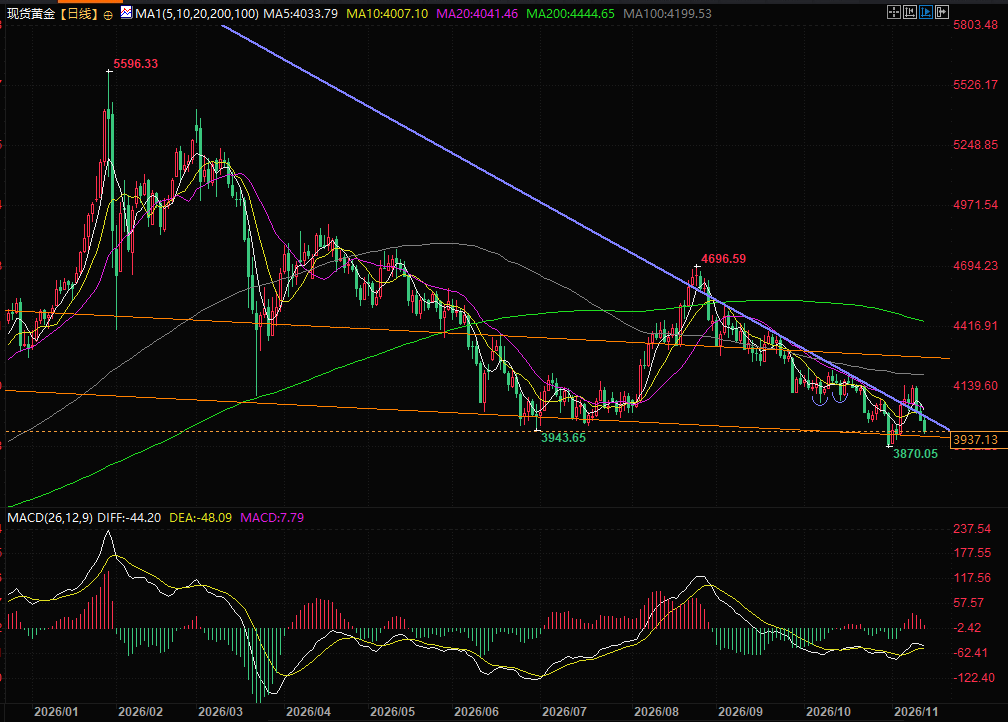 (Spot gold daily chart, source: EasyTrade) At 17:39 Beijing time, spot gold is currently trading at $3938 per ounce.
Inflation data exceeded expectations, and tightening expectations overwhelmed safe-haven buying.
US October CPI data significantly exceeded market expectations, with CPI rising 0.4% month-on-month and core CPI rising 0.3% month-on-month. Both figures were higher than expected, and the annualized level was significantly higher than the Fed's 2% target. Inflation is no longer solely driven by gasoline prices; prices for goods and services such as airfares, public transportation, express delivery, electricity, and groceries have risen across the board, exhibiting broad-based and persistent inflationary characteristics. The US economy maintained strong growth in the third quarter, with consumer spending continuing to support demand. Fed Governor Waller released hawkish signals, explicitly stating that a 50bp rate hike in December is not ruled out. CME FedWatch data shows that traders have already priced in a December rate hike and another rate hike in March next year. The opportunity cost of holding non-interest-bearing gold has increased, causing the dollar to surge to a 19-month high, directly suppressing gold prices. OCBC's commentary is very much in line with the current environment: in the short term, oil prices, the dollar, and US Treasury yields are fluctuating in both directions, intensifying the battle between bulls and bears in gold prices; the macroeconomic environment is bearish for gold in the short term, but the medium- to long-term outlook for gold prices is not bearish.Linked to crude oil: High oil prices are likely to persist for a longer period, with inflationary logic taking a greater weight.
Recent crude oil market activity provides a clearer picture: Following the US midterm elections, the market anticipated a resurgence in conflict intensity, leading to a pullback in crude oil prices and a decline in geopolitical premiums. However, this rapid decline doesn't address the unresolved nature of the ongoing conflicts between the US and Iran, and Russia and Ukraine. As long as these two geopolitical risks persist, even at low intensity, the energy shock could spread across the entire industry chain, creating inflationary pressure. While Iran is releasing negotiating leverage to mediate with the Houthis, tanker explosions continue in the Strait of Hormuz, maintaining the risk level for shipping lanes. Although Vance has initiated direct dialogue with Iran, the two sides have vastly different demands: Iran demands the lifting of sanctions, the unfreezing of assets, and the easing of oil sanctions, while the US retains the option of military pressure. Verbal easing does not equate to a final agreement, and the Middle East remains vulnerable to reversals. From a broader asset class perspective, the reduced intensity and suddenness of conflicts, coupled with the market's prioritization of the energy shock from prolonged conflicts and the Fed's tightening due to inflation, have relegated risk aversion to a secondary position. As long as inflation data remains strong, the downward pressure from interest rate expectations will outweigh the gold buying driven by geopolitical risks.Viewpoints and Technical Analysis:
Gold is currently in a delicate phase: no new large-scale geopolitical conflicts have erupted, preventing a strong safe-haven rally; however, persistent inflation stickiness and rising interest rate expectations continue to suppress gold prices. In the short term, two key factors are being monitored: first, whether there has been any substantial progress in US-Iran and Russia-Ukraine negotiations. The US has already sent a special envoy to Russia for negotiations, and Vance plans to personally lead a delegation to negotiate with Iran, offering a small degree of optimism; second, Friday's US PPI data will further verify whether upstream inflation continues to be transmitted. In the medium term, with geopolitical tensions not completely resolved and high interest rate expectations fully priced in, gold still retains its investment value. Short-term market movements are dominated by the US dollar, US Treasury yields, and inflation data. Before a clear inflation inflection point, the downward pressure on gold prices is unlikely to reverse quickly. Technically, the break below 4050 indicates that the bottom reversal structure has not formed, and the reversal pattern has failed. Furthermore, after breaking below the descending resistance line, gold is retesting the bottom. Currently, the area around 3900 still represents the area where the technical analysis's directional decline has been met. Gold prices are still very close to the recent bottom area, and a period of consolidation to choose a direction is highly probable. Bulls should not panic excessively. (Spot gold daily chart, source: EasyTrade) At 17:39 Beijing time, spot gold is currently trading at $3938 per ounce.
- Risk Warning and Disclaimer
- The market involves risk, and trading may not be suitable for all investors. This article is for reference only and does not constitute personal investment advice, nor does it take into account certain users’ specific investment objectives, financial situation, or other needs. Any investment decisions made based on this information are at your own risk.