One chart: The Baltic Dry Index ended its seven-day winning streak, but still rose 4.4% for the week, marking its fourth consecutive day of gains.
2026-11-14 00:12:29
The latest data shows that on November 13, 2026, the Baltic Dry Index (BDI) was 2980 points, a decrease of 1.32% compared to the previous week, marking the largest drop since November 3, 2026. Looking at the short-term charts, the BDI has seen positive growth 8 times, negative growth 3 times, and zero growth 0 times in the last 11 BDI data points. Specifically, the Panamax Freight Index (BPI) was 2118 points, up 0.05% from the previous week; the Capesize Freight Index (BCI) was 4719 points, down 2.42%; and the Supramax Freight Index (BSI) was 1836 points, up 0.27%. For detailed charts of the latest 720-day and 10-year trends of the Baltic Dry Index and its three main sub-indices, please refer to the charts specially created by FX678. 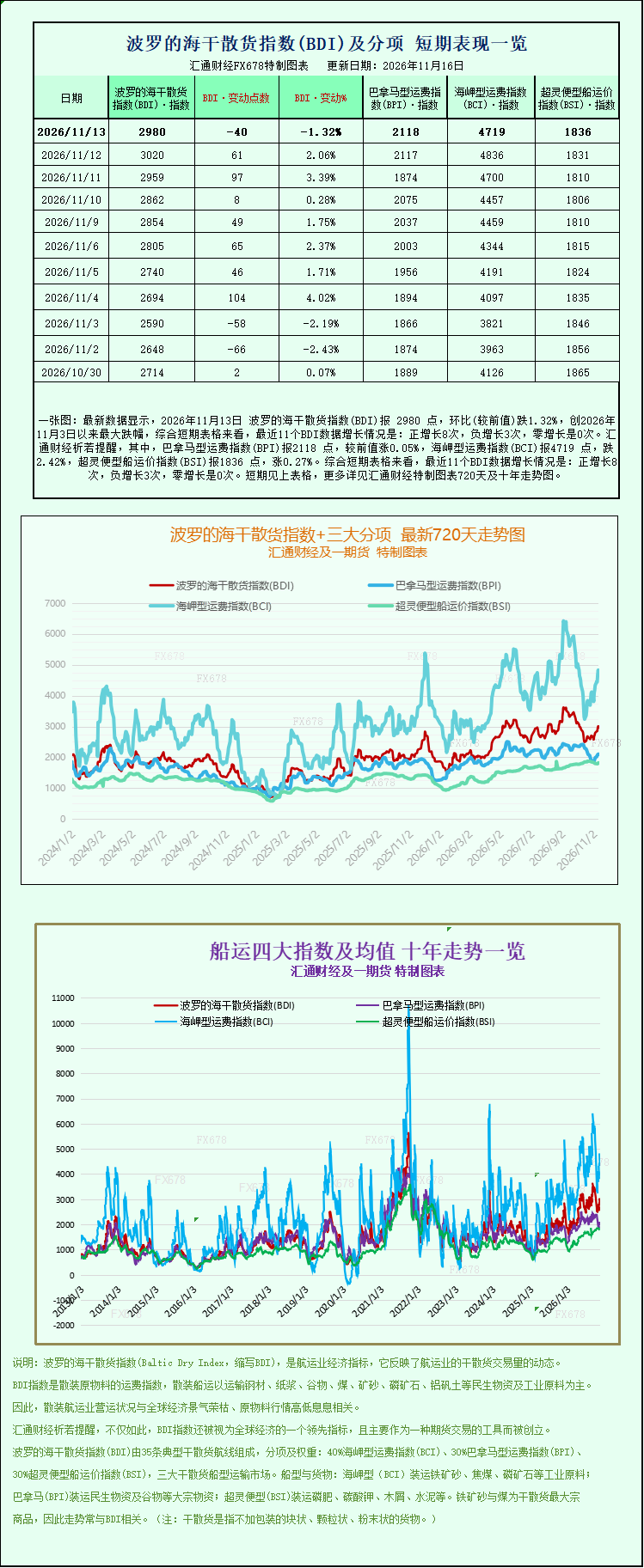 Dragged down by weaker freight rates in the Capesize segment, the Baltic Dry Index (BDI) ended its seven-day winning streak since November 3rd on Friday, but still recorded a 4.4% weekly gain, marking its fourth consecutive weekly increase. This combination of "single-day pullback, but strong weekly performance" indicates that the dry bulk shipping market is maintaining a certain resilience at the end of the traditional peak season. I. Composite Index: Down 1.3% on Friday, four-week winning streak The main index, tracking freight rates for Capesize, Panamax, and Supramax vessels, fell 40 points, or 1.3%, to close at 2980 points on Friday. Previously, the index had risen for seven consecutive trading days since November 3rd, with the cumulative gain over the four-plus trading days this week ultimately turning into a 4.4% weekly increase, also marking its fourth consecutive week of gains. II . Capesize: Pullback after reaching a near six-week high, weekly gain of 5.8% The Capesize index fell 117 points, or 2.4%, to 4719 points. The previous trading day, the index had just climbed to its strongest level since October 2nd. However, looking at the weekly chart, the Capesize index has risen for the fourth consecutive week, with a 5.8% increase this week. Capesize vessels typically carry 150,000-tonnage cargoes, mainly iron ore and coal, and are the largest of the three vessel types, having the most direct impact on the composite index—accounting for approximately 40% of the weighting according to the Baltic Exchange's weighting method. The average daily charter rate for this vessel type decreased by $1,062 to $39,295. The strength of Capesize freight rates is typically highly correlated with iron ore shipments, port congestion, fuel costs, and the pricing trends of forward freight agreements (FFAs). The strength in the early part of this week and the pullback on Friday reflect the typical characteristics of this sector: high elasticity and rapid fluctuations. Once spot transactions on major routes slow down, freight rates react quickly. III. Panamax and Supramax: Slight Gains, Hedging Effect The Panamax index rose slightly by 1 point to 2118, its highest level since October 22nd. The index rose 4% this week, marking its second consecutive weekly gain. Panamax vessels typically carry 60,000 to 70,000 tons of coal or grain, and their average daily charter rate rose by $9 to $19,063. The Supramax index rose 5 points, or 0.3%, to 1836, its highest level since November 3rd. It rose a cumulative 1.4% this week, ending two consecutive weeks of weekly declines. The relative strength of small and medium-sized vessels partially offset the drag on the composite index from the Capesize correction. This divergence also indicates that current market pressure is more concentrated in the iron ore transportation segment carried by large vessels, rather than the overall demand for smaller bulk commodities such as coal, grain, steel, and cement. In other words, the index decline stemmed more from structural factors than from a market-wide contraction. IV. Iron Ore: Port Inventories Accumulate, Futures Fall for Three Consecutive Days Contrary to freight rate trends, iron ore futures on the Dalian Commodity Exchange fell for the third consecutive trading day on Friday, recording their largest weekly decline in five weeks. The pressure stemmed from two directions: firstly, the continued accumulation of iron ore inventories at Chinese ports; and secondly, persistently weak end-user demand for steel. Iron ore is the core cargo for Capesize vessels, and its futures and spot prices often lead or synchronize with changes in maritime demand. High port inventories mean that steel mills are slowing down their restocking pace and reducing their willingness to purchase in the immediate market, thus suppressing spot charter demand for Capesize vessels. Meanwhile, weak steel demand is transmitted upstream, compressing steel mills' purchasing flexibility for raw materials and further affecting the arrival schedule of imported iron ore. This resulted in a short-term resonance between freight rates and ore prices, both weakening in the same direction. V. What is the BDI and why is it worth paying attention to? The Baltic Dry Index (BDI), compiled by the London Baltic Exchange, uses January 4, 1985 as its base period (1000 points). It is weighted by three sub-indices: Capesize, Panamax, and Supramax, reflecting the freight rate level of the global dry bulk spot charter market. Because dry bulk shipping carries the maritime trade of basic raw materials such as iron ore, coal, grain, and bauxite, the BDI has long been considered one of the leading indicators for observing global trade activity and commodity demand. Its characteristics include volatile and highly cyclical fluctuations, and it is highly sensitive to shipping capacity supply (new ship deliveries and scrapping), port congestion, weather, and geopolitical factors. Therefore, the reference value of daily data is limited; weekly and monthly trends are more reflective of the fundamentals. VI . Several variables to observe in the future market : Current data shows a structural divergence in the market: large ships are experiencing a correction, while medium and small ships remain resilient. Key variables to watch include: first, the year-end restocking efforts of Chinese steel mills and the rate of port inventory reduction; second, seasonal disruptions in iron ore shipments, including the impact of the rainy season in Australia and Brazil on shipment schedules; third, the pace of new ship deliveries and port congestion; and fourth, the pricing of forward freight agreements (FFAs) for the traditional peak season in the first quarter of next year. In the medium term, the gradual ramp-up of the Simandou iron ore project in Guinea will significantly lengthen shipping distances and increase ton-mile demand, making it a crucial long-term variable for the Capesize vessel market. Its actual shipment pace and the ramp-up progress of supporting ports and railways warrant continuous monitoring. Overall, until a clear turning point is seen on both the high inventory and weak demand sides, the short-term direction of the index may still fluctuate, and the ups and downs of a single trading day should not be over-interpreted.
- Risk Warning and Disclaimer
- The market involves risk, and trading may not be suitable for all investors. This article is for reference only and does not constitute personal investment advice, nor does it take into account certain users’ specific investment objectives, financial situation, or other needs. Any investment decisions made based on this information are at your own risk.