After two consecutive days of gains, the US dollar is adjusting against the Indian rupee. Is this a turning point or a respite?
2026-11-16 16:18:31
The dollar edged lower against the Indian rupee in European trading on Monday (November 16) after two consecutive days of gains, currently trading around 94. This is as the rupee is sandwiched between a stronger dollar and high US Treasury yields. These market movements are largely driven by rising expectations that the Federal Reserve will accelerate its monetary tightening. 
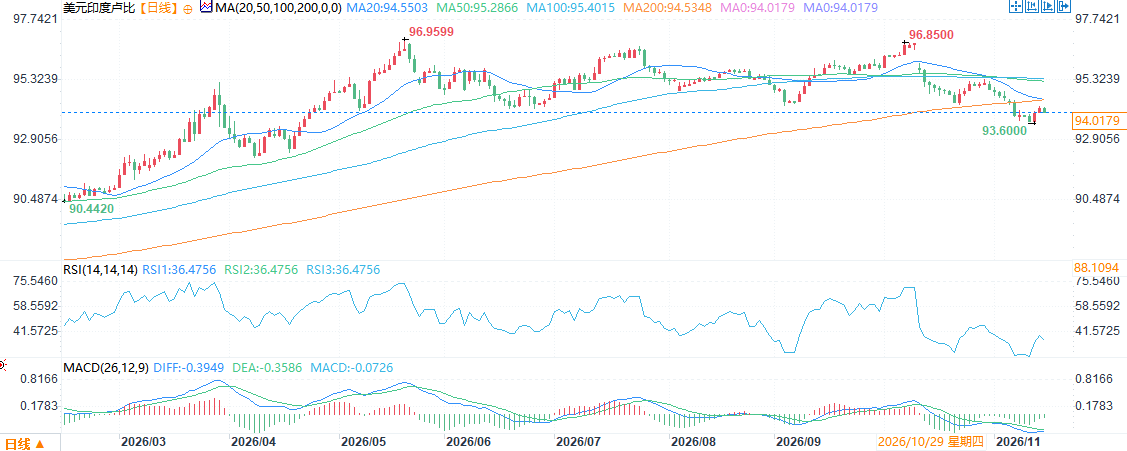 (USD/INR daily chart, source: FX678) At 16:10 Beijing time, the USD/INR exchange rate was 94.02/03.
Foreign capital inflows: Nearly $9 billion this month, a significant reversal from the outflows in September and October.
The Indian rupee may find support from a strong recovery in foreign securities investment inflows. Overseas investors have bought nearly $9 billion worth of Indian stocks so far this month, a significant reversal from outflows of approximately $3.5 billion each in September and October. A foreign exchange trader at a private bank noted that current levels favor importers increasing hedging, but the scale of foreign capital inflows makes a “completely bearish rupee” strategy difficult. The rupee's support has a logic independent of the dollar – foreign capital inflows translate into demand for the rupee through the linkage between the stock and currency markets, and the nearly $9 billion in inflows are sufficient to offset some of the pressure from a stronger dollar and rising yields.Institutional View: The rupee is the "unexpected star of emerging markets this month," with FPI inflows exceeding $5 billion.
One institutional strategist described the Indian rupee as "the unexpected star of emerging markets this month (total return +1.6% against the US dollar)," emphasizing that this move was "driven by over $5 billion in FPI inflows," as investors expanded their market bets beyond AI-themed markets such as South Korea and Taiwan. They added that sentiment was also supported by "optimism following the US midterm elections regarding a ceasefire on Iran, pushing Brent crude down to $90/barrel," reinforcing the constructive backdrop of the rupee near a six-month low against the dollar. The rupee's strength did not stem from a sudden shift in domestic fundamentals, but rather from a combination of "fund rotation + falling oil prices"—when global funds dispersed from AI-themed markets and oil prices fell due to easing expectations, India, as a "non-AI, energy-importing" economy, actually benefited.Oil prices fell as strong Middle East supplies and signs of easing eased conditions reduced demand for petrodollars.
The rupee also faced fewer headwinds as lower oil prices eased India's demand for petrodollars. Oil prices fell as traders weighed signs of strong Middle East supply against geopolitical de-escalation signals—Tehran indicated a diplomatic solution remained possible, and Trump stated additional strikes against Iran might no longer be necessary. The lower oil prices directly improved India's terms of trade, providing dual support along with foreign investment inflows—the former impacting import bills and the latter affecting the capital account.Indian Inflation and the Federal Reserve: CPI expected to reach 6.3%, exceeding the upper limit; 100% probability of a December rate hike.
Some economists predict that India's overall CPI in October has "exceeded the Reserve Bank of India's (RBI) ceiling," with their economics team forecasting inflation at 6.3%. In their view, this result "should lock in a 25-basis-point rate hike by the Monetary Policy Committee on December 4th," reinforcing expectations that the RBI will respond to the latest unexpected price increases. Meanwhile, the US dollar continues to be supported by market speculation about a December rate hike by the Federal Reserve—according to the CME FedWatch tool, the market is pricing in a nearly 93.5% probability of a 25-basis-point rate hike next month, raising the current target range of 3.75% to 4.0%, and adding another hike in January. Traders are awaiting Fed Chairman Warsh's speech on "Artificial Intelligence and Financial Stability," as well as this week's US October retail sales data and the FOMC meeting minutes. The RBI and the Fed may raise rates simultaneously—if India's CPI reaches 6.3%, the RBI raises rates on December 4th, and the Fed raises rates in December, the interest rate differential between the two countries may remain unchanged, and the rupee's interest rate disadvantage will not widen further, providing another buffer for the rupee.in conclusion
The dollar edged lower against the rupee after two consecutive days of gains, with the rupee caught between a strengthening dollar and high US Treasury yields. Support came from two sources: foreign investors have bought nearly $9 billion worth of Indian stocks this month, a significant reversal from outflows in September and October, with institutions calling the rupee the "unexpected star of emerging markets this month"; and over $5 billion in FPI inflows. Oil prices fell due to strong Middle East supply and signs of easing, reducing India's demand for petrodollars. On the dollar front, a December rate hike is 100% likely, awaiting Warsh's speech and this week's US retail sales and FOMC minutes. On the Indian front, October CPI is expected to reach 6.3%, exceeding the central bank's ceiling, and institutions expect a 25 basis point rate hike at the December 4th meeting. If the Reserve Bank of India and the Federal Reserve raise rates in tandem, the interest rate differential may remain unchanged, preventing the rupee's interest rate disadvantage from widening further, providing another buffer for the rupee. (USD/INR daily chart, source: FX678) At 16:10 Beijing time, the USD/INR exchange rate was 94.02/03.
- Risk Warning and Disclaimer
- The market involves risk, and trading may not be suitable for all investors. This article is for reference only and does not constitute personal investment advice, nor does it take into account certain users’ specific investment objectives, financial situation, or other needs. Any investment decisions made based on this information are at your own risk.