The anticipated Russia-Ukraine peace agreement is expected to impact oil price prospects, with crude oil futures declining due to supply concerns.
2025-11-27 21:29:09
On Thursday (November 27), during the European trading session, West Texas Intermediate (WTI) crude oil futures rose slightly by about 0.5%. WTI crude oil was trading at $58.93 per barrel, while Brent crude oil was trading at $62.64 per barrel.

Traders are focused on the possibility of a return of Russian supply.
Geopolitical factors dominated all trading decisions, with markets reacting strongly to reports that Ukraine had essentially agreed to a US-backed peace proposal. Traders interpreted these headlines as a harbinger of a potential easing of Western sanctions on Russian energy exports—a scenario that could lead to a surge in new supply into an already well-supplied market.
Market participants question the pace of change
Not all analysts believe a peace agreement is imminent. UBS analyst Giovanni Staunovo warned that uncertainty remains regarding Russia's acceptance of the agreement. A survey of nearly 20 traders corroborated this view, with most respondents not expecting a rapid change in Russian crude oil exports. Even if an agreement is ultimately reached, many believe it will take time for the oil to actually enter the global market.
Increased inventories exacerbate supply concerns
Data released by the U.S. government further increased pressure on oil prices. The latest report from the U.S. Energy Information Administration (EIA) showed that commercial crude oil inventories increased by 2.774 million barrels, while the market had expected a decrease of 1.3 million barrels. Total crude oil inventories now stand at 426.9 million barrels, about 4% below the five-year average; gasoline inventories increased by 2.5 million barrels, but are still 3% below the seasonal average. This data reinforced market concerns about a supply-demand imbalance before the end of the year.
OPEC+ maintains stable production; market awaits meeting results.
Market expectations for supply remain ample. Eight OPEC+ members, including Saudi Arabia, Russia, Iraq, and the UAE, confirmed they will adjust their daily production by 137,000 barrels in December 2025 and suspend planned production increases in the first quarter of 2026. The alliance will meet on November 30, and traders are bracing for discussions on how to address the growing supply glut.
Investment banks warn of long-term market oversupply
Major investment banks continue to maintain a bearish stance. Goldman Sachs predicts a significant oversupply of approximately 2 million barrels per day in the crude oil market throughout 2026, with Brent crude averaging $56 per barrel and WTI crude averaging $52 per barrel. Deutsche Bank believes there is no clear path for the market to return to a supply-demand imbalance, while JP Morgan warns that if supply continues to grow, Brent crude prices could fall to the $30 range by 2027.
What factors support oil prices?
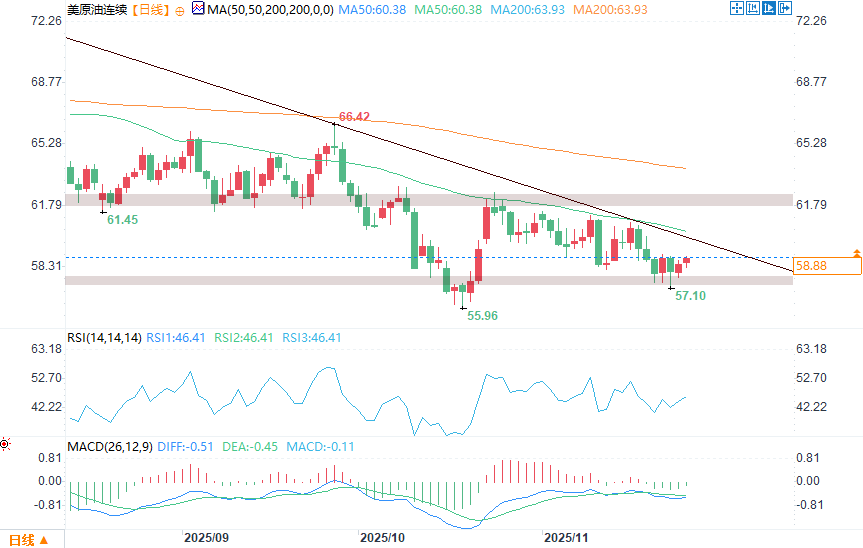
(WTI crude oil daily chart source: FX678)
Market expectations of a December rate cut by the Federal Reserve and new U.S. sanctions against Russia's largest oil company provided some support—refiners in India and China have reduced their purchases of Russian crude. However, optimism about a potential peace negotiation has outweighed the supply-tightening effect of the sanctions.
Oil price forecast: Bearish in the short term
Given the potential for increased Russian supply, continued growth in crude oil production from the US, Brazil, and Guyana, and OPEC+'s preparation to gradually lift production cuts, the short-term outlook for oil prices remains bearish. Trading is expected to be thin during the holiday period, with the OPEC+ meeting on November 30th serving as the next key catalyst.
Traders are focused on the possibility of a return of Russian supply.
Geopolitical factors dominated all trading decisions, with markets reacting strongly to reports that Ukraine had essentially agreed to a US-backed peace proposal. Traders interpreted these headlines as a harbinger of a potential easing of Western sanctions on Russian energy exports—a scenario that could lead to a surge in new supply into an already well-supplied market.
Market participants question the pace of change
Not all analysts believe a peace agreement is imminent. UBS analyst Giovanni Staunovo warned that uncertainty remains regarding Russia's acceptance of the agreement. A survey of nearly 20 traders corroborated this view, with most respondents not expecting a rapid change in Russian crude oil exports. Even if an agreement is ultimately reached, many believe it will take time for the oil to actually enter the global market.
Increased inventories exacerbate supply concerns
Data released by the U.S. government further increased pressure on oil prices. The latest report from the U.S. Energy Information Administration (EIA) showed that commercial crude oil inventories increased by 2.774 million barrels, while the market had expected a decrease of 1.3 million barrels. Total crude oil inventories now stand at 426.9 million barrels, about 4% below the five-year average; gasoline inventories increased by 2.5 million barrels, but are still 3% below the seasonal average. This data reinforced market concerns about a supply-demand imbalance before the end of the year.
OPEC+ maintains stable production; market awaits meeting results.
Market expectations for supply remain ample. Eight OPEC+ members, including Saudi Arabia, Russia, Iraq, and the UAE, confirmed they will adjust their daily production by 137,000 barrels in December 2025 and suspend planned production increases in the first quarter of 2026. The alliance will meet on November 30, and traders are bracing for discussions on how to address the growing supply glut.
Investment banks warn of long-term market oversupply
Major investment banks continue to maintain a bearish stance. Goldman Sachs predicts a significant oversupply of approximately 2 million barrels per day in the crude oil market throughout 2026, with Brent crude averaging $56 per barrel and WTI crude averaging $52 per barrel. Deutsche Bank believes there is no clear path for the market to return to a supply-demand imbalance, while JP Morgan warns that if supply continues to grow, Brent crude prices could fall to the $30 range by 2027.
What factors support oil prices?
(WTI crude oil daily chart source: FX678)
Market expectations of a December rate cut by the Federal Reserve and new U.S. sanctions against Russia's largest oil company provided some support—refiners in India and China have reduced their purchases of Russian crude. However, optimism about a potential peace negotiation has outweighed the supply-tightening effect of the sanctions.
Oil price forecast: Bearish in the short term
Given the potential for increased Russian supply, continued growth in crude oil production from the US, Brazil, and Guyana, and OPEC+'s preparation to gradually lift production cuts, the short-term outlook for oil prices remains bearish. Trading is expected to be thin during the holiday period, with the OPEC+ meeting on November 30th serving as the next key catalyst.
- Risk Warning and Disclaimer
- The market involves risk, and trading may not be suitable for all investors. This article is for reference only and does not constitute personal investment advice, nor does it take into account certain users’ specific investment objectives, financial situation, or other needs. Any investment decisions made based on this information are at your own risk.