Data Tears at Markets: Is Eurozone Inflation Overheating While the Real Economy Is Quietly Weakening?
2025-12-02 22:04:27
On Tuesday (December 2), the euro traded in a narrow range against the dollar during the North American session, currently at 1.1613, stabilizing after falling from the 1.1650 area on Monday. Unexpectedly rising inflation and climbing unemployment in the Eurozone presented contradictory signals, while the dollar found some respite supported by safe-haven demand, with bulls and bears locked in a tug-of-war at key technical levels.

The Eurozone's preliminary Harmonized Index of Consumer Prices (HICP) for November exceeded expectations, with the year-on-year growth rate rising to 2.2% from 2.1% in October, higher than the market expectation of a flat reading of 2.1%. However, the core HICP remained unchanged at 2.4%, failing to reach the market expectation of a 2.5% increase. On the monthly data front, overall inflation contracted by 0.3% month-on-month, compared to a 0.2% increase in the previous month; the core inflation rate fell even more sharply by 0.5% month-on-month, a stark contrast to the 0.3% increase in the previous month. The inflation structure shows a superficial recovery but a weak core, unlikely to shake the European Central Bank's established path of maintaining stable interest rates.
Concerns are also emerging in the labor market. The Eurozone unemployment rate unexpectedly climbed to 6.4% in October, a 16-month high and significantly deviating from market expectations of 6.3%. Meanwhile, the September figure was revised upward from 6.3% to 6.4%, suggesting that the cooling in the job market may be more pronounced than anticipated. This divergence between inflation and employment data puts the European Central Bank in a dilemma—rising price pressures limit its room for easing, while a weakening labor market provides a potential reason for a policy shift.
The US ISM Manufacturing Purchasing Managers' Index (PMI) slipped further into contraction territory in November, falling to 48.2 from 48.7 in October, below market expectations of 48.6. All sub-indices weakened: the new orders index plummeted from 49.4 to 47.4, and the employment index dropped from 46 to 44, both pointing to continued contraction in manufacturing activity. Alarmingly, the prices paid index rose from 58.0 to 58.5, indicating that the transmission effect of tariff policies on inflation is beginning to emerge.
Bank of Japan Governor Kazuo Ueda signaled a December rate hike on Monday, triggering sharp fluctuations in global bond markets. US Treasury yields rose in response, providing support for the already pressured dollar. Earlier on Tuesday, a positive Japanese government bond auction eased market panic somewhat, but risk appetite remained fragile. This week's market focus will shift to the US ISM Services PMI and ADP employment change report, to be released on Wednesday.
The Eurozone manufacturing sector is also mired in difficulties. The final reading of the HCOB Manufacturing Purchasing Managers' Index for November was revised down to 49.6, a further decline from the initial reading of 49.7, marking a five-month low and a significant deterioration compared to the 50.0 threshold separating expansion from contraction in October. The synchronized weakness in European and American manufacturing sectors makes it difficult for exchange rates to receive unilateral guidance from fundamentals.
The daily chart shows that the euro has begun a recovery against the US dollar after hitting a low of 1.1468; the current price is around 1.1613, which is exactly in the middle of the previous trading range.
From a candlestick chart perspective, the exchange rate has repeatedly encountered resistance below the 1.1700 level, which has formed a valid horizontal resistance line. Recent price action exhibits a typical pattern of rallies followed by pullbacks: a rapid retreat after reaching 1.1655, followed by a rebound to the 1.1651 area where it was met with selling pressure, suggesting a potential double top formation. The 1.16 level has provided effective support multiple times and is a key area for bullish defense.
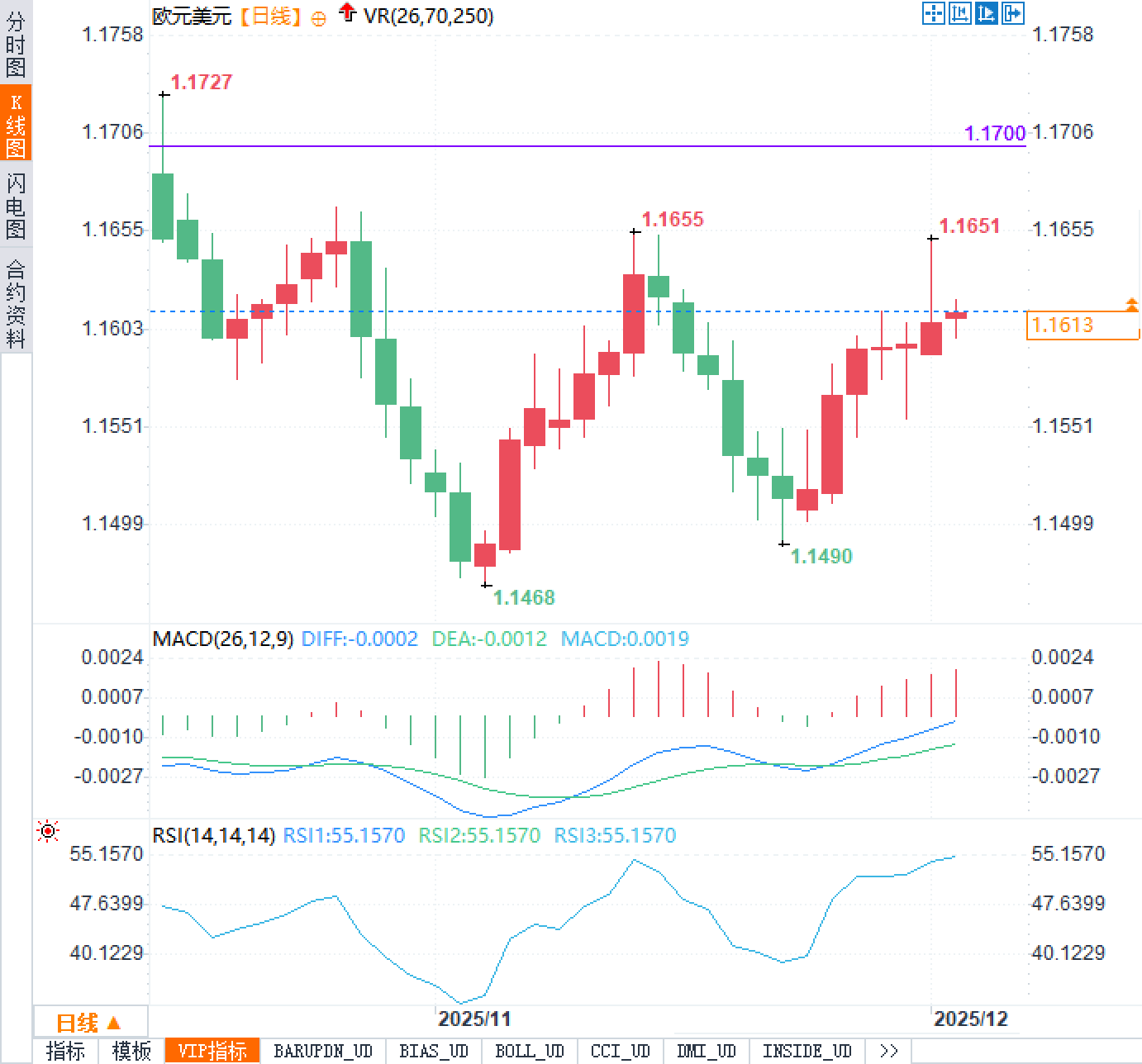
Regarding the MACD indicator, the fast line DIFF is at -0.0002, the slow line DEA is at -0.0012, and the MACD histogram reading is 0.0019. Currently, both DIFF and DEA are below the zero axis, but the histogram has turned from green to red, indicating that the bearish momentum is weakening.
The Relative Strength Index (RSI) (14) was 55.1570, which is in the slightly bullish position within the neutral range. This reading is far from the 70 overbought and 30 oversold thresholds, indicating that the forces of the bulls and bears are relatively balanced, and the exchange rate has neither obvious overbought pressure nor triggered an oversold rebound signal.
From a support and resistance perspective, the 1.1650-1.1655 area forms near-term resistance, while the psychological level of 1.1700 creates a strong resistance zone. On the downside, 1.16 is the primary support level; a break below this level would then see 1.1550 and 1.1490 become the next lines of defense for the bulls. It's worth noting that 1.1490, together with the previous low of 1.1468, forms a solid bottom support area.
Current market sentiment is cautious and wait-and-see. While the bond market turmoil triggered by the Bank of Japan's unexpected hawkish stance has subsided somewhat, global risk appetite remains in a recovery phase, and safe-haven demand is providing temporary support for the US dollar. The contradictory signals from the Eurozone's fundamentals—a marginal recovery in inflation coupled with a weakening labor market—have left both bulls and bears lacking confidence in placing bets, resulting in a directional stalemate in the exchange rate.
Judging from fund flows, bulls showed strong profit-taking intent above 1.1650, and two attempts to break through this area failed, indicating that upward momentum is waning. Meanwhile, bears also failed to exert effective pressure below the 1.1600 level, with decent buying support at the bottom. This stalemate reflects a divergence of opinion among traders regarding the future direction, with waiting for clearer macroeconomic guidance becoming the mainstream strategy.
The US ISM services data and ADP employment report, to be released this Wednesday, will be key variables in breaking the deadlock. If the services data continues the weakness of the manufacturing sector, the dollar may face further selling pressure, creating an opportunity for the euro to rise; conversely, if the services sector's resilience exceeds expectations, coupled with robust employment data, dollar bulls' confidence will be boosted.
Fundamentals:
The Eurozone's preliminary Harmonized Index of Consumer Prices (HICP) for November exceeded expectations, with the year-on-year growth rate rising to 2.2% from 2.1% in October, higher than the market expectation of a flat reading of 2.1%. However, the core HICP remained unchanged at 2.4%, failing to reach the market expectation of a 2.5% increase. On the monthly data front, overall inflation contracted by 0.3% month-on-month, compared to a 0.2% increase in the previous month; the core inflation rate fell even more sharply by 0.5% month-on-month, a stark contrast to the 0.3% increase in the previous month. The inflation structure shows a superficial recovery but a weak core, unlikely to shake the European Central Bank's established path of maintaining stable interest rates.
Concerns are also emerging in the labor market. The Eurozone unemployment rate unexpectedly climbed to 6.4% in October, a 16-month high and significantly deviating from market expectations of 6.3%. Meanwhile, the September figure was revised upward from 6.3% to 6.4%, suggesting that the cooling in the job market may be more pronounced than anticipated. This divergence between inflation and employment data puts the European Central Bank in a dilemma—rising price pressures limit its room for easing, while a weakening labor market provides a potential reason for a policy shift.
The US ISM Manufacturing Purchasing Managers' Index (PMI) slipped further into contraction territory in November, falling to 48.2 from 48.7 in October, below market expectations of 48.6. All sub-indices weakened: the new orders index plummeted from 49.4 to 47.4, and the employment index dropped from 46 to 44, both pointing to continued contraction in manufacturing activity. Alarmingly, the prices paid index rose from 58.0 to 58.5, indicating that the transmission effect of tariff policies on inflation is beginning to emerge.
Bank of Japan Governor Kazuo Ueda signaled a December rate hike on Monday, triggering sharp fluctuations in global bond markets. US Treasury yields rose in response, providing support for the already pressured dollar. Earlier on Tuesday, a positive Japanese government bond auction eased market panic somewhat, but risk appetite remained fragile. This week's market focus will shift to the US ISM Services PMI and ADP employment change report, to be released on Wednesday.
The Eurozone manufacturing sector is also mired in difficulties. The final reading of the HCOB Manufacturing Purchasing Managers' Index for November was revised down to 49.6, a further decline from the initial reading of 49.7, marking a five-month low and a significant deterioration compared to the 50.0 threshold separating expansion from contraction in October. The synchronized weakness in European and American manufacturing sectors makes it difficult for exchange rates to receive unilateral guidance from fundamentals.
Technical aspects:
The daily chart shows that the euro has begun a recovery against the US dollar after hitting a low of 1.1468; the current price is around 1.1613, which is exactly in the middle of the previous trading range.
From a candlestick chart perspective, the exchange rate has repeatedly encountered resistance below the 1.1700 level, which has formed a valid horizontal resistance line. Recent price action exhibits a typical pattern of rallies followed by pullbacks: a rapid retreat after reaching 1.1655, followed by a rebound to the 1.1651 area where it was met with selling pressure, suggesting a potential double top formation. The 1.16 level has provided effective support multiple times and is a key area for bullish defense.
Regarding the MACD indicator, the fast line DIFF is at -0.0002, the slow line DEA is at -0.0012, and the MACD histogram reading is 0.0019. Currently, both DIFF and DEA are below the zero axis, but the histogram has turned from green to red, indicating that the bearish momentum is weakening.
The Relative Strength Index (RSI) (14) was 55.1570, which is in the slightly bullish position within the neutral range. This reading is far from the 70 overbought and 30 oversold thresholds, indicating that the forces of the bulls and bears are relatively balanced, and the exchange rate has neither obvious overbought pressure nor triggered an oversold rebound signal.
From a support and resistance perspective, the 1.1650-1.1655 area forms near-term resistance, while the psychological level of 1.1700 creates a strong resistance zone. On the downside, 1.16 is the primary support level; a break below this level would then see 1.1550 and 1.1490 become the next lines of defense for the bulls. It's worth noting that 1.1490, together with the previous low of 1.1468, forms a solid bottom support area.
Market sentiment observation:
Current market sentiment is cautious and wait-and-see. While the bond market turmoil triggered by the Bank of Japan's unexpected hawkish stance has subsided somewhat, global risk appetite remains in a recovery phase, and safe-haven demand is providing temporary support for the US dollar. The contradictory signals from the Eurozone's fundamentals—a marginal recovery in inflation coupled with a weakening labor market—have left both bulls and bears lacking confidence in placing bets, resulting in a directional stalemate in the exchange rate.
Judging from fund flows, bulls showed strong profit-taking intent above 1.1650, and two attempts to break through this area failed, indicating that upward momentum is waning. Meanwhile, bears also failed to exert effective pressure below the 1.1600 level, with decent buying support at the bottom. This stalemate reflects a divergence of opinion among traders regarding the future direction, with waiting for clearer macroeconomic guidance becoming the mainstream strategy.
The US ISM services data and ADP employment report, to be released this Wednesday, will be key variables in breaking the deadlock. If the services data continues the weakness of the manufacturing sector, the dollar may face further selling pressure, creating an opportunity for the euro to rise; conversely, if the services sector's resilience exceeds expectations, coupled with robust employment data, dollar bulls' confidence will be boosted.
- Risk Warning and Disclaimer
- The market involves risk, and trading may not be suitable for all investors. This article is for reference only and does not constitute personal investment advice, nor does it take into account certain users’ specific investment objectives, financial situation, or other needs. Any investment decisions made based on this information are at your own risk.