Warning signs of a "death spiral" in Japan's debt crisis have been sounded! Is the Bank of Japan's massive buying spree a sacrifice of the yen?
2025-12-03 09:29:22
With the yield on Japan's 10-year government bonds exceeding 1.85% on Tuesday (December 2nd), reaching its highest level since 2006, the market interpreted this as the start of a new tightening cycle by the Bank of Japan. However, the actual fundamentals contradict this.
The current rise in Japanese government bond yields under the current macroeconomic policy framework is neither a signal of a strong economy nor an endorsement of Japanese economic growth or the central bank's policy decisions. It is merely a repricing of the inflation premium by the market in a system unable to sustain positive real interest rates. In Japan, rising yields are precisely a sign of economic weakness, because the structural support that once anchored the bond market has disappeared.
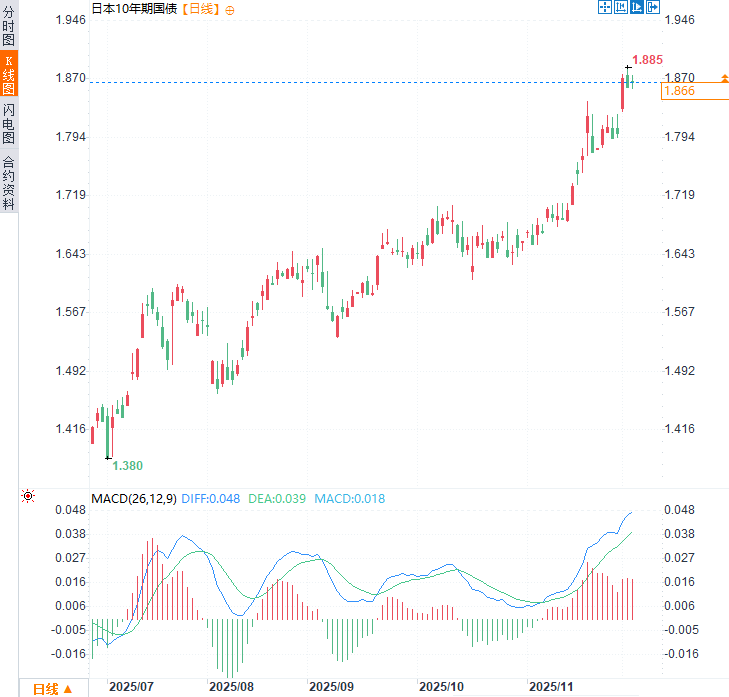
(Daily chart of 10-year Japanese government bonds, source: EasyForex)
In a system where even slight changes in long-term nominal yields can shake the foundations of debt, the bond market is attempting to reprice inflation risk. To understand this, we must begin with the fundamental characteristics of Japanese government debt. Japanese government bonds are essentially debt certificates between different groups within Japanese society, with the total debt entirely absorbed domestically. Approximately half of Japanese government bonds are held by the Bank of Japan—accounting for about 50%-53% of the total market. Foreign investors hold only 11%-12%. The remaining 35%-40% are held by domestic banks, Japan Post Bank, insurance companies such as Nippon Life and Dai-ichi Life, and pension funds such as GPIF. Japanese households almost never directly hold government bonds, but rather indirectly through the aforementioned institutions.
This distribution of holders reveals the essence of the problem. The ownership structure of Japanese government bonds makes the situation crystal clear—the Bank of Japan holds more than half of the market share, foreign ownership is just over one-tenth, and the remainder is scattered among banks, insurance companies, and pension funds—meaning the government has lost its natural base of private sector buyers. This is a direct consequence of the collapse in domestic savings: an aging population, declining savings rates, stagnant incomes, and the disappearance of the trade surplus have all contributed to this situation .
If the Bank of Japan hadn't intervened to fill the gap left by the contraction of private sector balance sheets, the demand for Japanese government bonds would have been far less than the government's borrowing needs. Long-term yields should have surged years ago, breaking any sustainable debt path and triggering a full-blown fiscal crisis. The only reason the system hasn't collapsed is because the Bank of Japan absorbs half the market ; once that support is removed, the entire structure will crumble. This also explains why the yen, rather than the bond market, has absorbed all the shocks.
When total debt exceeds 250% of GDP, even domestic debt can destabilize the economy. Every 1 percentage point increase in the average interest rate means taxpayers transfer approximately 2.5% of GDP's wealth to bondholders. While this is still considered a "domestic" transfer, such a scale is far too burdensome for Japan, with its shrinking population and declining workforce.
Japan will not be forced into a traditional debt default because it issues debt in its own currency, and its central bank can always generate the yen needed to fulfill its nominal repayment obligations. The only possible default Japan could experience is an inflationary default: the country repays its debt at nominal value while simultaneously destroying real value through currency devaluation and negative real interest rates . This is the inevitable path for all highly indebted developed economies, and Japan is already deeply mired in it.
From this perspective, the current sell-off of Japanese government bonds is not a signal of a credible tightening policy from the Bank of Japan. Japan simply cannot sustain a tightening cycle. If long-term yields rise too much, they will break through the "Cherhot line"—the critical nominal interest rate at which Japanese debt surges out of control. With a nominal growth rate of approximately 3.5%-4%, a primary deficit approaching 3% of GDP, and a debt ratio reaching 250% of GDP, long-term yields must be kept below approximately 2.5%-3% for Japan to stabilize its debt. The current yield of 1.85% is merely the market priced in an inflation premium. If yields climb further, the Bank of Japan will be forced to intervene.
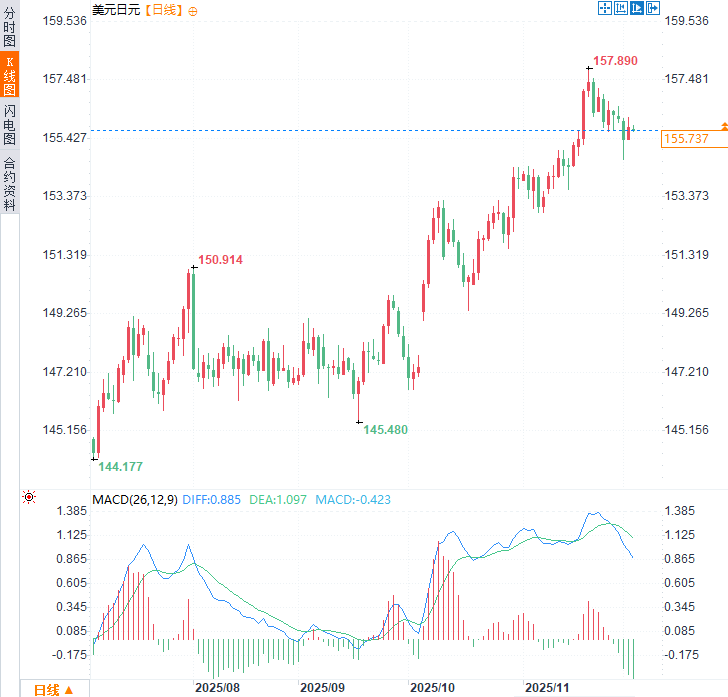
(USD/JPY daily chart, source: FX678)
From 1975 to 2010, the Japanese economy operated on a powerful external stabilizer: the trade balance. When the trade surplus narrowed, the yen weakened; when the trade surplus widened, the yen strengthened. This correlation stemmed from the fact that Japan's export surplus generated foreign exchange earnings, which flowed back into yen, increasing domestic savings and ultimately flowing into the Japanese government bond market. The trade surplus indirectly supported the bond market.
However, this pattern was disrupted after the global financial crisis, and especially after the Fukushima nuclear accident. Japan transformed into a structural importer of energy, and its trade surplus disappeared. According to the old logic, the yen should have collapsed. But in reality, between 2010 and 2012, the yen strengthened because the scale of capital repatriation far exceeded the impact of trade channels—this period completely broke the original correlation.
Although the correlation has been broken, the trend remains unchanged. After 2012, the trade balance remained weak, and the yen began its longest period of depreciation. Japan no longer drives the yen's strength through export surpluses, but rather through import dependence. As trade surpluses no longer increase domestic savings, the balance sheets of banks, insurance companies, and pension funds have also stopped expanding. This gap must be filled by the Bank of Japan.
Once the Bank of Japan controls yields, the pressure to adjust will fall solely on the exchange rate—this is the essence of the current policy framework. When the Bank of Japan suppresses yields, all macroeconomic pressures are borne by the yen: every time the central bank attempts to tighten, the yen rebounds sharply; whenever the central bank falls deeper into negative real interest rates, the yen weakens again . The long-term depreciation trend of the yen is an external manifestation of Japan's "inflation default" mechanism.
Japan's economy has only three possible paths forward: first, a significant depreciation of the yen to the 170-200 range to restore its trade surplus and savings base; second, achieving structural inflation; and third—and the only truly sustainable long-term solution—opening up immigration.
For decades, immigration policy was an unthinkable taboo in Japan, but now it enjoys political tolerance. This is the only structural solution that can reverse the population decline, expand the labor force, and revitalize the savings rate, enabling Japan to rebuild its debt repayment capacity without relying on financial repression.
During this period, the Japanese economy will rely on its vast overseas assets to survive.
Japan is a super-creditor nation with over 500 trillion yen in net overseas assets. However, these assets do not flow back to the homeland but remain overseas—because Japan's real yield is negative, while overseas markets offer positive real returns.
Institutional investors consistently measure real yields, not nominal interest rates. As long as Japan needs to maintain negative real interest rates to prevent its debt from spiraling out of control, Japanese investors will not allow capital to flow back home. This preordains that the yen will remain fundamentally weak in the long term and will continue to be trapped in its role as a funding currency . The strongest empirical evidence comes from the data trajectory of the balance of payments itself.
Japan's current account surplus has surged to a record high, but the cause points to a structural predicament: primary income items (interest, dividends, and overseas profits denominated in depreciating currencies) have soared to over 4 trillion yen, while the trade balance has remained on the verge of profitability. Japan has transformed from a trade surplus country to an investment income surplus country. Since these incomes are generated overseas, they do not create demand for the yen—institutional investors continue to reinvest their funds in overseas markets due to higher real returns. This explains why the yen continues to weaken despite the record high current account surplus: capital has not flowed back to the homeland .
Japan can only rebuild its trade surplus under the dual conditions of a weaker yen and a strong US economy. A weaker yen will stimulate a surge in exports, while the expansion of the US economy will boost external demand—which will restart the traditional engine of corporate profit growth driving domestic savings expansion.
The yen will continue to maintain its characteristics as a structural funding currency: every few quarters, when imported inflation surges and forces the Bank of Japan to tighten policy, the yen rebounds sharply; but debt arithmetic will eventually force the central bank to return to easing, and the yen will resume its decline.
Japan was forced to choose between rescuing its bond market or defending the value of its currency; the two were mutually exclusive. Thus, as always, it chose to protect its bond market. The cost, however, was borne by the yen.
At 9:28 Beijing time, the US dollar was trading at 155.64/65 against the Japanese yen.
The current rise in Japanese government bond yields under the current macroeconomic policy framework is neither a signal of a strong economy nor an endorsement of Japanese economic growth or the central bank's policy decisions. It is merely a repricing of the inflation premium by the market in a system unable to sustain positive real interest rates. In Japan, rising yields are precisely a sign of economic weakness, because the structural support that once anchored the bond market has disappeared.
Japan's Debt Magic
(Daily chart of 10-year Japanese government bonds, source: EasyForex)
In a system where even slight changes in long-term nominal yields can shake the foundations of debt, the bond market is attempting to reprice inflation risk. To understand this, we must begin with the fundamental characteristics of Japanese government debt. Japanese government bonds are essentially debt certificates between different groups within Japanese society, with the total debt entirely absorbed domestically. Approximately half of Japanese government bonds are held by the Bank of Japan—accounting for about 50%-53% of the total market. Foreign investors hold only 11%-12%. The remaining 35%-40% are held by domestic banks, Japan Post Bank, insurance companies such as Nippon Life and Dai-ichi Life, and pension funds such as GPIF. Japanese households almost never directly hold government bonds, but rather indirectly through the aforementioned institutions.
This distribution of holders reveals the essence of the problem. The ownership structure of Japanese government bonds makes the situation crystal clear—the Bank of Japan holds more than half of the market share, foreign ownership is just over one-tenth, and the remainder is scattered among banks, insurance companies, and pension funds—meaning the government has lost its natural base of private sector buyers. This is a direct consequence of the collapse in domestic savings: an aging population, declining savings rates, stagnant incomes, and the disappearance of the trade surplus have all contributed to this situation .
If the Bank of Japan hadn't intervened to fill the gap left by the contraction of private sector balance sheets, the demand for Japanese government bonds would have been far less than the government's borrowing needs. Long-term yields should have surged years ago, breaking any sustainable debt path and triggering a full-blown fiscal crisis. The only reason the system hasn't collapsed is because the Bank of Japan absorbs half the market ; once that support is removed, the entire structure will crumble. This also explains why the yen, rather than the bond market, has absorbed all the shocks.
When total debt exceeds 250% of GDP, even domestic debt can destabilize the economy. Every 1 percentage point increase in the average interest rate means taxpayers transfer approximately 2.5% of GDP's wealth to bondholders. While this is still considered a "domestic" transfer, such a scale is far too burdensome for Japan, with its shrinking population and declining workforce.
Japan will not be forced into a traditional debt default because it issues debt in its own currency, and its central bank can always generate the yen needed to fulfill its nominal repayment obligations. The only possible default Japan could experience is an inflationary default: the country repays its debt at nominal value while simultaneously destroying real value through currency devaluation and negative real interest rates . This is the inevitable path for all highly indebted developed economies, and Japan is already deeply mired in it.
From this perspective, the current sell-off of Japanese government bonds is not a signal of a credible tightening policy from the Bank of Japan. Japan simply cannot sustain a tightening cycle. If long-term yields rise too much, they will break through the "Cherhot line"—the critical nominal interest rate at which Japanese debt surges out of control. With a nominal growth rate of approximately 3.5%-4%, a primary deficit approaching 3% of GDP, and a debt ratio reaching 250% of GDP, long-term yields must be kept below approximately 2.5%-3% for Japan to stabilize its debt. The current yield of 1.85% is merely the market priced in an inflation premium. If yields climb further, the Bank of Japan will be forced to intervene.
Japan's economic structural transformation and the fate of the yen
(USD/JPY daily chart, source: FX678)
From 1975 to 2010, the Japanese economy operated on a powerful external stabilizer: the trade balance. When the trade surplus narrowed, the yen weakened; when the trade surplus widened, the yen strengthened. This correlation stemmed from the fact that Japan's export surplus generated foreign exchange earnings, which flowed back into yen, increasing domestic savings and ultimately flowing into the Japanese government bond market. The trade surplus indirectly supported the bond market.
However, this pattern was disrupted after the global financial crisis, and especially after the Fukushima nuclear accident. Japan transformed into a structural importer of energy, and its trade surplus disappeared. According to the old logic, the yen should have collapsed. But in reality, between 2010 and 2012, the yen strengthened because the scale of capital repatriation far exceeded the impact of trade channels—this period completely broke the original correlation.
Although the correlation has been broken, the trend remains unchanged. After 2012, the trade balance remained weak, and the yen began its longest period of depreciation. Japan no longer drives the yen's strength through export surpluses, but rather through import dependence. As trade surpluses no longer increase domestic savings, the balance sheets of banks, insurance companies, and pension funds have also stopped expanding. This gap must be filled by the Bank of Japan.
Once the Bank of Japan controls yields, the pressure to adjust will fall solely on the exchange rate—this is the essence of the current policy framework. When the Bank of Japan suppresses yields, all macroeconomic pressures are borne by the yen: every time the central bank attempts to tighten, the yen rebounds sharply; whenever the central bank falls deeper into negative real interest rates, the yen weakens again . The long-term depreciation trend of the yen is an external manifestation of Japan's "inflation default" mechanism.
Japan's economy has only three possible paths forward: first, a significant depreciation of the yen to the 170-200 range to restore its trade surplus and savings base; second, achieving structural inflation; and third—and the only truly sustainable long-term solution—opening up immigration.
For decades, immigration policy was an unthinkable taboo in Japan, but now it enjoys political tolerance. This is the only structural solution that can reverse the population decline, expand the labor force, and revitalize the savings rate, enabling Japan to rebuild its debt repayment capacity without relying on financial repression.
During this period, the Japanese economy will rely on its vast overseas assets to survive.
Negative interest rate differentials anchor the fate of the yen as a funding currency.
Japan is a super-creditor nation with over 500 trillion yen in net overseas assets. However, these assets do not flow back to the homeland but remain overseas—because Japan's real yield is negative, while overseas markets offer positive real returns.
Institutional investors consistently measure real yields, not nominal interest rates. As long as Japan needs to maintain negative real interest rates to prevent its debt from spiraling out of control, Japanese investors will not allow capital to flow back home. This preordains that the yen will remain fundamentally weak in the long term and will continue to be trapped in its role as a funding currency . The strongest empirical evidence comes from the data trajectory of the balance of payments itself.
Inflated profits, real predicament
Japan's current account surplus has surged to a record high, but the cause points to a structural predicament: primary income items (interest, dividends, and overseas profits denominated in depreciating currencies) have soared to over 4 trillion yen, while the trade balance has remained on the verge of profitability. Japan has transformed from a trade surplus country to an investment income surplus country. Since these incomes are generated overseas, they do not create demand for the yen—institutional investors continue to reinvest their funds in overseas markets due to higher real returns. This explains why the yen continues to weaken despite the record high current account surplus: capital has not flowed back to the homeland .
Japan can only rebuild its trade surplus under the dual conditions of a weaker yen and a strong US economy. A weaker yen will stimulate a surge in exports, while the expansion of the US economy will boost external demand—which will restart the traditional engine of corporate profit growth driving domestic savings expansion.
The yen will continue to maintain its characteristics as a structural funding currency: every few quarters, when imported inflation surges and forces the Bank of Japan to tighten policy, the yen rebounds sharply; but debt arithmetic will eventually force the central bank to return to easing, and the yen will resume its decline.
Japan was forced to choose between rescuing its bond market or defending the value of its currency; the two were mutually exclusive. Thus, as always, it chose to protect its bond market. The cost, however, was borne by the yen.
At 9:28 Beijing time, the US dollar was trading at 155.64/65 against the Japanese yen.
- Risk Warning and Disclaimer
- The market involves risk, and trading may not be suitable for all investors. This article is for reference only and does not constitute personal investment advice, nor does it take into account certain users’ specific investment objectives, financial situation, or other needs. Any investment decisions made based on this information are at your own risk.