Has Trump's tariffs backfired? Delayed effects are emerging, potentially leading to a wave of layoffs in the US next year.
2025-12-03 11:37:09
US President Trump aims to bring overseas manufacturing jobs back to the United States through tariffs, but according to recent reports from business executives and economic forecasters, this move could actually lead to a reduction in domestic employment.
The current labor market is in a stalemate of "no layoffs, no hiring," and the industry is increasingly worried that tariffs on U.S. imports will drive up business operating costs and force companies to start cutting staff.
For example, respondents to the Institute for Supply Management's November manufacturing conditions survey expressed strong concerns. One transportation equipment executive wrote, "We are beginning to implement more permanent adjustments due to the tariff environment, including layoffs, new guidance to shareholders, and developing more offshore manufacturing operations—which were originally intended for U.S. exports."
The Institute for Supply Management's survey does not disclose the names of respondents, only their industry.
Similar views were expressed in other parts of the report, which showed that the ISM Manufacturing Index slipped further into the range indicating a deteriorating business environment. The overall reading of 48.2% represents the proportion of businesses reporting business expansion, so any figure below 50% signifies industry contraction.
The employment indicator in the survey fell 2 percentage points to 44%, the lowest level since last August, consistent with a gradual and persistent weakening trend in the labor market. Other signs suggest that the employment outlook is dimming as we head into 2026.
The Trump administration aggressively promoted energy exploration and increased the use of fossil fuels. However, one interviewee from the oil and coal industry stated, "There haven't been major changes yet, but looking ahead to 2026, we expect to see significant shifts in cash flow and headcount. The company has sold off most of its free cash flow generating businesses and offered voluntary severance packages to all employees."
A manager in the electrical equipment, home appliance, and component industry pointed out that tariff policies are creating a more challenging business environment than during the pandemic. The interviewee stated, "In terms of supply chain uncertainty, the current situation is more challenging than during the coronavirus pandemic."
Admittedly, the overall economic environment remains relatively stable. According to data tracked by the Atlanta Federal Reserve, the annualized growth rate of U.S. GDP in the third quarter is projected to be 3.9%. Furthermore, the job market performed better than expected in September—non-farm payrolls increased by 119,000 despite signs of layoffs at large companies. For example, Amazon announced in late October that it would lay off 30,000 employees, and several other large companies have also announced layoff plans.
A report released Tuesday (December 2) by the Organization for Economic Cooperation and Development (OECD), a group of 38 member countries, indicated that tariff policies have not yet had a substantial impact on the global economy, but warned that the full effects may not yet be apparent.
The report from the OECD in Paris states that "the impact of higher tariffs on the U.S. economy has not yet fully materialized," while noting that "the value of U.S. imports subject to tariffs has fallen sharply," which "indicates that tariffs are affecting demand and will continue to suppress trade volumes as the announced tariff measures take full effect."
These risks pose challenges to the labor market next year. The Federal Reserve's economic report last week also noted that the employment rate had "slightly declined" over the past seven weeks or so, while manufacturers reported that "tariff and tariff policy uncertainty continues to pose a headwind."
A Cleveland Fed survey revealed the duality of tariffs: "One large retailer is studying how to spread these additional costs, as tariffs have increased its annual costs by about 20%; in contrast, another large retailer did not anticipate further cost increases and said the impact of tariffs has stabilized."
Trump's current tariff policies pose a short-term disturbance and a medium-term risk to the US dollar. Although short-term economic data remains resilient, leading indicators from manufacturing and businesses are flashing warning signs.
As the full impact of tariffs gradually permeates broader economic sectors (as warned by the OECD and anticipated by many businesses), the downside risks facing the US dollar will increase significantly . The dollar index fell for the seventh consecutive trading day on Wednesday, declining by approximately 0.11%.
Traders need to closely monitor ISM data, non-farm payroll reports, and corporate earnings guidance in the coming quarters to verify whether the concerns expressed by corporate executives in the text translate into macroeconomic reality.
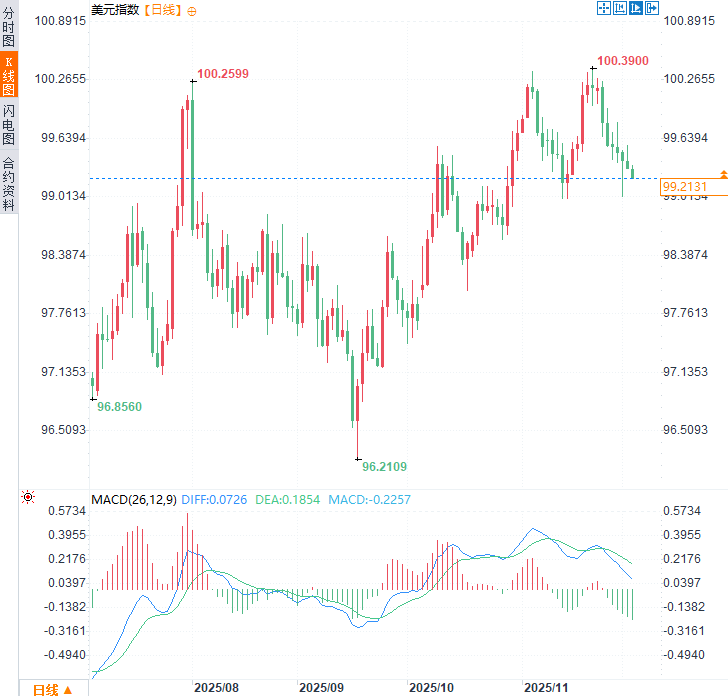
(US Dollar Index Daily Chart, Source: FX678)
At 11:35 Beijing time, the US dollar index is currently at 99.22.
The current labor market is in a stalemate of "no layoffs, no hiring," and the industry is increasingly worried that tariffs on U.S. imports will drive up business operating costs and force companies to start cutting staff.
For example, respondents to the Institute for Supply Management's November manufacturing conditions survey expressed strong concerns. One transportation equipment executive wrote, "We are beginning to implement more permanent adjustments due to the tariff environment, including layoffs, new guidance to shareholders, and developing more offshore manufacturing operations—which were originally intended for U.S. exports."
The Institute for Supply Management's survey does not disclose the names of respondents, only their industry.
Similar views were expressed in other parts of the report, which showed that the ISM Manufacturing Index slipped further into the range indicating a deteriorating business environment. The overall reading of 48.2% represents the proportion of businesses reporting business expansion, so any figure below 50% signifies industry contraction.
The employment indicator in the survey fell 2 percentage points to 44%, the lowest level since last August, consistent with a gradual and persistent weakening trend in the labor market. Other signs suggest that the employment outlook is dimming as we head into 2026.
The Trump administration aggressively promoted energy exploration and increased the use of fossil fuels. However, one interviewee from the oil and coal industry stated, "There haven't been major changes yet, but looking ahead to 2026, we expect to see significant shifts in cash flow and headcount. The company has sold off most of its free cash flow generating businesses and offered voluntary severance packages to all employees."
A manager in the electrical equipment, home appliance, and component industry pointed out that tariff policies are creating a more challenging business environment than during the pandemic. The interviewee stated, "In terms of supply chain uncertainty, the current situation is more challenging than during the coronavirus pandemic."
contradictory signals
Admittedly, the overall economic environment remains relatively stable. According to data tracked by the Atlanta Federal Reserve, the annualized growth rate of U.S. GDP in the third quarter is projected to be 3.9%. Furthermore, the job market performed better than expected in September—non-farm payrolls increased by 119,000 despite signs of layoffs at large companies. For example, Amazon announced in late October that it would lay off 30,000 employees, and several other large companies have also announced layoff plans.
A report released Tuesday (December 2) by the Organization for Economic Cooperation and Development (OECD), a group of 38 member countries, indicated that tariff policies have not yet had a substantial impact on the global economy, but warned that the full effects may not yet be apparent.
The report from the OECD in Paris states that "the impact of higher tariffs on the U.S. economy has not yet fully materialized," while noting that "the value of U.S. imports subject to tariffs has fallen sharply," which "indicates that tariffs are affecting demand and will continue to suppress trade volumes as the announced tariff measures take full effect."
These risks pose challenges to the labor market next year. The Federal Reserve's economic report last week also noted that the employment rate had "slightly declined" over the past seven weeks or so, while manufacturers reported that "tariff and tariff policy uncertainty continues to pose a headwind."
A Cleveland Fed survey revealed the duality of tariffs: "One large retailer is studying how to spread these additional costs, as tariffs have increased its annual costs by about 20%; in contrast, another large retailer did not anticipate further cost increases and said the impact of tariffs has stabilized."
Suppression of the US dollar and risk factors
Trump's current tariff policies pose a short-term disturbance and a medium-term risk to the US dollar. Although short-term economic data remains resilient, leading indicators from manufacturing and businesses are flashing warning signs.
As the full impact of tariffs gradually permeates broader economic sectors (as warned by the OECD and anticipated by many businesses), the downside risks facing the US dollar will increase significantly . The dollar index fell for the seventh consecutive trading day on Wednesday, declining by approximately 0.11%.
Traders need to closely monitor ISM data, non-farm payroll reports, and corporate earnings guidance in the coming quarters to verify whether the concerns expressed by corporate executives in the text translate into macroeconomic reality.
(US Dollar Index Daily Chart, Source: FX678)
At 11:35 Beijing time, the US dollar index is currently at 99.22.
- Risk Warning and Disclaimer
- The market involves risk, and trading may not be suitable for all investors. This article is for reference only and does not constitute personal investment advice, nor does it take into account certain users’ specific investment objectives, financial situation, or other needs. Any investment decisions made based on this information are at your own risk.