The euro is back! It's reclaiming its throne step by step on the path to the dollar's collapse.
2025-12-03 17:42:56
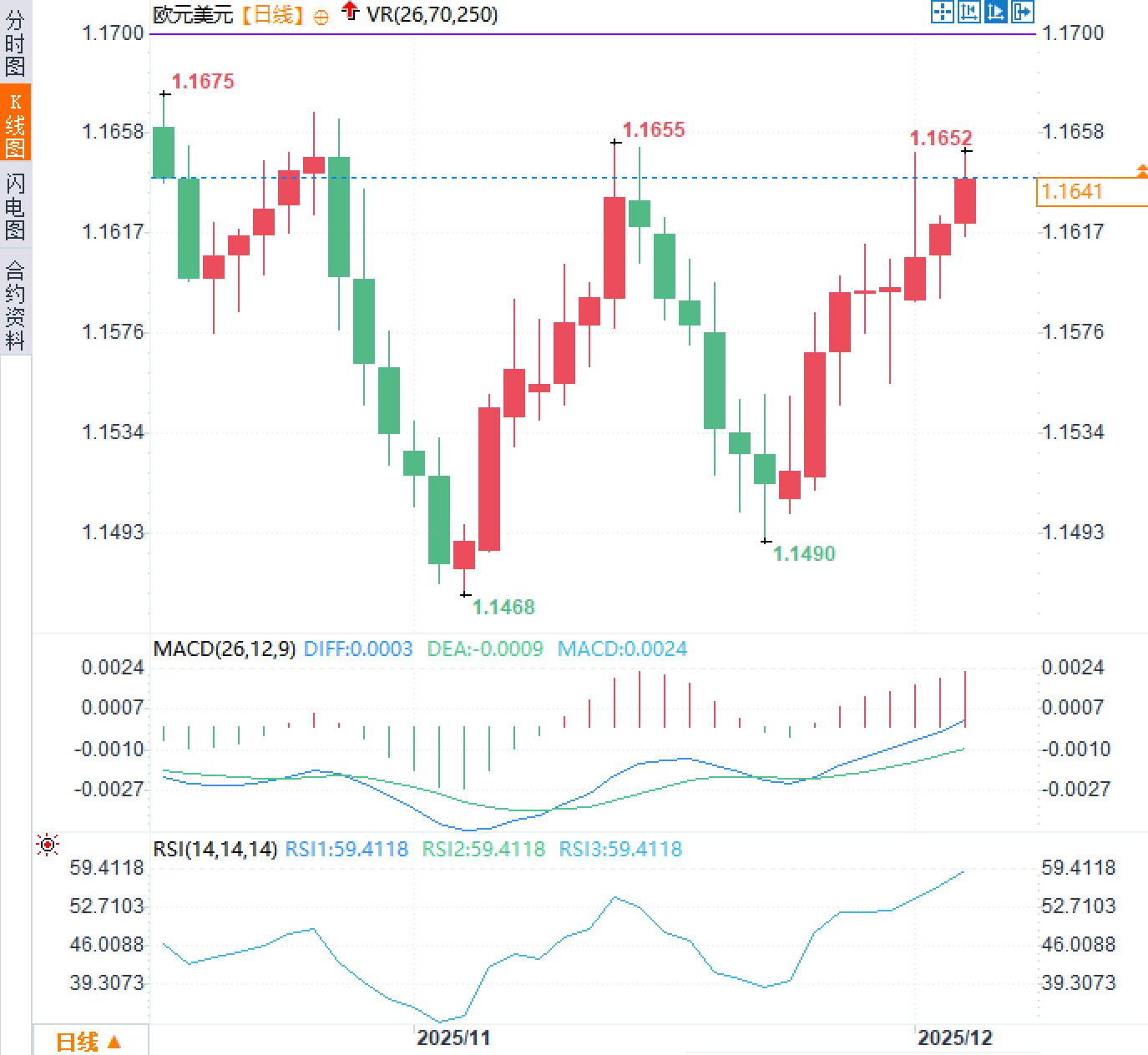
On December 3rd, Wednesday, during the early European session, the euro maintained its strength against the US dollar, rising to around 1.1650, continuing the positive closing trend of the previous two trading days. The current exchange rate shows a clear short-term bullish signal in its technical pattern, and overall market sentiment leans towards supporting further euro strength. The main driving force behind this round of gains is not a surge in Eurozone economic data, but rather the overall weakness of the US dollar index.

Recent market expectations for the Federal Reserve's future policy path have clearly shifted towards a dovish stance, becoming the core factor suppressing the dollar's performance. With the Federal Open Market Committee (FOMC) about to hold its final meeting of the year, investors are closely watching whether various economic data are sufficient to support expectations of an earlier interest rate cut. Currently, the market has priced in a 95% probability of an interest rate cut next year, and this strong expectation of a policy shift has significantly weakened the dollar's attractiveness. A high-interest-rate environment was originally the foundation for a strong dollar, but once an interest rate cut is imminent, the yield advantage of holding dollar assets will quickly diminish, and funds will naturally flow to other relatively more attractive currencies.
More notably, US President Trump recently hinted at his intention to nominate current chief economic advisor Kevin Hassett to succeed outgoing Federal Reserve Chairman Jerome Powell. Hassett is widely regarded as a representative of the "dovish" camp in monetary policy, with a policy inclination focused more on supporting economic growth and job expansion than controlling inflation. If this appointment is ultimately finalized, it will further solidify market expectations that the Fed will adopt an accommodative stance in the future, thereby continuing to exert downward pressure on the dollar and providing support for the euro against the dollar.
The US will release two important economic indicators today: the ADP private sector employment report and the ISM Services Purchasing Managers' Index (PMI) for November. The employment sub-index of the ISM Services PMI is particularly crucial. Since the next non-farm payroll data will not be released until after the Federal Reserve's interest rate meeting, this PMI employment index will be an important leading indicator for assessing the state of the labor market.
If the index rises above the 50-point threshold, indicating a return to expansion in service sector employment, it could temporarily boost confidence in the US dollar and limit the euro's upside potential against the dollar. Conversely, if the reading remains below October's 48.2 level, it will further intensify market concerns about a slowdown in US economic momentum, exacerbate dollar selling pressure, and push the euro to open a new upward channel against the dollar.
Meanwhile, volatility in global bond markets provided additional context for the foreign exchange market. Yesterday's Japanese-led bond sell-off eased somewhat, but failed to sustain its upward momentum during European and American trading sessions. US Treasury yields fluctuated within a narrow range throughout the day, ranging from -2.1 basis points to +0.9 basis points. The German bond yield curve steepened in tandem, with short-term rates falling by approximately 1.4 basis points. UK government bonds also reversed their gains and fell, with yields across all maturities generally declining slightly. Nevertheless, Japanese long-term bond yields climbed again in early Asian trading today, with the 30-year yield approaching a new high. The market is awaiting the results of tomorrow's crucial bond auction, and the subsequent trend remains uncertain.
Despite renewed cracks in French politics—according to local newspaper Le Figaro, Horizons, one of the members of the ruling coalition, will not support Prime Minister Le Cornu's social security budget bill, with a vote scheduled for December 9—the euro exchange rate has not yet shown a significant reaction. As a result, French government bonds (OATs) have underperformed other European sovereign bonds, with spreads widening.
However, the euro did not come under pressure, indicating that the main pricing logic in the current foreign exchange market remains focused on the differences in monetary policy between the US and Europe, rather than the political risks of a single country. In fact, with ECB President Lagarde about to attend a parliamentary hearing, the market is more focused on whether she will release any clues about future policy adjustments. Although the ECB has not yet shown any clear intention to ease monetary policy, the relative stability of the Eurozone's monetary policy, compared to the more certain prospect of interest rate cuts by the Federal Reserve, has actually supported the euro's valuation to some extent.
In cross-currency pairs, the euro encountered resistance at the 0.88 level after rising for three consecutive days against the pound. Given the multiple challenges facing the UK economy, analysts maintain a bearish view on the pound and believe the fair value of the euro against the pound should be above 0.90. This implies that the euro still has room to appreciate against the pound in the medium term, indirectly strengthening the euro's overall strength.
With the Federal Reserve's policy expectations remaining dovish, the dollar under broad pressure, and systemic risks in Europe yet to materialize, the euro has a basis for further upside against the dollar. While the political situation in France is volatile, it hasn't yet created a force strong enough to reverse the exchange rate trend. Unless key US economic data shows unexpectedly strong performance, the dollar is unlikely to escape its weakness, and the euro is expected to continue testing important technical resistance levels.
Of course, the possibility of a short-term pullback cannot be completely ruled out. If market concerns about French fiscal policy intensify or global risk aversion reignites, funds may temporarily flow back into dollar assets. However, unless US economic data shows significant resilience and shakes expectations of interest rate cuts, such a rebound is likely merely a correction and unlikely to alter the medium-term downward trend. Overall, the current market theme is clear: monetary policy divergence is driving exchange rate movements, and the euro is benefiting from the relative weakness of the dollar. In the absence of significant reversal signals, the euro/dollar exchange rate will likely maintain a volatile but slightly bullish trend. The key point to observe in the next phase is the subtle changes in the European Central Bank's policy communication.
Recent market expectations for the Federal Reserve's future policy path have clearly shifted towards a dovish stance, becoming the core factor suppressing the dollar's performance. With the Federal Open Market Committee (FOMC) about to hold its final meeting of the year, investors are closely watching whether various economic data are sufficient to support expectations of an earlier interest rate cut. Currently, the market has priced in a 95% probability of an interest rate cut next year, and this strong expectation of a policy shift has significantly weakened the dollar's attractiveness. A high-interest-rate environment was originally the foundation for a strong dollar, but once an interest rate cut is imminent, the yield advantage of holding dollar assets will quickly diminish, and funds will naturally flow to other relatively more attractive currencies.
More notably, US President Trump recently hinted at his intention to nominate current chief economic advisor Kevin Hassett to succeed outgoing Federal Reserve Chairman Jerome Powell. Hassett is widely regarded as a representative of the "dovish" camp in monetary policy, with a policy inclination focused more on supporting economic growth and job expansion than controlling inflation. If this appointment is ultimately finalized, it will further solidify market expectations that the Fed will adopt an accommodative stance in the future, thereby continuing to exert downward pressure on the dollar and providing support for the euro against the dollar.
Key data is about to be released, and the market is holding its breath for the leading indicator.
The US will release two important economic indicators today: the ADP private sector employment report and the ISM Services Purchasing Managers' Index (PMI) for November. The employment sub-index of the ISM Services PMI is particularly crucial. Since the next non-farm payroll data will not be released until after the Federal Reserve's interest rate meeting, this PMI employment index will be an important leading indicator for assessing the state of the labor market.
If the index rises above the 50-point threshold, indicating a return to expansion in service sector employment, it could temporarily boost confidence in the US dollar and limit the euro's upside potential against the dollar. Conversely, if the reading remains below October's 48.2 level, it will further intensify market concerns about a slowdown in US economic momentum, exacerbate dollar selling pressure, and push the euro to open a new upward channel against the dollar.
Meanwhile, volatility in global bond markets provided additional context for the foreign exchange market. Yesterday's Japanese-led bond sell-off eased somewhat, but failed to sustain its upward momentum during European and American trading sessions. US Treasury yields fluctuated within a narrow range throughout the day, ranging from -2.1 basis points to +0.9 basis points. The German bond yield curve steepened in tandem, with short-term rates falling by approximately 1.4 basis points. UK government bonds also reversed their gains and fell, with yields across all maturities generally declining slightly. Nevertheless, Japanese long-term bond yields climbed again in early Asian trading today, with the 30-year yield approaching a new high. The market is awaiting the results of tomorrow's crucial bond auction, and the subsequent trend remains uncertain.
Political turmoil failed to shake the euro; divergent monetary policies were the main reason.
Despite renewed cracks in French politics—according to local newspaper Le Figaro, Horizons, one of the members of the ruling coalition, will not support Prime Minister Le Cornu's social security budget bill, with a vote scheduled for December 9—the euro exchange rate has not yet shown a significant reaction. As a result, French government bonds (OATs) have underperformed other European sovereign bonds, with spreads widening.
However, the euro did not come under pressure, indicating that the main pricing logic in the current foreign exchange market remains focused on the differences in monetary policy between the US and Europe, rather than the political risks of a single country. In fact, with ECB President Lagarde about to attend a parliamentary hearing, the market is more focused on whether she will release any clues about future policy adjustments. Although the ECB has not yet shown any clear intention to ease monetary policy, the relative stability of the Eurozone's monetary policy, compared to the more certain prospect of interest rate cuts by the Federal Reserve, has actually supported the euro's valuation to some extent.
In cross-currency pairs, the euro encountered resistance at the 0.88 level after rising for three consecutive days against the pound. Given the multiple challenges facing the UK economy, analysts maintain a bearish view on the pound and believe the fair value of the euro against the pound should be above 0.90. This implies that the euro still has room to appreciate against the pound in the medium term, indirectly strengthening the euro's overall strength.
Overall
With the Federal Reserve's policy expectations remaining dovish, the dollar under broad pressure, and systemic risks in Europe yet to materialize, the euro has a basis for further upside against the dollar. While the political situation in France is volatile, it hasn't yet created a force strong enough to reverse the exchange rate trend. Unless key US economic data shows unexpectedly strong performance, the dollar is unlikely to escape its weakness, and the euro is expected to continue testing important technical resistance levels.
Of course, the possibility of a short-term pullback cannot be completely ruled out. If market concerns about French fiscal policy intensify or global risk aversion reignites, funds may temporarily flow back into dollar assets. However, unless US economic data shows significant resilience and shakes expectations of interest rate cuts, such a rebound is likely merely a correction and unlikely to alter the medium-term downward trend. Overall, the current market theme is clear: monetary policy divergence is driving exchange rate movements, and the euro is benefiting from the relative weakness of the dollar. In the absence of significant reversal signals, the euro/dollar exchange rate will likely maintain a volatile but slightly bullish trend. The key point to observe in the next phase is the subtle changes in the European Central Bank's policy communication.
- Risk Warning and Disclaimer
- The market involves risk, and trading may not be suitable for all investors. This article is for reference only and does not constitute personal investment advice, nor does it take into account certain users’ specific investment objectives, financial situation, or other needs. Any investment decisions made based on this information are at your own risk.