Crude oil trading alert: Concerns about oversupply pressure oil prices to fall again.
2025-12-09 09:16:42
On Tuesday during Asian trading hours, the global crude oil market saw a significant pullback, with US crude oil trading around $58.80 per barrel, mainly due to the resumption of production at Iraq's West Qurna 2 oil field, which accounts for approximately 0.5% of global supply.
Previously, production was significantly limited due to a leak in the export pipeline, but the Iraqi energy department confirmed in the latest communication that production has returned to the normal level of approximately 460,000 barrels per day.

This development quickly boosted market expectations of improved supply, driving oil prices to their biggest drop in nearly three weeks. Meanwhile, tensions surrounding Ukraine show no signs of substantial de-escalation.
Despite expectations for progress in the negotiations, significant differences remain on key issues such as security and territorial status, making the prospects for peace unclear in the short term.
Market experts point out that the recent continuous attacks on energy infrastructure have kept geopolitical risk premiums high, becoming an important factor suppressing market sentiment volatility.
"In the US market, a loose global oil supply and demand structure is gradually emerging, making investors more sensitive to future inventory changes," analysts further stated, adding that the global oil market is currently under the influence of multiple forces.
On the one hand, increased production in Iraq has reinforced expectations of a looser supply trend. On the other hand, the dynamics of the conflict between Russia and Ukraine could still trigger sudden supply disruptions, keeping risk premiums unstable.
Furthermore, policy uncertainty in Venezuela could also influence future supply trends, making the market more susceptible to news-driven fluctuations. The US Federal Reserve's interest rate decision is also closely watched.
Current market pricing indicates an 86% probability that the Federal Reserve will implement a 25 basis point interest rate cut this month. Analysts believe that in a lower interest rate environment, economic activity is typically more robust, thereby boosting oil demand.
However, given the continued ample supply, the demand-side support for oil prices still has a time lag. Overall, the oil market in the short term is caught in a complex interplay of supply and demand dynamics and geopolitical uncertainties. Investors need to pay attention to three main themes simultaneously: supply recovery, changes in geopolitical risk premiums, and the Federal Reserve's policy direction.
"The global oil price balance remains relatively loose, and this is gradually being reflected in visible inventory changes in the US market." "The ongoing geopolitical security events keep the market sensitive to risk premiums related to energy supply, exerting temporary downward pressure on prices." — Independent Energy Market Researcher
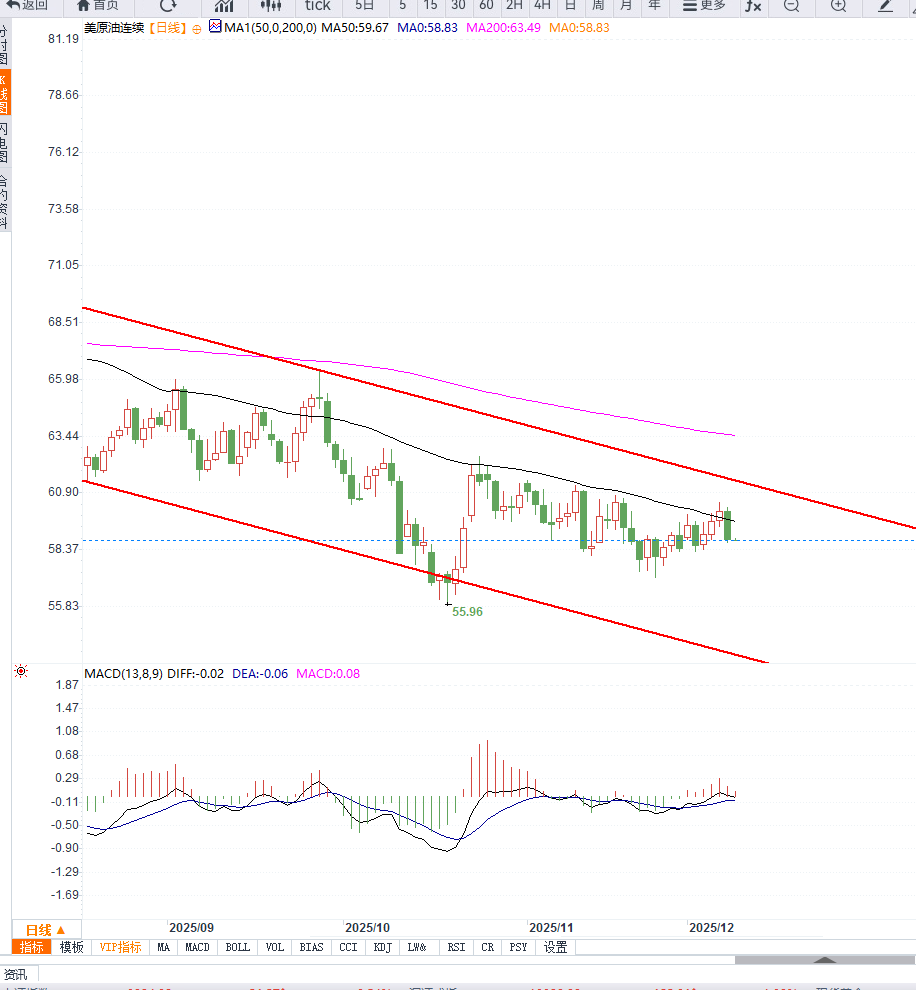
Looking at the daily chart of WTI crude oil, the price recently experienced a significant pullback after touching the resistance zone above $60/barrel, forming a large bearish candlestick, reflecting increased selling pressure above.
The current price has fallen back below the short-term moving average cluster, indicating that short-term market momentum is weakening. The MACD indicator is showing signs of a downward crossover near the zero line, suggesting that the momentum of the recent rebound is waning.
Furthermore, the $59-$60 range near the Bollinger Band's middle line has become a key battleground between bulls and bears. If the daily closing price continues to fall below the middle line, it may retest the support zones of $57.5 and $56.8. Overall, US crude oil is currently in a consolidation phase after high-level fluctuations, and the trend direction still needs further confirmation after news and the Fed's policy decisions are implemented.
Editor's Note:
From an overall structural perspective, this oil price decline largely reflects the market's rapid response to changes in supply. The resumption of production at Iraqi oil fields was a key event driving the price adjustment, but the medium-term trend still depends on whether the stimulus measures of the Federal Reserve's policies can effectively improve demand.
Meanwhile, geopolitical uncertainties remain a significant variable influencing market expectations. If supply continues to improve while demand fails to keep pace, oil prices may continue to fluctuate with a slightly bearish bias.
Previously, production was significantly limited due to a leak in the export pipeline, but the Iraqi energy department confirmed in the latest communication that production has returned to the normal level of approximately 460,000 barrels per day.
This development quickly boosted market expectations of improved supply, driving oil prices to their biggest drop in nearly three weeks. Meanwhile, tensions surrounding Ukraine show no signs of substantial de-escalation.
Despite expectations for progress in the negotiations, significant differences remain on key issues such as security and territorial status, making the prospects for peace unclear in the short term.
Market experts point out that the recent continuous attacks on energy infrastructure have kept geopolitical risk premiums high, becoming an important factor suppressing market sentiment volatility.
"In the US market, a loose global oil supply and demand structure is gradually emerging, making investors more sensitive to future inventory changes," analysts further stated, adding that the global oil market is currently under the influence of multiple forces.
On the one hand, increased production in Iraq has reinforced expectations of a looser supply trend. On the other hand, the dynamics of the conflict between Russia and Ukraine could still trigger sudden supply disruptions, keeping risk premiums unstable.
Furthermore, policy uncertainty in Venezuela could also influence future supply trends, making the market more susceptible to news-driven fluctuations. The US Federal Reserve's interest rate decision is also closely watched.
Current market pricing indicates an 86% probability that the Federal Reserve will implement a 25 basis point interest rate cut this month. Analysts believe that in a lower interest rate environment, economic activity is typically more robust, thereby boosting oil demand.
However, given the continued ample supply, the demand-side support for oil prices still has a time lag. Overall, the oil market in the short term is caught in a complex interplay of supply and demand dynamics and geopolitical uncertainties. Investors need to pay attention to three main themes simultaneously: supply recovery, changes in geopolitical risk premiums, and the Federal Reserve's policy direction.
"The global oil price balance remains relatively loose, and this is gradually being reflected in visible inventory changes in the US market." "The ongoing geopolitical security events keep the market sensitive to risk premiums related to energy supply, exerting temporary downward pressure on prices." — Independent Energy Market Researcher
Looking at the daily chart of WTI crude oil, the price recently experienced a significant pullback after touching the resistance zone above $60/barrel, forming a large bearish candlestick, reflecting increased selling pressure above.
The current price has fallen back below the short-term moving average cluster, indicating that short-term market momentum is weakening. The MACD indicator is showing signs of a downward crossover near the zero line, suggesting that the momentum of the recent rebound is waning.
Furthermore, the $59-$60 range near the Bollinger Band's middle line has become a key battleground between bulls and bears. If the daily closing price continues to fall below the middle line, it may retest the support zones of $57.5 and $56.8. Overall, US crude oil is currently in a consolidation phase after high-level fluctuations, and the trend direction still needs further confirmation after news and the Fed's policy decisions are implemented.
Editor's Note:
From an overall structural perspective, this oil price decline largely reflects the market's rapid response to changes in supply. The resumption of production at Iraqi oil fields was a key event driving the price adjustment, but the medium-term trend still depends on whether the stimulus measures of the Federal Reserve's policies can effectively improve demand.
Meanwhile, geopolitical uncertainties remain a significant variable influencing market expectations. If supply continues to improve while demand fails to keep pace, oil prices may continue to fluctuate with a slightly bearish bias.
- Risk Warning and Disclaimer
- The market involves risk, and trading may not be suitable for all investors. This article is for reference only and does not constitute personal investment advice, nor does it take into account certain users’ specific investment objectives, financial situation, or other needs. Any investment decisions made based on this information are at your own risk.