Crude oil trading reminder: With supply growth exceeding demand, oil prices remain range-bound, awaiting a directional move.
2025-12-11 09:07:20
WTI crude oil prices continued to rise slightly on Thursday, trading around $58.80 per barrel. Although the decline in U.S. inventories was significantly less than market expectations, the Fed's interest rate cut and the resulting weaker dollar supported the rebound in oil prices.
Overall, oil prices have seen a moderate rebound but lack breakthrough momentum. From a fundamental perspective, the weekly report from the U.S. Energy Information Administration (EIA) showed that U.S. commercial crude oil inventories fell by only 1.8 million barrels, lower than the market consensus of 2.3 million barrels and also lower than the 4.8 million barrel decline previously reported by the American Petroleum Institute (API).

Weak inventory data has refocused the market on structural pressures from oversupply. While global risk factors are escalating, they are insufficient to offset the pressure from accumulating inventories. Recent attacks by Ukraine on Russian oil and gas infrastructure have triggered geopolitical tensions, which should theoretically provide upward momentum for the oil market.
However, this risk premium has been weakened as global fuel inventories continue to accumulate. The EIA's latest Short-Term Energy Outlook indicates that global supply growth is outpacing demand, and inventories are projected to continue accumulating at a rate of 2 million barrels per day until 2026, limiting future upside potential for oil prices.
"Crude oil prices remain near recent lows, and market concerns about oversupply in the coming months continue to intensify. U.S. crude oil production hit a record high this year, but may slow from 2026 onwards." — Saxo Bank
"While the API's reported decrease in crude oil inventories provided some support, the sharp increase in gasoline inventories weakened the overall bullish effect," Saxo Bank added.
Overall, the structural surplus in the global market has become a key variable suppressing oil prices, while weakening inventory data and supply and demand prospects make it difficult for oil prices to break out of the range in the short term.
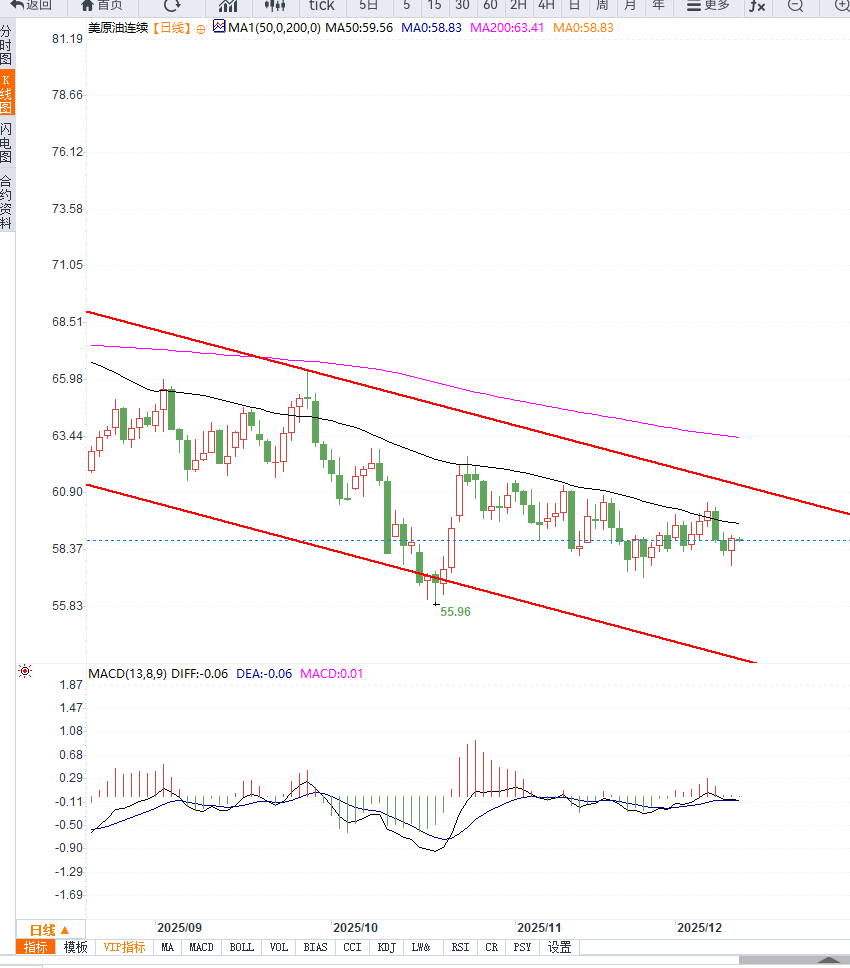
From a technical perspective, WTI prices continue to fluctuate narrowly between $58 and $60, with candlestick patterns indicating limited bullish momentum. Prices have repeatedly encountered resistance near $60, while $58 has formed temporary support, resulting in a weak sideways trading pattern in the short term.
The MACD indicator shows a shortening of the momentum bars, and the RSI is hovering in the neutral zone, indicating that market sentiment remains cautious. This means that in the absence of clear bullish drivers, oil prices are unlikely to break through the upper resistance zone in the short term, while supply-side pressures are expected to continue to dominate the medium-term direction.
Editor's Note:
The core issue affecting oil prices has shifted from geopolitical factors to a long-term structural oversupply. The EIA's explicit indication of continuously increasing inventories is a key indicator to watch in the coming quarters. If demand fails to recover significantly, oil prices may continue to experience fragile rebounds and volatile price fluctuations.
We need to pay more attention to inventory trends and changes in the strategies of major oil-producing countries, rather than focusing on short-term events.
Overall, oil prices have seen a moderate rebound but lack breakthrough momentum. From a fundamental perspective, the weekly report from the U.S. Energy Information Administration (EIA) showed that U.S. commercial crude oil inventories fell by only 1.8 million barrels, lower than the market consensus of 2.3 million barrels and also lower than the 4.8 million barrel decline previously reported by the American Petroleum Institute (API).
Weak inventory data has refocused the market on structural pressures from oversupply. While global risk factors are escalating, they are insufficient to offset the pressure from accumulating inventories. Recent attacks by Ukraine on Russian oil and gas infrastructure have triggered geopolitical tensions, which should theoretically provide upward momentum for the oil market.
However, this risk premium has been weakened as global fuel inventories continue to accumulate. The EIA's latest Short-Term Energy Outlook indicates that global supply growth is outpacing demand, and inventories are projected to continue accumulating at a rate of 2 million barrels per day until 2026, limiting future upside potential for oil prices.
"Crude oil prices remain near recent lows, and market concerns about oversupply in the coming months continue to intensify. U.S. crude oil production hit a record high this year, but may slow from 2026 onwards." — Saxo Bank
"While the API's reported decrease in crude oil inventories provided some support, the sharp increase in gasoline inventories weakened the overall bullish effect," Saxo Bank added.
Overall, the structural surplus in the global market has become a key variable suppressing oil prices, while weakening inventory data and supply and demand prospects make it difficult for oil prices to break out of the range in the short term.
From a technical perspective, WTI prices continue to fluctuate narrowly between $58 and $60, with candlestick patterns indicating limited bullish momentum. Prices have repeatedly encountered resistance near $60, while $58 has formed temporary support, resulting in a weak sideways trading pattern in the short term.
The MACD indicator shows a shortening of the momentum bars, and the RSI is hovering in the neutral zone, indicating that market sentiment remains cautious. This means that in the absence of clear bullish drivers, oil prices are unlikely to break through the upper resistance zone in the short term, while supply-side pressures are expected to continue to dominate the medium-term direction.
Editor's Note:
The core issue affecting oil prices has shifted from geopolitical factors to a long-term structural oversupply. The EIA's explicit indication of continuously increasing inventories is a key indicator to watch in the coming quarters. If demand fails to recover significantly, oil prices may continue to experience fragile rebounds and volatile price fluctuations.
We need to pay more attention to inventory trends and changes in the strategies of major oil-producing countries, rather than focusing on short-term events.
- Risk Warning and Disclaimer
- The market involves risk, and trading may not be suitable for all investors. This article is for reference only and does not constitute personal investment advice, nor does it take into account certain users’ specific investment objectives, financial situation, or other needs. Any investment decisions made based on this information are at your own risk.