Crude oil trading alert: Continued ample global supply is suppressing oil prices; be wary of a potential break below support levels.
2025-12-12 09:22:56
Despite heightened geopolitical tensions following the US seizure of a Venezuelan oil tanker, international oil prices failed to find support. WTI crude oil instead fell to a seven-week low of $57.93 per barrel, while Brent crude also retreated to $61.56.
The market's calm reaction to this event highlights that the dominant logic in the current oil market is not risk premium, but rather a long-term loose supply situation.
In recent months, oil prices have remained within a narrow range, despite potential supply risks such as Ukraine's attack on Russian energy infrastructure and the US actions against Venezuela.

This performance reflects a decline in investors' sensitivity to geopolitical events, as the factors driving oil price movements are gradually shifting from "short-term risks" to "medium- to long-term supply and demand structures."
PVM Oil Associates noted, "The U.S. seizure of the Venezuelan oil tanker should have spurred a strong rebound in oil prices, but the market's muted reaction suggests that the dominant narrative of oversupply remains unchanged."
Meanwhile, the International Energy Agency (IEA) further reinforced the market's perception of an ample supply environment in its latest monthly report. The report shows that global supply remained higher than demand in the past month, with overall supply growth significantly outpacing demand growth despite declines in production from Russia and Venezuela.
Global demand is projected to increase by only about 830,000 barrels per day in 2025 and only 860,000 barrels per day in 2026, while supply is projected to increase by 3 million barrels per day and 2.4 million barrels per day, respectively, creating a significant gap.
Global inventories continue to accumulate, averaging 1.2 million barrels per day in the first ten months, indicating that fundamental pressures on the oil market remain. Even if geopolitical factors occasionally boost market sentiment, such effects are usually unsustainable given the continued ample supply.
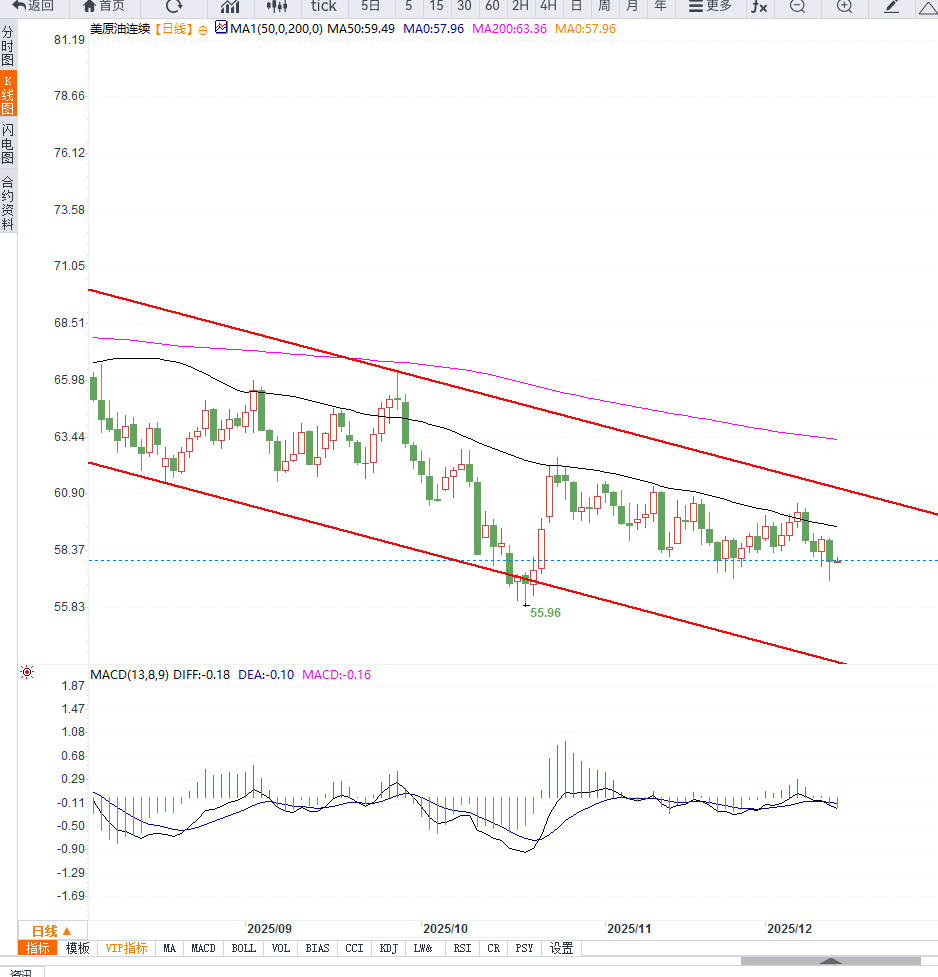
From a technical perspective, WTI crude oil prices also exhibit a weak trend. After several weeks of consolidation, oil prices finally broke below the lower end of the previously maintained $58 to $63 range, shifting the short-term trend from sideways to bearish.
On the daily chart, the price not only broke through key support levels, but short-term moving averages also formed a clear downward alignment, indicating that bearish forces are dominating the market. The recent continuous downward pressure on the price chart further confirms that the market has entered a new downward trend from its previous high-level consolidation phase.
The MACD indicator has fallen back below the zero line and shows signs of widening green bars, indicating that momentum is tilting towards the bears. The market is currently less receptive to rallies, and any move back to the $58.5 to $59.2 range is likely to encounter selling pressure.
From a support perspective, the $56.8 to $55.8 range forms the next key defense zone. If oil prices fail to stabilize in this area, then a deeper correction could be possible.
Overall, the current technical structure does not support a rapid reversal in oil prices, and weak fluctuations will be the main trend for some time to come.
Editor's Note:
From both fundamental and technical perspectives, the main contradiction facing the crude oil market is that supply continues to exceed demand, the inventory accumulation trend has not yet ended, and global demand growth remains weak. The recovery and increase in supply is far outpacing that of consumption, leaving the market lacking the impetus to drive oil prices higher.
In this context, while geopolitical events can stimulate price fluctuations in the short term, the sustainability of price increases is difficult to guarantee as long as inventory pressure remains unresolved.
Therefore, the rebound in oil prices will remain suppressed in the future, and the market is more likely to exhibit a pattern of repeated fluctuations and weak operation.
The future trend will depend on three key variables: first, whether major oil-producing countries will reassess their production policies and take further production cuts; second, whether global inventories will slow down or even reverse significantly in the coming quarters; and third, whether global economic growth can drive a recovery in energy demand.
If the above factors do not improve significantly, the upside potential for oil prices will be limited, and a continued weak and volatile trend is more reasonable.
The market's calm reaction to this event highlights that the dominant logic in the current oil market is not risk premium, but rather a long-term loose supply situation.
In recent months, oil prices have remained within a narrow range, despite potential supply risks such as Ukraine's attack on Russian energy infrastructure and the US actions against Venezuela.
This performance reflects a decline in investors' sensitivity to geopolitical events, as the factors driving oil price movements are gradually shifting from "short-term risks" to "medium- to long-term supply and demand structures."
PVM Oil Associates noted, "The U.S. seizure of the Venezuelan oil tanker should have spurred a strong rebound in oil prices, but the market's muted reaction suggests that the dominant narrative of oversupply remains unchanged."
Meanwhile, the International Energy Agency (IEA) further reinforced the market's perception of an ample supply environment in its latest monthly report. The report shows that global supply remained higher than demand in the past month, with overall supply growth significantly outpacing demand growth despite declines in production from Russia and Venezuela.
Global demand is projected to increase by only about 830,000 barrels per day in 2025 and only 860,000 barrels per day in 2026, while supply is projected to increase by 3 million barrels per day and 2.4 million barrels per day, respectively, creating a significant gap.
Global inventories continue to accumulate, averaging 1.2 million barrels per day in the first ten months, indicating that fundamental pressures on the oil market remain. Even if geopolitical factors occasionally boost market sentiment, such effects are usually unsustainable given the continued ample supply.
From a technical perspective, WTI crude oil prices also exhibit a weak trend. After several weeks of consolidation, oil prices finally broke below the lower end of the previously maintained $58 to $63 range, shifting the short-term trend from sideways to bearish.
On the daily chart, the price not only broke through key support levels, but short-term moving averages also formed a clear downward alignment, indicating that bearish forces are dominating the market. The recent continuous downward pressure on the price chart further confirms that the market has entered a new downward trend from its previous high-level consolidation phase.
The MACD indicator has fallen back below the zero line and shows signs of widening green bars, indicating that momentum is tilting towards the bears. The market is currently less receptive to rallies, and any move back to the $58.5 to $59.2 range is likely to encounter selling pressure.
From a support perspective, the $56.8 to $55.8 range forms the next key defense zone. If oil prices fail to stabilize in this area, then a deeper correction could be possible.
Overall, the current technical structure does not support a rapid reversal in oil prices, and weak fluctuations will be the main trend for some time to come.
Editor's Note:
From both fundamental and technical perspectives, the main contradiction facing the crude oil market is that supply continues to exceed demand, the inventory accumulation trend has not yet ended, and global demand growth remains weak. The recovery and increase in supply is far outpacing that of consumption, leaving the market lacking the impetus to drive oil prices higher.
In this context, while geopolitical events can stimulate price fluctuations in the short term, the sustainability of price increases is difficult to guarantee as long as inventory pressure remains unresolved.
Therefore, the rebound in oil prices will remain suppressed in the future, and the market is more likely to exhibit a pattern of repeated fluctuations and weak operation.
The future trend will depend on three key variables: first, whether major oil-producing countries will reassess their production policies and take further production cuts; second, whether global inventories will slow down or even reverse significantly in the coming quarters; and third, whether global economic growth can drive a recovery in energy demand.
If the above factors do not improve significantly, the upside potential for oil prices will be limited, and a continued weak and volatile trend is more reasonable.
- Risk Warning and Disclaimer
- The market involves risk, and trading may not be suitable for all investors. This article is for reference only and does not constitute personal investment advice, nor does it take into account certain users’ specific investment objectives, financial situation, or other needs. Any investment decisions made based on this information are at your own risk.