Historic moment: Gold breaks through a near two-month high, with the next target at $4,500?
2025-12-12 15:12:28
Friday, December 12th. Overnight, the market continued the trading theme driven by easing expectations following the Fed's policy decision. The dollar index rebounded slightly after hitting a seven-week low of 98.13 on Thursday, but its overall weakness remained unchanged. Spot gold prices were under slight pressure, but lacked sustained selling momentum, trading around $4280 in pre-European trading, maintaining a range-bound movement within the highs since October 21st.
The most important event this week was undoubtedly the Federal Reserve's interest rate decision and its subsequent guidance. On Wednesday, the Fed announced a 25 basis point rate cut, lowering the target range for the federal funds rate to 3.50% to 3.75%, a move in line with market expectations. However, market focus quickly shifted to the policy statement and Chairman Powell's press conference. The dot plot showed that policymakers expect the federal funds rate to fall to 3.4% by the end of 2026, implying only one rate cut opportunity next year. Nevertheless, Powell emphasized at the press conference that the US labor market faces significant downside risks, and the Fed does not want its policies to stifle job creation. This wording was interpreted by the market as a dovish signal, leading some traders to bet on two rate cuts next year, rather than the single cut suggested by the dot plot.
This subtle divergence in policy expectations has provided significant support for the gold market. As a non-interest-bearing asset, the cost of holding gold is inversely related to interest rate levels. When the market expects interest rates to level off or even decline, gold's relative attractiveness increases. The Federal Reserve's continued easing cycle with inflation pressures still above its 2% target, ruling out a pause in rate cuts, has put pressure on the dollar and provided upward momentum for gold prices. The dollar index fell to a more than two-month low on Thursday, reflecting the market's repricing of the Fed's policy path. Although the dollar attempted to stabilize during Friday's Asian session, the overall trend remained weak, creating a favorable exchange rate environment for dollar-denominated gold.
Besides monetary policy factors, geopolitical risk premiums are also a significant variable supporting gold prices. The Russia-Ukraine peace talks remain deadlocked, with sharp disagreements between the two sides over territorial issues. Ukrainian President Zelenskyy stated that pressure from the US is demanding concessions on the territorial issue, while a US spokesperson revealed that high-level officials are dissatisfied with both Russia and Ukraine and hope to see substantial progress as soon as possible, rather than endless negotiations. This high degree of geopolitical uncertainty maintains safe-haven demand in the market, providing a floor for gold prices.
Spot gold has recently exhibited a clear bullish trend. On Thursday, prices broke out of the consolidation range of the past two weeks, reaching their highest level since October 21st. This technical breakout is significant, indicating that bullish momentum has been confirmed at a key resistance level. From a chart analysis perspective, gold prices have risen more than 10% since the low of $3886.51 and are currently trading steadily above the $4200 level. The MACD indicator shows a DIFF value of 52.79 and a DEA value of 47.74, with the histogram remaining positive, indicating that short-term momentum remains biased towards the bulls. The RSI indicator is at 67.65, approaching but not yet entering the traditionally overbought zone, suggesting that the upward trend may continue.
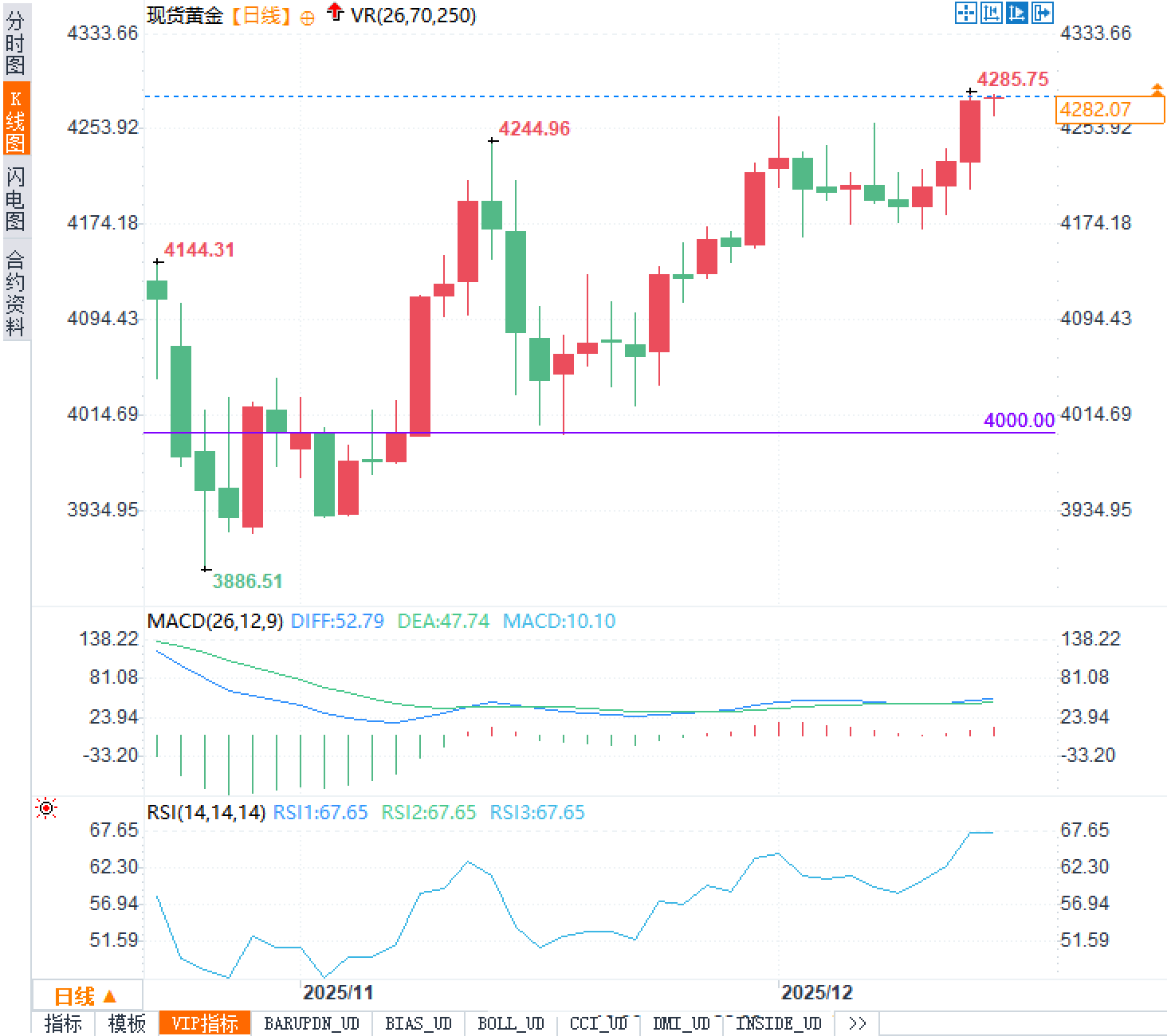
From a price structure perspective, $4285.75 constitutes short-term resistance. If it can be effectively broken and held, the gold price may challenge the $4300 mark. The support below is located at $4244.96, which is the upper edge of the recent consolidation range and has now become support after being broken.
From a market logic and forward-looking perspective, the core drivers of the current gold market can be summarized into three levels. First, there's the expectation gap in monetary policy. While the Federal Reserve has signaled a cautious pace of interest rate cuts, market pricing has been relatively more aggressive. This expectation gap will continue to dominate the dollar's performance in the short term, thus affecting gold prices. Second, there's the geopolitical risk premium. Uncertainty surrounding the Russia-Ukraine conflict and the evolution of the global trade landscape could both act as catalysts for safe-haven demand. Third, there's inflation stickiness and changes in real interest rates. Although nominal interest rates have begun to decline, the pace and magnitude of the inflation decline will determine the ultimate direction of real interest rates, which is crucial for the medium- to long-term valuation of gold.
Next week's US non-farm payroll data will also be a key market driver. Powell's emphasis on labor market risks means that marginal changes in employment data could significantly impact policy expectations. If the employment data is unexpectedly weak, market bets on interest rate cuts may intensify, which would benefit gold; conversely, if employment remains resilient, the dollar may get a breather, and gold prices will face some downward pressure.
From a longer-term perspective, gold's dual attributes as an inflation hedge and a safe-haven asset give it unique investment value in the current complex macroeconomic environment. Global central bank gold purchases remain active, and the increase in gold reserves reflects a reassessment of long-term confidence in the fiat currency system. This structural demand shift provides solid support for gold prices and is a key reason why the market remains optimistic in the face of short-term volatility.
In summary, spot gold continued its strong performance amid a combination of the Federal Reserve's dovish stance and geopolitical risks, reaching a near two-month high before consolidating at high levels. Technical breakout signals are clear, and the bullish trend remains intact, but short-term pressure comes from rising risk appetite in the stock market. The market is currently in a window of opportunity, where policy expectations and data verification are intertwined; future price movements will depend on statements from Federal Reserve officials and the performance of key economic data.
The most important event this week was undoubtedly the Federal Reserve's interest rate decision and its subsequent guidance. On Wednesday, the Fed announced a 25 basis point rate cut, lowering the target range for the federal funds rate to 3.50% to 3.75%, a move in line with market expectations. However, market focus quickly shifted to the policy statement and Chairman Powell's press conference. The dot plot showed that policymakers expect the federal funds rate to fall to 3.4% by the end of 2026, implying only one rate cut opportunity next year. Nevertheless, Powell emphasized at the press conference that the US labor market faces significant downside risks, and the Fed does not want its policies to stifle job creation. This wording was interpreted by the market as a dovish signal, leading some traders to bet on two rate cuts next year, rather than the single cut suggested by the dot plot.
This subtle divergence in policy expectations has provided significant support for the gold market. As a non-interest-bearing asset, the cost of holding gold is inversely related to interest rate levels. When the market expects interest rates to level off or even decline, gold's relative attractiveness increases. The Federal Reserve's continued easing cycle with inflation pressures still above its 2% target, ruling out a pause in rate cuts, has put pressure on the dollar and provided upward momentum for gold prices. The dollar index fell to a more than two-month low on Thursday, reflecting the market's repricing of the Fed's policy path. Although the dollar attempted to stabilize during Friday's Asian session, the overall trend remained weak, creating a favorable exchange rate environment for dollar-denominated gold.
Besides monetary policy factors, geopolitical risk premiums are also a significant variable supporting gold prices. The Russia-Ukraine peace talks remain deadlocked, with sharp disagreements between the two sides over territorial issues. Ukrainian President Zelenskyy stated that pressure from the US is demanding concessions on the territorial issue, while a US spokesperson revealed that high-level officials are dissatisfied with both Russia and Ukraine and hope to see substantial progress as soon as possible, rather than endless negotiations. This high degree of geopolitical uncertainty maintains safe-haven demand in the market, providing a floor for gold prices.
Market performance
Spot gold has recently exhibited a clear bullish trend. On Thursday, prices broke out of the consolidation range of the past two weeks, reaching their highest level since October 21st. This technical breakout is significant, indicating that bullish momentum has been confirmed at a key resistance level. From a chart analysis perspective, gold prices have risen more than 10% since the low of $3886.51 and are currently trading steadily above the $4200 level. The MACD indicator shows a DIFF value of 52.79 and a DEA value of 47.74, with the histogram remaining positive, indicating that short-term momentum remains biased towards the bulls. The RSI indicator is at 67.65, approaching but not yet entering the traditionally overbought zone, suggesting that the upward trend may continue.
From a price structure perspective, $4285.75 constitutes short-term resistance. If it can be effectively broken and held, the gold price may challenge the $4300 mark. The support below is located at $4244.96, which is the upper edge of the recent consolidation range and has now become support after being broken.
From a market logic and forward-looking perspective, the core drivers of the current gold market can be summarized into three levels. First, there's the expectation gap in monetary policy. While the Federal Reserve has signaled a cautious pace of interest rate cuts, market pricing has been relatively more aggressive. This expectation gap will continue to dominate the dollar's performance in the short term, thus affecting gold prices. Second, there's the geopolitical risk premium. Uncertainty surrounding the Russia-Ukraine conflict and the evolution of the global trade landscape could both act as catalysts for safe-haven demand. Third, there's inflation stickiness and changes in real interest rates. Although nominal interest rates have begun to decline, the pace and magnitude of the inflation decline will determine the ultimate direction of real interest rates, which is crucial for the medium- to long-term valuation of gold.
Looking ahead
Next week's US non-farm payroll data will also be a key market driver. Powell's emphasis on labor market risks means that marginal changes in employment data could significantly impact policy expectations. If the employment data is unexpectedly weak, market bets on interest rate cuts may intensify, which would benefit gold; conversely, if employment remains resilient, the dollar may get a breather, and gold prices will face some downward pressure.
From a longer-term perspective, gold's dual attributes as an inflation hedge and a safe-haven asset give it unique investment value in the current complex macroeconomic environment. Global central bank gold purchases remain active, and the increase in gold reserves reflects a reassessment of long-term confidence in the fiat currency system. This structural demand shift provides solid support for gold prices and is a key reason why the market remains optimistic in the face of short-term volatility.
In summary, spot gold continued its strong performance amid a combination of the Federal Reserve's dovish stance and geopolitical risks, reaching a near two-month high before consolidating at high levels. Technical breakout signals are clear, and the bullish trend remains intact, but short-term pressure comes from rising risk appetite in the stock market. The market is currently in a window of opportunity, where policy expectations and data verification are intertwined; future price movements will depend on statements from Federal Reserve officials and the performance of key economic data.
- Risk Warning and Disclaimer
- The market involves risk, and trading may not be suitable for all investors. This article is for reference only and does not constitute personal investment advice, nor does it take into account certain users’ specific investment objectives, financial situation, or other needs. Any investment decisions made based on this information are at your own risk.