The euro has been quietly rising for two months, and looking back: wow, it's almost breaking 1.18?
2025-12-12 19:59:35
Friday, December 12th. Following this week's major event—the Federal Reserve's interest rate meeting—the global foreign exchange market is digesting policy signals. The euro retreated slightly against the dollar after hitting a two-month high of 1.1762 on Thursday, trading around 1.1725 during the European session. The dollar index remained under pressure, hovering near a two-month low above 98.00, reflecting the ongoing repricing of the Fed's policy path by the market.
The Federal Reserve completed its rate cut this week and hinted at a possible further cut in 2026. However, there is a significant divergence between market expectations and official guidance. Traders generally believe the Fed will cut rates at least twice more, an expectation partly stemming from considerations of a potential leadership change in monetary policy. The market is watching closely as White House economic advisor Kevin Hassett is expected to succeed current Chairman Powell, and Hassett has repeatedly expressed a preference for lower borrowing costs. This potential personnel change is being priced into the market in advance.
Meanwhile, noteworthy changes have emerged in the US labor market. Initial jobless claims data released Thursday showed that the number of people filing for unemployment benefits for the first time in the first week of December increased by 44,000 to 236,000, marking the largest weekly increase in more than four years. This data reinforced market expectations that the Federal Reserve will be forced to further cut interest rates to support the job market. The marginal weakening of the labor market has put additional downward pressure on the dollar.
In Europe, the evolution of monetary policy is equally complex. The European Central Bank (ECB) previously predicted that consumer prices would slow to 1.7% in 2026 and return to the 2% target level in 2027. However, the euro's cumulative appreciation against the US dollar of over 13% since the beginning of 2025 is posing a potential threat to this inflationary path. According to estimates by ECB Chief Economist Philip Lane, a 10% appreciation of the euro is expected to lower the consumer price index over the next three years, with the most significant impact in the first year, amounting to approximately -0.6 percentage points.
Policy disagreements are emerging within the European Central Bank's (ECB) Governing Council. French central bank governor François Villeroy de Gallo indicated that further interest rate cuts are not ruled out, a dovish stance. Meanwhile, German council member Isabelle Schnabel expressed satisfaction with the futures market's expectation that the ECB will tighten rather than loosen monetary policy next. This internal divergence reflects the ECB's complex situation in balancing currency appreciation and its inflation target; the ECB's next policy meeting is scheduled for December 18th.
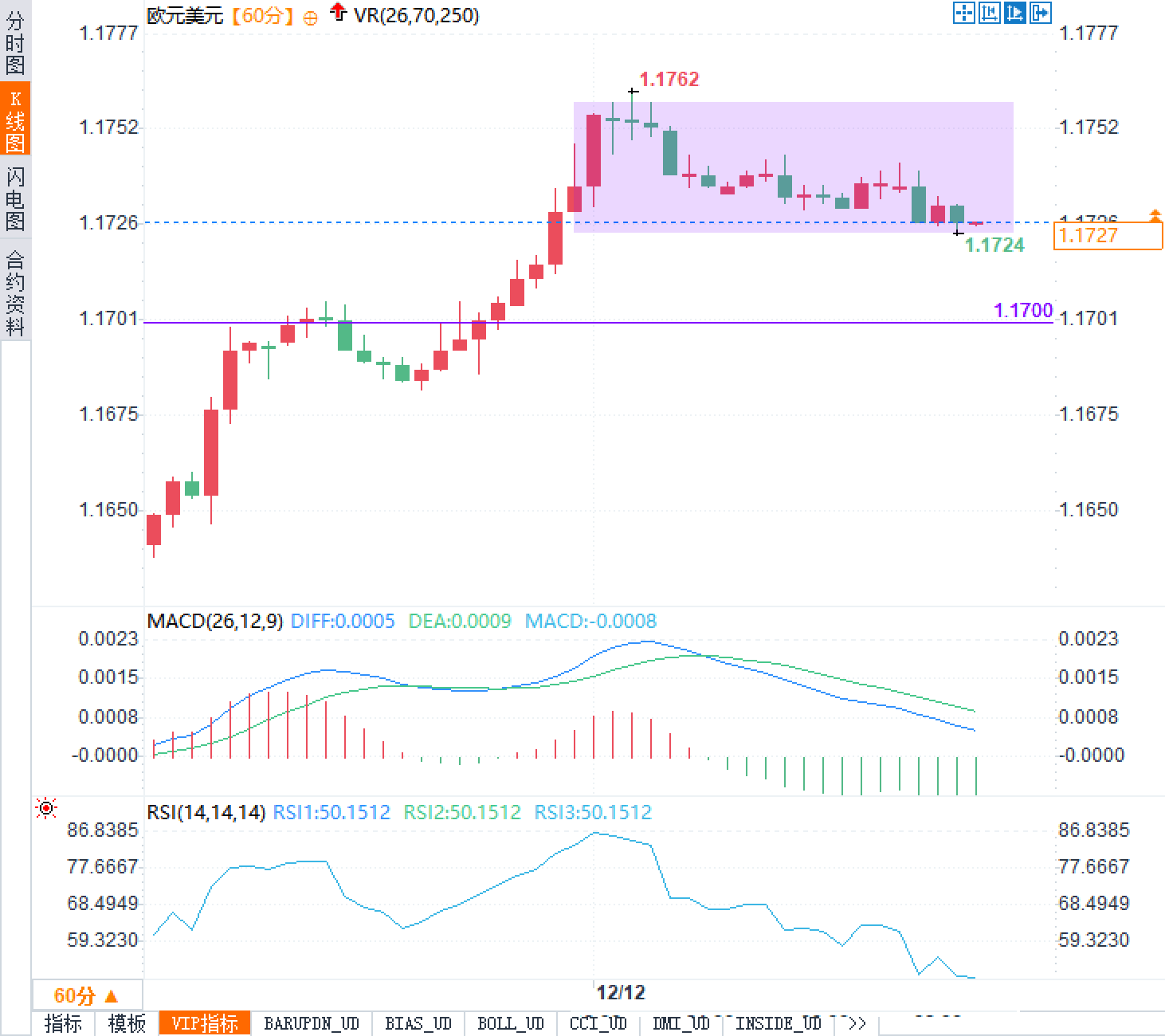
The euro has risen nearly 2% against the dollar over the past three weeks, exhibiting an overall upward trend with fluctuations. On Friday, the exchange rate consolidated narrowly around 1.1730, retreating slightly from the previous trading day's high of 1.1762, indicating a weakening of short-term bullish momentum. From a technical perspective, the exchange rate found effective support after breaking through the key resistance level of 1.1700 and is currently consolidating within the 1.1724-1.1750 range.
Germany's Harmonized Index of Consumer Prices (HICP) released on Friday showed that the year-on-year growth rate accelerated to 2.6% in November from 2.3% in the previous month, but fell by 0.5% month-on-month. Since the data was largely consistent with the preliminary estimate, its immediate impact on the euro was limited. However, the rebound in inflation in core eurozone countries has somewhat reduced the urgency for the European Central Bank to cut interest rates significantly, providing medium-term support for the euro.
In terms of market liquidity, trading sentiment has become more cautious as the year draws to a close. From a trader psychology perspective, bulls opted to take some profits after encountering resistance at 1.1762, while bearish forces were also relatively weak, failing to push the exchange rate below the 1.1700 support level. Structurally, the euro/dollar exchange rate is currently in an upward cycle driven by policy divergence. The widening difference in monetary policy between the Federal Reserve and the European Central Bank is the core logic supporting the exchange rate.
Traders are watching several key variables. First and foremost are the speeches by Federal Reserve officials. Philadelphia Fed President Anna Paulson, Cleveland Fed President Beth Hammark, Chicago Fed President Austan Goolsby, and Kansas City Fed President Jeff Schmid will all deliver public comments during the US trading session, which could provide the market with further clues about the Fed's policy path.
Secondly, there's the upcoming US employment data. The October and November non-farm payroll reports will be released before the European Central Bank's December meeting, and this data is crucial for assessing the resilience of the US economy and the direction of the Federal Reserve's policy. Strong employment data could alleviate downward pressure on the dollar to some extent; conversely, weak data would further solidify market expectations for accelerated interest rate cuts by the Federal Reserve.
Thirdly, the evolving statements from ECB officials are crucial. Given the potential impact of a stronger euro on the inflation target, subsequent remarks from ECB Governing Council members warrant close monitoring. Subtle shifts in policy signals could trigger a reassessment of the ECB's stance by the market.
From a market perspective, the current upward trend of the euro against the US dollar is supported by relatively solid fundamentals, but it also faces technical adjustment pressure and event-driven uncertainties in the short term. Within the 1.1700 to 1.1762 range, bulls and bears may engage in a tug-of-war, awaiting new catalysts to break the balance.
In summary, the euro is currently in an upward cycle against the dollar, driven by divergent monetary policies. The Federal Reserve's dovish shift and the marginal weakening of the US labor market have diminished the dollar's appeal; while policy disagreements within the European Central Bank have provided some support for the euro, but also sown the seeds of uncertainty.
The Federal Reserve completed its rate cut this week and hinted at a possible further cut in 2026. However, there is a significant divergence between market expectations and official guidance. Traders generally believe the Fed will cut rates at least twice more, an expectation partly stemming from considerations of a potential leadership change in monetary policy. The market is watching closely as White House economic advisor Kevin Hassett is expected to succeed current Chairman Powell, and Hassett has repeatedly expressed a preference for lower borrowing costs. This potential personnel change is being priced into the market in advance.
Meanwhile, noteworthy changes have emerged in the US labor market. Initial jobless claims data released Thursday showed that the number of people filing for unemployment benefits for the first time in the first week of December increased by 44,000 to 236,000, marking the largest weekly increase in more than four years. This data reinforced market expectations that the Federal Reserve will be forced to further cut interest rates to support the job market. The marginal weakening of the labor market has put additional downward pressure on the dollar.
In Europe, the evolution of monetary policy is equally complex. The European Central Bank (ECB) previously predicted that consumer prices would slow to 1.7% in 2026 and return to the 2% target level in 2027. However, the euro's cumulative appreciation against the US dollar of over 13% since the beginning of 2025 is posing a potential threat to this inflationary path. According to estimates by ECB Chief Economist Philip Lane, a 10% appreciation of the euro is expected to lower the consumer price index over the next three years, with the most significant impact in the first year, amounting to approximately -0.6 percentage points.
Policy disagreements are emerging within the European Central Bank's (ECB) Governing Council. French central bank governor François Villeroy de Gallo indicated that further interest rate cuts are not ruled out, a dovish stance. Meanwhile, German council member Isabelle Schnabel expressed satisfaction with the futures market's expectation that the ECB will tighten rather than loosen monetary policy next. This internal divergence reflects the ECB's complex situation in balancing currency appreciation and its inflation target; the ECB's next policy meeting is scheduled for December 18th.
Market performance
The euro has risen nearly 2% against the dollar over the past three weeks, exhibiting an overall upward trend with fluctuations. On Friday, the exchange rate consolidated narrowly around 1.1730, retreating slightly from the previous trading day's high of 1.1762, indicating a weakening of short-term bullish momentum. From a technical perspective, the exchange rate found effective support after breaking through the key resistance level of 1.1700 and is currently consolidating within the 1.1724-1.1750 range.
Germany's Harmonized Index of Consumer Prices (HICP) released on Friday showed that the year-on-year growth rate accelerated to 2.6% in November from 2.3% in the previous month, but fell by 0.5% month-on-month. Since the data was largely consistent with the preliminary estimate, its immediate impact on the euro was limited. However, the rebound in inflation in core eurozone countries has somewhat reduced the urgency for the European Central Bank to cut interest rates significantly, providing medium-term support for the euro.
In terms of market liquidity, trading sentiment has become more cautious as the year draws to a close. From a trader psychology perspective, bulls opted to take some profits after encountering resistance at 1.1762, while bearish forces were also relatively weak, failing to push the exchange rate below the 1.1700 support level. Structurally, the euro/dollar exchange rate is currently in an upward cycle driven by policy divergence. The widening difference in monetary policy between the Federal Reserve and the European Central Bank is the core logic supporting the exchange rate.
Looking ahead
Traders are watching several key variables. First and foremost are the speeches by Federal Reserve officials. Philadelphia Fed President Anna Paulson, Cleveland Fed President Beth Hammark, Chicago Fed President Austan Goolsby, and Kansas City Fed President Jeff Schmid will all deliver public comments during the US trading session, which could provide the market with further clues about the Fed's policy path.
Secondly, there's the upcoming US employment data. The October and November non-farm payroll reports will be released before the European Central Bank's December meeting, and this data is crucial for assessing the resilience of the US economy and the direction of the Federal Reserve's policy. Strong employment data could alleviate downward pressure on the dollar to some extent; conversely, weak data would further solidify market expectations for accelerated interest rate cuts by the Federal Reserve.
Thirdly, the evolving statements from ECB officials are crucial. Given the potential impact of a stronger euro on the inflation target, subsequent remarks from ECB Governing Council members warrant close monitoring. Subtle shifts in policy signals could trigger a reassessment of the ECB's stance by the market.
From a market perspective, the current upward trend of the euro against the US dollar is supported by relatively solid fundamentals, but it also faces technical adjustment pressure and event-driven uncertainties in the short term. Within the 1.1700 to 1.1762 range, bulls and bears may engage in a tug-of-war, awaiting new catalysts to break the balance.
In summary, the euro is currently in an upward cycle against the dollar, driven by divergent monetary policies. The Federal Reserve's dovish shift and the marginal weakening of the US labor market have diminished the dollar's appeal; while policy disagreements within the European Central Bank have provided some support for the euro, but also sown the seeds of uncertainty.
- Risk Warning and Disclaimer
- The market involves risk, and trading may not be suitable for all investors. This article is for reference only and does not constitute personal investment advice, nor does it take into account certain users’ specific investment objectives, financial situation, or other needs. Any investment decisions made based on this information are at your own risk.