At the moment of whale fall, the US dollar is trapped in a death spiral of devaluation hedging.
2025-12-12 20:55:34
While the Trump administration's new tariff policy for 2025 followed protectionist logic, it unexpectedly triggered a significant 7% depreciation of the US dollar, directly undermining the credibility of US fiscal policy and creating demand for domestic companies to sell US dollars to hedge against exchange rate risks. Subsequently, the Bank of Japan's decision to raise interest rates caused Japanese government bond yields to soar, which in turn boosted investors' demand to borrow cheap yen for hedging, leading to a further depreciation of the US dollar.
For foreign investors outside the United States, the simplest way to lock in the returns on their dollar investments and avoid exchange rate risk is to have a bank sell dollars now and hold a corresponding forward contract in another country's currency, agreeing that in the future, when the foreign investor finishes their investment, they will exchange the dollars held by the future investor for the corresponding foreign currency held by the bank now. Similarly, if domestic producers want to lock in the future purchasing power of dollars, they also need to have a bank sell dollars now to obtain foreign exchange, and then the producers can use the future dollars to buy foreign exchange locked in at the current exchange rate.

The daily size of the foreign exchange hedging market has surged to $9.5 trillion, with 91% of North American companies having initiated foreign exchange hedging operations, effectively covering 57% of their risk exposure through forward/option instruments.
Amid continued uncertainty surrounding US policies, the euro and yen strengthened in tandem, prompting investors to accelerate portfolio adjustments, shifting towards emerging market stocks (the MSCI Emerging Markets Index has risen by 22% cumulatively) and non-dollar assets in search of both safe-haven and value-added returns.
As the volatility index (VIX) soars, the traditional "safe-haven" attribute of the US dollar has completely collapsed, the trend of de-dollarization is accelerating, and the global capital flow pattern is facing structural reshaping.
In 2025, the dollar's status as the world's core reserve currency and a traditional safe-haven asset will face severe challenges due to the dual impact of a radical shift in trade policies and the abnormal depreciation of the dollar under high tariffs.
President Trump announced a base tariff of 10% on all imported goods and a retaliatory tariff of up to 24% on Japanese goods.
Research data shows that this move triggered a 7% depreciation of the US dollar starting in December 2024, a 0.5% drop compared to the same period last year.
This depreciation trend defies traditional economic theory—according to classic logic, protectionist measures should have strengthened the dollar, but the actual performance reflects multiple downward pressures: the escalating retaliatory measures from trading partners, coupled with the gradual erosion of public trust in the US fiscal policy. Data provides clear evidence for this.
Faced with the sharp rise in the volatility of the US dollar, market participants' foreign exchange hedging strategies have undergone a substantial shift. In April 2025, the average daily turnover of the global foreign exchange market surged to $9.5 trillion, as companies and investors increased their hedging operations to mitigate the exposure risks brought about by the weakening dollar.
Forward and option instruments have become the preferred choice in the market, with the penetration rate of foreign exchange hedging among North American enterprises jumping from 82% in 2024 to 91% in 2025. As a core indicator for measuring the degree of risk coverage, the hedging ratio in the US and UK markets has climbed to 57%, a figure that clearly reflects that, under long-term policy uncertainty, the market tends to lock in exchange rate costs through defensive strategies.
The hedging period has been significantly extended, with some contracts having a maximum term of five years, highlighting the market's consensus expectation of prolonged dollar volatility. Market analysis indicates that the activity of forward initiation swaps and fixed-rate collection swaps continues to increase, with companies using these tools to hedge against interest rate volatility risks caused by tariff policies.
Meanwhile, foreign exchange options are favored for their flexibility and adaptability. Analysts point out that these tools allow companies to cope with unpredictable exchange rate fluctuations without having to assume rigid performance obligations, and their operational flexibility is significantly better than other tools.
The sharp fluctuations and trend of depreciation of the US dollar in 2025 will lead to a surge in the trading volume of hedging instruments such as futures and options, which may cause the US dollar index to overshoot in the short term.
In the short term, the US dollar index may fall into a vicious cycle of depreciation expectations → hedging demand → selling dollars → continued dollar depreciation → increased hedging demand → selling more dollars → further dollar depreciation. Although this spiral cycle may exist in the short term, it is difficult to sustain in the long term and requires comprehensive judgment based on policy intervention and market structure.
The recent sharp fluctuations in the US dollar index have triggered trading opportunities in many commodities, and the overshooting of the dollar's depreciation also means that a rebound could occur at any time.
For most investors, the core signal is clear: the era of dollar exceptionalism is gradually coming to an end. In this new market landscape, the ability to flexibly adapt to changing strategies will directly determine the ultimate success or failure of investment transactions.
The US dollar index rebounded after reaching the 98.13 level, which met the expected range for the decline. However, given the overall bearish alignment of the moving averages, the downward trend of the US dollar index may be difficult to reverse in the short term.
The rebound resistance level is around 98.60, with the next resistance level at 98.87, and the support level at 98.13.
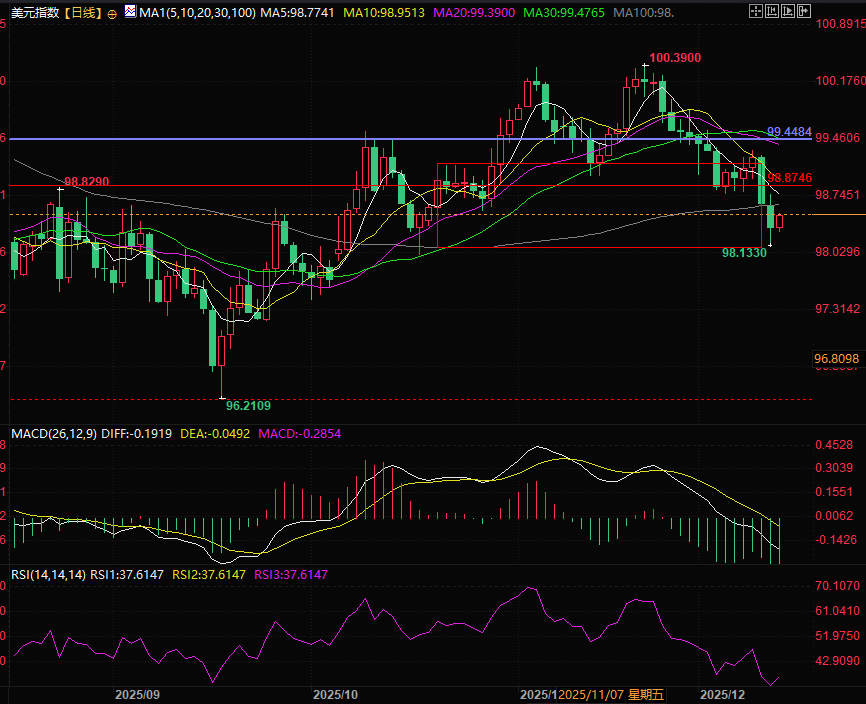
(US Dollar Index Daily Chart, Source: FX678)
At 20:53 Beijing time, the US dollar index is currently at 98.50.
For foreign investors outside the United States, the simplest way to lock in the returns on their dollar investments and avoid exchange rate risk is to have a bank sell dollars now and hold a corresponding forward contract in another country's currency, agreeing that in the future, when the foreign investor finishes their investment, they will exchange the dollars held by the future investor for the corresponding foreign currency held by the bank now. Similarly, if domestic producers want to lock in the future purchasing power of dollars, they also need to have a bank sell dollars now to obtain foreign exchange, and then the producers can use the future dollars to buy foreign exchange locked in at the current exchange rate.
The daily size of the foreign exchange hedging market has surged to $9.5 trillion, with 91% of North American companies having initiated foreign exchange hedging operations, effectively covering 57% of their risk exposure through forward/option instruments.
Amid continued uncertainty surrounding US policies, the euro and yen strengthened in tandem, prompting investors to accelerate portfolio adjustments, shifting towards emerging market stocks (the MSCI Emerging Markets Index has risen by 22% cumulatively) and non-dollar assets in search of both safe-haven and value-added returns.
As the volatility index (VIX) soars, the traditional "safe-haven" attribute of the US dollar has completely collapsed, the trend of de-dollarization is accelerating, and the global capital flow pattern is facing structural reshaping.
Policy shocks: The underlying logic of the abnormal depreciation of the US dollar
In 2025, the dollar's status as the world's core reserve currency and a traditional safe-haven asset will face severe challenges due to the dual impact of a radical shift in trade policies and the abnormal depreciation of the dollar under high tariffs.
President Trump announced a base tariff of 10% on all imported goods and a retaliatory tariff of up to 24% on Japanese goods.
Research data shows that this move triggered a 7% depreciation of the US dollar starting in December 2024, a 0.5% drop compared to the same period last year.
This depreciation trend defies traditional economic theory—according to classic logic, protectionist measures should have strengthened the dollar, but the actual performance reflects multiple downward pressures: the escalating retaliatory measures from trading partners, coupled with the gradual erosion of public trust in the US fiscal policy. Data provides clear evidence for this.
Hedging Boom: Tool Iteration and Strategy Transformation
Faced with the sharp rise in the volatility of the US dollar, market participants' foreign exchange hedging strategies have undergone a substantial shift. In April 2025, the average daily turnover of the global foreign exchange market surged to $9.5 trillion, as companies and investors increased their hedging operations to mitigate the exposure risks brought about by the weakening dollar.
Forward and option instruments have become the preferred choice in the market, with the penetration rate of foreign exchange hedging among North American enterprises jumping from 82% in 2024 to 91% in 2025. As a core indicator for measuring the degree of risk coverage, the hedging ratio in the US and UK markets has climbed to 57%, a figure that clearly reflects that, under long-term policy uncertainty, the market tends to lock in exchange rate costs through defensive strategies.
The hedging period has been significantly extended, with some contracts having a maximum term of five years, highlighting the market's consensus expectation of prolonged dollar volatility. Market analysis indicates that the activity of forward initiation swaps and fixed-rate collection swaps continues to increase, with companies using these tools to hedge against interest rate volatility risks caused by tariff policies.
Meanwhile, foreign exchange options are favored for their flexibility and adaptability. Analysts point out that these tools allow companies to cope with unpredictable exchange rate fluctuations without having to assume rigid performance obligations, and their operational flexibility is significantly better than other tools.
Summary and Technical Analysis:
The sharp fluctuations and trend of depreciation of the US dollar in 2025 will lead to a surge in the trading volume of hedging instruments such as futures and options, which may cause the US dollar index to overshoot in the short term.
In the short term, the US dollar index may fall into a vicious cycle of depreciation expectations → hedging demand → selling dollars → continued dollar depreciation → increased hedging demand → selling more dollars → further dollar depreciation. Although this spiral cycle may exist in the short term, it is difficult to sustain in the long term and requires comprehensive judgment based on policy intervention and market structure.
The recent sharp fluctuations in the US dollar index have triggered trading opportunities in many commodities, and the overshooting of the dollar's depreciation also means that a rebound could occur at any time.
For most investors, the core signal is clear: the era of dollar exceptionalism is gradually coming to an end. In this new market landscape, the ability to flexibly adapt to changing strategies will directly determine the ultimate success or failure of investment transactions.
The US dollar index rebounded after reaching the 98.13 level, which met the expected range for the decline. However, given the overall bearish alignment of the moving averages, the downward trend of the US dollar index may be difficult to reverse in the short term.
The rebound resistance level is around 98.60, with the next resistance level at 98.87, and the support level at 98.13.
(US Dollar Index Daily Chart, Source: FX678)
At 20:53 Beijing time, the US dollar index is currently at 98.50.
- Risk Warning and Disclaimer
- The market involves risk, and trading may not be suitable for all investors. This article is for reference only and does not constitute personal investment advice, nor does it take into account certain users’ specific investment objectives, financial situation, or other needs. Any investment decisions made based on this information are at your own risk.