Fed officials clash over rate cut; what's next for the dollar?
2025-12-12 21:49:52
Friday, December 12th. The market is currently in a period of observation following the Federal Reserve's latest monetary policy decision. At the recent Federal Open Market Committee meeting, the Fed voted 9-3 to cut the federal funds rate by 25 basis points. While this action was in line with most traders' expectations, significant internal disagreements have prompted deeper interpretations. The US dollar index traded around 98.40 during the North American session, fluctuating in a relatively low range compared to the past three months, reflecting a market reassessment of the path of US monetary policy.
While the interest rate cut cycle has been confirmed to have begun, the pace of its subsequent decline remains highly uncertain. Against this backdrop, recent divergent statements from Federal Reserve officials, particularly the starkly contrasting stances of Chicago Fed President Goolsby and Philadelphia Fed President Paulson, further highlight the policymakers' divided assessment of the balance between inflation and employment. This ambiguity in the policy outlook is becoming a key variable influencing the dollar's trajectory.
The US economy presents a complex picture: robust growth, a moderate slowdown in the labor market, and persistently sticky inflation. On the one hand, multiple indicators show that overall economic activity has not shown significant signs of slowing down, corporate profits remain resilient, and consumer spending has not shrunk significantly, providing some support for maintaining relatively high interest rates. On the other hand, core inflation has hovered above the target for several months and has failed to decline effectively for four and a half years, with businesses and residents generally still prioritizing price pressures.
In this context, Goolsby explicitly expressed concern about "premature" rate cuts, arguing that easing policy too early without sufficient data could reignite inflation expectations and increase the difficulty of controlling inflation later. He advocated for patience, waiting until at least early 2026 to assess whether further action was needed. This view reflects a typical hawkish stance, emphasizing price stability over the risk management logic of excessive employment decline. In contrast, Paulson focused more on marginal changes in the labor market, describing the current employment situation as "bent but not broken," and pointing out that current monetary policy is sufficiently restrictive to continue suppressing upward inflationary pressures. She specifically mentioned that some of the recent inflation rise could be attributed to the cost-push effect of trade tariffs, and that such factors may be temporary, thus allowing for a "reasonable possibility" of future inflation declines. The different statements from the two regional Fed presidents essentially reflect the differing trade-offs within the Fed regarding its dual mandate—how to balance controlling inflation with preventing a rapid rise in unemployment.
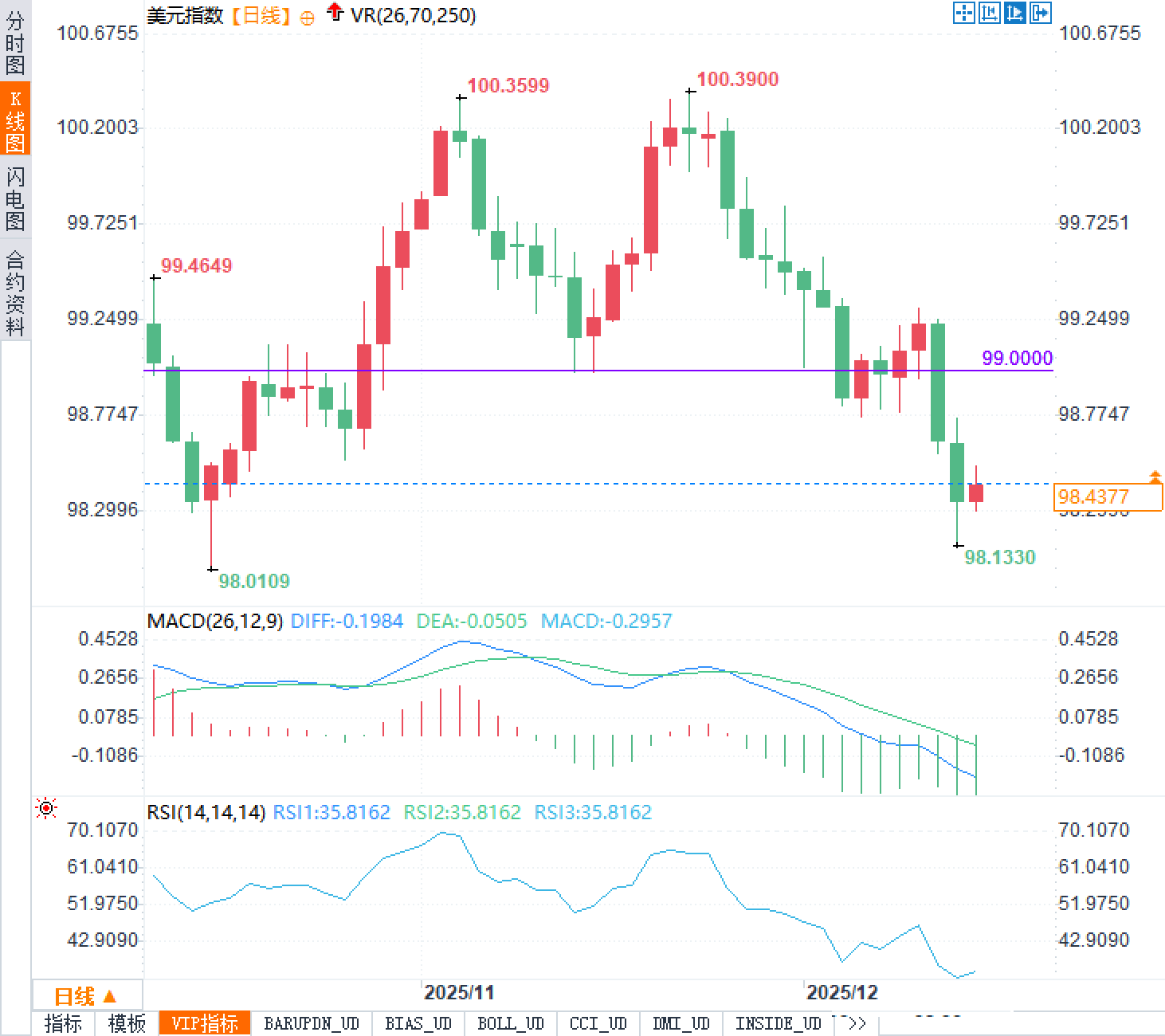
From a daily chart perspective, the US dollar index failed to sustain its upward momentum after two attempts to break through the 100.36/100.39 level, forming a double top before falling back. It has recently broken below and continued to trade below the 99.00 level, indicating a significant downward shift in its center of gravity. Currently trading around 98.40, it is approaching the support zone near the previous low of 98.1330. In terms of momentum indicators, the MACD is below the zero line, and the DIFF (-0.1984) is lower than the DEA (-0.0505), with the histogram continuing to weaken, indicating that downward momentum still dominates. The RSI is around 35.8, in a weak zone, showing signs of short-term oversold conditions. However, the sustainability of any rebound needs further confirmation before the trend reverses. The key resistance levels to watch are around 98.80 and 99.00, while the key support levels to watch are 98.13 and 98.00.
A deeper analysis of the current market logic reveals that the dollar's trajectory is facing a pull from multiple forces. On the one hand, the Federal Reserve has officially entered a rate-cutting cycle, which should theoretically weaken the dollar's attractiveness; but on the other hand, there is a clear divergence between hawks and doves within the Fed. While the dot plot maintains a neutral forecast of one rate cut per year, the individual forecasts are extremely dispersed, implying that there is room for two-way adjustments in future policy.
Market focus will quickly shift to the November non-farm payrolls report and the latest consumer price index, both of which will directly impact interest rate expectations for December and the first quarter of next year. If the job market shows signs of accelerating cooling, it could reinforce dovish rhetoric and push the dollar further down; conversely, if inflation rebounds or wage growth exceeds expectations, it could trigger discussions about pausing rate cuts or even restarting tightening, thereby boosting the dollar. Meanwhile, several voting Fed officials will speak intensively next week, and their remarks will be closely watched.
The current movement of the US dollar index is not driven by a single factor, but rather is the result of the combined effects of policy expectations, economic data, cross-border interest rate differentials, and market sentiment. While the recent interest rate cuts have opened the door to a dollar correction, the divergence in internal policy stances makes a rapid decline unlikely. The cautious approach, represented by Goolsby, warns the market not to underestimate the stubbornness of inflation, while the balanced approach, embodied by Paulson, emphasizes the importance of the employment situation. This coexistence of both approaches increases the uncertainty of the policy path. Against this backdrop, the dollar lacks the foundation for a strong upward surge, nor has it entered a systemic depreciation trend; instead, it is exhibiting more range-bound fluctuations.
While the interest rate cut cycle has been confirmed to have begun, the pace of its subsequent decline remains highly uncertain. Against this backdrop, recent divergent statements from Federal Reserve officials, particularly the starkly contrasting stances of Chicago Fed President Goolsby and Philadelphia Fed President Paulson, further highlight the policymakers' divided assessment of the balance between inflation and employment. This ambiguity in the policy outlook is becoming a key variable influencing the dollar's trajectory.
The US economy presents a complex picture: robust growth, a moderate slowdown in the labor market, and persistently sticky inflation. On the one hand, multiple indicators show that overall economic activity has not shown significant signs of slowing down, corporate profits remain resilient, and consumer spending has not shrunk significantly, providing some support for maintaining relatively high interest rates. On the other hand, core inflation has hovered above the target for several months and has failed to decline effectively for four and a half years, with businesses and residents generally still prioritizing price pressures.
In this context, Goolsby explicitly expressed concern about "premature" rate cuts, arguing that easing policy too early without sufficient data could reignite inflation expectations and increase the difficulty of controlling inflation later. He advocated for patience, waiting until at least early 2026 to assess whether further action was needed. This view reflects a typical hawkish stance, emphasizing price stability over the risk management logic of excessive employment decline. In contrast, Paulson focused more on marginal changes in the labor market, describing the current employment situation as "bent but not broken," and pointing out that current monetary policy is sufficiently restrictive to continue suppressing upward inflationary pressures. She specifically mentioned that some of the recent inflation rise could be attributed to the cost-push effect of trade tariffs, and that such factors may be temporary, thus allowing for a "reasonable possibility" of future inflation declines. The different statements from the two regional Fed presidents essentially reflect the differing trade-offs within the Fed regarding its dual mandate—how to balance controlling inflation with preventing a rapid rise in unemployment.
Market Watch
From a daily chart perspective, the US dollar index failed to sustain its upward momentum after two attempts to break through the 100.36/100.39 level, forming a double top before falling back. It has recently broken below and continued to trade below the 99.00 level, indicating a significant downward shift in its center of gravity. Currently trading around 98.40, it is approaching the support zone near the previous low of 98.1330. In terms of momentum indicators, the MACD is below the zero line, and the DIFF (-0.1984) is lower than the DEA (-0.0505), with the histogram continuing to weaken, indicating that downward momentum still dominates. The RSI is around 35.8, in a weak zone, showing signs of short-term oversold conditions. However, the sustainability of any rebound needs further confirmation before the trend reverses. The key resistance levels to watch are around 98.80 and 99.00, while the key support levels to watch are 98.13 and 98.00.
A deeper analysis of the current market logic reveals that the dollar's trajectory is facing a pull from multiple forces. On the one hand, the Federal Reserve has officially entered a rate-cutting cycle, which should theoretically weaken the dollar's attractiveness; but on the other hand, there is a clear divergence between hawks and doves within the Fed. While the dot plot maintains a neutral forecast of one rate cut per year, the individual forecasts are extremely dispersed, implying that there is room for two-way adjustments in future policy.
Market focus will quickly shift to the November non-farm payrolls report and the latest consumer price index, both of which will directly impact interest rate expectations for December and the first quarter of next year. If the job market shows signs of accelerating cooling, it could reinforce dovish rhetoric and push the dollar further down; conversely, if inflation rebounds or wage growth exceeds expectations, it could trigger discussions about pausing rate cuts or even restarting tightening, thereby boosting the dollar. Meanwhile, several voting Fed officials will speak intensively next week, and their remarks will be closely watched.
The current movement of the US dollar index is not driven by a single factor, but rather is the result of the combined effects of policy expectations, economic data, cross-border interest rate differentials, and market sentiment. While the recent interest rate cuts have opened the door to a dollar correction, the divergence in internal policy stances makes a rapid decline unlikely. The cautious approach, represented by Goolsby, warns the market not to underestimate the stubbornness of inflation, while the balanced approach, embodied by Paulson, emphasizes the importance of the employment situation. This coexistence of both approaches increases the uncertainty of the policy path. Against this backdrop, the dollar lacks the foundation for a strong upward surge, nor has it entered a systemic depreciation trend; instead, it is exhibiting more range-bound fluctuations.
- Risk Warning and Disclaimer
- The market involves risk, and trading may not be suitable for all investors. This article is for reference only and does not constitute personal investment advice, nor does it take into account certain users’ specific investment objectives, financial situation, or other needs. Any investment decisions made based on this information are at your own risk.