Gold's initial surge was neither too early nor too late; the second wave of sharp rise holds hidden secrets.
2025-12-12 21:53:46
On Friday (December 12), following the Fed's rate cut this week, market expectations for further easing policies continued to rise, directly driving gold (XAU/USD) to continue its strong upward trend. The Fed's dovish tone provided solid buying support for gold prices. It is currently trading around 4337.
Although the Federal Reserve did not provide clear forward policy guidance, Chairman Jerome Powell clearly signaled that the probability of a near-term rate hike was extremely low after the decision. While reiterating its signature data-dependent policy framework, he also emphasized the balance of two-way risks facing the Fed's dual mandate. This dovish stance far exceeded the market's previous expectations.
Meanwhile, the Fed's latest dot plot is very dispersed, indicating that voting members still have room to explore the path of future interest rate cuts.
This breakout rally not only helped gold break out of its two-week consolidation range, but also triggered a continued reassessment of the Federal Reserve's policy trajectory in 2026, suggesting that the market may be reacting to important events next week.
Next week, the US will release supplementary non-farm payroll data for October and November, as well as supplementary retail sales data. The market anticipated in advance, based on this interest rate cut, that these key data would not be very good.
Meanwhile, the US core PCE price data to be released next week may not be too severe, and this data could support this rate cut. At the same time, the European Central Bank will keep its interest rate unchanged or may even signal a future rate hike, and the Bank of Japan is highly likely to raise interest rates. This is conducive to the rise in Japanese government bond yields and the outflow of US dollars. These important events are coming together to make the market buy gold in advance.
The continued pressure on the US dollar index further benefits gold prices from an exchange rate perspective, and may even be a clear buy signal.
As a core asset denominated in US dollars, a weaker dollar directly reduces the cost of gold purchases for overseas buyers, and the core driver of this trend is the market's pricing in the Federal Reserve's dovish policies.
The dollar index (DXY), which tracks the dollar against six major currencies, is currently trading around 98.43 after hitting an eight-week low on Thursday and is on track for its third consecutive week of decline. The weakness of the dollar has further enhanced the trading appeal of gold, becoming an important supporting factor driving gold prices higher.
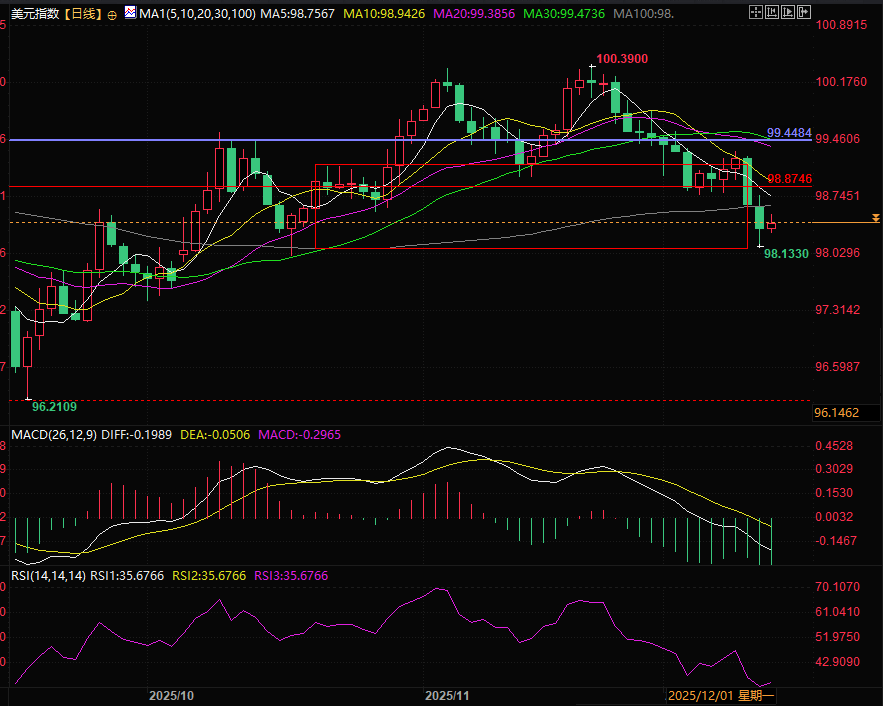
(US Dollar Index Daily Chart)
Gold prices have returned to near historical highs, with a year-to-date gain of over 60%, heading toward their best annual performance since 1979. This is supported by a confluence of multiple core driving factors, making it the current focus of the trading market.
From a funding perspective, large-scale gold purchases by central banks around the world and continuous net inflows into gold ETFs have provided long-term structural support for gold prices; while the dovish policy orientation of the Federal Reserve has become a direct driver of short-term market trends. Coupled with the continued escalation of geopolitical risks, this has jointly created a bullish market for gold.
Major international investment banks are also optimistic about the future trend. Goldman Sachs stated on Wednesday that its previous forecast of $4,900 per ounce for gold by the end of 2026 has significant upside potential, while Bank of America predicts that gold prices will challenge the $5,000 per ounce mark, injecting a strong boost into market sentiment.
Following the implementation of new regulatory reforms in India, the National Pension System (NPS) and other pension plans are now allowed to invest a portion of their assets in gold and silver ETFs regulated by the Securities and Exchange Commission of India (SEBI). This marks the first time that Indian pension funds have gained a direct channel to allocate precious metal assets.
As a major global gold consumer market, India's pension funds are generating structural allocation demand, which is expected to bring continuous incremental funds, becoming an important support for gold demand, providing a long-term logic for the trading market, and further strengthening the certainty of gold price increases.
Internal disagreements within the Federal Reserve have introduced potential variables into market movements, becoming a focus of close attention for traders. The decision to cut interest rates was not unanimously approved, with the final vote being 9 in favor and 3 against. Governor Stephen Milan again proposed a larger rate cut of 50 basis points, while Chicago Fed President Austan Goolsby and Kansas City Fed President Jeffrey Schmid advocated maintaining the current interest rate level.
On Friday night, Goolsby said that if future data shows inflation returning to target, interest rates could still fall “significantly” next year, but he was concerned about cutting rates prematurely at this point. As a representative of the hawks, this statement suggests a possible shift in his stance.
Although I have always believed that the Russia-Ukraine issue is easing, which is not good for gold, there is still room for short-term geopolitical maneuvering, which can provide short-term news-based stimulus to gold.
The US-led peace talks between Russia and Ukraine in Europe have stalled, and geopolitical tensions continue to escalate. Ukrainian President Volodymyr Zelensky has expressed strong concern over the US proposal to establish the disputed Donbas region as a free economic zone. US President Donald Trump has also publicly expressed dissatisfaction with the progress of the negotiations and hinted that he may skip the peace talks to be held in Europe this weekend.
The escalation of geopolitical risks has further enhanced gold's safe-haven properties. Against the backdrop of rising global economic policy uncertainty, gold's value as a "safe haven" asset has become prominent, serving as a key supporting factor for the bullish market.
The Wall Street adage "buy the rumor, sell the news" was perfectly illustrated in the past two days' trading, as the Fed's rate cut announcement did not elicit a significant reaction, but rather a subsequent rise.
After holding above the lower rail of its upward channel, spot gold broke through the key support level of 4236, resolving the short-term bearish crisis. Meanwhile, the 5, 10, 20, and 30-day moving averages are arranged in a bullish pattern and diverging upwards, forming a typical moving average pattern indicating an accelerated upward trend.
However, MACD analysis suggests that if the gold price breaks through 4381, it will trigger a top divergence pattern. Combined with wave theory, this upward trend may not go very far. Traders can refer to this information.
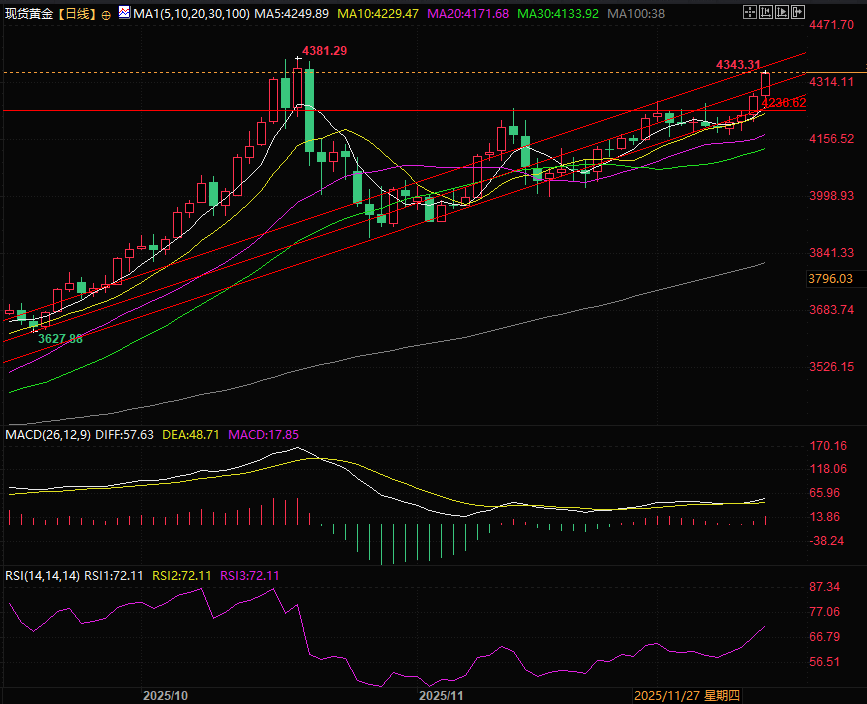
(Spot gold daily chart, source: FX678)
At 21:50 Beijing time, spot gold was trading at $4337.55 per ounce.
Although the Federal Reserve did not provide clear forward policy guidance, Chairman Jerome Powell clearly signaled that the probability of a near-term rate hike was extremely low after the decision. While reiterating its signature data-dependent policy framework, he also emphasized the balance of two-way risks facing the Fed's dual mandate. This dovish stance far exceeded the market's previous expectations.
Meanwhile, the Fed's latest dot plot is very dispersed, indicating that voting members still have room to explore the path of future interest rate cuts.
This breakout rally not only helped gold break out of its two-week consolidation range, but also triggered a continued reassessment of the Federal Reserve's policy trajectory in 2026, suggesting that the market may be reacting to important events next week.
Key Driver: Gold Pricing Next Week's News
Next week, the US will release supplementary non-farm payroll data for October and November, as well as supplementary retail sales data. The market anticipated in advance, based on this interest rate cut, that these key data would not be very good.
Meanwhile, the US core PCE price data to be released next week may not be too severe, and this data could support this rate cut. At the same time, the European Central Bank will keep its interest rate unchanged or may even signal a future rate hike, and the Bank of Japan is highly likely to raise interest rates. This is conducive to the rise in Japanese government bond yields and the outflow of US dollars. These important events are coming together to make the market buy gold in advance.
Key signal: Continued pressure on the US dollar reduces the cost of purchasing gold overseas.
The continued pressure on the US dollar index further benefits gold prices from an exchange rate perspective, and may even be a clear buy signal.
As a core asset denominated in US dollars, a weaker dollar directly reduces the cost of gold purchases for overseas buyers, and the core driver of this trend is the market's pricing in the Federal Reserve's dovish policies.
The dollar index (DXY), which tracks the dollar against six major currencies, is currently trading around 98.43 after hitting an eight-week low on Thursday and is on track for its third consecutive week of decline. The weakness of the dollar has further enhanced the trading appeal of gold, becoming an important supporting factor driving gold prices higher.
(US Dollar Index Daily Chart)
Multiple positive factors converge: Gold prices begin a trend of upward movement.
Gold prices have returned to near historical highs, with a year-to-date gain of over 60%, heading toward their best annual performance since 1979. This is supported by a confluence of multiple core driving factors, making it the current focus of the trading market.
From a funding perspective, large-scale gold purchases by central banks around the world and continuous net inflows into gold ETFs have provided long-term structural support for gold prices; while the dovish policy orientation of the Federal Reserve has become a direct driver of short-term market trends. Coupled with the continued escalation of geopolitical risks, this has jointly created a bullish market for gold.
Major international investment banks are also optimistic about the future trend. Goldman Sachs stated on Wednesday that its previous forecast of $4,900 per ounce for gold by the end of 2026 has significant upside potential, while Bank of America predicts that gold prices will challenge the $5,000 per ounce mark, injecting a strong boost into market sentiment.
Increased liquidity: Indian pension funds enter the market, opening up space for long-term demand.
Following the implementation of new regulatory reforms in India, the National Pension System (NPS) and other pension plans are now allowed to invest a portion of their assets in gold and silver ETFs regulated by the Securities and Exchange Commission of India (SEBI). This marks the first time that Indian pension funds have gained a direct channel to allocate precious metal assets.
As a major global gold consumer market, India's pension funds are generating structural allocation demand, which is expected to bring continuous incremental funds, becoming an important support for gold demand, providing a long-term logic for the trading market, and further strengthening the certainty of gold price increases.
Policy variables: Internal divisions within the Federal Reserve, focusing on clues from officials' speeches.
Internal disagreements within the Federal Reserve have introduced potential variables into market movements, becoming a focus of close attention for traders. The decision to cut interest rates was not unanimously approved, with the final vote being 9 in favor and 3 against. Governor Stephen Milan again proposed a larger rate cut of 50 basis points, while Chicago Fed President Austan Goolsby and Kansas City Fed President Jeffrey Schmid advocated maintaining the current interest rate level.
On Friday night, Goolsby said that if future data shows inflation returning to target, interest rates could still fall “significantly” next year, but he was concerned about cutting rates prematurely at this point. As a representative of the hawks, this statement suggests a possible shift in his stance.
Safe-haven support: Geopolitical tensions enhance the value of gold as an investment.
Although I have always believed that the Russia-Ukraine issue is easing, which is not good for gold, there is still room for short-term geopolitical maneuvering, which can provide short-term news-based stimulus to gold.
The US-led peace talks between Russia and Ukraine in Europe have stalled, and geopolitical tensions continue to escalate. Ukrainian President Volodymyr Zelensky has expressed strong concern over the US proposal to establish the disputed Donbas region as a free economic zone. US President Donald Trump has also publicly expressed dissatisfaction with the progress of the negotiations and hinted that he may skip the peace talks to be held in Europe this weekend.
The escalation of geopolitical risks has further enhanced gold's safe-haven properties. Against the backdrop of rising global economic policy uncertainty, gold's value as a "safe haven" asset has become prominent, serving as a key supporting factor for the bullish market.
Summary and Technical Analysis:
The Wall Street adage "buy the rumor, sell the news" was perfectly illustrated in the past two days' trading, as the Fed's rate cut announcement did not elicit a significant reaction, but rather a subsequent rise.
After holding above the lower rail of its upward channel, spot gold broke through the key support level of 4236, resolving the short-term bearish crisis. Meanwhile, the 5, 10, 20, and 30-day moving averages are arranged in a bullish pattern and diverging upwards, forming a typical moving average pattern indicating an accelerated upward trend.
However, MACD analysis suggests that if the gold price breaks through 4381, it will trigger a top divergence pattern. Combined with wave theory, this upward trend may not go very far. Traders can refer to this information.
(Spot gold daily chart, source: FX678)
At 21:50 Beijing time, spot gold was trading at $4337.55 per ounce.
- Risk Warning and Disclaimer
- The market involves risk, and trading may not be suitable for all investors. This article is for reference only and does not constitute personal investment advice, nor does it take into account certain users’ specific investment objectives, financial situation, or other needs. Any investment decisions made based on this information are at your own risk.