Switzerland's economy is experiencing a "laissez-faire" growth, with the US dollar and Swiss franc locked in a battle of wills to see which is weaker.
2025-12-15 17:55:18
Monday, December 15th. The USD/CHF exchange rate traded around 0.7965 during the European session, with market sentiment influenced by a confluence of factors. The policy signals from last week's Federal Reserve meeting continued to resonate, while the latest Swiss economic forecasts provided a new dimension of reference for the Swiss franc's movement. With year-end trading expected to be subdued, this week's US employment and inflation data will be key variables influencing the currency market's direction, and the USD/CHF's movement may receive clearer guidance after the data release.

The divergence in monetary policy between the Federal Reserve and the Swiss National Bank is undergoing a delicate rebalancing process. Last week, the Fed cut interest rates by 25 basis points as expected, but Fed Chairman Powell's remarks at the press conference were interpreted by the market as dovish. Notably, Powell downplayed concerns about inflation risks in his post-meeting comments, while emphasizing signs of weakness in the labor market. This suggests that the Fed's tolerance for inflation may be higher than previously perceived by the market, while its vigilance regarding a weakening job market has clearly increased. According to the latest summary of economic projections, the so-called dot plot, Fed officials' median expectation for further rate cuts next year is one. Currently, interest rate futures market pricing reflects a cumulative rate cut of approximately 57 basis points by the end of 2026, a narrowing of previous expectations, indicating that the market is reassessing the room for further easing in US monetary policy.
In Switzerland, a recent economic forecast report released by the Secretariat for National Economic Affairs paints a picture of low inflation and moderate growth. According to the report, Switzerland's inflation rate is projected to remain at an average of 0.2% in 2025 and 2026, before moderately rising to 0.5% in 2027. Regarding economic growth, GDP growth is expected to be 1.4% in 2025, slowing to 1.1% in 2026, and then rebounding to 1.7% in 2027. This forecast indicates that the Swiss economy will continue its trend of low inflation and stable growth, providing support for the Swiss National Bank to maintain its current policy stance. In fact, the Swiss National Bank has already maintained its policy rate at 0%, and the market widely expects this ultra-low interest rate policy to remain unchanged for a considerable period to cope with persistently low inflationary pressures.
From an interest rate differential perspective, the expectation of further interest rate cuts by the Federal Reserve undoubtedly puts pressure on the US dollar. Since last week's interest rate meeting, the dollar index has generally weakened, reflecting the market's forward pricing of a shift towards a looser US monetary policy. In contrast, the Swiss National Bank currently has no room for further interest rate cuts, and the relative trajectories of the two countries' monetary policies are changing. The interest rate differential advantage that previously supported the dollar's strength is gradually narrowing, which is one of the core reasons for the recent pressure on the dollar against the Swiss franc.
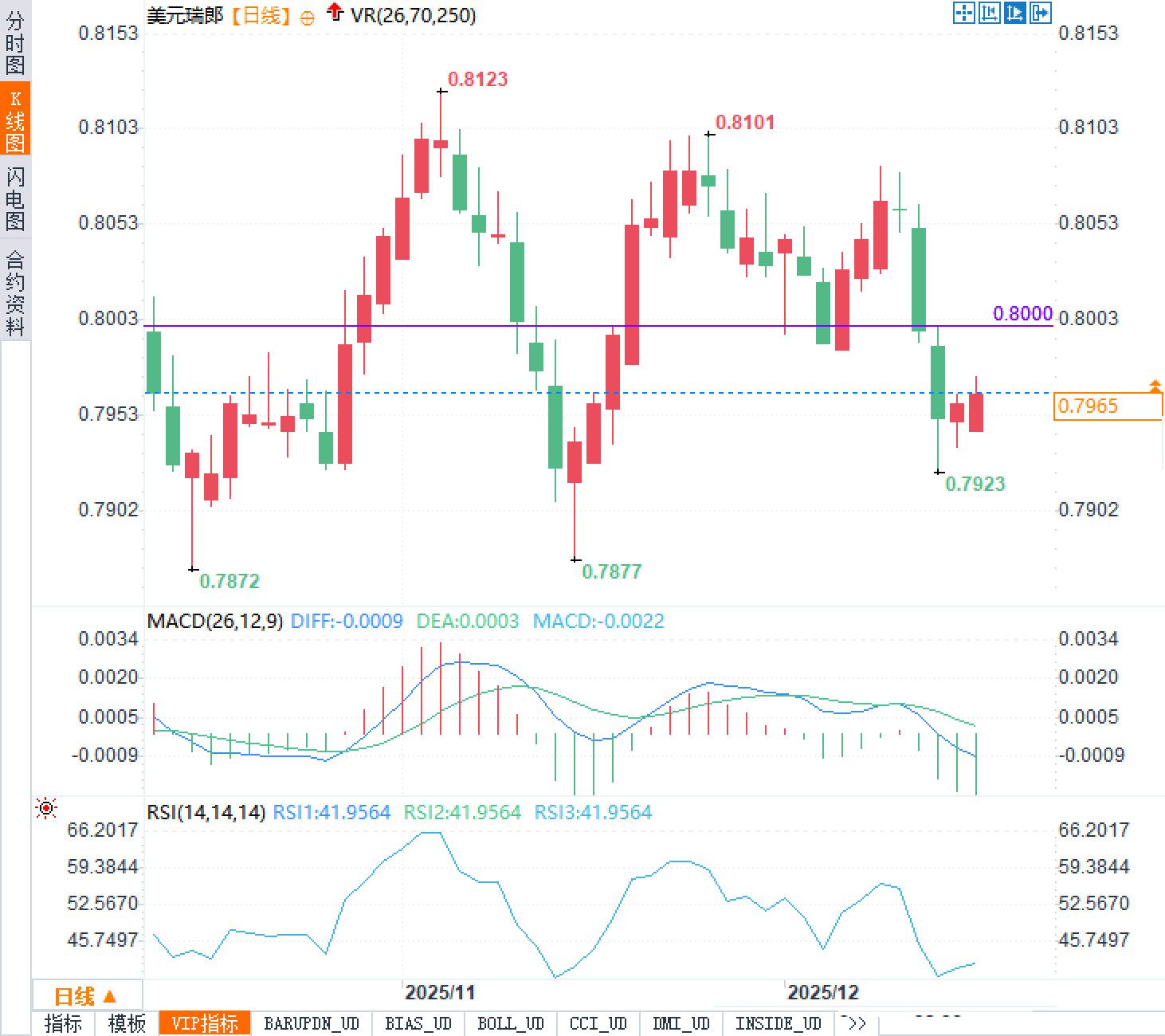
The USD/CHF pair traded in a narrow range between 0.7960 and 0.7965 during the early European session, with overall trading sentiment cautious. Looking at the daily chart, the pair has recently experienced a significant pullback, declining from a high of 0.8101 to a low of 0.7923 before a technical rebound. Currently, the pair is finding some support around 0.7960, but the psychological level of 0.8000 presents short-term resistance. Technically, the Relative Strength Index (RSI) is around 41.95, in the neutral-to-weak zone, indicating that neither bulls nor bears have yet established a clear advantage. The MACD indicator is trending negative, suggesting short-term momentum leaning towards the bears.
In terms of market structural characteristics, the Swiss franc's status as a traditional safe-haven currency has once again attracted attention in the current environment. As the year draws to a close, global market risk appetite has shown signs of cooling, and with a plethora of important data releases this week, traders are inclined to reduce risk exposure, providing some support for the Swiss franc. Analysts point out that the US government shutdown previously delayed the release of October and November non-farm payroll data; the two months' employment reports will be released all at once this Tuesday, meaning that data interpretation will face greater complexity. From the perspective of policymakers, regardless of the data results, they are likely to interpret it with a more cautious attitude than usual, focusing primarily on discerning the true trends in the US labor market.
From a trader's psychological perspective, a clear wait-and-see approach is currently evident. On the one hand, uncertainty surrounding the Federal Reserve's policy path makes it difficult for traders to establish clear directional positions; on the other hand, the gradual tightening of liquidity at the end of the year also suppresses the willingness for large-scale trading. Against this backdrop, short-term fluctuations in the USD/CHF exchange rate are more driven by data than by trend forces. If the US employment data released this week is strong, especially if the labor market shows unexpected resilience, it could trigger a hawkish correction in market expectations for a Fed rate cut, thus providing a short-term boost to the dollar. Conversely, weak data will strengthen market bets on the Fed accelerating its easing pace, further pressuring the dollar.
This week's US economic data will be the core variable driving the USD/CHF exchange rate. The October and November non-farm payroll reports, released on Tuesday, will be the first test for the market. Given the previous delays in data release, market attention to this "bi-monthly" employment report is exceptionally high. The consumer price index data released on Thursday will further guide the Federal Reserve's policy path. From a market perspective, if the employment data shows a resilient labor market while inflation remains moderate, the Fed may have greater policy flexibility. In this scenario, the dollar's movement will depend on how the market weighs the relative importance of growth and inflation.
From a medium-term perspective, the USD/CHF exchange rate will continue to be influenced by changes in the degree of policy divergence between the Federal Reserve and the Swiss National Bank. Current market expectations for a Fed rate cut in 2026 are approximately 57 basis points. If subsequent data supports this expectation, the USD/CHF exchange rate may maintain a weak trend. However, any better-than-expected economic performance could trigger a rapid correction in expectations, leading to significant exchange rate volatility.
The divergence in monetary policy between the Federal Reserve and the Swiss National Bank is undergoing a delicate rebalancing process. Last week, the Fed cut interest rates by 25 basis points as expected, but Fed Chairman Powell's remarks at the press conference were interpreted by the market as dovish. Notably, Powell downplayed concerns about inflation risks in his post-meeting comments, while emphasizing signs of weakness in the labor market. This suggests that the Fed's tolerance for inflation may be higher than previously perceived by the market, while its vigilance regarding a weakening job market has clearly increased. According to the latest summary of economic projections, the so-called dot plot, Fed officials' median expectation for further rate cuts next year is one. Currently, interest rate futures market pricing reflects a cumulative rate cut of approximately 57 basis points by the end of 2026, a narrowing of previous expectations, indicating that the market is reassessing the room for further easing in US monetary policy.
In Switzerland, a recent economic forecast report released by the Secretariat for National Economic Affairs paints a picture of low inflation and moderate growth. According to the report, Switzerland's inflation rate is projected to remain at an average of 0.2% in 2025 and 2026, before moderately rising to 0.5% in 2027. Regarding economic growth, GDP growth is expected to be 1.4% in 2025, slowing to 1.1% in 2026, and then rebounding to 1.7% in 2027. This forecast indicates that the Swiss economy will continue its trend of low inflation and stable growth, providing support for the Swiss National Bank to maintain its current policy stance. In fact, the Swiss National Bank has already maintained its policy rate at 0%, and the market widely expects this ultra-low interest rate policy to remain unchanged for a considerable period to cope with persistently low inflationary pressures.
From an interest rate differential perspective, the expectation of further interest rate cuts by the Federal Reserve undoubtedly puts pressure on the US dollar. Since last week's interest rate meeting, the dollar index has generally weakened, reflecting the market's forward pricing of a shift towards a looser US monetary policy. In contrast, the Swiss National Bank currently has no room for further interest rate cuts, and the relative trajectories of the two countries' monetary policies are changing. The interest rate differential advantage that previously supported the dollar's strength is gradually narrowing, which is one of the core reasons for the recent pressure on the dollar against the Swiss franc.
Technical aspects
The USD/CHF pair traded in a narrow range between 0.7960 and 0.7965 during the early European session, with overall trading sentiment cautious. Looking at the daily chart, the pair has recently experienced a significant pullback, declining from a high of 0.8101 to a low of 0.7923 before a technical rebound. Currently, the pair is finding some support around 0.7960, but the psychological level of 0.8000 presents short-term resistance. Technically, the Relative Strength Index (RSI) is around 41.95, in the neutral-to-weak zone, indicating that neither bulls nor bears have yet established a clear advantage. The MACD indicator is trending negative, suggesting short-term momentum leaning towards the bears.
In terms of market structural characteristics, the Swiss franc's status as a traditional safe-haven currency has once again attracted attention in the current environment. As the year draws to a close, global market risk appetite has shown signs of cooling, and with a plethora of important data releases this week, traders are inclined to reduce risk exposure, providing some support for the Swiss franc. Analysts point out that the US government shutdown previously delayed the release of October and November non-farm payroll data; the two months' employment reports will be released all at once this Tuesday, meaning that data interpretation will face greater complexity. From the perspective of policymakers, regardless of the data results, they are likely to interpret it with a more cautious attitude than usual, focusing primarily on discerning the true trends in the US labor market.
From a trader's psychological perspective, a clear wait-and-see approach is currently evident. On the one hand, uncertainty surrounding the Federal Reserve's policy path makes it difficult for traders to establish clear directional positions; on the other hand, the gradual tightening of liquidity at the end of the year also suppresses the willingness for large-scale trading. Against this backdrop, short-term fluctuations in the USD/CHF exchange rate are more driven by data than by trend forces. If the US employment data released this week is strong, especially if the labor market shows unexpected resilience, it could trigger a hawkish correction in market expectations for a Fed rate cut, thus providing a short-term boost to the dollar. Conversely, weak data will strengthen market bets on the Fed accelerating its easing pace, further pressuring the dollar.
Looking ahead
This week's US economic data will be the core variable driving the USD/CHF exchange rate. The October and November non-farm payroll reports, released on Tuesday, will be the first test for the market. Given the previous delays in data release, market attention to this "bi-monthly" employment report is exceptionally high. The consumer price index data released on Thursday will further guide the Federal Reserve's policy path. From a market perspective, if the employment data shows a resilient labor market while inflation remains moderate, the Fed may have greater policy flexibility. In this scenario, the dollar's movement will depend on how the market weighs the relative importance of growth and inflation.
From a medium-term perspective, the USD/CHF exchange rate will continue to be influenced by changes in the degree of policy divergence between the Federal Reserve and the Swiss National Bank. Current market expectations for a Fed rate cut in 2026 are approximately 57 basis points. If subsequent data supports this expectation, the USD/CHF exchange rate may maintain a weak trend. However, any better-than-expected economic performance could trigger a rapid correction in expectations, leading to significant exchange rate volatility.
- Risk Warning and Disclaimer
- The market involves risk, and trading may not be suitable for all investors. This article is for reference only and does not constitute personal investment advice, nor does it take into account certain users’ specific investment objectives, financial situation, or other needs. Any investment decisions made based on this information are at your own risk.