Inflation persists, PMI data poses a potential risk! Euro bulls face a test of their high-stakes gamble.
2025-12-16 19:50:42
On Tuesday (December 16), during the Asian and European sessions, the euro traded strongly against the US dollar around 1.1758 before the release of the US non-farm payroll data. The logic behind the euro's high support was further confirmed by the December Eurozone PMI data. Despite the slowdown in business activity led by Germany and the divergence between the manufacturing and service sectors, the resilience of the fundamentals that continued to expand throughout the year and the intensified inflationary pressures at the end of the year have continued to reinforce the ECB's policy stance of maintaining unchanged interest rates, providing a clear anchor for the euro against the US dollar.
However, it is worth noting that at the same time, the UK's manufacturing and services PMIs both exceeded expectations, causing the euro to fall sharply against the pound. In other words, the fact that the euro did not fall against the dollar could not mask the weaker-than-expected PMI data from the Eurozone and Germany.

The Eurozone Composite PMI fell to 51.9 in December (previous value 52.8), a three-month low, but remained above the 50-point threshold separating expansion from contraction. This indicates that 2025 will be the first year since 2019 to achieve sustained monthly expansion, with the core driver being the service sector, which has seen seven consecutive months of growth.
Despite the services PMI slowing to 52.6 (previous value 53.6), the slowest expansion in three months, the robust growth trend remains unchanged, and it continues to be the "ballast" of the Eurozone economy.
Manufacturing performance was relatively weak: the December PMI fell to 49.2 (previous value 49.6), remaining in contraction territory for the eighth consecutive month, with the output sub-index falling to 49.7 (previous value 50.4), a ten-month low.
Regionally, the situation also showed divergence: German output growth slowed to its weakest level in four months, France nearly stagnated, and only the rest of the Eurozone maintained moderate growth, albeit at a slower pace.
However, manufacturing confidence has risen to its highest level since February 2022, and French manufacturing is showing initial signs of recovery, laying the groundwork for further improvement in fundamentals.
While there are concerns on the demand side—new orders have increased for the fifth consecutive month, but at a slower pace, and overseas new orders have seen the largest decline since March, with manufacturing exports falling faster than services—the overall expansion trend has not reversed and has not weakened the euro's fundamental support.
Year-end inflation data became a key highlight supporting the euro: the eurozone's input cost inflation rate hit a nine-month high in December, with service sector costs continuing to rise faster than manufacturing costs, with Germany's cost growth reaching a near one-year peak; output price increases accelerated slightly to a "moderate" level, with service sector price increases accelerating significantly, while manufacturing prices remained basically flat.
This data directly hits the core logic of the euro trade – inflation stickiness will force the ECB to maintain the current interest rate level.
The chief economist at Commerzbank Hamburg explicitly pointed out that inflation has reached a nine-month high, and the ECB is expected to maintain its current interest rate policy. The market further anticipates that if inflationary pressures persist, the ECB may even signal a rate hike in 2026, creating a stark policy contrast with the Fed's rate cut expectations and becoming a key support for the euro's stabilization at high levels.
It is worth noting that although inflation is rising at the end of the year, the average annual value of input cost and output price indices in 2025 will still be the lowest since the 2020 pandemic, which means that inflation is not at risk of getting out of control and the ECB does not need to tighten excessively. This combination of "moderate inflation + economic expansion" is the best fundamental environment for the euro.
The labor market did not put pressure on the euro: private sector employment rose for the third consecutive month, although the overall increase was slight and German employment declined slightly. However, the pattern of slight increase in France and moderate growth in other regions avoided the risk of a deteriorating labor market and provided a foundation for consumption and economic stability.
The divergence at the supply chain level has not had a substantial impact: manufacturing purchases have been reduced at the fastest pace since March, and supplier delivery delays have reached the highest level since October 2022. However, finished goods inventories have declined for 32 consecutive months and the rate of decline has slowed, indicating that corporate inventory adjustments are gradually coming to an end and the drag on production is expected to weaken.
The core of the current euro trading is the "hawkish ECB policy" logic solidified by the "resilience of economic expansion throughout the year + rising inflation at the end of the year," and the policy gap formed by the Fed's easing expectations is the core driving force for euro bulls.
Meanwhile, the weaker-than-expected manufacturing PMI in the Eurozone and Germany also poses a potential threat to the Eurozone economy.
Currently, the euro's exchange rate against the US dollar is mainly supported by the continuous weakening of the US dollar index. At the same time, it is necessary to observe the US non-farm payroll data for October and November. If the US dollar index is affected by unfavorable non-farm payroll data and eventually rebounds after the negative news has been priced in, the euro will face a correction.
The euro has temporarily escaped the bearish crisis against the US dollar and has turned from a downtrend to an uptrend. The current support level is at the 5-day moving average and the blue upward trend line, while the resistance level is at the 1.1800 psychological level.
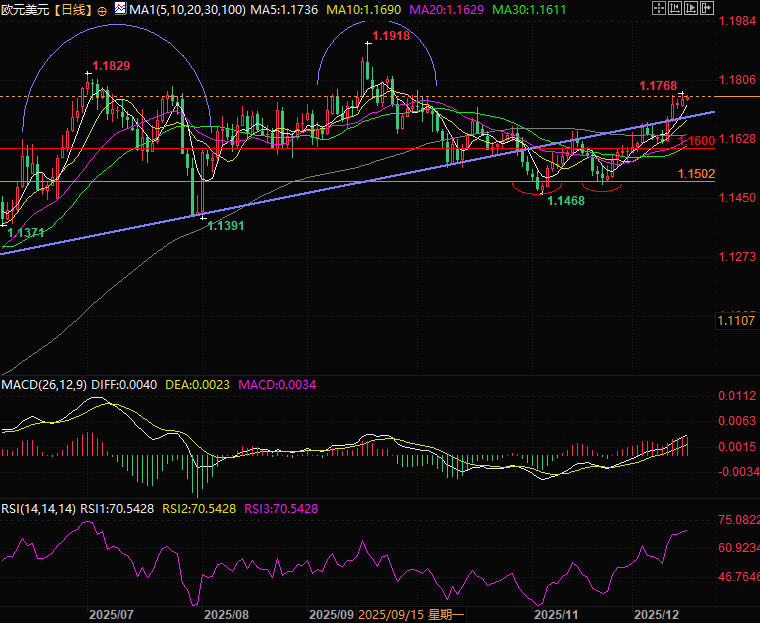
(Euro/USD daily chart, source: FX678)
At 19:48 Beijing time, the euro was trading at 1.1759/60 against the US dollar.
However, it is worth noting that at the same time, the UK's manufacturing and services PMIs both exceeded expectations, causing the euro to fall sharply against the pound. In other words, the fact that the euro did not fall against the dollar could not mask the weaker-than-expected PMI data from the Eurozone and Germany.
The divergence in PMI data reveals resilience, and the overall expansion throughout the year provides fundamental support.
The Eurozone Composite PMI fell to 51.9 in December (previous value 52.8), a three-month low, but remained above the 50-point threshold separating expansion from contraction. This indicates that 2025 will be the first year since 2019 to achieve sustained monthly expansion, with the core driver being the service sector, which has seen seven consecutive months of growth.
Despite the services PMI slowing to 52.6 (previous value 53.6), the slowest expansion in three months, the robust growth trend remains unchanged, and it continues to be the "ballast" of the Eurozone economy.
Manufacturing performance was relatively weak: the December PMI fell to 49.2 (previous value 49.6), remaining in contraction territory for the eighth consecutive month, with the output sub-index falling to 49.7 (previous value 50.4), a ten-month low.
Regionally, the situation also showed divergence: German output growth slowed to its weakest level in four months, France nearly stagnated, and only the rest of the Eurozone maintained moderate growth, albeit at a slower pace.
However, manufacturing confidence has risen to its highest level since February 2022, and French manufacturing is showing initial signs of recovery, laying the groundwork for further improvement in fundamentals.
While there are concerns on the demand side—new orders have increased for the fifth consecutive month, but at a slower pace, and overseas new orders have seen the largest decline since March, with manufacturing exports falling faster than services—the overall expansion trend has not reversed and has not weakened the euro's fundamental support.
Rising inflationary pressures: a key driver for euro bulls, reinforcing expectations of a hawkish ECB stance.
Year-end inflation data became a key highlight supporting the euro: the eurozone's input cost inflation rate hit a nine-month high in December, with service sector costs continuing to rise faster than manufacturing costs, with Germany's cost growth reaching a near one-year peak; output price increases accelerated slightly to a "moderate" level, with service sector price increases accelerating significantly, while manufacturing prices remained basically flat.
This data directly hits the core logic of the euro trade – inflation stickiness will force the ECB to maintain the current interest rate level.
The chief economist at Commerzbank Hamburg explicitly pointed out that inflation has reached a nine-month high, and the ECB is expected to maintain its current interest rate policy. The market further anticipates that if inflationary pressures persist, the ECB may even signal a rate hike in 2026, creating a stark policy contrast with the Fed's rate cut expectations and becoming a key support for the euro's stabilization at high levels.
It is worth noting that although inflation is rising at the end of the year, the average annual value of input cost and output price indices in 2025 will still be the lowest since the 2020 pandemic, which means that inflation is not at risk of getting out of control and the ECB does not need to tighten excessively. This combination of "moderate inflation + economic expansion" is the best fundamental environment for the euro.
Employment and supply chain: No significant drag, risks manageable
The labor market did not put pressure on the euro: private sector employment rose for the third consecutive month, although the overall increase was slight and German employment declined slightly. However, the pattern of slight increase in France and moderate growth in other regions avoided the risk of a deteriorating labor market and provided a foundation for consumption and economic stability.
The divergence at the supply chain level has not had a substantial impact: manufacturing purchases have been reduced at the fastest pace since March, and supplier delivery delays have reached the highest level since October 2022. However, finished goods inventories have declined for 32 consecutive months and the rate of decline has slowed, indicating that corporate inventory adjustments are gradually coming to an end and the drag on production is expected to weaken.
Summary and Technical Analysis:
The core of the current euro trading is the "hawkish ECB policy" logic solidified by the "resilience of economic expansion throughout the year + rising inflation at the end of the year," and the policy gap formed by the Fed's easing expectations is the core driving force for euro bulls.
Meanwhile, the weaker-than-expected manufacturing PMI in the Eurozone and Germany also poses a potential threat to the Eurozone economy.
Currently, the euro's exchange rate against the US dollar is mainly supported by the continuous weakening of the US dollar index. At the same time, it is necessary to observe the US non-farm payroll data for October and November. If the US dollar index is affected by unfavorable non-farm payroll data and eventually rebounds after the negative news has been priced in, the euro will face a correction.
The euro has temporarily escaped the bearish crisis against the US dollar and has turned from a downtrend to an uptrend. The current support level is at the 5-day moving average and the blue upward trend line, while the resistance level is at the 1.1800 psychological level.
(Euro/USD daily chart, source: FX678)
At 19:48 Beijing time, the euro was trading at 1.1759/60 against the US dollar.
- Risk Warning and Disclaimer
- The market involves risk, and trading may not be suitable for all investors. This article is for reference only and does not constitute personal investment advice, nor does it take into account certain users’ specific investment objectives, financial situation, or other needs. Any investment decisions made based on this information are at your own risk.