Is the Australian dollar poised to "buy low" against the US dollar in 2026?
2025-12-16 21:29:38
The Australian dollar rebounded from 0.5914 to 0.6650 against the US dollar in 2025, primarily due not to Australia's strong economic performance, but rather to the weakness of the US dollar itself: weakening US employment, the Federal Reserve's resumption of interest rate cuts, and the government shutdown all eroded the dollar's credibility; while Australia's stable economy and rising inflation led to tighter policy expectations, and the interest rate differential and confidence advantage drove the Australian dollar higher. If the US dollar continues to be under pressure in 2026, the Australian dollar may continue its upward trend.
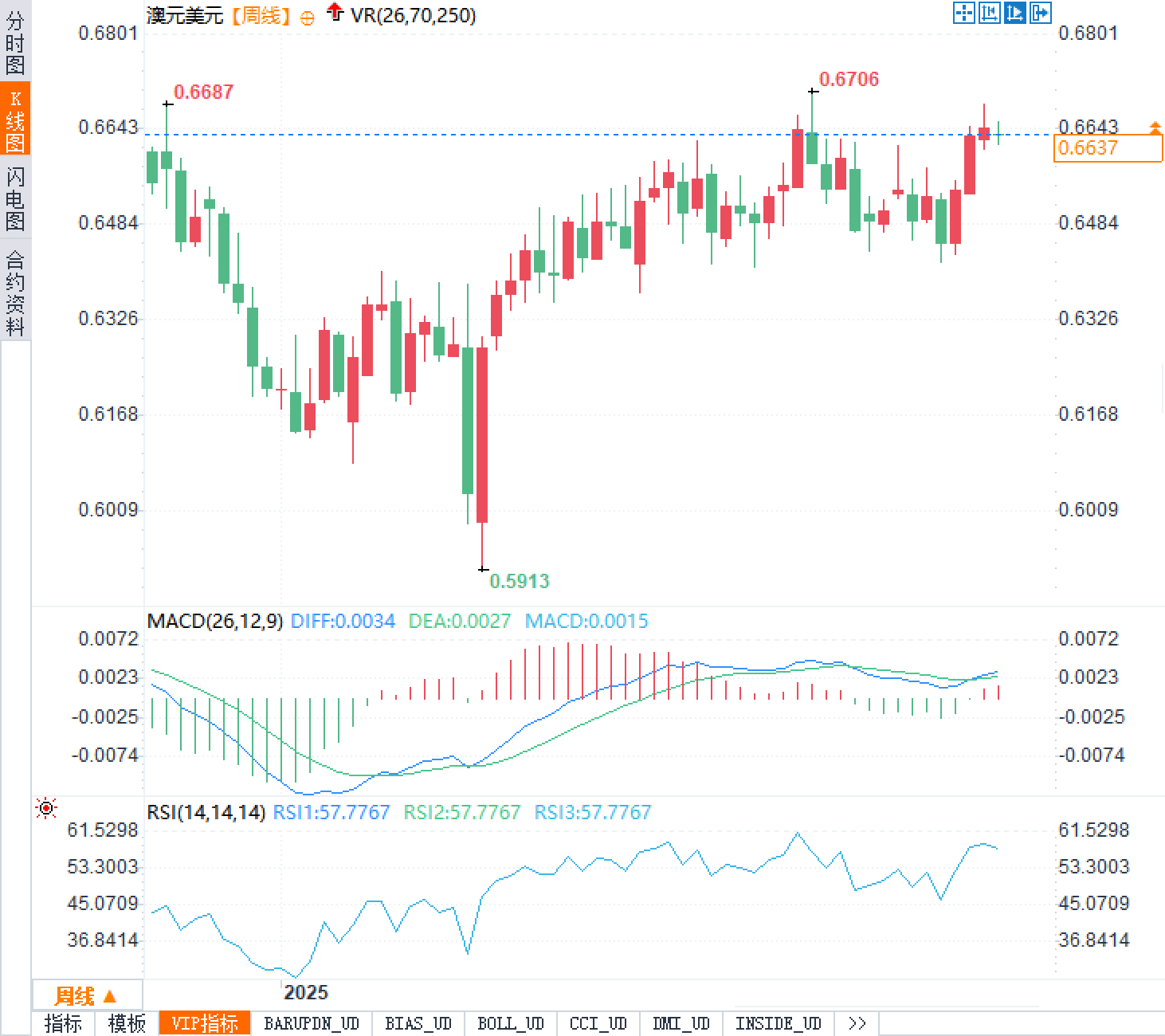
2025 was a tumultuous year for the Australian dollar against the US dollar. At the beginning of the year, the exchange rate hovered around 0.6140, but by April 9th, it had plummeted to a low of 0.5914. Within just a few months, the Australian dollar seemed to have been thrown into an abyss. However, this was not the end of the story. With the reversal of fortunes, the Australian dollar embarked on a strong recovery, reaching a high of 0.6707 on September 17th. Currently, the exchange rate is stable at around 0.6650, representing a cumulative increase of approximately 7% for the year.
This V-shaped price movement was not driven by a single event, but rather by the ebb and flow of two macroeconomic narratives. The initial driver was deteriorating risk sentiment – the US announced tariff increases, triggering global market concerns about the trade outlook. As a currency highly correlated with commodities and international trade, the Australian dollar was the first to be sold off. Investors quickly reduced their exposure to cyclical currencies, putting downward pressure on the Australian dollar.
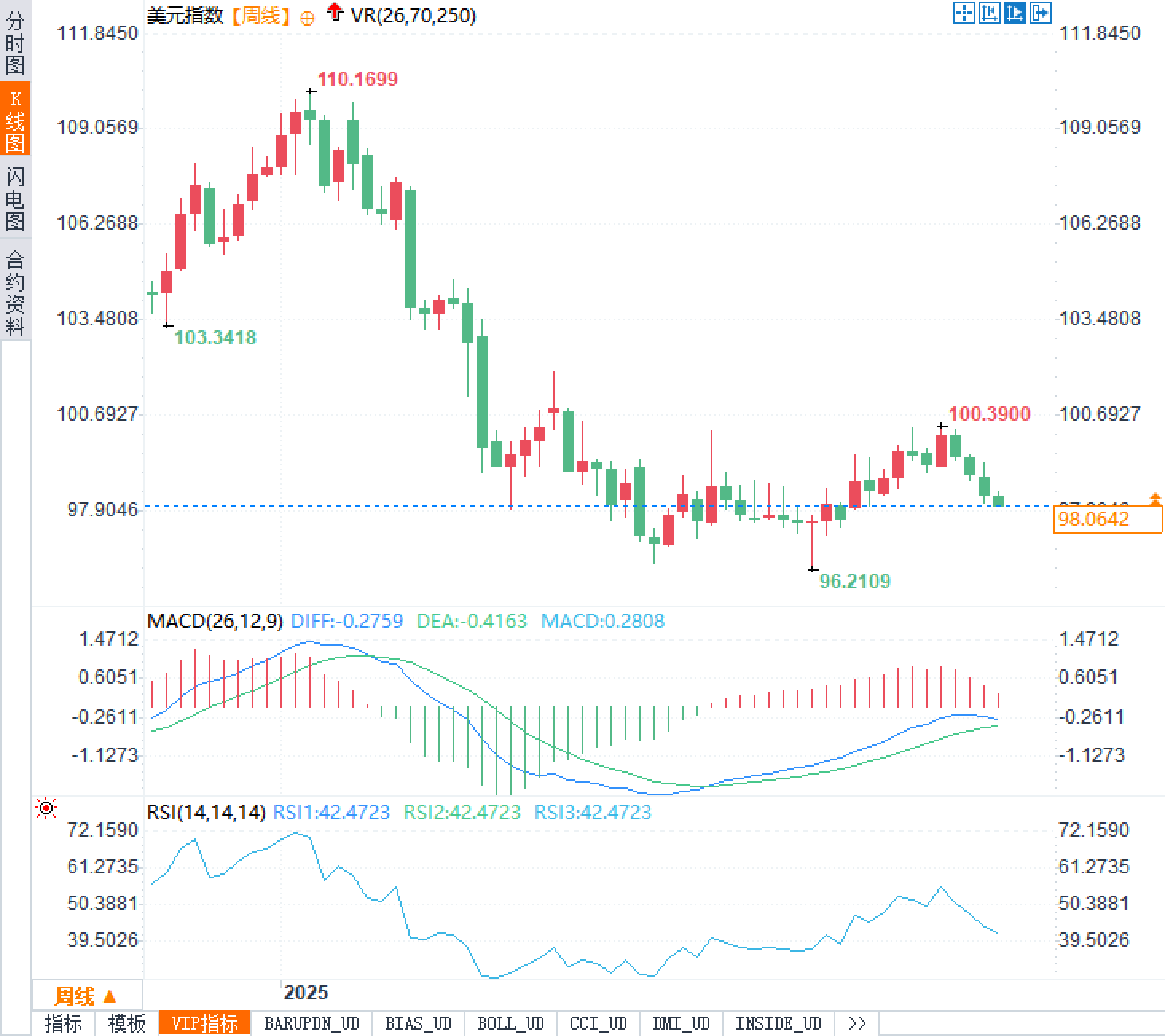
However, the real turning point came in the second half of the year. At this point, the market's focus shifted from external shocks to the structural problems within the United States itself. The US dollar index fell from 110.18 at the beginning of the year to 96.22 on September 17th, and subsequently failed to return above 100. The annual decline exceeded 10%, a relatively rare annual correction since the era of floating exchange rates. This weakening signaled a shift in the logic of foreign exchange pricing: it was no longer simply about chasing a "strong dollar," but rather about comparing the relative strengths and weaknesses of each country's fundamentals and institutional credibility. It was against this backdrop that the previously unremarkable Australian dollar unexpectedly became a beneficiary.
If the Australian dollar's decline in the first half of the year was due to "taking medicine when others are sick," then the rebound in the second half is more like "walking while others stumble." The key force truly driving the Australian dollar's recovery was not Australia's own explosive growth, but rather the multiple blows to the US dollar's credibility.
First, there's the change in monetary policy path. The Federal Reserve cut interest rates three times in 2024, then paused in 2025. However, with a significant weakening of the labor market, easing resumed. Starting in September, the Fed implemented three more rate cuts within three months. More worryingly, inflation has not fallen as expected. In September, core CPI remained at 3.0% year-on-year, and core PCE rebounded to 2.8%, both well above the 2% target. Theoretically, such data should support higher interest rates, but in reality, employment pressures have outweighed everything else.
The changes in non-farm payroll data were highly impactful: December 2024 saw a surge of 323,000 new jobs, but this plummeted to 111,000 in January 2025; the data remained weak for several consecutive months, with a net decrease of 13,000 in June and another 4,000 in August. The unemployment rate rose to 4.4% in September, the highest level in four years. This deterioration in employment not only altered interest rate expectations but also weakened foreign investors' long-term willingness to allocate assets to the US dollar.
An even greater blow comes from the political sphere—the US federal government shutdown in the fourth quarter of 2025 (October 1 to November 12) disrupted the release of several key economic data points, creating an "information vacuum." When markets lack accurate data, decision-making becomes reliant on speculation and sentiment, significantly reducing policy predictability. At this point, the US dollar is no longer seen as a natural safe-haven asset but rather a risk asset that needs to be reassessed. Analysts point out that the dollar index, having fallen by more than 10% throughout the year, exhibits characteristics of structural adjustment rather than short-term fluctuations.
Under this logic, the Australian dollar doesn't need to "perform exceptionally well." As long as the US continues to release negative signals, it can naturally gain support. Every time the Federal Reserve releases expectations of further easing, or when controversy arises regarding policy direction, it translates into a weakening of the US dollar, indirectly pushing up the Australian dollar.
In contrast to the dramatic fluctuations in the US economy, Australia's performance can be described as remarkably stable. By 2025, the country's GDP growth is projected to gradually recover from 1.4% in the first quarter to 2.1% in the third quarter, approaching its potential growth rate. This indicates that the economy is neither overheating nor stalling, and is on a sustainable growth trajectory. The manufacturing PMI registered 51.6 in November, and the services PMI was 52.8, both remaining in expansion territory, demonstrating the resilience of domestic demand.
While the job market has cooled slightly, the overall situation remains manageable. The unemployment rate rose slightly from 4.1% in January to 4.3% in November, but is still within a historically low range. More importantly, job losses are mainly reflected in a slowdown in hiring rather than large-scale layoffs, and residents' income expectations have not suffered a precipitous decline, reducing the risk of the economy falling into a negative feedback loop.
In terms of monetary policy, the Reserve Bank of Australia (RBA) kept the cash rate unchanged at 4.35% in 2024, and began a rate-cutting cycle in February 2025, lowering the rate to 3.60% by August, before pausing operations. This process was seen as a normalization calibration against the backdrop of declining inflation. However, the situation changed abruptly at the end of the year: the year-on-year CPI jumped from 1.9% in July to 3.8% in October; the cut-off mean inflation, which the RBA is more concerned about, also rose from 2.8% to 3.3%, once again approaching the upper limit of the target range.
Faced with rebounding inflation, the Reserve Bank of Australia (RBA) shifted significantly to caution in its December statement, emphasizing the possibility of raising interest rates if necessary. This shift from a "dovish" to a "hawkish" tone was quickly picked up by the foreign exchange market. Interest rate expectations began to tilt towards the Australian dollar, and the willingness for capital inflows increased. Especially in an environment of rising global uncertainty, a central bank that can respond promptly to inflation risks and maintain policy flexibility is more likely to win trust. This "policy credibility premium" became an important support for the subsequent strengthening of the Australian dollar.
Entering 2026, the core variable determining the Australian dollar's exchange rate against the US dollar will still depend more on the US dollar. Although the US economy is expected to recover to some extent through the transmission of interest rate cuts, with the IMF predicting that its growth rate may return to around 2.3%, structural contradictions remain: inflation is still higher than the target, while employment remains weak, leaving policymakers in a dilemma of "both stabilizing growth and controlling prices."
A bigger variable lies in the change of leadership at the Federal Reserve. Current Chairman Jerome Powell is expected to step down in May 2026, and his successor is likely to be either Kevin Hassett or Kevin Warsh. For the foreign exchange market, the key is not the candidate themselves, but how the market interprets their policy inclinations. If the new chairman is perceived to prioritize employment and growth and be willing to tolerate a lower interest rate environment, then the dollar's interest rate support will be further weakened.
The market has already priced in this expectation. According to calculations using interest rate swaps, the expected endpoint for the Federal Reserve's policy rate has fallen to the 3.00%-3.25% range. Interest rate futures indicate that there is approximately a 31.8% probability that rates will fall within this range by December 2026, meaning the market has already priced in the possibility of at least two additional rate cuts. If this occurs, the dollar's interest rate advantage will continue to narrow.
In contrast, Australia is more likely to maintain a policy stance of "prolonged pause." Current market expectations for the central cash rate are concentrated around 3.60%, but after the Reserve Bank of Australia (RBA) released hawkish signals at the end of the year, the probability of a 25 basis point rate hike in February 2026 has jumped from 0 to 27%. Although a rate hike is not the primary scenario, this "upside tail risk" itself has strong pricing power. Especially against the backdrop of continued rate cuts by the Federal Reserve, as long as the RBA holds steady or even raises rates, short-term interest rate differentials are more likely to support the Australian dollar.
Of course, the road ahead is not necessarily smooth. Factors such as fluctuating tariff policies, sticky inflation, and data noise could still cause the market to frequently switch between "interest rate differential logic" and "risk appetite logic." The ideal scenario is: a continued weakening of the US dollar and persistent institutional uncertainty, a moderate but not out-of-control decline in Australian inflation, and a credible prudent stance from the Reserve Bank of Australia. If US policy turns hawkish, or Australian growth deviates significantly from its cruising pace of around 2%, the exchange rate may return to a wide range of fluctuations.
Overall, the Australian dollar's rebound in 2025, while seemingly a technical correction, was actually a result of a reshaping of the global pricing framework—as the dollar's luster faded, seemingly ordinary yet stable economies gained new valuation space. And in 2026, this contest may have only just entered its second act.
Rebound from the trough: The Australian dollar staged a stunning V-shaped reversal.
2025 was a tumultuous year for the Australian dollar against the US dollar. At the beginning of the year, the exchange rate hovered around 0.6140, but by April 9th, it had plummeted to a low of 0.5914. Within just a few months, the Australian dollar seemed to have been thrown into an abyss. However, this was not the end of the story. With the reversal of fortunes, the Australian dollar embarked on a strong recovery, reaching a high of 0.6707 on September 17th. Currently, the exchange rate is stable at around 0.6650, representing a cumulative increase of approximately 7% for the year.
This V-shaped price movement was not driven by a single event, but rather by the ebb and flow of two macroeconomic narratives. The initial driver was deteriorating risk sentiment – the US announced tariff increases, triggering global market concerns about the trade outlook. As a currency highly correlated with commodities and international trade, the Australian dollar was the first to be sold off. Investors quickly reduced their exposure to cyclical currencies, putting downward pressure on the Australian dollar.
However, the real turning point came in the second half of the year. At this point, the market's focus shifted from external shocks to the structural problems within the United States itself. The US dollar index fell from 110.18 at the beginning of the year to 96.22 on September 17th, and subsequently failed to return above 100. The annual decline exceeded 10%, a relatively rare annual correction since the era of floating exchange rates. This weakening signaled a shift in the logic of foreign exchange pricing: it was no longer simply about chasing a "strong dollar," but rather about comparing the relative strengths and weaknesses of each country's fundamentals and institutional credibility. It was against this backdrop that the previously unremarkable Australian dollar unexpectedly became a beneficiary.
The US dollar itself "dropped the ball".
If the Australian dollar's decline in the first half of the year was due to "taking medicine when others are sick," then the rebound in the second half is more like "walking while others stumble." The key force truly driving the Australian dollar's recovery was not Australia's own explosive growth, but rather the multiple blows to the US dollar's credibility.
First, there's the change in monetary policy path. The Federal Reserve cut interest rates three times in 2024, then paused in 2025. However, with a significant weakening of the labor market, easing resumed. Starting in September, the Fed implemented three more rate cuts within three months. More worryingly, inflation has not fallen as expected. In September, core CPI remained at 3.0% year-on-year, and core PCE rebounded to 2.8%, both well above the 2% target. Theoretically, such data should support higher interest rates, but in reality, employment pressures have outweighed everything else.
The changes in non-farm payroll data were highly impactful: December 2024 saw a surge of 323,000 new jobs, but this plummeted to 111,000 in January 2025; the data remained weak for several consecutive months, with a net decrease of 13,000 in June and another 4,000 in August. The unemployment rate rose to 4.4% in September, the highest level in four years. This deterioration in employment not only altered interest rate expectations but also weakened foreign investors' long-term willingness to allocate assets to the US dollar.
An even greater blow comes from the political sphere—the US federal government shutdown in the fourth quarter of 2025 (October 1 to November 12) disrupted the release of several key economic data points, creating an "information vacuum." When markets lack accurate data, decision-making becomes reliant on speculation and sentiment, significantly reducing policy predictability. At this point, the US dollar is no longer seen as a natural safe-haven asset but rather a risk asset that needs to be reassessed. Analysts point out that the dollar index, having fallen by more than 10% throughout the year, exhibits characteristics of structural adjustment rather than short-term fluctuations.
Under this logic, the Australian dollar doesn't need to "perform exceptionally well." As long as the US continues to release negative signals, it can naturally gain support. Every time the Federal Reserve releases expectations of further easing, or when controversy arises regarding policy direction, it translates into a weakening of the US dollar, indirectly pushing up the Australian dollar.
Australia's stability has become its biggest advantage: its steady and measured approach has earned it trust.
In contrast to the dramatic fluctuations in the US economy, Australia's performance can be described as remarkably stable. By 2025, the country's GDP growth is projected to gradually recover from 1.4% in the first quarter to 2.1% in the third quarter, approaching its potential growth rate. This indicates that the economy is neither overheating nor stalling, and is on a sustainable growth trajectory. The manufacturing PMI registered 51.6 in November, and the services PMI was 52.8, both remaining in expansion territory, demonstrating the resilience of domestic demand.
While the job market has cooled slightly, the overall situation remains manageable. The unemployment rate rose slightly from 4.1% in January to 4.3% in November, but is still within a historically low range. More importantly, job losses are mainly reflected in a slowdown in hiring rather than large-scale layoffs, and residents' income expectations have not suffered a precipitous decline, reducing the risk of the economy falling into a negative feedback loop.
In terms of monetary policy, the Reserve Bank of Australia (RBA) kept the cash rate unchanged at 4.35% in 2024, and began a rate-cutting cycle in February 2025, lowering the rate to 3.60% by August, before pausing operations. This process was seen as a normalization calibration against the backdrop of declining inflation. However, the situation changed abruptly at the end of the year: the year-on-year CPI jumped from 1.9% in July to 3.8% in October; the cut-off mean inflation, which the RBA is more concerned about, also rose from 2.8% to 3.3%, once again approaching the upper limit of the target range.
Faced with rebounding inflation, the Reserve Bank of Australia (RBA) shifted significantly to caution in its December statement, emphasizing the possibility of raising interest rates if necessary. This shift from a "dovish" to a "hawkish" tone was quickly picked up by the foreign exchange market. Interest rate expectations began to tilt towards the Australian dollar, and the willingness for capital inflows increased. Especially in an environment of rising global uncertainty, a central bank that can respond promptly to inflation risks and maintain policy flexibility is more likely to win trust. This "policy credibility premium" became an important support for the subsequent strengthening of the Australian dollar.
What will 2026 bring? A game of leadership change and interest rate spread reassessment.
Entering 2026, the core variable determining the Australian dollar's exchange rate against the US dollar will still depend more on the US dollar. Although the US economy is expected to recover to some extent through the transmission of interest rate cuts, with the IMF predicting that its growth rate may return to around 2.3%, structural contradictions remain: inflation is still higher than the target, while employment remains weak, leaving policymakers in a dilemma of "both stabilizing growth and controlling prices."
A bigger variable lies in the change of leadership at the Federal Reserve. Current Chairman Jerome Powell is expected to step down in May 2026, and his successor is likely to be either Kevin Hassett or Kevin Warsh. For the foreign exchange market, the key is not the candidate themselves, but how the market interprets their policy inclinations. If the new chairman is perceived to prioritize employment and growth and be willing to tolerate a lower interest rate environment, then the dollar's interest rate support will be further weakened.
The market has already priced in this expectation. According to calculations using interest rate swaps, the expected endpoint for the Federal Reserve's policy rate has fallen to the 3.00%-3.25% range. Interest rate futures indicate that there is approximately a 31.8% probability that rates will fall within this range by December 2026, meaning the market has already priced in the possibility of at least two additional rate cuts. If this occurs, the dollar's interest rate advantage will continue to narrow.
In contrast, Australia is more likely to maintain a policy stance of "prolonged pause." Current market expectations for the central cash rate are concentrated around 3.60%, but after the Reserve Bank of Australia (RBA) released hawkish signals at the end of the year, the probability of a 25 basis point rate hike in February 2026 has jumped from 0 to 27%. Although a rate hike is not the primary scenario, this "upside tail risk" itself has strong pricing power. Especially against the backdrop of continued rate cuts by the Federal Reserve, as long as the RBA holds steady or even raises rates, short-term interest rate differentials are more likely to support the Australian dollar.
Of course, the road ahead is not necessarily smooth. Factors such as fluctuating tariff policies, sticky inflation, and data noise could still cause the market to frequently switch between "interest rate differential logic" and "risk appetite logic." The ideal scenario is: a continued weakening of the US dollar and persistent institutional uncertainty, a moderate but not out-of-control decline in Australian inflation, and a credible prudent stance from the Reserve Bank of Australia. If US policy turns hawkish, or Australian growth deviates significantly from its cruising pace of around 2%, the exchange rate may return to a wide range of fluctuations.
Overall, the Australian dollar's rebound in 2025, while seemingly a technical correction, was actually a result of a reshaping of the global pricing framework—as the dollar's luster faded, seemingly ordinary yet stable economies gained new valuation space. And in 2026, this contest may have only just entered its second act.
- Risk Warning and Disclaimer
- The market involves risk, and trading may not be suitable for all investors. This article is for reference only and does not constitute personal investment advice, nor does it take into account certain users’ specific investment objectives, financial situation, or other needs. Any investment decisions made based on this information are at your own risk.