Gold Trading Alert: US Jobs Report "Torn Apart," Gold Prices Hang Above $4300! Can It Reach $5000?
2025-12-17 07:47:26
On Tuesday (December 16), spot gold prices fluctuated at high levels, briefly falling to around $4,272 before quickly rebounding to $4,335, ultimately closing at $4,302, essentially unchanged. This volatility was not accidental, but rather influenced by multiple factors including US employment data, geopolitical tensions, and expectations regarding Federal Reserve policy. Data showed that US job growth rebounded in November, but the unemployment rate unexpectedly rose to a four-year high of 4.6%. This not only strengthened market expectations for further Fed rate cuts but also pushed the dollar index to a two-month low, making gold more attractive to overseas buyers. Meanwhile, the latest developments in the Russia-Ukraine conflict provided potential safe-haven support for gold. Investors are closely watching the upcoming CPI and PCE data, as well as speeches by Fed officials, which will collectively shape the short-term trend of gold. On Wednesday (December 17) in early Asian trading, spot gold traded in a narrow range, currently hovering around $4,306 per ounce.

The release of the US November jobs report was a major driver of volatility in the gold market.
According to Labor Department data, nonfarm payrolls increased by 64,000 last month, exceeding economists' expectations of 50,000, marking a strong rebound in job growth from October's largest drop in nearly five years. October saw a loss of 105,000 jobs, primarily due to a sharp decline of 162,000 federal government positions resulting from a 43-day government shutdown. The shutdown not only disrupted data collection but also prevented the release of the October unemployment rate, the first time such a situation had occurred since 1948.
Despite better-than-expected job growth, the unemployment rate rose to 4.6% from 4.4% in September, the highest level in more than four years. This increase was partly attributed to technical factors, such as some federal employees self-reporting as unemployed in household surveys when the government shutdown ended, coupled with a survey response rate of only 64%, far below normal levels, and "rotation bias" caused by an unusually large number of new households participating in the survey.
Economists caution that the standard error of the unemployment rate data is higher than normal, thus requiring careful interpretation. While the average monthly increase of 75,000 private sector jobs is seen as a positive sign of a healthy labor market, overall, economic uncertainty stemming from President Trump's aggressive trade policies is making employers more conservative in their hiring. Import tariffs have pushed up commodity prices, leading to cautious spending by consumers, especially low- and middle-income families, as evidenced by flat retail sales in October. These mixed signals have made gold bulls hesitant: the rebound in employment has supported a reduction in the dollar's losses, but the rising unemployment rate has strengthened expectations of interest rate cuts, pushing gold prices back from their lows.
The Federal Reserve's monetary policy has consistently been a core driver of gold prices. Last week, the Federal Open Market Committee (FOMC) announced a 25 basis point rate cut, adjusting the benchmark interest rate to a range of 3.50%-3.75%. Chairman Powell's remarks were interpreted by the market as more dovish than expected. He specifically mentioned "significant downside risks" to the labor market and cited preliminary benchmark revisions showing an estimate that job growth over the past 12 months was 911,000 fewer than reported. Following this rate cut, officials hinted that borrowing costs were unlikely to decline further in the near term, but the market did not fully embrace this assessment.
US interest rate futures indicate that two more rate cuts are expected in 2026, each by 25 basis points, for a total of 59 basis points for the year. Federal funds rate futures traders believe there is only a 24% probability of a rate cut at the January meeting, with the next cut likely in April. Non-interest-bearing gold typically performs strongly in low-interest-rate environments due to reduced opportunity costs, and a weaker dollar further enhances its appeal.
On Tuesday, the dollar index fell to a two-month low of 98.22, hitting a new low since October 7 at 97.87 during the session, directly making dollar-denominated gold cheaper for overseas buyers. Meanwhile, the 10-year Treasury yield edged lower to 4.155%, and the two-year yield fell to 3.485%, with the spread remaining at 67 basis points. Economists pointed out that wage growth slowed to 3.5%, the lowest level since May 2021, which helped curb inflation but could also weaken consumer spending, further amplifying the risk of a slowdown in the labor market. Investors are awaiting Thursday's November CPI and Friday's PCE data; weak inflation data would further solidify expectations of interest rate cuts, pushing gold prices higher.
Besides US economic data, the latest developments in the Russia-Ukraine conflict have also provided significant safe-haven support for gold. Gold prices initially fell on Tuesday as rumors of a peaceful future in Ukraine dampened safe-haven demand, but subsequently rebounded. The Russian Ministry of Defense stated that it had taken control of the Novoplatonovka settlement in the Kharkiv region and carried out 154 strikes against Ukrainian military facilities, destroying several armored vehicles and drones.
Ukraine reports repelling Russian attacks from multiple directions and destroying Russian tanks and artillery. The US and EU are considering providing security protection to Ukraine after a ceasefire. German Chancellor Merz stated that peacekeeping forces could use force against Russian troops if necessary, emphasizing the US commitment to protecting Ukraine as it would protect NATO territory under a ceasefire. This includes establishing a demilitarized zone and actions against any potential invasion, although Russia has not yet agreed to the agreement.
Mertz believes there is a 50% chance that Europe will reach an agreement to use frozen Russian assets to provide financial support to Ukraine for at least two years.
These developments indicate that geopolitical tensions are far from eased, and any escalation of conflict could quickly drive up demand for gold. As a traditional safe-haven asset, gold often benefits from heightened uncertainty, especially when stock markets fall, the dollar weakens, and bond yields decline. Tuesday's decline in Wall Street stocks reflects this risk aversion.
The broader global economic context is also influencing the gold market. The S&P Global PMI preliminary reading for December, released Tuesday, fell to 53.0, the lowest since June and down from 54.2 in November. While a reading above 50 indicates continued economic expansion, new business growth was the smallest in 20 months, and new goods orders declined for the first time in a year. The services PMI fell to 52.9, and the manufacturing PMI fell to 51.8, both below expectations.
Chief Business Economist Chris Williamson points out that this suggests a weakening economic growth momentum, with fourth-quarter GDP growing at an annualized rate of approximately 2.5%, but slowing for two consecutive months. Job growth is constrained by cost concerns and weak demand, while input prices have risen to their highest level in three years, with service sector costs surging, adding to the Federal Reserve's hesitation regarding interest rate cuts. From a global perspective, these indicators reflect increased economic uncertainty, particularly under the influence of Trump's trade policies. While consumer spending remains resilient, further weakening of the labor market remains a major risk. Gold, as a hedging tool, becomes even more valuable in this environment.
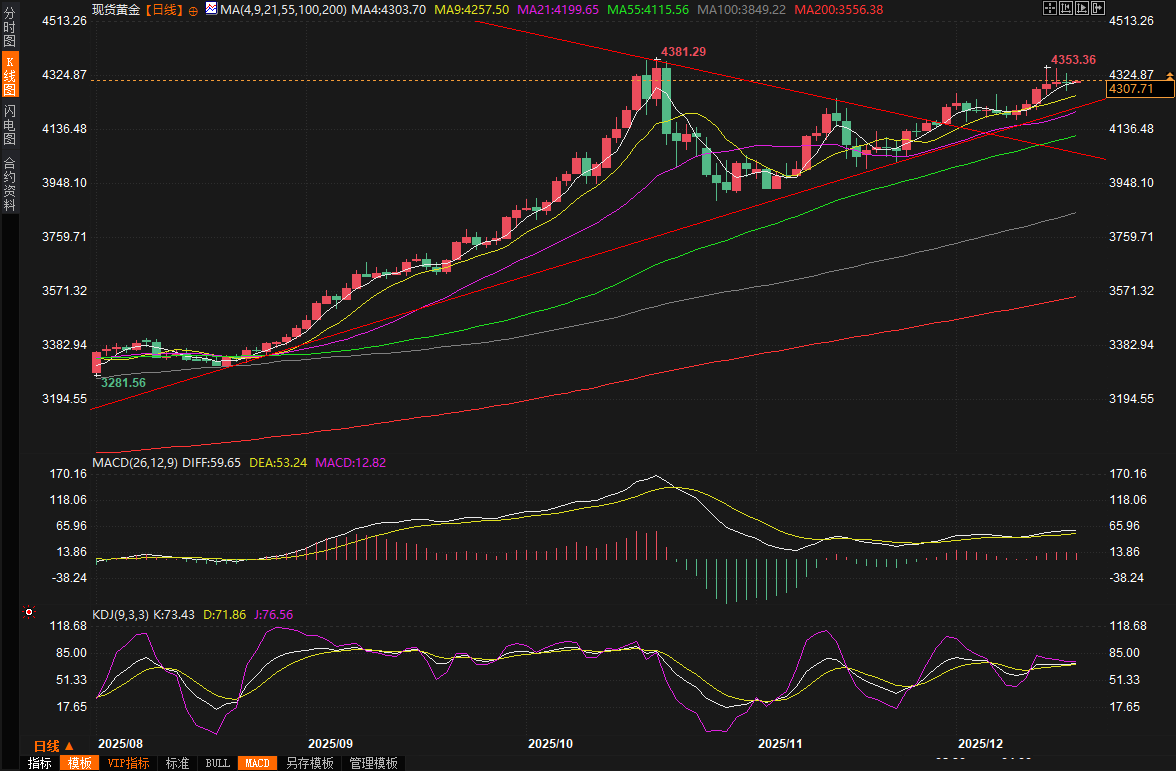
(Spot gold daily chart, source: FX678)
In summarizing these factors, we can see that the gold market is at a delicate balance: the rebound in US employment data has provided some stability, but rising unemployment and weak economic indicators have reinforced expectations of interest rate cuts; while geopolitical risks offer a glimmer of hope for peace, ongoing conflicts continue to safeguard safe-haven demand. Experts predict that if gold closes above $4,400 in 2025, it could rise to $4,859-$5,590 in 2026, and silver might even retest the $50 mark. Investors should closely monitor upcoming inflation data and the Fed's actions to avoid blindly chasing highs, but in the long run, low interest rates and global uncertainty will continue to support gold's upside potential. Furthermore, speeches by Fed officials should be noted today.
At 07:45 Beijing time, spot gold was trading at $4307.38 per ounce.
US jobs data was mixed: growth rebounded but unemployment remained a concern.
The release of the US November jobs report was a major driver of volatility in the gold market.
According to Labor Department data, nonfarm payrolls increased by 64,000 last month, exceeding economists' expectations of 50,000, marking a strong rebound in job growth from October's largest drop in nearly five years. October saw a loss of 105,000 jobs, primarily due to a sharp decline of 162,000 federal government positions resulting from a 43-day government shutdown. The shutdown not only disrupted data collection but also prevented the release of the October unemployment rate, the first time such a situation had occurred since 1948.
Despite better-than-expected job growth, the unemployment rate rose to 4.6% from 4.4% in September, the highest level in more than four years. This increase was partly attributed to technical factors, such as some federal employees self-reporting as unemployed in household surveys when the government shutdown ended, coupled with a survey response rate of only 64%, far below normal levels, and "rotation bias" caused by an unusually large number of new households participating in the survey.
Economists caution that the standard error of the unemployment rate data is higher than normal, thus requiring careful interpretation. While the average monthly increase of 75,000 private sector jobs is seen as a positive sign of a healthy labor market, overall, economic uncertainty stemming from President Trump's aggressive trade policies is making employers more conservative in their hiring. Import tariffs have pushed up commodity prices, leading to cautious spending by consumers, especially low- and middle-income families, as evidenced by flat retail sales in October. These mixed signals have made gold bulls hesitant: the rebound in employment has supported a reduction in the dollar's losses, but the rising unemployment rate has strengthened expectations of interest rate cuts, pushing gold prices back from their lows.
Fed policy shift: Rising expectations of rate cuts, low-interest-rate environment benefits gold.
The Federal Reserve's monetary policy has consistently been a core driver of gold prices. Last week, the Federal Open Market Committee (FOMC) announced a 25 basis point rate cut, adjusting the benchmark interest rate to a range of 3.50%-3.75%. Chairman Powell's remarks were interpreted by the market as more dovish than expected. He specifically mentioned "significant downside risks" to the labor market and cited preliminary benchmark revisions showing an estimate that job growth over the past 12 months was 911,000 fewer than reported. Following this rate cut, officials hinted that borrowing costs were unlikely to decline further in the near term, but the market did not fully embrace this assessment.
US interest rate futures indicate that two more rate cuts are expected in 2026, each by 25 basis points, for a total of 59 basis points for the year. Federal funds rate futures traders believe there is only a 24% probability of a rate cut at the January meeting, with the next cut likely in April. Non-interest-bearing gold typically performs strongly in low-interest-rate environments due to reduced opportunity costs, and a weaker dollar further enhances its appeal.
On Tuesday, the dollar index fell to a two-month low of 98.22, hitting a new low since October 7 at 97.87 during the session, directly making dollar-denominated gold cheaper for overseas buyers. Meanwhile, the 10-year Treasury yield edged lower to 4.155%, and the two-year yield fell to 3.485%, with the spread remaining at 67 basis points. Economists pointed out that wage growth slowed to 3.5%, the lowest level since May 2021, which helped curb inflation but could also weaken consumer spending, further amplifying the risk of a slowdown in the labor market. Investors are awaiting Thursday's November CPI and Friday's PCE data; weak inflation data would further solidify expectations of interest rate cuts, pushing gold prices higher.
Escalating geopolitical risks: The Russia-Ukraine conflict injects safe-haven appeal into gold.
Besides US economic data, the latest developments in the Russia-Ukraine conflict have also provided significant safe-haven support for gold. Gold prices initially fell on Tuesday as rumors of a peaceful future in Ukraine dampened safe-haven demand, but subsequently rebounded. The Russian Ministry of Defense stated that it had taken control of the Novoplatonovka settlement in the Kharkiv region and carried out 154 strikes against Ukrainian military facilities, destroying several armored vehicles and drones.
Ukraine reports repelling Russian attacks from multiple directions and destroying Russian tanks and artillery. The US and EU are considering providing security protection to Ukraine after a ceasefire. German Chancellor Merz stated that peacekeeping forces could use force against Russian troops if necessary, emphasizing the US commitment to protecting Ukraine as it would protect NATO territory under a ceasefire. This includes establishing a demilitarized zone and actions against any potential invasion, although Russia has not yet agreed to the agreement.
Mertz believes there is a 50% chance that Europe will reach an agreement to use frozen Russian assets to provide financial support to Ukraine for at least two years.
These developments indicate that geopolitical tensions are far from eased, and any escalation of conflict could quickly drive up demand for gold. As a traditional safe-haven asset, gold often benefits from heightened uncertainty, especially when stock markets fall, the dollar weakens, and bond yields decline. Tuesday's decline in Wall Street stocks reflects this risk aversion.
Weak global economic indicators: PMI decline suggests slower growth
The broader global economic context is also influencing the gold market. The S&P Global PMI preliminary reading for December, released Tuesday, fell to 53.0, the lowest since June and down from 54.2 in November. While a reading above 50 indicates continued economic expansion, new business growth was the smallest in 20 months, and new goods orders declined for the first time in a year. The services PMI fell to 52.9, and the manufacturing PMI fell to 51.8, both below expectations.
Chief Business Economist Chris Williamson points out that this suggests a weakening economic growth momentum, with fourth-quarter GDP growing at an annualized rate of approximately 2.5%, but slowing for two consecutive months. Job growth is constrained by cost concerns and weak demand, while input prices have risen to their highest level in three years, with service sector costs surging, adding to the Federal Reserve's hesitation regarding interest rate cuts. From a global perspective, these indicators reflect increased economic uncertainty, particularly under the influence of Trump's trade policies. While consumer spending remains resilient, further weakening of the labor market remains a major risk. Gold, as a hedging tool, becomes even more valuable in this environment.
(Spot gold daily chart, source: FX678)
In summarizing these factors, we can see that the gold market is at a delicate balance: the rebound in US employment data has provided some stability, but rising unemployment and weak economic indicators have reinforced expectations of interest rate cuts; while geopolitical risks offer a glimmer of hope for peace, ongoing conflicts continue to safeguard safe-haven demand. Experts predict that if gold closes above $4,400 in 2025, it could rise to $4,859-$5,590 in 2026, and silver might even retest the $50 mark. Investors should closely monitor upcoming inflation data and the Fed's actions to avoid blindly chasing highs, but in the long run, low interest rates and global uncertainty will continue to support gold's upside potential. Furthermore, speeches by Fed officials should be noted today.
At 07:45 Beijing time, spot gold was trading at $4307.38 per ounce.
- Risk Warning and Disclaimer
- The market involves risk, and trading may not be suitable for all investors. This article is for reference only and does not constitute personal investment advice, nor does it take into account certain users’ specific investment objectives, financial situation, or other needs. Any investment decisions made based on this information are at your own risk.