Crude oil trading alert: Weakening geopolitical premiums coupled with increasing inventory pressure are accelerating the decline in oil prices.
2025-12-17 09:11:44
International crude oil prices rebounded slightly on Wednesday, failing to continue yesterday's weakness, but have now broken below the support level of the trading range. After the rebound, further declines are possible, with prices trading around $55.67 per barrel during the Asian session. Yesterday, Brent crude oil successively broke through the key levels of $60 and $59, while WTI crude oil briefly fell below $55 per barrel, hitting its lowest level since the beginning of 2021.
After key technical support levels were breached, market sentiment turned bearish. From a funding perspective, money management companies reduced their net long positions in Brent crude oil to the lowest level since the end of October last week, commodity trading advisors generally held a bearish stance, and trend-following funds were almost at their maximum short position.
Meanwhile, implied volatility for the WTI next-month contract fell to its lowest level since April, and option skewness indicated that demand for put options was dominant, reflecting that market pricing in downside risk is solidifying.
On the fundamental side, as expectations of a ceasefire continue to rise, market concerns about the disruption of Russian oil exports have eased significantly. This change comes at a time when global crude oil inventories are already at a relatively abundant or even excessive level.
Once the relevant agreement is implemented, the risk of short-term supply disruptions in Russia will decrease significantly, and a large amount of Russian crude oil currently stranded at sea may flow back into the market.
According to data from oil analysis firm Vortexa, there are currently about 1.4 billion barrels of crude oil in "floating storage" worldwide, providing a realistic basis for the potential release of supply.

The latest developments in the Russia-Ukraine ceasefire negotiations have shifted from supporting oil prices to suppressing them, becoming a significant trigger for traders to short the market.
Despite ongoing attacks by Ukraine on some Russian oil refining facilities and related assets, the risks to shipping security in the Black Sea have not been completely eliminated, and the United States has taken enforcement actions against tankers from individual oil-producing countries, market price trends clearly show that whenever there are positive signs in the negotiations, oil prices face significant downward pressure.
Analysts believe that geopolitical risk premiums are being systematically squeezed out of the oil price system, and the bullish logic that originally hedged against supply disruptions is rapidly collapsing.
High inventory levels coupled with policy changes could further amplify the oversupply. On the supply side, both the U.S. Energy Information Administration (EIA) and the International Energy Agency (IEA) have warned that the global crude oil market is facing a structural surplus rarely seen in recent years, with inventory levels rising to a near four-year high.
If the peace process progresses, attacks on oil infrastructure and related sanctions may be lifted relatively quickly, which will accelerate the return of supplies.
Furthermore, changes in the sanctions environment may reshape the internal incentive mechanisms of OPEC+. Given the previous suspension of production increases, if member countries choose to increase output again to compete for market share, supply-side pressures could intensify once more.
The latest U.S. data shows that while national commercial crude oil inventories fell by about 1.8 million barrels, the decline was significantly less than market expectations; inventories in Cushing, Oklahoma, rose for the first time in a month after a period of continuous decline.
Meanwhile, refinery operating rates remain at a relatively high level for the same period since 2018, but this has not translated into strong competition for crude oil. Changes in crack spreads also confirm the loose supply situation.
The crack spread fell to its lowest level since February, and the profit margins for gasoline and diesel declined in tandem, indicating that the refinery system was not short of raw materials at the end of the year and that the supply of refined oil products was in a "comfortable range".
On the demand side, no force has yet emerged to reverse the supply-demand imbalance. U.S. gasoline demand weakened at the end of the year and is currently down about 1.3% year-on-year. Although cold weather boosted heating demand, leading to a temporary rebound in distillate fuel consumption, and aviation fuel demand recovered somewhat, these localized improvements failed to prevent crack spreads from declining or inventories from remaining high.
Globally, apparent oil demand still grew year-on-year in November, but the Middle East spot market weakened significantly. The premium of Murban crude over Brent narrowed to its lowest level since early October, and crude oil offers to Asian buyers showed a significant discount, indicating stronger bargaining power in the region.
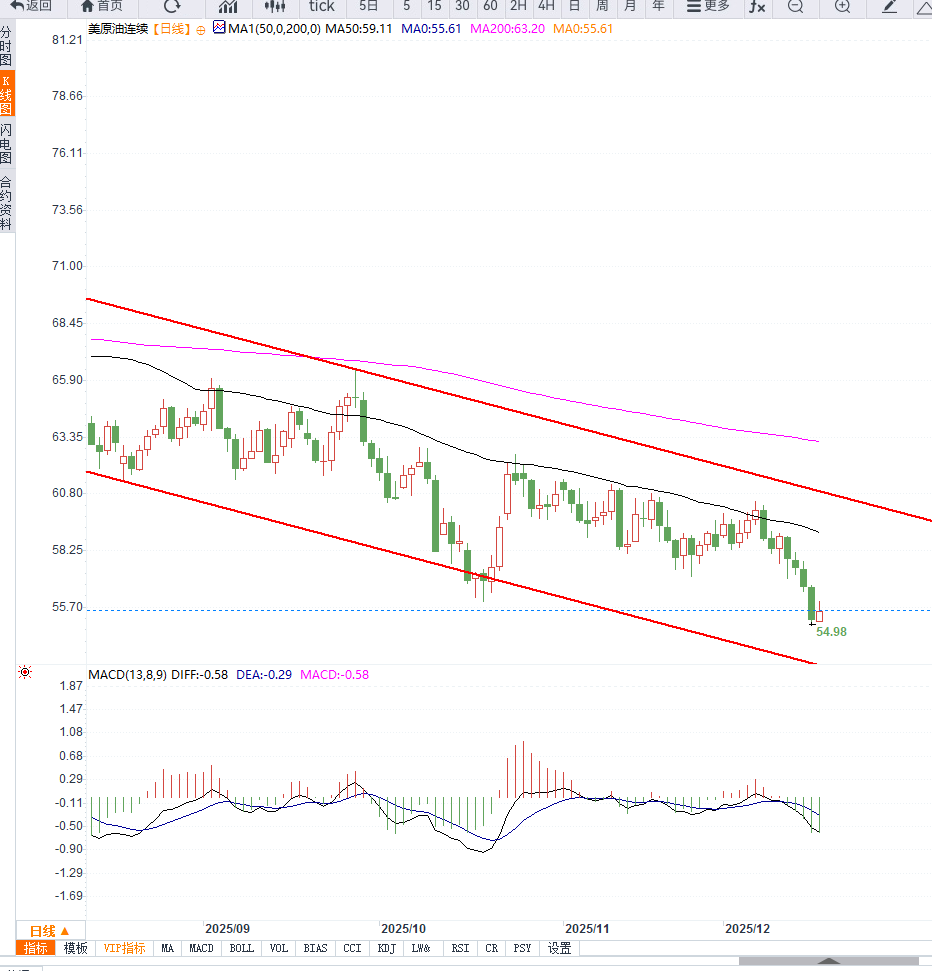
The WTI near-month contract is trading around $55.60 per barrel. The price has broken below the previous consolidation range. If it falls further, the short-term support level is $54.50. If this level is breached, the price could target the $52 area. The resistance level is $56.50–$57.00, and a significant positive fundamental factor is needed for a recovery.
The short- and medium-term moving average system is in a bearish alignment, and rebounds are more likely to be seen as technical corrections rather than trend reversals.
Editor's Note:
The core logic of the current crude oil market has shifted from "supply disruption concerns" to "supply release expectations." The prospect of a ceasefire has weakened the geopolitical premium, while high inventories, weak refining spreads, and short selling by funds have combined to exert systemic downward pressure on oil prices.
In the absence of strong demand-side stimulus, crude oil is more likely to maintain a weak trend, and any rebound should be viewed as a temporary correction within a medium-term downtrend.
After key technical support levels were breached, market sentiment turned bearish. From a funding perspective, money management companies reduced their net long positions in Brent crude oil to the lowest level since the end of October last week, commodity trading advisors generally held a bearish stance, and trend-following funds were almost at their maximum short position.
Meanwhile, implied volatility for the WTI next-month contract fell to its lowest level since April, and option skewness indicated that demand for put options was dominant, reflecting that market pricing in downside risk is solidifying.
On the fundamental side, as expectations of a ceasefire continue to rise, market concerns about the disruption of Russian oil exports have eased significantly. This change comes at a time when global crude oil inventories are already at a relatively abundant or even excessive level.
Once the relevant agreement is implemented, the risk of short-term supply disruptions in Russia will decrease significantly, and a large amount of Russian crude oil currently stranded at sea may flow back into the market.
According to data from oil analysis firm Vortexa, there are currently about 1.4 billion barrels of crude oil in "floating storage" worldwide, providing a realistic basis for the potential release of supply.
The latest developments in the Russia-Ukraine ceasefire negotiations have shifted from supporting oil prices to suppressing them, becoming a significant trigger for traders to short the market.
Despite ongoing attacks by Ukraine on some Russian oil refining facilities and related assets, the risks to shipping security in the Black Sea have not been completely eliminated, and the United States has taken enforcement actions against tankers from individual oil-producing countries, market price trends clearly show that whenever there are positive signs in the negotiations, oil prices face significant downward pressure.
Analysts believe that geopolitical risk premiums are being systematically squeezed out of the oil price system, and the bullish logic that originally hedged against supply disruptions is rapidly collapsing.
High inventory levels coupled with policy changes could further amplify the oversupply. On the supply side, both the U.S. Energy Information Administration (EIA) and the International Energy Agency (IEA) have warned that the global crude oil market is facing a structural surplus rarely seen in recent years, with inventory levels rising to a near four-year high.
If the peace process progresses, attacks on oil infrastructure and related sanctions may be lifted relatively quickly, which will accelerate the return of supplies.
Furthermore, changes in the sanctions environment may reshape the internal incentive mechanisms of OPEC+. Given the previous suspension of production increases, if member countries choose to increase output again to compete for market share, supply-side pressures could intensify once more.
The latest U.S. data shows that while national commercial crude oil inventories fell by about 1.8 million barrels, the decline was significantly less than market expectations; inventories in Cushing, Oklahoma, rose for the first time in a month after a period of continuous decline.
Meanwhile, refinery operating rates remain at a relatively high level for the same period since 2018, but this has not translated into strong competition for crude oil. Changes in crack spreads also confirm the loose supply situation.
The crack spread fell to its lowest level since February, and the profit margins for gasoline and diesel declined in tandem, indicating that the refinery system was not short of raw materials at the end of the year and that the supply of refined oil products was in a "comfortable range".
On the demand side, no force has yet emerged to reverse the supply-demand imbalance. U.S. gasoline demand weakened at the end of the year and is currently down about 1.3% year-on-year. Although cold weather boosted heating demand, leading to a temporary rebound in distillate fuel consumption, and aviation fuel demand recovered somewhat, these localized improvements failed to prevent crack spreads from declining or inventories from remaining high.
Globally, apparent oil demand still grew year-on-year in November, but the Middle East spot market weakened significantly. The premium of Murban crude over Brent narrowed to its lowest level since early October, and crude oil offers to Asian buyers showed a significant discount, indicating stronger bargaining power in the region.
The WTI near-month contract is trading around $55.60 per barrel. The price has broken below the previous consolidation range. If it falls further, the short-term support level is $54.50. If this level is breached, the price could target the $52 area. The resistance level is $56.50–$57.00, and a significant positive fundamental factor is needed for a recovery.
The short- and medium-term moving average system is in a bearish alignment, and rebounds are more likely to be seen as technical corrections rather than trend reversals.
Editor's Note:
The core logic of the current crude oil market has shifted from "supply disruption concerns" to "supply release expectations." The prospect of a ceasefire has weakened the geopolitical premium, while high inventories, weak refining spreads, and short selling by funds have combined to exert systemic downward pressure on oil prices.
In the absence of strong demand-side stimulus, crude oil is more likely to maintain a weak trend, and any rebound should be viewed as a temporary correction within a medium-term downtrend.
- Risk Warning and Disclaimer
- The market involves risk, and trading may not be suitable for all investors. This article is for reference only and does not constitute personal investment advice, nor does it take into account certain users’ specific investment objectives, financial situation, or other needs. Any investment decisions made based on this information are at your own risk.