The euro has surged, so why are traders quietly reducing their positions? Two major concerns are at play.
2025-12-17 15:36:07
Wednesday, December 17th. Over the past two trading days, the euro briefly broke through 1.1800 against the US dollar, reaching a relative high since late September, but momentum subsequently weakened, giving back gains. Currently, in early European trading, it has fallen back to around 1.1700. While the short-term trend appears to be dominated by a "rise and fall," two main factors are at play: firstly, the recalibration of dollar interest rate expectations due to US employment data; and secondly, the upcoming interest rate decision and updated macroeconomic forecasts from the European Central Bank, making euro bulls more cautious.

Recent US employment data has sent mixed signals. The latest figures show a decrease of 105,000 in non-farm payrolls in October, compared to an increase of 64,000 in November. On the surface, the significant decline in October could easily trigger market speculation of an economic slowdown, thus depressing the dollar immediately after the data release. However, the dollar's subsequent rapid stabilization and recovery suggests that traders are more focused on the "underlying components and sustainability of the data" rather than just the single-month result. One explanation for the October outlier is that government sector jobs were disrupted during the shutdown, reducing the representativeness of the monthly figure. In this narrative, the drag on the dollar from the employment data appears more like a short-lived shock than a trend reversal.
In terms of interest rate expectations, the policy path implied by interest rate futures has not shifted significantly due to this employment data: the pricing probability of a 25 basis point rate cut in January remains around 25%. This "probability unchanged, volatility preceding price action" state often means that the foreign exchange market is more prone to two types of behavior: first, the directional reaction at the moment of data release is faster and sharper, but shorter in duration; second, prices subsequently re-anchor to the main theme of "official statements and financial conditions," with the dollar returning to a pricing framework centered on yields and risk appetite. Meanwhile, some Federal Reserve officials emphasized that the employment picture is "mixed," and pointed out that several surveys still point to rising input costs. For the dollar, the impact of such statements is not to provide definitive conclusions, but to increase the market's weight of "patient observation," making the dollar more likely to find support after a pullback.
If the dollar's situation is one of "expectations not having completely shifted," then the euro's situation is one of "event risks approaching, and pricing space needing verification." The European Central Bank (ECB) will announce its interest rate decision and release revised macroeconomic forecasts on Thursday, which makes the euro's trading logic emphasize two points: First, the market will assess whether the ECB's trade-off between declining inflation and growth resilience has changed, especially whether its wording on the future pace of policy is more neutral or more dovish; second, the forecast path itself will affect the expected central level of the Eurozone yield curve, thus transmitting to the euro exchange rate through the interest rate differential. Given that the euro has already risen against the dollar and reached a relatively high level, it is not surprising that bulls are choosing to reduce their exposure before the event without further "fundamental confirmation," which explains why the price has struggled to continue its breakout above 1.1800.
This round of volatility is more like a combination of a dollar rebound and the euro awaiting a catalyst. In the US, several Federal Reserve officials will speak in the next day or two. During this window of limited major data releases, the marginal impact of these speeches on short-term interest rate expectations will be amplified: if more officials echo the approach of "keeping interest rates unchanged and observing cost pressures," the dollar may remain resilient, suppressing the euro's upward momentum against the dollar; conversely, if officials emphasize the risks of weakening employment and maintain greater flexibility in future policy, the dollar's rebound may be limited, and the exchange rate is more likely to revert to pricing driven primarily by the European Central Bank's actions.
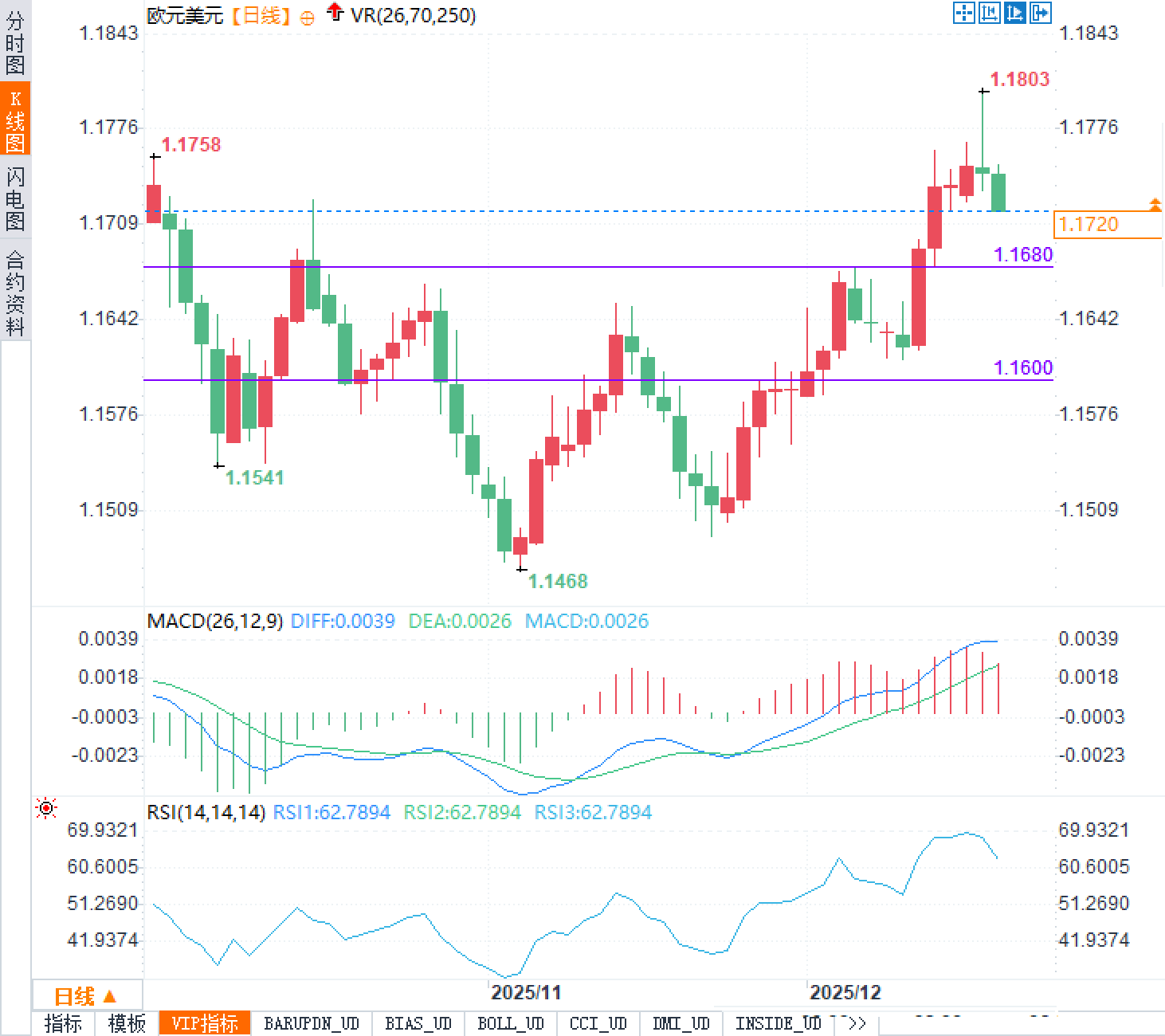
Technical patterns are also reinforcing this atmosphere of "caution at high levels." On the daily chart, the previous high for EUR/USD was around 1.1803. The 1.1800 area is both a psychological level and a key retracement zone since late September. A short-term breakout that failed to hold could trigger some funds to view it as a short-term resistance zone. Currently, 1.1720 is in the upper-middle part of an upward wave, and there is a relatively clear horizontal support zone around 1.1680. If the pullback deepens, the area around 1.1600 represents a lower structural support level.
Market focus is likely to concentrate on three key "verification points." First, whether speeches by Federal Reserve officials reinforce the pricing of "delayed easing," thereby influencing exchange rate elasticity through short-term yields and the cost of dollar funding. Second, how the European Central Bank describes the path of inflation decline and its assessment of economic momentum in its interest rate decisions and macroeconomic forecasts will determine whether the euro yield curve can provide new upward momentum for the exchange rate. Third, technically, the price's reaction to the support zone around 1.1680 will reflect the understanding of the "reversal nature" by both bulls and bears: if trading and volatility are more orderly during the pullback, it often indicates a rebalancing before an event; if the pullback is accompanied by significantly increased volatility, it may suggest that the market is pricing in increased risk in the macroeconomic narrative.
In summary, the euro's pullback from above 1.1800 to around 1.1700 against the dollar does not necessarily indicate a trend reversal. Rather, it is more likely that the dollar completed a second pricing after the impact of the employment data, while the euro entered a wait-and-see phase ahead of the ECB's decision.
Recent US employment data has sent mixed signals. The latest figures show a decrease of 105,000 in non-farm payrolls in October, compared to an increase of 64,000 in November. On the surface, the significant decline in October could easily trigger market speculation of an economic slowdown, thus depressing the dollar immediately after the data release. However, the dollar's subsequent rapid stabilization and recovery suggests that traders are more focused on the "underlying components and sustainability of the data" rather than just the single-month result. One explanation for the October outlier is that government sector jobs were disrupted during the shutdown, reducing the representativeness of the monthly figure. In this narrative, the drag on the dollar from the employment data appears more like a short-lived shock than a trend reversal.
In terms of interest rate expectations, the policy path implied by interest rate futures has not shifted significantly due to this employment data: the pricing probability of a 25 basis point rate cut in January remains around 25%. This "probability unchanged, volatility preceding price action" state often means that the foreign exchange market is more prone to two types of behavior: first, the directional reaction at the moment of data release is faster and sharper, but shorter in duration; second, prices subsequently re-anchor to the main theme of "official statements and financial conditions," with the dollar returning to a pricing framework centered on yields and risk appetite. Meanwhile, some Federal Reserve officials emphasized that the employment picture is "mixed," and pointed out that several surveys still point to rising input costs. For the dollar, the impact of such statements is not to provide definitive conclusions, but to increase the market's weight of "patient observation," making the dollar more likely to find support after a pullback.
If the dollar's situation is one of "expectations not having completely shifted," then the euro's situation is one of "event risks approaching, and pricing space needing verification." The European Central Bank (ECB) will announce its interest rate decision and release revised macroeconomic forecasts on Thursday, which makes the euro's trading logic emphasize two points: First, the market will assess whether the ECB's trade-off between declining inflation and growth resilience has changed, especially whether its wording on the future pace of policy is more neutral or more dovish; second, the forecast path itself will affect the expected central level of the Eurozone yield curve, thus transmitting to the euro exchange rate through the interest rate differential. Given that the euro has already risen against the dollar and reached a relatively high level, it is not surprising that bulls are choosing to reduce their exposure before the event without further "fundamental confirmation," which explains why the price has struggled to continue its breakout above 1.1800.
Market performance
This round of volatility is more like a combination of a dollar rebound and the euro awaiting a catalyst. In the US, several Federal Reserve officials will speak in the next day or two. During this window of limited major data releases, the marginal impact of these speeches on short-term interest rate expectations will be amplified: if more officials echo the approach of "keeping interest rates unchanged and observing cost pressures," the dollar may remain resilient, suppressing the euro's upward momentum against the dollar; conversely, if officials emphasize the risks of weakening employment and maintain greater flexibility in future policy, the dollar's rebound may be limited, and the exchange rate is more likely to revert to pricing driven primarily by the European Central Bank's actions.
Technical patterns are also reinforcing this atmosphere of "caution at high levels." On the daily chart, the previous high for EUR/USD was around 1.1803. The 1.1800 area is both a psychological level and a key retracement zone since late September. A short-term breakout that failed to hold could trigger some funds to view it as a short-term resistance zone. Currently, 1.1720 is in the upper-middle part of an upward wave, and there is a relatively clear horizontal support zone around 1.1680. If the pullback deepens, the area around 1.1600 represents a lower structural support level.
Looking ahead
Market focus is likely to concentrate on three key "verification points." First, whether speeches by Federal Reserve officials reinforce the pricing of "delayed easing," thereby influencing exchange rate elasticity through short-term yields and the cost of dollar funding. Second, how the European Central Bank describes the path of inflation decline and its assessment of economic momentum in its interest rate decisions and macroeconomic forecasts will determine whether the euro yield curve can provide new upward momentum for the exchange rate. Third, technically, the price's reaction to the support zone around 1.1680 will reflect the understanding of the "reversal nature" by both bulls and bears: if trading and volatility are more orderly during the pullback, it often indicates a rebalancing before an event; if the pullback is accompanied by significantly increased volatility, it may suggest that the market is pricing in increased risk in the macroeconomic narrative.
In summary, the euro's pullback from above 1.1800 to around 1.1700 against the dollar does not necessarily indicate a trend reversal. Rather, it is more likely that the dollar completed a second pricing after the impact of the employment data, while the euro entered a wait-and-see phase ahead of the ECB's decision.
- Risk Warning and Disclaimer
- The market involves risk, and trading may not be suitable for all investors. This article is for reference only and does not constitute personal investment advice, nor does it take into account certain users’ specific investment objectives, financial situation, or other needs. Any investment decisions made based on this information are at your own risk.