Why did the USD/CAD pair suddenly rebound after falling by half? The truth behind it is surprising.
2025-12-17 19:57:44
Wednesday, December 17th. As the year draws to a close, the market is balancing the release of delayed US labor market data with rebalancing positions in preparation for the upcoming US Consumer Price Index (CPI) data. Against this backdrop, the USD/CAD pair rebounded from a recent low of around 1.3745, trading above 1.3780 during the European session.
The core of this round of USD/CAD fluctuations remains the relative strength between the "repricing of the Fed's rate-cutting path" and the "Bank of Canada's willingness to maintain interest rates." US labor market data is showing signs of weakness: net employment fell by approximately 105,000 in October, and while it rebounded by about 64,000 in November, this was less than the market's expectation of a "stronger recovery"; the unemployment rate rose to a four-year high of 4.6%, while wage growth slowed to 3.5% year-on-year. Looking at this information alone, it would typically push the market towards a more dovish interest rate expectation, meaning that the Fed has more room to continue easing. The problem is that exchange rates don't just trade on the data itself, but also on the "increase in the data relative to expectations" and "whether the expectations have already been priced in." When the market has already priced in the weak data and the expectation of rate cuts, the downward pressure on the dollar from new information may diminish, even leading to a typical pattern of "first falling, then stabilizing, and then rebounding."
This also explains the dollar's rebound after a period of weakness. Market expectations for the Fed's actions in January have cooled significantly, while assessments of the March meeting are closer to a 50/50 split. In this divergent landscape, the dollar's direction is driven by the next key inflation data point: if inflation provides clearer evidence of a downward trend, the narrative of interest rate cuts will be smoother; if inflation remains sticky, the pace of rate cuts will be forced to be delayed. With the US Consumer Price Index approaching, funds are more inclined to reduce unilateral exposure and instead hedge risks through short-term fluctuations, which will lead to more frequent fluctuations in the USD/CAD pair within a low range.
The variables on the Canadian side are relatively more "stable." Bank of Canada Governor Macklem's statement emphasized that the current interest rate level is "appropriate," with the goal of keeping inflation near 2%, conveying a strong "hold-off" signal and suppressing market expectations for another near-term rate hike. Meanwhile, Canada's November Consumer Price Index (CPI) remained at 2.2% year-on-year, lower than the market's previous expectation of a rebound to 2.4%; the core CPI fell 0.1% month-on-month, and the year-on-year growth rate was 2.9%, unchanged from the previous month. For the Canadian dollar, this data doesn't simply mean bullish or bearish: inflation hasn't rebounded significantly, making further rate hikes less urgent; however, inflation hasn't plummeted either, meaning there's also little compelling reason to quickly shift to easing. As a result, the Canadian dollar's pricing is more range-bound, fluctuating more in line with the external US dollar.
Looking at both ends together helps explain the USD/CAD pair's "falling to a low and then being pulled back" structure: While the US dollar is pressured by weakening labor market conditions, the marginal change in interest rate cut expectations may have already been partially priced in; the Canadian dollar, anchored by the Bank of Canada's "appropriate interest rate," lacks new catalysts for significant strengthening. Therefore, the exchange rate is prone to rebalancing before key data releases: the demand for dollar replenishment and profit-taking by low-level short sellers jointly drive a recovery from around 1.3745 to the 1.3780 and 1.3790 areas.
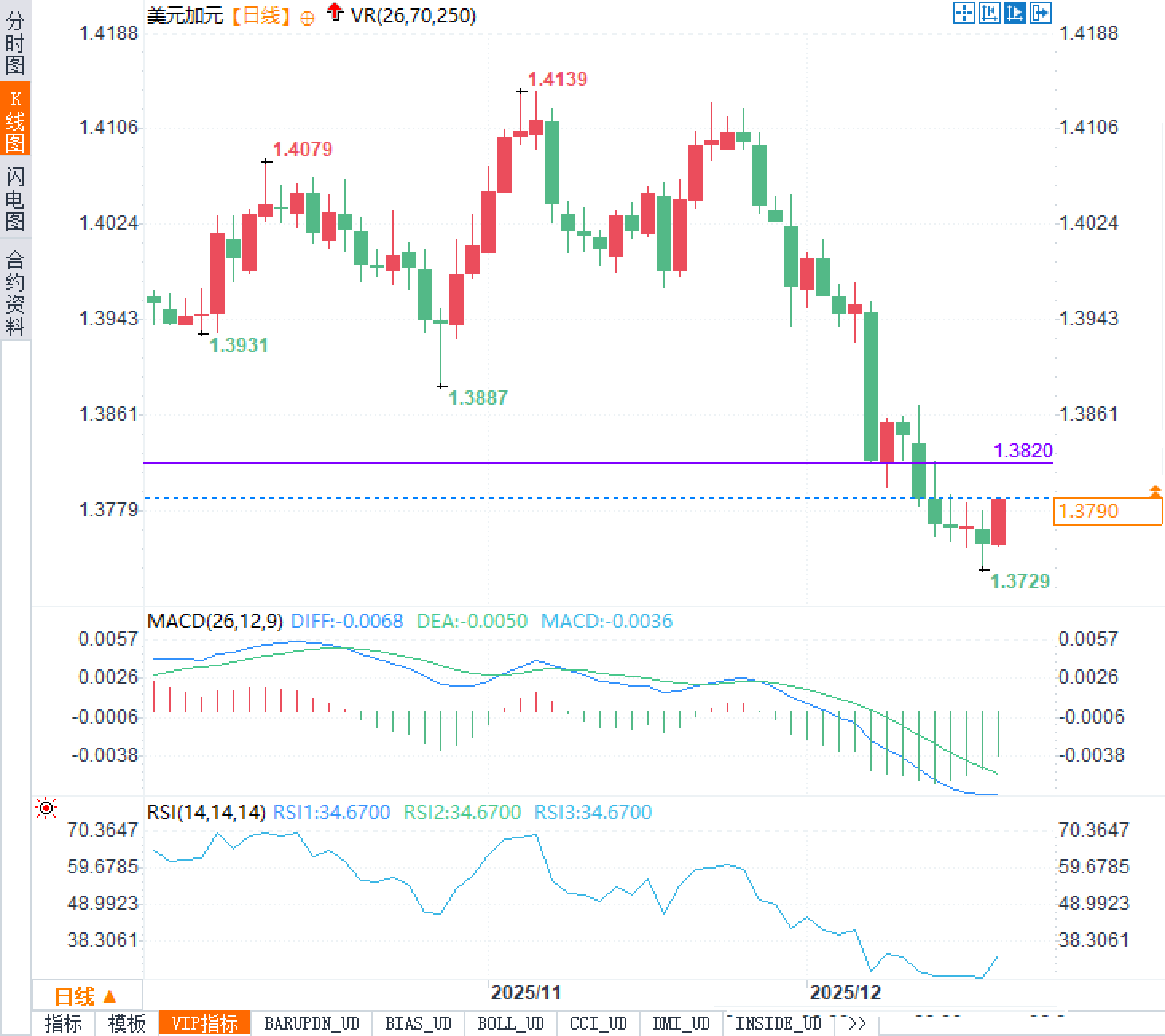
The daily chart shows that the exchange rate previously fell from a high near 1.41, recently breaking below and retesting the key reference area around 1.3820, and is currently trading below it. In terms of momentum indicators, the MACD is below the zero line and the histogram is weak, reflecting that the downward trend still dominates; the RSI is hovering around 30, indicating that short-term selling pressure has been largely released, but this does not automatically mean a trend reversal. It's more like entering a consolidation phase of "falling, then recovering, and then choosing a direction again." The recent low near 1.3729 showed a lower shadow, and combined with the current price of 1.3790, the current situation can be understood as a combination of emotional recovery and technical rebound at lower levels.
The performance of the US dollar index also provides an external framework for the USD/CAD pair. The dollar index's moderate rise after digesting the labor market data suggests that funds are not directly equating "weakening labor force" with "long-term dollar weakness," but rather are waiting for confirmation from inflation data before deciding on a medium-term direction. Some analysts, based on price patterns, believe the dollar index may be attempting a phase of upward movement, with initial resistance around 98.80. Even if this upward movement is merely a rebound within a larger correction, it is sufficient to provide short-term support for the USD/CAD pair, preventing a sustained accelerated decline before key data releases.
In summary, the current main themes for USD/CAD can be summarized in three points: First, expectations for a Fed rate cut remain, but the extent to which it can go further needs to be verified by inflation data; second, the Bank of Canada's emphasis on appropriate policy makes the Canadian dollar more stable, appearing more passively following the dollar's fluctuations in the short term; third, year-end liquidity thinning and position adjustments make the price more susceptible to two-way fluctuations. Going forward, traders are likely to continue closely monitoring the US Consumer Price Index and its implications for interest rate paths, while also paying attention to whether Canadian inflation and growth show new deviations, thereby changing the Bank of Canada's focus of its statements.
The core of this round of USD/CAD fluctuations remains the relative strength between the "repricing of the Fed's rate-cutting path" and the "Bank of Canada's willingness to maintain interest rates." US labor market data is showing signs of weakness: net employment fell by approximately 105,000 in October, and while it rebounded by about 64,000 in November, this was less than the market's expectation of a "stronger recovery"; the unemployment rate rose to a four-year high of 4.6%, while wage growth slowed to 3.5% year-on-year. Looking at this information alone, it would typically push the market towards a more dovish interest rate expectation, meaning that the Fed has more room to continue easing. The problem is that exchange rates don't just trade on the data itself, but also on the "increase in the data relative to expectations" and "whether the expectations have already been priced in." When the market has already priced in the weak data and the expectation of rate cuts, the downward pressure on the dollar from new information may diminish, even leading to a typical pattern of "first falling, then stabilizing, and then rebounding."
This also explains the dollar's rebound after a period of weakness. Market expectations for the Fed's actions in January have cooled significantly, while assessments of the March meeting are closer to a 50/50 split. In this divergent landscape, the dollar's direction is driven by the next key inflation data point: if inflation provides clearer evidence of a downward trend, the narrative of interest rate cuts will be smoother; if inflation remains sticky, the pace of rate cuts will be forced to be delayed. With the US Consumer Price Index approaching, funds are more inclined to reduce unilateral exposure and instead hedge risks through short-term fluctuations, which will lead to more frequent fluctuations in the USD/CAD pair within a low range.
The variables on the Canadian side are relatively more "stable." Bank of Canada Governor Macklem's statement emphasized that the current interest rate level is "appropriate," with the goal of keeping inflation near 2%, conveying a strong "hold-off" signal and suppressing market expectations for another near-term rate hike. Meanwhile, Canada's November Consumer Price Index (CPI) remained at 2.2% year-on-year, lower than the market's previous expectation of a rebound to 2.4%; the core CPI fell 0.1% month-on-month, and the year-on-year growth rate was 2.9%, unchanged from the previous month. For the Canadian dollar, this data doesn't simply mean bullish or bearish: inflation hasn't rebounded significantly, making further rate hikes less urgent; however, inflation hasn't plummeted either, meaning there's also little compelling reason to quickly shift to easing. As a result, the Canadian dollar's pricing is more range-bound, fluctuating more in line with the external US dollar.
Looking at both ends together helps explain the USD/CAD pair's "falling to a low and then being pulled back" structure: While the US dollar is pressured by weakening labor market conditions, the marginal change in interest rate cut expectations may have already been partially priced in; the Canadian dollar, anchored by the Bank of Canada's "appropriate interest rate," lacks new catalysts for significant strengthening. Therefore, the exchange rate is prone to rebalancing before key data releases: the demand for dollar replenishment and profit-taking by low-level short sellers jointly drive a recovery from around 1.3745 to the 1.3780 and 1.3790 areas.
Technical aspects
The daily chart shows that the exchange rate previously fell from a high near 1.41, recently breaking below and retesting the key reference area around 1.3820, and is currently trading below it. In terms of momentum indicators, the MACD is below the zero line and the histogram is weak, reflecting that the downward trend still dominates; the RSI is hovering around 30, indicating that short-term selling pressure has been largely released, but this does not automatically mean a trend reversal. It's more like entering a consolidation phase of "falling, then recovering, and then choosing a direction again." The recent low near 1.3729 showed a lower shadow, and combined with the current price of 1.3790, the current situation can be understood as a combination of emotional recovery and technical rebound at lower levels.
The performance of the US dollar index also provides an external framework for the USD/CAD pair. The dollar index's moderate rise after digesting the labor market data suggests that funds are not directly equating "weakening labor force" with "long-term dollar weakness," but rather are waiting for confirmation from inflation data before deciding on a medium-term direction. Some analysts, based on price patterns, believe the dollar index may be attempting a phase of upward movement, with initial resistance around 98.80. Even if this upward movement is merely a rebound within a larger correction, it is sufficient to provide short-term support for the USD/CAD pair, preventing a sustained accelerated decline before key data releases.
In summary, the current main themes for USD/CAD can be summarized in three points: First, expectations for a Fed rate cut remain, but the extent to which it can go further needs to be verified by inflation data; second, the Bank of Canada's emphasis on appropriate policy makes the Canadian dollar more stable, appearing more passively following the dollar's fluctuations in the short term; third, year-end liquidity thinning and position adjustments make the price more susceptible to two-way fluctuations. Going forward, traders are likely to continue closely monitoring the US Consumer Price Index and its implications for interest rate paths, while also paying attention to whether Canadian inflation and growth show new deviations, thereby changing the Bank of Canada's focus of its statements.
- Risk Warning and Disclaimer
- The market involves risk, and trading may not be suitable for all investors. This article is for reference only and does not constitute personal investment advice, nor does it take into account certain users’ specific investment objectives, financial situation, or other needs. Any investment decisions made based on this information are at your own risk.