A rebounding dollar and profit-taking pressured gold prices, causing them to retreat from their highs, but the medium- to long-term bullish trend remains unchanged.
2025-12-18 10:17:37
Gold prices (XAU/USD) edged lower during Thursday's Asian trading session, falling back to around $4,330. Gold had previously hit a seven-week high, and the current pullback is mainly attributed to profit-taking by some long positions and a temporary rebound in the US dollar.
However, overall, the downside potential for gold prices may be relatively limited. From a macroeconomic perspective, the latest US employment data has further strengthened market expectations for future interest rate cuts by the Federal Reserve, which will put downward pressure on the US dollar in the medium term and also benefit the allocation value of gold, a non-interest-bearing asset.
Lower interest rates mean a lower opportunity cost of holding gold, which remains a key factor supporting gold prices. Meanwhile, geopolitical risks have escalated again. Venezuela, under threat of a US blockade, deployed its navy to escort oil tankers, further escalating regional tensions.

This change has heightened market concerns about potential conflict and provided additional support for gold, a traditional safe-haven asset. The market will now turn its attention to the upcoming US inflation data.
The November Consumer Price Index (CPI), to be released later on Thursday, is highly anticipated, with the market expecting a year-on-year increase of 3.1% and core CPI expected to rise by 3.0% year-on-year.
In addition, the number of initial jobless claims in the United States this week will also be released. These data may have a direct impact on the Federal Reserve's policy expectations and the dollar's trend, thereby affecting short-term fluctuations in gold prices.
The Venezuelan government's order for its navy to escort oil tankers has escalated geopolitical tensions and fueled a resurgence of risk aversion. Meanwhile, Federal Reserve Governor Christopher Waller expressed support for continued interest rate cuts to push policy back to neutral, but emphasized that there is no need to rush given the still-high inflation environment.
Atlanta Fed President Raphael Bostic stated that he does not support a near-term rate cut and believes that conditions for a rate cut next year are not present until inflation has clearly subsided. Interest rate futures indicate that the market is currently pricing in a 31% probability of a Fed rate cut next month, a significant increase from before the non-farm payroll data release.
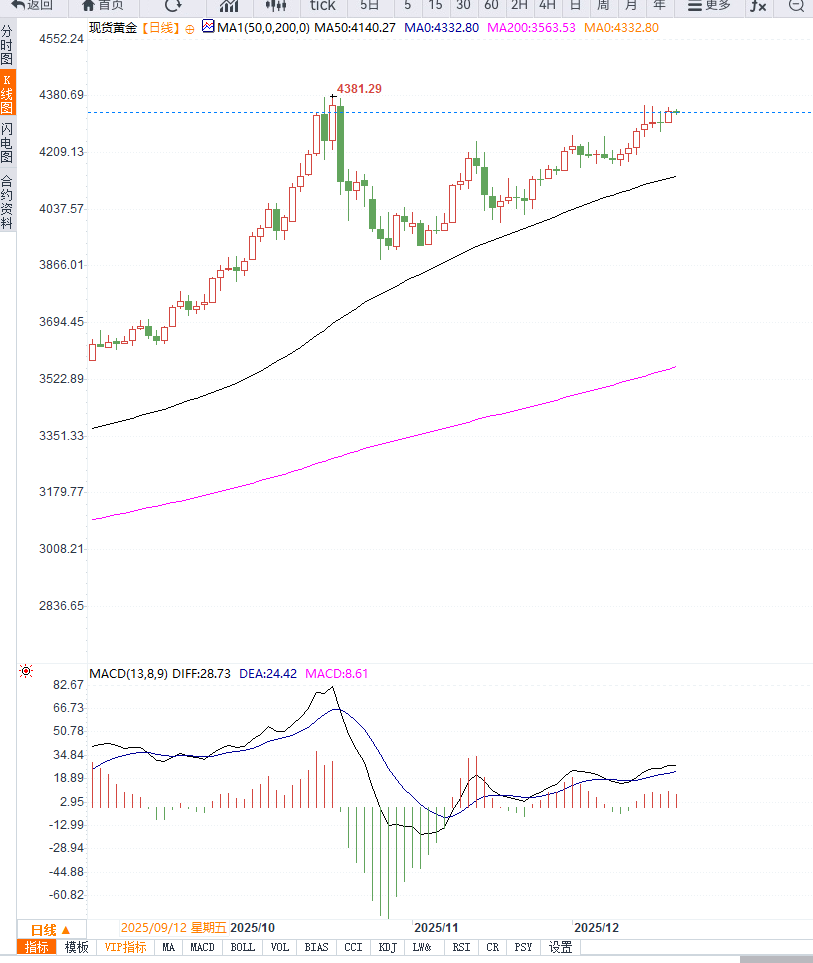
From the 4-hour chart, although gold prices saw a slight pullback during the day, the overall technical structure remains bullish. Prices are still firmly above the 100-day exponential moving average, indicating effective support for the medium-term trend.
The Bollinger Bands are expanding, suggesting increased volatility, and the 14-period RSI indicator is above the 50 midline, indicating that the bullish momentum has not been broken, and the overall "path of least resistance" still leans towards the upside.
If the bulls regain momentum and effectively break through the upper Bollinger Band at around $4,350, gold prices could challenge the historical high of $4,380 again and further test the psychological level of $4,400.
Conversely, if the pullback continues and the price falls below $4,300 (the low of December 17), it may attract more selling pressure in the short term. Key support levels to watch are $4,270 and the 100-day EMA around $4,230. Overall, the technical picture indicates that gold is still in a high-level consolidation phase, and the bullish structure has not yet been broken.
Editor's Note:
Overall, the recent slight pullback in gold prices from their highs appears to be a normal technical adjustment within an uptrend, rather than a trend reversal signal. The US employment data, signaling a "resilient slowdown," makes it difficult to reverse market expectations for further interest rate cuts by the Federal Reserve, which will continue to suppress the dollar and support demand for gold in the medium term.
Meanwhile, escalating geopolitical risks related to Venezuela have also provided a safe-haven premium for gold prices on a sentiment level. It should be noted that key data such as the US CPI may trigger amplified volatility in the short term, and gold prices may fluctuate repeatedly within the high range.
However, until the expectation of declining real interest rates is disproven, the medium- to long-term bullish logic for gold remains valid, and pullbacks are more likely to be seen as buying opportunities rather than signals of a trend reversal to bearishness.
However, overall, the downside potential for gold prices may be relatively limited. From a macroeconomic perspective, the latest US employment data has further strengthened market expectations for future interest rate cuts by the Federal Reserve, which will put downward pressure on the US dollar in the medium term and also benefit the allocation value of gold, a non-interest-bearing asset.
Lower interest rates mean a lower opportunity cost of holding gold, which remains a key factor supporting gold prices. Meanwhile, geopolitical risks have escalated again. Venezuela, under threat of a US blockade, deployed its navy to escort oil tankers, further escalating regional tensions.
This change has heightened market concerns about potential conflict and provided additional support for gold, a traditional safe-haven asset. The market will now turn its attention to the upcoming US inflation data.
The November Consumer Price Index (CPI), to be released later on Thursday, is highly anticipated, with the market expecting a year-on-year increase of 3.1% and core CPI expected to rise by 3.0% year-on-year.
In addition, the number of initial jobless claims in the United States this week will also be released. These data may have a direct impact on the Federal Reserve's policy expectations and the dollar's trend, thereby affecting short-term fluctuations in gold prices.
The Venezuelan government's order for its navy to escort oil tankers has escalated geopolitical tensions and fueled a resurgence of risk aversion. Meanwhile, Federal Reserve Governor Christopher Waller expressed support for continued interest rate cuts to push policy back to neutral, but emphasized that there is no need to rush given the still-high inflation environment.
Atlanta Fed President Raphael Bostic stated that he does not support a near-term rate cut and believes that conditions for a rate cut next year are not present until inflation has clearly subsided. Interest rate futures indicate that the market is currently pricing in a 31% probability of a Fed rate cut next month, a significant increase from before the non-farm payroll data release.
From the 4-hour chart, although gold prices saw a slight pullback during the day, the overall technical structure remains bullish. Prices are still firmly above the 100-day exponential moving average, indicating effective support for the medium-term trend.
The Bollinger Bands are expanding, suggesting increased volatility, and the 14-period RSI indicator is above the 50 midline, indicating that the bullish momentum has not been broken, and the overall "path of least resistance" still leans towards the upside.
If the bulls regain momentum and effectively break through the upper Bollinger Band at around $4,350, gold prices could challenge the historical high of $4,380 again and further test the psychological level of $4,400.
Conversely, if the pullback continues and the price falls below $4,300 (the low of December 17), it may attract more selling pressure in the short term. Key support levels to watch are $4,270 and the 100-day EMA around $4,230. Overall, the technical picture indicates that gold is still in a high-level consolidation phase, and the bullish structure has not yet been broken.
Editor's Note:
Overall, the recent slight pullback in gold prices from their highs appears to be a normal technical adjustment within an uptrend, rather than a trend reversal signal. The US employment data, signaling a "resilient slowdown," makes it difficult to reverse market expectations for further interest rate cuts by the Federal Reserve, which will continue to suppress the dollar and support demand for gold in the medium term.
Meanwhile, escalating geopolitical risks related to Venezuela have also provided a safe-haven premium for gold prices on a sentiment level. It should be noted that key data such as the US CPI may trigger amplified volatility in the short term, and gold prices may fluctuate repeatedly within the high range.
However, until the expectation of declining real interest rates is disproven, the medium- to long-term bullish logic for gold remains valid, and pullbacks are more likely to be seen as buying opportunities rather than signals of a trend reversal to bearishness.
- Risk Warning and Disclaimer
- The market involves risk, and trading may not be suitable for all investors. This article is for reference only and does not constitute personal investment advice, nor does it take into account certain users’ specific investment objectives, financial situation, or other needs. Any investment decisions made based on this information are at your own risk.