The US dollar index lacks upward momentum, awaiting the release of CPI data.
2025-12-18 14:24:03
During Thursday's Asian trading session, the US dollar index lacked momentum after a slight rebound the previous day, fluctuating narrowly below the 98 level and remaining essentially flat throughout the day.
Market sentiment has clearly turned cautious, with investors awaiting the release of the U.S. Consumer Price Index (CPI) during the North American session to determine the Federal Reserve's next policy path.
 Inflation data is considered the most critical pricing variable at present, and its results will directly affect the market's judgment on the interest rate outlook and determine the directional choice of the US dollar index in the next stage.
Ahead of the data release, dovish expectations from the Federal Reserve kept dollar bulls on the defensive. Fundamentally, although the Fed's overall stance still emphasizes "caution," the market has already begun pricing in the possibility of two more rate cuts in 2026.
This expectation is based on the backdrop of a continued cooling of the US labor market, which also weakens the medium-term appeal of the US dollar. Furthermore, political discussions surrounding the selection of the Federal Reserve Chair have, to some extent, fueled market expectations of future policy easing.
US President Trump publicly stated that he hopes the next Federal Reserve Chairman will be more supportive of significant interest rate cuts, a statement that reinforces the market's interpretation of a dovish policy outlook.
However, Federal Reserve Governor Waller's latest remarks eased market concerns to some extent. His emphasis on reiterating the importance of central bank independence to the president provided limited support for the dollar.
However, overall, this support is more of a correction in sentiment and is not enough to reverse the fundamental pressure on the US dollar.
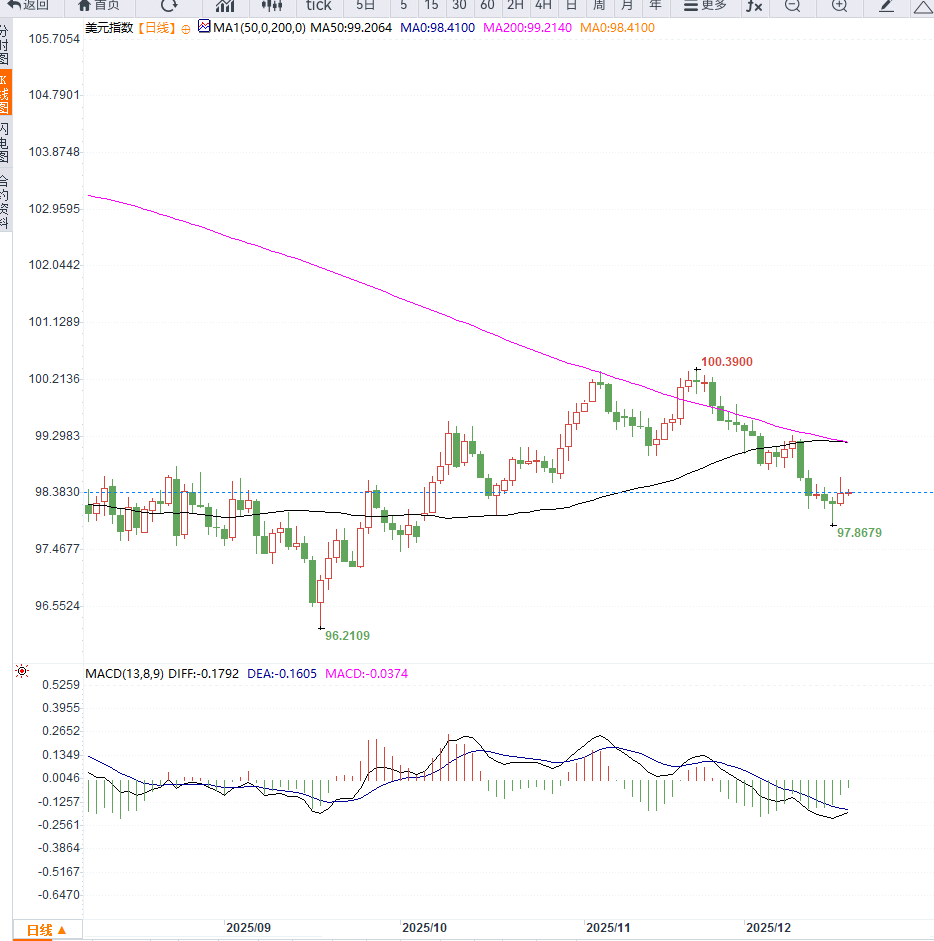
From a technical perspective, the US dollar index's previous rebound failed to hold above the 200-day simple moving average and has since fallen back below it, reinforcing the bearish trend in the short to medium term.
The index is currently trading around the 98 level and remains within a downward channel. In terms of momentum indicators, while the daily oscillator has not yet entered the extreme oversold zone, it remains in a weak range, indicating that downward pressure has not yet been fully released.
In this context, any rebound is more likely to be seen as a technical correction or a selling opportunity rather than a trend reversal. If the index fails to regain the 200-day moving average, there is still a risk of retesting previous lows; only after key moving averages are effectively recovered can the medium-term structure of the US dollar index be repaired.
Editor's Note:
In summary, the US dollar index is currently in a sensitive phase characterized by "bearish fundamentals, technical pressure, and event-driven factors." Before the release of US inflation data, the market lacks a clear direction, and consolidation is the more likely scenario.
From a medium-term perspective, a cooling labor market and dovish policy expectations remain the main constraints on the US dollar. Even if a short-term rebound occurs, it is more of a correction than a trend of strengthening. If inflation does not rebound significantly, the structural pressure on the US dollar will continue, and its future trend should be viewed with caution, as there is a risk of a weak rebound followed by further weakening.
Market sentiment has clearly turned cautious, with investors awaiting the release of the U.S. Consumer Price Index (CPI) during the North American session to determine the Federal Reserve's next policy path.
Inflation data is considered the most critical pricing variable at present, and its results will directly affect the market's judgment on the interest rate outlook and determine the directional choice of the US dollar index in the next stage.Ahead of the data release, dovish expectations from the Federal Reserve kept dollar bulls on the defensive. Fundamentally, although the Fed's overall stance still emphasizes "caution," the market has already begun pricing in the possibility of two more rate cuts in 2026.
This expectation is based on the backdrop of a continued cooling of the US labor market, which also weakens the medium-term appeal of the US dollar. Furthermore, political discussions surrounding the selection of the Federal Reserve Chair have, to some extent, fueled market expectations of future policy easing.
US President Trump publicly stated that he hopes the next Federal Reserve Chairman will be more supportive of significant interest rate cuts, a statement that reinforces the market's interpretation of a dovish policy outlook.
However, Federal Reserve Governor Waller's latest remarks eased market concerns to some extent. His emphasis on reiterating the importance of central bank independence to the president provided limited support for the dollar.
However, overall, this support is more of a correction in sentiment and is not enough to reverse the fundamental pressure on the US dollar.
From a technical perspective, the US dollar index's previous rebound failed to hold above the 200-day simple moving average and has since fallen back below it, reinforcing the bearish trend in the short to medium term.
The index is currently trading around the 98 level and remains within a downward channel. In terms of momentum indicators, while the daily oscillator has not yet entered the extreme oversold zone, it remains in a weak range, indicating that downward pressure has not yet been fully released.
In this context, any rebound is more likely to be seen as a technical correction or a selling opportunity rather than a trend reversal. If the index fails to regain the 200-day moving average, there is still a risk of retesting previous lows; only after key moving averages are effectively recovered can the medium-term structure of the US dollar index be repaired.
Editor's Note:
In summary, the US dollar index is currently in a sensitive phase characterized by "bearish fundamentals, technical pressure, and event-driven factors." Before the release of US inflation data, the market lacks a clear direction, and consolidation is the more likely scenario.
From a medium-term perspective, a cooling labor market and dovish policy expectations remain the main constraints on the US dollar. Even if a short-term rebound occurs, it is more of a correction than a trend of strengthening. If inflation does not rebound significantly, the structural pressure on the US dollar will continue, and its future trend should be viewed with caution, as there is a risk of a weak rebound followed by further weakening.
- Risk Warning and Disclaimer
- The market involves risk, and trading may not be suitable for all investors. This article is for reference only and does not constitute personal investment advice, nor does it take into account certain users’ specific investment objectives, financial situation, or other needs. Any investment decisions made based on this information are at your own risk.