Gold is playing a long game: on the surface it's driven by news, but in reality two underlying lines have already been laid.
2026-01-05 17:55:32
Monday, January 5th. After the New Year, the market has been oscillating between rising risk aversion and the repricing of interest rate expectations. Intraday fluctuations in foreign exchange and US Treasury yields remain key clues for precious metal pricing. Spot gold traded around $4430 during the European session; in a week packed with risk events, prices were significantly more sensitive to news, with funds more inclined to use macroeconomic data and geopolitical variables to validate previously established upward trends.

The direct catalyst driving gold prices higher came from escalating geopolitical tensions in the Americas. Related news increased the uncertainty premium, causing some funds to return to gold, a traditional safe-haven asset, in the short term. It's important to note that the impact of geopolitical events on gold often exhibits a "sentiment-first, verification-later" characteristic: emotional shocks can raise the price center in the short term, but whether they evolve into trend support depends on whether subsequent risks spread and whether they further transmit to broader macroeconomic variables such as energy and inflation expectations.
From a broader fundamental perspective, gold's core support in the near term still stems from a reassessment of the cooling US economy and inflation. Previously released inflation and employment data were weaker than expected, opening up room for speculation about the Federal Reserve's policy path and strengthening expectations of a decline in real interest rates. For gold, real interest rates and opportunity cost are the main drivers of medium-term pricing: when the market believes that "nominal interest rates have limited room to rise, while the rate of inflation decline is slowing," real interest rates are more likely to fall, increasing gold's relative attractiveness. Conversely, if data becomes stronger again and interest rate expectations are reassessed with a more hawkish stance, gold often faces short-term pressure from a combination of valuation squeeze and profit-taking.
This week's key risk events focus on the US labor market and economic indicators. Monday's ISM Manufacturing Purchasing Managers' Index will provide new cross-sectional information on "growth momentum" and "price pressures." Midweek will also see the release of US private sector employment data, the services PMI, and job openings data. Thursday will see the release of initial jobless claims. Friday will bring the market's most anticipated US December non-farm payrolls report. Given that the previous data may have been affected by special factors, this non-farm payrolls report is considered a more accurate indicator of the true employment trend. If employment and wage sub-indices strengthen again, the market may reassess the pace and starting point of interest rate cuts, thus creating temporary volatility in gold prices. If the data remains dovish, it will be more conducive to maintaining the narrative of "slowly declining real interest rates," providing a more solid macroeconomic foundation for gold.
Spot gold previously experienced a rapid pullback after reaching a new high, subsequently returning to a more balanced trading range. This "pump-pullback-repricing" pattern is common in the later stages of a trending market. Looking at the daily chart, the recent high reached around $4549.69, before retreating and repeatedly testing the $4330 level, indicating that this area holds significant short-term significance as a key support/resistance level. Meanwhile, the upward trendline around $4230 has been repeatedly mentioned by the market, appearing more like a "structural support reference" for medium-term trend traders.
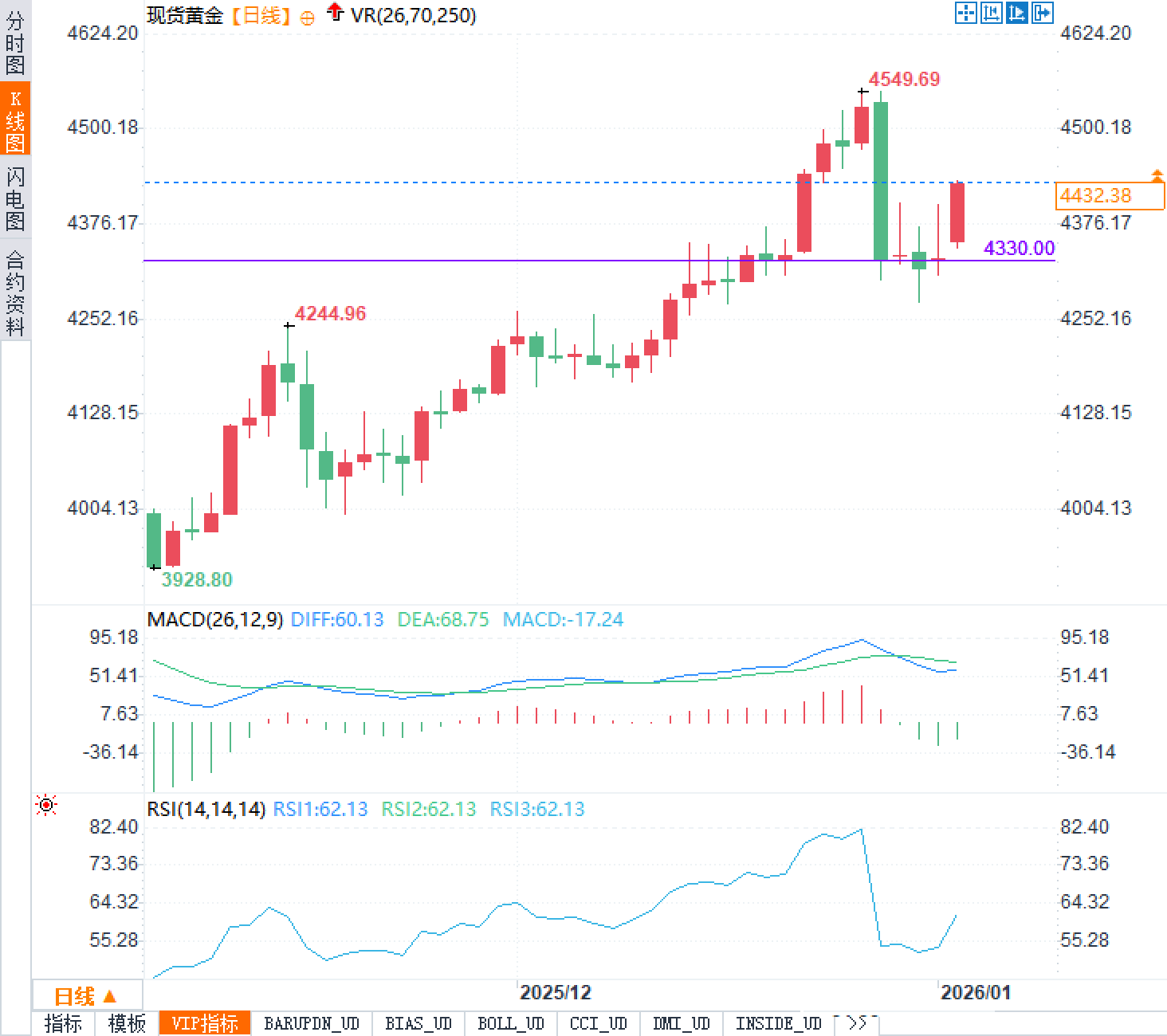
In terms of momentum indicators, the price pullback after the initial surge has cooled short-term momentum, but it hasn't completely disrupted the previous medium-term upward trend. A more direct signal is that when news triggers safe-haven buying, prices quickly return to near the upper edge of the range, indicating that the market hasn't abandoned its demand for gold. However, before important data releases, bulls often choose to reduce leverage and shorten duration, making upward momentum more reliant on unexpected risks and data surprises. Therefore, short-term "news-driven rallies" and "cautious pre-data pullbacks" may alternate, with a high probability of prices repeatedly fluctuating around the key range.
The current market logic for gold presents two parallel main lines. The first is the medium-term main line: pricing around the Federal Reserve's reaction function and real interest rate trends determines the overall direction of gold. The second is the short-term main line: risk premium fluctuations caused by geopolitical uncertainties and unexpected data determine the rhythm and magnitude of gold's price movement on a weekly or even daily basis. The parallel existence of these two main lines means that prices may maintain an upward bias when the macroeconomic narrative is stable, but may also experience significant pullbacks and repricing after a single data release or event shock.
Traders are focusing on two types of "verification." First, whether there are signs of renewed tightening in the labor market, triggering a renewed upward shift in interest rate expectations. Second, whether geopolitical risks escalate from "rhetoric and events" to "persistent conflict or broader policy friction," further impacting inflation and growth expectations. For gold, the former affects opportunity cost more, while the latter affects the safe-haven premium more. When both move in the same direction, the market is more likely to exhibit a one-sided upward trend; when they offset each other, a highly volatile, range-bound trading environment is more likely to emerge.
The direct catalyst driving gold prices higher came from escalating geopolitical tensions in the Americas. Related news increased the uncertainty premium, causing some funds to return to gold, a traditional safe-haven asset, in the short term. It's important to note that the impact of geopolitical events on gold often exhibits a "sentiment-first, verification-later" characteristic: emotional shocks can raise the price center in the short term, but whether they evolve into trend support depends on whether subsequent risks spread and whether they further transmit to broader macroeconomic variables such as energy and inflation expectations.
From a broader fundamental perspective, gold's core support in the near term still stems from a reassessment of the cooling US economy and inflation. Previously released inflation and employment data were weaker than expected, opening up room for speculation about the Federal Reserve's policy path and strengthening expectations of a decline in real interest rates. For gold, real interest rates and opportunity cost are the main drivers of medium-term pricing: when the market believes that "nominal interest rates have limited room to rise, while the rate of inflation decline is slowing," real interest rates are more likely to fall, increasing gold's relative attractiveness. Conversely, if data becomes stronger again and interest rate expectations are reassessed with a more hawkish stance, gold often faces short-term pressure from a combination of valuation squeeze and profit-taking.
This week's key risk events focus on the US labor market and economic indicators. Monday's ISM Manufacturing Purchasing Managers' Index will provide new cross-sectional information on "growth momentum" and "price pressures." Midweek will also see the release of US private sector employment data, the services PMI, and job openings data. Thursday will see the release of initial jobless claims. Friday will bring the market's most anticipated US December non-farm payrolls report. Given that the previous data may have been affected by special factors, this non-farm payrolls report is considered a more accurate indicator of the true employment trend. If employment and wage sub-indices strengthen again, the market may reassess the pace and starting point of interest rate cuts, thus creating temporary volatility in gold prices. If the data remains dovish, it will be more conducive to maintaining the narrative of "slowly declining real interest rates," providing a more solid macroeconomic foundation for gold.
In terms of pricing behavior
Spot gold previously experienced a rapid pullback after reaching a new high, subsequently returning to a more balanced trading range. This "pump-pullback-repricing" pattern is common in the later stages of a trending market. Looking at the daily chart, the recent high reached around $4549.69, before retreating and repeatedly testing the $4330 level, indicating that this area holds significant short-term significance as a key support/resistance level. Meanwhile, the upward trendline around $4230 has been repeatedly mentioned by the market, appearing more like a "structural support reference" for medium-term trend traders.
In terms of momentum indicators, the price pullback after the initial surge has cooled short-term momentum, but it hasn't completely disrupted the previous medium-term upward trend. A more direct signal is that when news triggers safe-haven buying, prices quickly return to near the upper edge of the range, indicating that the market hasn't abandoned its demand for gold. However, before important data releases, bulls often choose to reduce leverage and shorten duration, making upward momentum more reliant on unexpected risks and data surprises. Therefore, short-term "news-driven rallies" and "cautious pre-data pullbacks" may alternate, with a high probability of prices repeatedly fluctuating around the key range.
In summary
The current market logic for gold presents two parallel main lines. The first is the medium-term main line: pricing around the Federal Reserve's reaction function and real interest rate trends determines the overall direction of gold. The second is the short-term main line: risk premium fluctuations caused by geopolitical uncertainties and unexpected data determine the rhythm and magnitude of gold's price movement on a weekly or even daily basis. The parallel existence of these two main lines means that prices may maintain an upward bias when the macroeconomic narrative is stable, but may also experience significant pullbacks and repricing after a single data release or event shock.
Traders are focusing on two types of "verification." First, whether there are signs of renewed tightening in the labor market, triggering a renewed upward shift in interest rate expectations. Second, whether geopolitical risks escalate from "rhetoric and events" to "persistent conflict or broader policy friction," further impacting inflation and growth expectations. For gold, the former affects opportunity cost more, while the latter affects the safe-haven premium more. When both move in the same direction, the market is more likely to exhibit a one-sided upward trend; when they offset each other, a highly volatile, range-bound trading environment is more likely to emerge.
- Risk Warning and Disclaimer
- The market involves risk, and trading may not be suitable for all investors. This article is for reference only and does not constitute personal investment advice, nor does it take into account certain users’ specific investment objectives, financial situation, or other needs. Any investment decisions made based on this information are at your own risk.