Silver prices fell sharply, putting downward pressure on gold prices.
2026-01-08 22:02:42
Gold and silver prices fell in early U.S. trading on Thursday (January 8), with silver experiencing a sharp decline, primarily driven by profit-taking by short-term futures traders and the liquidation of weak long positions. The formation of a bearish technical pattern in the silver market has caused panic among bullish investors in both precious metals. Furthermore, an old trading adage states that a mature bull market requires a continuous influx of new positive news to sustain it. Currently, both precious metals appear to lack such support. February gold futures (generally trading at a premium of several dollars above spot gold) were at $4431.7 per ounce, down $30.8; March silver futures were at $73.83 per ounce, down $3.783.

Gold and silver traders and investors are preparing for the annual rebalancing of commodity indices, with billions of dollars worth of futures contracts potentially being sold off in the coming days. Reports indicate that Citigroup estimates approximately $6.8 billion in silver futures may be sold to meet rebalancing requirements, with a roughly similar outflow from gold futures. Bloomberg points out that this sell-off is due to a significant increase in the weighting of precious metals in benchmark commodity indices.
Data from consulting firm Challenger, Gray & Christmas shows that U.S. layoffs in December fell to their lowest level since July 2024. The firm reported today that U.S. employers announced 35,553 job cuts in December, the lowest number since July 2024, down from 71,321 in November and 8% lower than December 2024. Andy Challenger of the firm stated, “2025 ended with the lowest layoff plans of the year. While December is typically a slow season for layoffs, combined with higher hiring plans, this is a positive sign after a year of high layoff plans.” In 2025, U.S. employers announced a total of 1,206,374 job cuts, a 58% increase from 2024 and the highest level since 2020. The government sector led all industries with 308,167 layoffs, primarily concentrated at the federal government level; in the private sector, the technology industry saw the most layoffs, reaching 154,445. Challenger stated, "The technology industry is developing and applying artificial intelligence much faster than any other sector. Coupled with over-hiring over the past decade, this has led to a wave of unemployment in the industry." Meanwhile, employers announced planned hiring of 507,647 people, a 34% decrease from 2024 and the lowest level since 2010.
The U.S. Supreme Court may rule on the legality of tariffs as early as Friday. President Trump could learn as early as Friday whether the Supreme Court will overturn key parts of his tariff policy. The report states, "The Supreme Court is considering whether Trump can use an emergency power law that has never been invoked before to impose import tariffs, and its ruling could be included in a series of upcoming unspecified cases. Lower courts have ruled that Trump's invocation of the International Emergency Economic Powers Act of 1977 to defend his comprehensive 'reciprocal' tariffs against U.S. trading partners, as well as separate tariffs against China, Canada, and Mexico, exceeded his authority." While the legal proceedings are ongoing, the U.S. tariff policy remains in effect. If the Supreme Court finds these tariffs illegal, most of the tariffs implemented by Trump during his second term could be reversed, and the U.S. government could face billions of dollars in refund obligations. The report also points out: "However, there are other avenues for his tariff policy to continue. Although the Constitution grants Congress the power to tax and impose tariffs, lawmakers have delegated some of that power to the executive branch through several laws. These laws provide Trump with at least five different tariff implementation options. Overall, these alternatives come with more restrictions and procedural constraints, meaning Trump can hardly impose tariffs immediately or arbitrarily set high tariff rates."
President Trump proposed increasing the U.S. defense budget by 50%. In a social media post, Trump stated his desire to increase annual defense spending by $500 billion to $1.5 trillion, threatening to exclude some companies that could otherwise benefit from the increase. Trump also signed an executive order requiring major defense contractors to halt stock buybacks and dividends, and capping executive compensation at $5 million annually until these companies increase investment in factory construction and research and development. Trump's statement caused a drop in the stock prices of major defense contractors, with companies such as Raytheon Technologies, Northrop Grumman, Lockheed Martin, and General Dynamics all experiencing declines. Trump wrote on social media, "This will enable us to build the 'dream army' we have long deserved, and more importantly, an army that will keep us safe, no matter what enemy we face."
Details of the US policy toward Venezuelan oil have emerged. Reports indicate that oil traders and US refiners are scrambling to adjust their positions to secure access to Venezuelan oil supplies after the Trump administration announced it would take control of up to 50 million barrels of Venezuelan crude—one of the largest unexpected supply shifts in recent years. President Trump first announced this US strategy on social media late Tuesday night, and Energy Secretary Chris Wright released further details on Wednesday. This strategy allows the federal government direct involvement in the international oil market and is expected to reactivate Venezuelan oil supplies to US refineries after years of sanctions. The return of Venezuelan oil to US buyers could mark one of the most significant shifts in the global energy market in recent years. This news has already caused Canadian crude prices to plummet and put pressure on benchmark crude futures prices. Venezuela possesses the world's largest oil reserves, but after decades of underinvestment, trade sanctions, and economic isolation, its oil production has fallen below 1 million barrels per day. Trump stated that the US will take over Venezuela and extract its oil for years to come. He told the newspaper, "We will rebuild Venezuela's oil industry in a highly profitable manner." Although major U.S. oil companies plan to meet with Trump at the White House in the coming days, Bloomberg points out that without a clear political and legal environment to ensure their success, many drilling companies may remain cautious about quickly returning to or entering the Venezuelan market.
Key external market developments today: The US dollar index strengthened slightly; crude oil prices rose, trading around $57.00 per barrel; the benchmark 10-year US Treasury yield is currently at 4.16%.
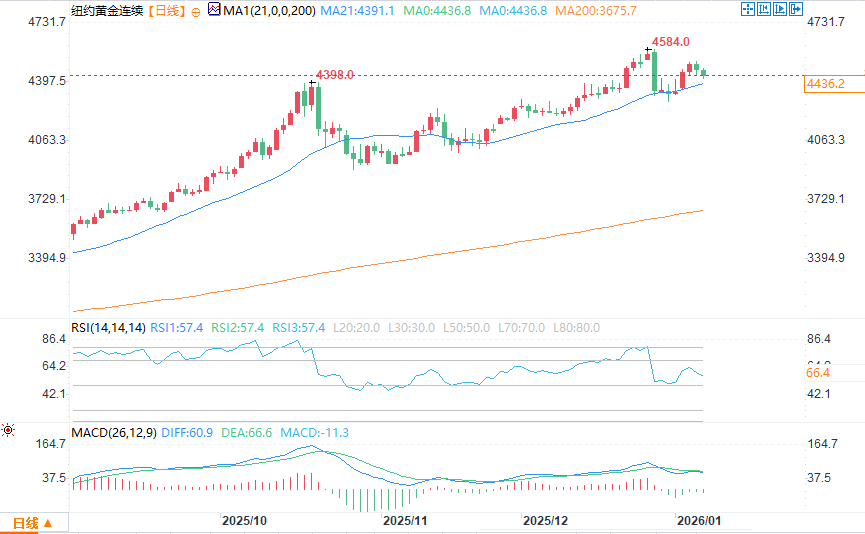
(COMEX Gold Daily Chart Source: FX678)
Technical Analysis: The next upside target for February gold futures bulls is a closing price break above the key resistance level – the contract's all-time high of $4,584.00/oz; the near-term downside target for bears is to push futures prices below the key technical support level of $4,284.30/oz. The first resistance level is the overnight high of $4,475.20/oz, followed by $4,500.00/oz; the first support level is $4,400.00/oz, followed by this week's low of $4,354.60/oz.
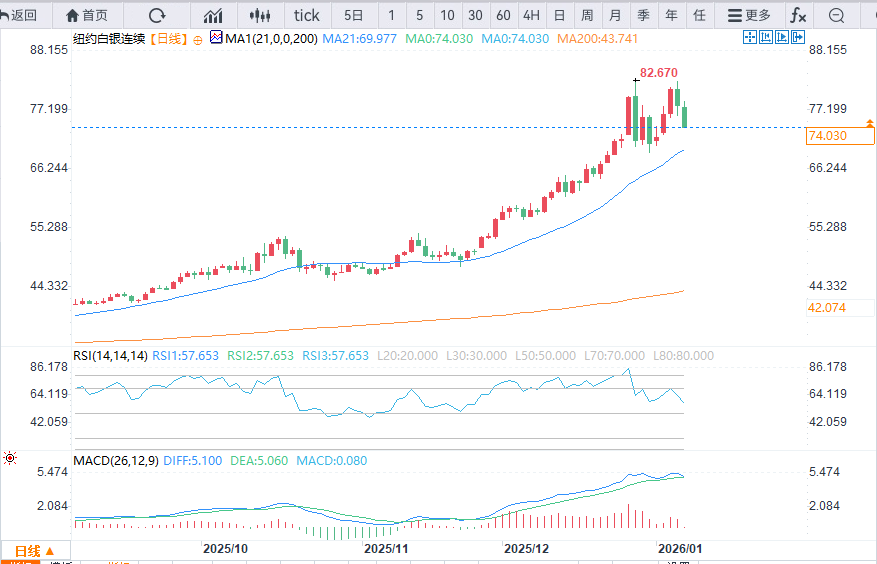
(COMEX silver daily chart source: FX678)
This week's price action in March silver futures has fueled concerns about a potential bearish double-top reversal pattern forming on the daily chart. The next upside target for bulls is a closing price break above the key technical resistance level – the all-time high of $82.67/oz; the next downside target for bears is a closing price break below the key support level – last week's low of $69.225/oz. The first resistance level is $75.00/oz, followed by $76.00/oz; the next support level is $74.00/oz, followed by $72.50/oz.
Note: The gold market operates primarily through two pricing mechanisms. The first is the spot market, where prices are quoted for immediate purchase and delivery; the second is the futures market, which determines the price for delivery on a future date. Due to year-end position adjustments and market liquidity, the most actively traded contract on the Chicago Mercantile Exchange (CME) is currently the December gold futures contract.
Gold and silver traders and investors are preparing for the annual rebalancing of commodity indices, with billions of dollars worth of futures contracts potentially being sold off in the coming days. Reports indicate that Citigroup estimates approximately $6.8 billion in silver futures may be sold to meet rebalancing requirements, with a roughly similar outflow from gold futures. Bloomberg points out that this sell-off is due to a significant increase in the weighting of precious metals in benchmark commodity indices.
Data from consulting firm Challenger, Gray & Christmas shows that U.S. layoffs in December fell to their lowest level since July 2024. The firm reported today that U.S. employers announced 35,553 job cuts in December, the lowest number since July 2024, down from 71,321 in November and 8% lower than December 2024. Andy Challenger of the firm stated, “2025 ended with the lowest layoff plans of the year. While December is typically a slow season for layoffs, combined with higher hiring plans, this is a positive sign after a year of high layoff plans.” In 2025, U.S. employers announced a total of 1,206,374 job cuts, a 58% increase from 2024 and the highest level since 2020. The government sector led all industries with 308,167 layoffs, primarily concentrated at the federal government level; in the private sector, the technology industry saw the most layoffs, reaching 154,445. Challenger stated, "The technology industry is developing and applying artificial intelligence much faster than any other sector. Coupled with over-hiring over the past decade, this has led to a wave of unemployment in the industry." Meanwhile, employers announced planned hiring of 507,647 people, a 34% decrease from 2024 and the lowest level since 2010.
The U.S. Supreme Court may rule on the legality of tariffs as early as Friday. President Trump could learn as early as Friday whether the Supreme Court will overturn key parts of his tariff policy. The report states, "The Supreme Court is considering whether Trump can use an emergency power law that has never been invoked before to impose import tariffs, and its ruling could be included in a series of upcoming unspecified cases. Lower courts have ruled that Trump's invocation of the International Emergency Economic Powers Act of 1977 to defend his comprehensive 'reciprocal' tariffs against U.S. trading partners, as well as separate tariffs against China, Canada, and Mexico, exceeded his authority." While the legal proceedings are ongoing, the U.S. tariff policy remains in effect. If the Supreme Court finds these tariffs illegal, most of the tariffs implemented by Trump during his second term could be reversed, and the U.S. government could face billions of dollars in refund obligations. The report also points out: "However, there are other avenues for his tariff policy to continue. Although the Constitution grants Congress the power to tax and impose tariffs, lawmakers have delegated some of that power to the executive branch through several laws. These laws provide Trump with at least five different tariff implementation options. Overall, these alternatives come with more restrictions and procedural constraints, meaning Trump can hardly impose tariffs immediately or arbitrarily set high tariff rates."
President Trump proposed increasing the U.S. defense budget by 50%. In a social media post, Trump stated his desire to increase annual defense spending by $500 billion to $1.5 trillion, threatening to exclude some companies that could otherwise benefit from the increase. Trump also signed an executive order requiring major defense contractors to halt stock buybacks and dividends, and capping executive compensation at $5 million annually until these companies increase investment in factory construction and research and development. Trump's statement caused a drop in the stock prices of major defense contractors, with companies such as Raytheon Technologies, Northrop Grumman, Lockheed Martin, and General Dynamics all experiencing declines. Trump wrote on social media, "This will enable us to build the 'dream army' we have long deserved, and more importantly, an army that will keep us safe, no matter what enemy we face."
Details of the US policy toward Venezuelan oil have emerged. Reports indicate that oil traders and US refiners are scrambling to adjust their positions to secure access to Venezuelan oil supplies after the Trump administration announced it would take control of up to 50 million barrels of Venezuelan crude—one of the largest unexpected supply shifts in recent years. President Trump first announced this US strategy on social media late Tuesday night, and Energy Secretary Chris Wright released further details on Wednesday. This strategy allows the federal government direct involvement in the international oil market and is expected to reactivate Venezuelan oil supplies to US refineries after years of sanctions. The return of Venezuelan oil to US buyers could mark one of the most significant shifts in the global energy market in recent years. This news has already caused Canadian crude prices to plummet and put pressure on benchmark crude futures prices. Venezuela possesses the world's largest oil reserves, but after decades of underinvestment, trade sanctions, and economic isolation, its oil production has fallen below 1 million barrels per day. Trump stated that the US will take over Venezuela and extract its oil for years to come. He told the newspaper, "We will rebuild Venezuela's oil industry in a highly profitable manner." Although major U.S. oil companies plan to meet with Trump at the White House in the coming days, Bloomberg points out that without a clear political and legal environment to ensure their success, many drilling companies may remain cautious about quickly returning to or entering the Venezuelan market.
Key external market developments today: The US dollar index strengthened slightly; crude oil prices rose, trading around $57.00 per barrel; the benchmark 10-year US Treasury yield is currently at 4.16%.
(COMEX Gold Daily Chart Source: FX678)
Technical Analysis: The next upside target for February gold futures bulls is a closing price break above the key resistance level – the contract's all-time high of $4,584.00/oz; the near-term downside target for bears is to push futures prices below the key technical support level of $4,284.30/oz. The first resistance level is the overnight high of $4,475.20/oz, followed by $4,500.00/oz; the first support level is $4,400.00/oz, followed by this week's low of $4,354.60/oz.
(COMEX silver daily chart source: FX678)
This week's price action in March silver futures has fueled concerns about a potential bearish double-top reversal pattern forming on the daily chart. The next upside target for bulls is a closing price break above the key technical resistance level – the all-time high of $82.67/oz; the next downside target for bears is a closing price break below the key support level – last week's low of $69.225/oz. The first resistance level is $75.00/oz, followed by $76.00/oz; the next support level is $74.00/oz, followed by $72.50/oz.
Note: The gold market operates primarily through two pricing mechanisms. The first is the spot market, where prices are quoted for immediate purchase and delivery; the second is the futures market, which determines the price for delivery on a future date. Due to year-end position adjustments and market liquidity, the most actively traded contract on the Chicago Mercantile Exchange (CME) is currently the December gold futures contract.
- Risk Warning and Disclaimer
- The market involves risk, and trading may not be suitable for all investors. This article is for reference only and does not constitute personal investment advice, nor does it take into account certain users’ specific investment objectives, financial situation, or other needs. Any investment decisions made based on this information are at your own risk.