Despite weak data, the dollar continues to rise; it's not that they won't pay, it's just that their time hasn't come yet.
2026-01-08 21:56:57
The recent increase in US Treasury bond purchases has impacted the US dollar. Faced with the US's escalating geopolitical exposure, the market tends to allocate more US dollars and US Treasury bonds as a response.
Meanwhile, the recent weak US employment data, coupled with the rise in the US dollar, confirms that the market's recent trading focus is on the US-Venezuela geopolitical issue. Market participants are taking a wait-and-see approach before the release of the non-farm payrolls (NFP) report, caught between concerns about a slowdown in the US economy and the support of the dollar's safe-haven status.
Recent key indicators, such as weaker-than-expected ADP employment data and a continued decline in job openings, clearly point to a cooling labor market. This could force the Federal Reserve to accelerate the pace of interest rate cuts, thereby exerting substantial pressure on the dollar's performance.
Current market sentiment is also dominated by another major event: the U.S. Supreme Court may rule on Friday on the legality of Trump's tariff remarks. Its conclusion will directly affect fiscal deficit and inflation expectations, becoming a key variable driving interest rates and the dollar's trend. The market is betting that the judge can quell the storm without affecting the tariff agreement, giving the dollar a tailwind.
On the data front, weak data may need to be combined with the non-farm payroll report and the fading of geopolitical tensions before it can once again become a decisive force in the dollar's trajectory.

Weak economic data (including ADP employment data showing only 41,000 new jobs) significantly limited the upward momentum of the US dollar index, and from a data perspective, the bulls lacked a fundamental logic for sustained gains.
Data from the Job Openings and Labor Mobility Survey (JOLTS) shows that the number of job openings has fallen to 7.146 million, lower than market expectations. This leading indicator clearly signals that labor demand is continuing to cool.
The U.S. Institute for Supply Management (ISM) Services Purchasing Managers' Index (PMI) rose to 54.4, indicating some resilience in the services sector. However, this localized bright spot was insufficient to offset the negative impact of the overall weakness in the labor market.
The good news is that the US Challenger employment data for December shows that hiring in December was the highest since 2022. Since 1989, the number of layoffs in 2025 ranks 7th highest. The US Challenger employment data for December shows 35,553 job cuts, compared to 71,321 in the previous month.
Andy Challenger, Chief Revenue Officer at Challenger Inc., stated that the layoff plans announced at the end of the year represent the fewest for 2025. While December layoffs are typically slow, this, coupled with increased hiring plans, is a positive sign.
The bad news is that a month's hiring and layoff data cannot completely reverse the trend of large-scale layoffs and reduced hiring throughout the year.
Meanwhile, the initial and continuing jobless claims data released by the United States, as important leading indicators before the non-farm payrolls report, also showed contradictions and confusion. Both data increased compared to the previous week, while initial claims were lower than expected and continuing claims were higher than expected, suggesting that layoffs are slowing down but jobs are still hard to find, without a clear direction.
The US dollar index remained in a narrow range above 98.50, reflecting the market's cautious expectations rather than the fundamental support for a sustained strength in the dollar.
The rise in 10-year and 30-year US Treasury yields along with the dollar suggests a demand for safe-haven assets in the market, driven by increased US military spending, the hostage situation of the Venezuelan president, and the instigation of geopolitical disputes similar to those surrounding Greenland.
Investors are choosing to hold their positions and wait and see due to risk aversion and uncertainty, especially with the high-impact non-farm payroll report approaching. Most traders tend to wait for clear signals before making any moves.
The fragile balance between current concerns about an economic slowdown and the safe-haven appeal of the US dollar means that, even though geopolitics is central to recent trading, the upward momentum could be disrupted by weaker-than-expected labor market data.
The market generally expects the non-farm payroll report to show that the number of new jobs has slowed to about 55,000, a further decline from 64,000 in the previous month, indicating that the momentum of job market expansion continues to weaken.
If the non-farm payroll report falls short of expectations (fewer than 50,000 new jobs or an unexpectedly high unemployment rate), it will directly increase market bets on aggressive interest rate cuts by the Federal Reserve, putting significant downward pressure on the dollar and potentially triggering the DXY to break below the key support level of 98.50.
Federal Reserve officials, including Stephen Milan and Neal Kashkari, have signaled a more dovish focus on economic growth, further reinforcing market pricing in loose monetary policy and setting the stage for a weakening dollar in the medium term.
The US dollar index is currently in a fragile position, with a weak labor market being its core downside risk, and its fundamental support logic continuing to weaken.
If Trump continues to signal an escalation of geopolitical tensions, the dollar may continue to strengthen.
Furthermore, various employment data are weak, with initial jobless claims, continuing jobless claims, and Challenger data failing to provide a clear direction. Everything will depend on the non-farm payroll report. If the non-farm payroll data is disappointing and the unemployment rate rises more than expected, it may push the US dollar index below the 98.63 support level and back into the bearish range, with the next support level around 98.10. Conversely, the US dollar index can maintain a strong rebound pattern in conjunction with geopolitical factors.
From a technical perspective, the US dollar index has shown signs of a sustained rebound after rising above 98.63. 98.90 is a key resistance level above. If it can rise above 98.90 and hold, the rebound pattern can be established, and the US dollar index will begin to strengthen again.
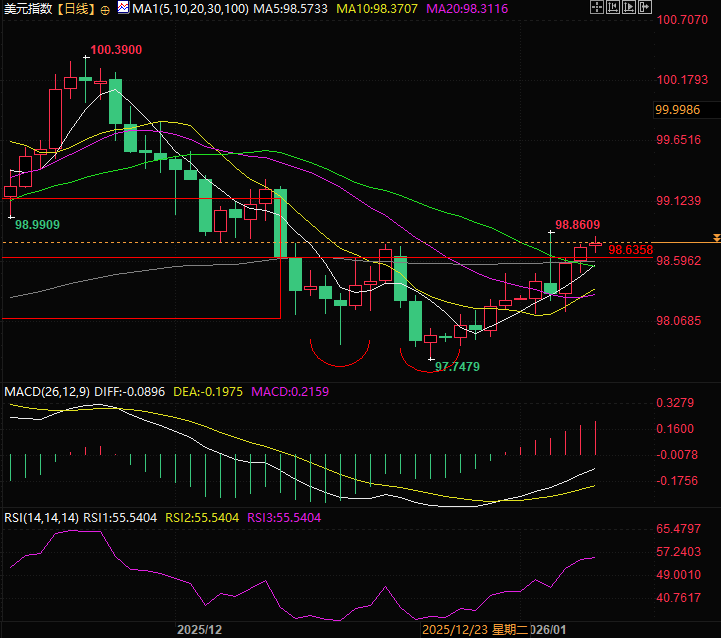
(US Dollar Index Daily Chart, Source: FX678)
At 21:55 Beijing time, the US dollar index is currently at 98.88.
Meanwhile, the recent weak US employment data, coupled with the rise in the US dollar, confirms that the market's recent trading focus is on the US-Venezuela geopolitical issue. Market participants are taking a wait-and-see approach before the release of the non-farm payrolls (NFP) report, caught between concerns about a slowdown in the US economy and the support of the dollar's safe-haven status.
Recent key indicators, such as weaker-than-expected ADP employment data and a continued decline in job openings, clearly point to a cooling labor market. This could force the Federal Reserve to accelerate the pace of interest rate cuts, thereby exerting substantial pressure on the dollar's performance.
Current market sentiment is also dominated by another major event: the U.S. Supreme Court may rule on Friday on the legality of Trump's tariff remarks. Its conclusion will directly affect fiscal deficit and inflation expectations, becoming a key variable driving interest rates and the dollar's trend. The market is betting that the judge can quell the storm without affecting the tariff agreement, giving the dollar a tailwind.
On the data front, weak data may need to be combined with the non-farm payroll report and the fading of geopolitical tensions before it can once again become a decisive force in the dollar's trajectory.
Impact of recent economic data
Weak economic data (including ADP employment data showing only 41,000 new jobs) significantly limited the upward momentum of the US dollar index, and from a data perspective, the bulls lacked a fundamental logic for sustained gains.
Data from the Job Openings and Labor Mobility Survey (JOLTS) shows that the number of job openings has fallen to 7.146 million, lower than market expectations. This leading indicator clearly signals that labor demand is continuing to cool.
The U.S. Institute for Supply Management (ISM) Services Purchasing Managers' Index (PMI) rose to 54.4, indicating some resilience in the services sector. However, this localized bright spot was insufficient to offset the negative impact of the overall weakness in the labor market.
The good news is that the US Challenger employment data for December shows that hiring in December was the highest since 2022. Since 1989, the number of layoffs in 2025 ranks 7th highest. The US Challenger employment data for December shows 35,553 job cuts, compared to 71,321 in the previous month.
Andy Challenger, Chief Revenue Officer at Challenger Inc., stated that the layoff plans announced at the end of the year represent the fewest for 2025. While December layoffs are typically slow, this, coupled with increased hiring plans, is a positive sign.
The bad news is that a month's hiring and layoff data cannot completely reverse the trend of large-scale layoffs and reduced hiring throughout the year.
Meanwhile, the initial and continuing jobless claims data released by the United States, as important leading indicators before the non-farm payrolls report, also showed contradictions and confusion. Both data increased compared to the previous week, while initial claims were lower than expected and continuing claims were higher than expected, suggesting that layoffs are slowing down but jobs are still hard to find, without a clear direction.
Market sentiment and the stability of the US dollar index
The US dollar index remained in a narrow range above 98.50, reflecting the market's cautious expectations rather than the fundamental support for a sustained strength in the dollar.
The rise in 10-year and 30-year US Treasury yields along with the dollar suggests a demand for safe-haven assets in the market, driven by increased US military spending, the hostage situation of the Venezuelan president, and the instigation of geopolitical disputes similar to those surrounding Greenland.
Investors are choosing to hold their positions and wait and see due to risk aversion and uncertainty, especially with the high-impact non-farm payroll report approaching. Most traders tend to wait for clear signals before making any moves.
The fragile balance between current concerns about an economic slowdown and the safe-haven appeal of the US dollar means that, even though geopolitics is central to recent trading, the upward momentum could be disrupted by weaker-than-expected labor market data.
Non-farm payrolls report and Federal Reserve policy expectations
The market generally expects the non-farm payroll report to show that the number of new jobs has slowed to about 55,000, a further decline from 64,000 in the previous month, indicating that the momentum of job market expansion continues to weaken.
If the non-farm payroll report falls short of expectations (fewer than 50,000 new jobs or an unexpectedly high unemployment rate), it will directly increase market bets on aggressive interest rate cuts by the Federal Reserve, putting significant downward pressure on the dollar and potentially triggering the DXY to break below the key support level of 98.50.
Federal Reserve officials, including Stephen Milan and Neal Kashkari, have signaled a more dovish focus on economic growth, further reinforcing market pricing in loose monetary policy and setting the stage for a weakening dollar in the medium term.
Conclusions and Technical Analysis:
The US dollar index is currently in a fragile position, with a weak labor market being its core downside risk, and its fundamental support logic continuing to weaken.
If Trump continues to signal an escalation of geopolitical tensions, the dollar may continue to strengthen.
Furthermore, various employment data are weak, with initial jobless claims, continuing jobless claims, and Challenger data failing to provide a clear direction. Everything will depend on the non-farm payroll report. If the non-farm payroll data is disappointing and the unemployment rate rises more than expected, it may push the US dollar index below the 98.63 support level and back into the bearish range, with the next support level around 98.10. Conversely, the US dollar index can maintain a strong rebound pattern in conjunction with geopolitical factors.
From a technical perspective, the US dollar index has shown signs of a sustained rebound after rising above 98.63. 98.90 is a key resistance level above. If it can rise above 98.90 and hold, the rebound pattern can be established, and the US dollar index will begin to strengthen again.
(US Dollar Index Daily Chart, Source: FX678)
At 21:55 Beijing time, the US dollar index is currently at 98.88.
- Risk Warning and Disclaimer
- The market involves risk, and trading may not be suitable for all investors. This article is for reference only and does not constitute personal investment advice, nor does it take into account certain users’ specific investment objectives, financial situation, or other needs. Any investment decisions made based on this information are at your own risk.