US Dollar Analysis: Rising Safe-Haven Demand Drives Dollar Higher
2026-01-05 18:16:59
On Monday (January 5), the US dollar rose for the fifth consecutive trading day during the European morning session, with the dollar index trading around 98.70. The core driver of this dollar rally was the resurgence of safe-haven demand triggered by escalating geopolitical tensions in Latin America.
Strong US economic data eases pressure to cut interest rates.
The annualized quarterly GDP growth rate in the third quarter of 2025 surged to 4.3%, exceeding market expectations. Last week's data, including increased pending home sales and a decline in initial jobless claims, further confirmed the resilience of the US economy. These positive indicators significantly reduced the necessity for the Federal Reserve to cut interest rates further in the short term. If the upcoming ISM Manufacturing PMI, ADP private employment, JOLTS job openings, and Friday's non-farm payroll data continue to show robust performance, the market may completely rule out expectations of a rate cut in the first half of 2026, thus providing solid support for the US dollar.
The Federal Reserve's monetary policy path leans towards caution.
The Federal Reserve is projected to cut interest rates by a total of 75 basis points in 2025, with the current target range for the federal funds rate at 3.50%-3.75%. The minutes of the December meeting showed that most members believed further rate cuts would only be appropriate if inflation continued to decline. The market is currently pricing in only two more 25-basis-point rate cuts in 2026, with the first cut postponed to June or later. Furthermore, investors are closely watching whether President Trump will nominate a new chairman with a dovish stance after Powell's term ends in May. This move could put downward pressure on the dollar in the medium to long term, but in the short term, policy uncertainty has actually strengthened the dollar's relative attractiveness.
Escalating geopolitical risks drive up demand for safe-haven assets
The US military intervention in Venezuela and the arrest of President Maduro triggered a short-term surge in global risk aversion, providing support for the US dollar, gold, and the Swiss franc. Trump's subsequent hardline stances on Colombia, Mexico, and Cuba further exacerbated geopolitical tensions in the Western Hemisphere. Investors will remain vigilant should the new Venezuelan government not fully cooperate with US policy, or the US launch a "second wave" of action. In the short term, highly liquid US dollar assets will continue to benefit from safe-haven inflows, while Latin American currencies (such as the Colombian peso and Mexican peso) are expected to face downward pressure.
Seasonal factors and technical indicators resonate
Historical data shows that after a seasonal weakening in December, the US dollar index often sees a rebound in January, especially February. The DXY has risen for two consecutive trading days, currently trading around 98.60 in Asian trading. Combined with fundamental support, dollar bears will face significant challenges in the coming months.
Technical Analysis
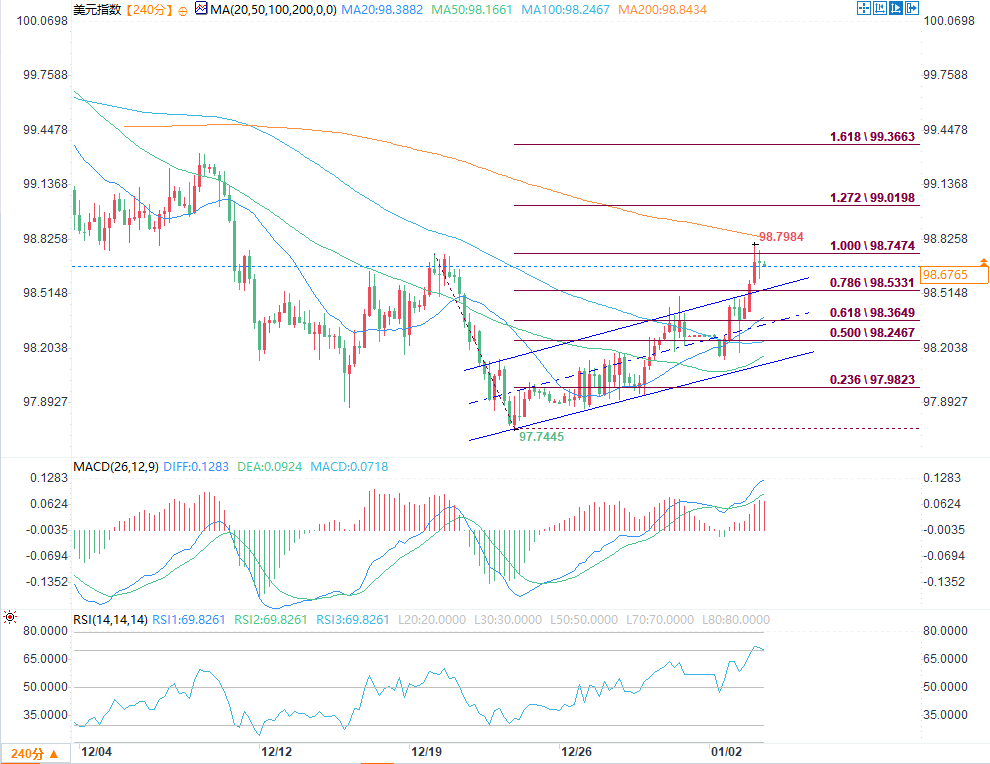
(US Dollar Index 4-hour chart source: FX678)
The 4-hour chart shows the US dollar index currently trading around 98.70, with the price continuing its rebound along the upward channel that began from the low of 97.75. The price has now recovered the 50% Fibonacci retracement level of 98.24 and is now testing the resistance level of 98.74 – which is also a previous key support level.
On the upside, the 200-period SMA at the 99.00 level is a key resistance level; support lies at 98.12 and 97.90. The current Relative Strength Index (RSI) reading is 69, indicating positive momentum.
Trading strategy suggestion: Consider buying on dips around 98.30, with a target of 99.20 and a stop loss below 97.95.
Strong US economic data eases pressure to cut interest rates.
The annualized quarterly GDP growth rate in the third quarter of 2025 surged to 4.3%, exceeding market expectations. Last week's data, including increased pending home sales and a decline in initial jobless claims, further confirmed the resilience of the US economy. These positive indicators significantly reduced the necessity for the Federal Reserve to cut interest rates further in the short term. If the upcoming ISM Manufacturing PMI, ADP private employment, JOLTS job openings, and Friday's non-farm payroll data continue to show robust performance, the market may completely rule out expectations of a rate cut in the first half of 2026, thus providing solid support for the US dollar.
The Federal Reserve's monetary policy path leans towards caution.
The Federal Reserve is projected to cut interest rates by a total of 75 basis points in 2025, with the current target range for the federal funds rate at 3.50%-3.75%. The minutes of the December meeting showed that most members believed further rate cuts would only be appropriate if inflation continued to decline. The market is currently pricing in only two more 25-basis-point rate cuts in 2026, with the first cut postponed to June or later. Furthermore, investors are closely watching whether President Trump will nominate a new chairman with a dovish stance after Powell's term ends in May. This move could put downward pressure on the dollar in the medium to long term, but in the short term, policy uncertainty has actually strengthened the dollar's relative attractiveness.
Escalating geopolitical risks drive up demand for safe-haven assets
The US military intervention in Venezuela and the arrest of President Maduro triggered a short-term surge in global risk aversion, providing support for the US dollar, gold, and the Swiss franc. Trump's subsequent hardline stances on Colombia, Mexico, and Cuba further exacerbated geopolitical tensions in the Western Hemisphere. Investors will remain vigilant should the new Venezuelan government not fully cooperate with US policy, or the US launch a "second wave" of action. In the short term, highly liquid US dollar assets will continue to benefit from safe-haven inflows, while Latin American currencies (such as the Colombian peso and Mexican peso) are expected to face downward pressure.
Seasonal factors and technical indicators resonate
Historical data shows that after a seasonal weakening in December, the US dollar index often sees a rebound in January, especially February. The DXY has risen for two consecutive trading days, currently trading around 98.60 in Asian trading. Combined with fundamental support, dollar bears will face significant challenges in the coming months.
Technical Analysis
(US Dollar Index 4-hour chart source: FX678)
The 4-hour chart shows the US dollar index currently trading around 98.70, with the price continuing its rebound along the upward channel that began from the low of 97.75. The price has now recovered the 50% Fibonacci retracement level of 98.24 and is now testing the resistance level of 98.74 – which is also a previous key support level.
On the upside, the 200-period SMA at the 99.00 level is a key resistance level; support lies at 98.12 and 97.90. The current Relative Strength Index (RSI) reading is 69, indicating positive momentum.
Trading strategy suggestion: Consider buying on dips around 98.30, with a target of 99.20 and a stop loss below 97.95.
- Risk Warning and Disclaimer
- The market involves risk, and trading may not be suitable for all investors. This article is for reference only and does not constitute personal investment advice, nor does it take into account certain users’ specific investment objectives, financial situation, or other needs. Any investment decisions made based on this information are at your own risk.