The truth behind the silver crash: History repeating itself or the start of a new cycle?
2026-01-05 19:17:46
At the end of 2025, the global precious metals market experienced extremely volatile fluctuations. Silver (XAGUSD) surged by over 160% at one point during the year, exceeding investors' expectations. However, just as the price broke through the $80 mark and the market anticipated moving towards $100, a sudden crash occurred, forcing a large number of highly leveraged long positions to be liquidated.
The trigger was the exchange's increase in trading margin requirements. This situation, where silver prices surge only to be met with increased pressure from exchanges, has occurred multiple times in history. To predict future price movements, we must first look for patterns in historical experience.
I. Historical lessons: Why did bull markets always collapse in 1980 and 2011?
Looking back over the past half-century, the fundamental causes of the two famous silver market crashes have been remarkably consistent: not the collapse of market fundamentals, but rather sudden changes in trading rules or policies.
1980: The Hunt Brothers' Leverage Endgame
Texas oil tycoons, the Hunt brothers, attempted to monopolize the silver market, driving prices to nearly $50 through physical silver hoarding and high leverage. In response, the New York Mercantile Exchange (COMEX) issued "Silver Rule 7," significantly increasing margin requirements and limiting the number of contracts an individual could hold, effectively blocking new margin trading.
Subsequently, the Federal Reserve announced a significant interest rate hike, and the interest on the mortgage loans held by the Hunt brothers quickly depleted their cash reserves, forcing them to liquidate their positions to repay margin and debt.
This regulatory and policy intervention directly triggered severe market turmoil, with silver prices plummeting by about 80% within a few months.
2011: The Margin Squeeze
Following the 2008 financial crisis, the Federal Reserve implemented zero interest rates and quantitative easing policies. Driven by speculative funds, silver prices surged from $8.50 to $50.00 within two years, an increase of nearly 500%. Low supply elasticity and the rise of ETFs led to more investors participating in the market, exacerbating the supply-demand imbalance.
However, this boom came to an abrupt end in 2011. The Chicago Mercantile Exchange (CME) raised silver futures margin requirements five times in just nine days, forcing highly leveraged funds to liquidate their positions, and silver prices plummeted by nearly 30% within weeks.
Despite the continued physical demand, silver prices are under significant pressure due to deleveraging in the futures market, the end of the second round of quantitative easing, rising real interest rates, and a stronger US dollar.
Compared to the present
The silver price crash at the end of 2025 almost repeated itself. On the eve of December 29th, the CME announced a 25% increase in margin requirements for the March 2026 main contract, triggering high-leverage positions in the $70-80 range. Silver's high volatility makes it a preferred target for regulators in maintaining market stability.
II. New variables in 2026: What's different this time?
Although a crash triggered by historical changes in trading rules has occurred again, the fundamentals of silver in 2026 show several significant differences compared to the previous two bull markets:
Industrial attribute enhancement
In 1980, industrial demand for silver accounted for about 40%, with financial attributes dominating; by the end of 2025, this proportion had reached nearly 55%. With the rapid growth of global photovoltaic installations and the rigid demand for high-performance conductive materials from AI data centers, silver is gradually becoming an industrial metal of strategic value.
Impact of China's Export Policies
On January 1, 2026, China will implement export licensing for silver, prioritizing the raw material needs of the domestic new energy industry. As a major global silver refiner and exporter, this policy may lead to a tightening of physical supply in the international market, providing potential support for both the futures and spot markets.
Changes in the global credit environment
Unlike the risk-averse market of 2011, the current global sovereign debt risk is rising. Gold is seen as a credit anchor, and silver, as a relatively low-priced precious metal, still has room for its financial premium to recover. Although the gold-silver ratio has declined somewhat, it remains above the historical average, providing some defensive support for silver's valuation.
III. Market Status and Operational Strategies
Currently, silver prices are fluctuating between $72 and $75. The sharp drop at the end of December cleared out crowded leveraged long positions and also tested key technical support levels.
From a technical perspective, the surge in silver prices in 2025 was too steep, with the RSI exceeding 90 at one point, indicating an overheated market. The recent correction helps restore rationality and also leaves room for the next phase of price movement.
Given the current high volatility of silver and the uncertainty of the policy environment, traders should maintain a neutral to cautious stance.
Position control: Maintain a moderate position and avoid chasing highs or operating with a full position.
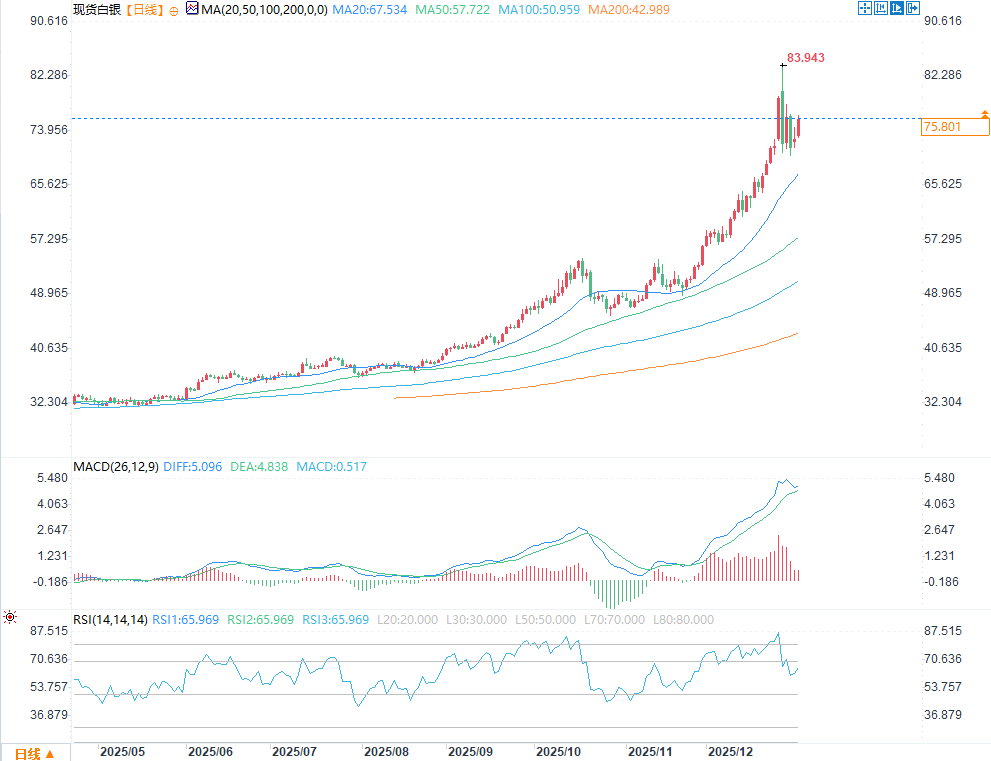
(Spot silver daily chart source: EasyTrade)
Watch for signals: Closely observe the premium spread between the Shanghai Gold Exchange (SGE) and the New York COMEX. If the premium widens, it may be appropriate to increase the base position.
Technical pattern reference: Pay attention to the potential head and shoulders pattern. If the silver price breaks below the neckline, it may mean that the upward momentum has been exhausted and the market may enter a period of adjustment.
IV. Conclusion: Risks and opportunities coexist
Silver prices remain high and highly volatile; they could continue to rise or fall rapidly. While potential opportunities exist, high leverage and policy uncertainty make the risks equally significant.
Traders should strictly control their position size, use leverage cautiously, and diversify their assets. In a highly volatile market, patience and discipline are key to protecting capital and seizing opportunities. Remember: the current silver market is a high-risk, high-volatility environment; every trade requires careful decision-making.
The trigger was the exchange's increase in trading margin requirements. This situation, where silver prices surge only to be met with increased pressure from exchanges, has occurred multiple times in history. To predict future price movements, we must first look for patterns in historical experience.
I. Historical lessons: Why did bull markets always collapse in 1980 and 2011?
Looking back over the past half-century, the fundamental causes of the two famous silver market crashes have been remarkably consistent: not the collapse of market fundamentals, but rather sudden changes in trading rules or policies.
1980: The Hunt Brothers' Leverage Endgame
Texas oil tycoons, the Hunt brothers, attempted to monopolize the silver market, driving prices to nearly $50 through physical silver hoarding and high leverage. In response, the New York Mercantile Exchange (COMEX) issued "Silver Rule 7," significantly increasing margin requirements and limiting the number of contracts an individual could hold, effectively blocking new margin trading.
Subsequently, the Federal Reserve announced a significant interest rate hike, and the interest on the mortgage loans held by the Hunt brothers quickly depleted their cash reserves, forcing them to liquidate their positions to repay margin and debt.
This regulatory and policy intervention directly triggered severe market turmoil, with silver prices plummeting by about 80% within a few months.
2011: The Margin Squeeze
Following the 2008 financial crisis, the Federal Reserve implemented zero interest rates and quantitative easing policies. Driven by speculative funds, silver prices surged from $8.50 to $50.00 within two years, an increase of nearly 500%. Low supply elasticity and the rise of ETFs led to more investors participating in the market, exacerbating the supply-demand imbalance.
However, this boom came to an abrupt end in 2011. The Chicago Mercantile Exchange (CME) raised silver futures margin requirements five times in just nine days, forcing highly leveraged funds to liquidate their positions, and silver prices plummeted by nearly 30% within weeks.
Despite the continued physical demand, silver prices are under significant pressure due to deleveraging in the futures market, the end of the second round of quantitative easing, rising real interest rates, and a stronger US dollar.
Compared to the present
The silver price crash at the end of 2025 almost repeated itself. On the eve of December 29th, the CME announced a 25% increase in margin requirements for the March 2026 main contract, triggering high-leverage positions in the $70-80 range. Silver's high volatility makes it a preferred target for regulators in maintaining market stability.
II. New variables in 2026: What's different this time?
Although a crash triggered by historical changes in trading rules has occurred again, the fundamentals of silver in 2026 show several significant differences compared to the previous two bull markets:
Industrial attribute enhancement
In 1980, industrial demand for silver accounted for about 40%, with financial attributes dominating; by the end of 2025, this proportion had reached nearly 55%. With the rapid growth of global photovoltaic installations and the rigid demand for high-performance conductive materials from AI data centers, silver is gradually becoming an industrial metal of strategic value.
Impact of China's Export Policies
On January 1, 2026, China will implement export licensing for silver, prioritizing the raw material needs of the domestic new energy industry. As a major global silver refiner and exporter, this policy may lead to a tightening of physical supply in the international market, providing potential support for both the futures and spot markets.
Changes in the global credit environment
Unlike the risk-averse market of 2011, the current global sovereign debt risk is rising. Gold is seen as a credit anchor, and silver, as a relatively low-priced precious metal, still has room for its financial premium to recover. Although the gold-silver ratio has declined somewhat, it remains above the historical average, providing some defensive support for silver's valuation.
III. Market Status and Operational Strategies
Currently, silver prices are fluctuating between $72 and $75. The sharp drop at the end of December cleared out crowded leveraged long positions and also tested key technical support levels.
From a technical perspective, the surge in silver prices in 2025 was too steep, with the RSI exceeding 90 at one point, indicating an overheated market. The recent correction helps restore rationality and also leaves room for the next phase of price movement.
Given the current high volatility of silver and the uncertainty of the policy environment, traders should maintain a neutral to cautious stance.
Position control: Maintain a moderate position and avoid chasing highs or operating with a full position.
(Spot silver daily chart source: EasyTrade)
Watch for signals: Closely observe the premium spread between the Shanghai Gold Exchange (SGE) and the New York COMEX. If the premium widens, it may be appropriate to increase the base position.
Technical pattern reference: Pay attention to the potential head and shoulders pattern. If the silver price breaks below the neckline, it may mean that the upward momentum has been exhausted and the market may enter a period of adjustment.
IV. Conclusion: Risks and opportunities coexist
Silver prices remain high and highly volatile; they could continue to rise or fall rapidly. While potential opportunities exist, high leverage and policy uncertainty make the risks equally significant.
Traders should strictly control their position size, use leverage cautiously, and diversify their assets. In a highly volatile market, patience and discipline are key to protecting capital and seizing opportunities. Remember: the current silver market is a high-risk, high-volatility environment; every trade requires careful decision-making.
- Risk Warning and Disclaimer
- The market involves risk, and trading may not be suitable for all investors. This article is for reference only and does not constitute personal investment advice, nor does it take into account certain users’ specific investment objectives, financial situation, or other needs. Any investment decisions made based on this information are at your own risk.