Geopolitical Perspective: US-Venezuela Conflict, Euro Pays the Bill
2026-01-05 21:37:52
On Monday (January 5), during the Asian and European sessions, the euro opened with a rapid decline, breaking through key support and currently trading around 1.1664, with a daily decline of -0.47%, while the US dollar index rose by 0.35%.
It is also worth noting that the British pound against the US dollar and the US dollar against the Japanese yen did not show significant performance, meaning that the appreciation of the US dollar was almost entirely driven by the euro. What happened to the euro?

The geopolitical events involving Venezuela that occurred over the weekend had a significant impact on overall risk appetite in the currency market. The joint statement from the 26 EU member states regarding Venezuela stated that respecting the will of the Venezuelan people is the only way for Venezuela to restore democracy and resolve the current crisis.
German Foreign Minister Karl-Heinz Wärts went even further, stating that the United States must provide a legal basis for its military actions and calling on the United States to increase transparency regarding Venezuela.
He stated that he hopes the United States "will not only respect international law, but also explain the basis for its actions to the United States and everyone else."
Meanwhile, the United States has recently continued to express interest in Greenland, Denmark, and Danish Prime Minister Mette Frederiksen said that President Trump must stop threatening Greenland.
Meanwhile, the issue of Denmark has also recently escalated. An EU spokesperson stated: "We have heard President Trump's statement on Greenland, and the EU will continue to uphold the principle of national sovereignty." A German minister even stated: "If necessary, NATO will discuss the protection of Greenland." This series of dialogues has directly increased market risk pricing for Europe.
Spain and several Latin American countries have criticized the United States for setting a dangerous precedent, and the Chilean president's warning, "Today it's Venezuela, tomorrow it could be any country," reflects widespread concern.
In addition to the issues of Venezuela and Greenland, Denmark, the continued escalation of the Russia-Ukraine conflict has further exacerbated the pressure on the euro.
Russia claims to have been hit by a series of drone attacks on its territory, while Ukraine has stated that its objective is to cripple Russia's core military and energy infrastructure. This escalation has reignited market concerns about European energy security—given the Eurozone's historical heavy reliance on Russian oil and gas imports.
Against this backdrop, investors are becoming more cautious about allocating their assets to the euro as a single currency, and rising risk aversion often puts downward pressure on the euro exchange rate.
Stephen Stanley, chief U.S. economist at Banco Bilbao Vizcaya Argentaria (BBVA), points out that the current recovery of U.S. manufacturing remains constrained by a highly uncertain tariff environment.
With the non-farm payrolls report approaching this Friday, the employment sub-index of the ISM Manufacturing PMI is attracting significant market attention.
From a transactional perspective, the performance of the labor market will directly affect the Federal Reserve's policy path, thereby influencing the dollar exchange rate and the trends of major asset classes.
Specifically, if the overall PMI reading is significantly better than expected and breaks through the 50 threshold, it will signal to the market that the US economy is improving marginally, while reducing the probability of a Fed rate cut, which would benefit the strengthening of the US dollar and thus put pressure on the euro. Conversely, if the data falls short of expectations, especially if it is significantly lower than the previous value of 48.2, it will weaken the dollar's performance, increase market bets on a Fed rate cut in March, and provide upward momentum for the euro against the dollar.
However, the European Central Bank's policy stance provided some support for the euro. At its December policy meeting, the bank chose to keep interest rates unchanged, signaling that rates are likely to remain at current levels for an extended period. ECB President Christine Lagarde emphasized that the current geopolitical and economic environment is fraught with uncertainty, making it difficult to provide clear forward guidance on future policy directions.
In contrast, the pound sterling gained support from expectations of the Bank of England's policy, which indirectly affected the euro-pound exchange rate.
The Bank of England cut its benchmark interest rate by 25 basis points to 3.75% in December, signaling a gradual easing of monetary policy. The market widely expects the Bank of England to initiate at least one more round of rate cuts in the first half of the year, with the pace of easing likely to remain steady and controllable.
The core logic supporting the Bank of England's cautious policy stance lies in the still high level of inflation. Although the UK's overall consumer price index (CPI) has fallen from its peak of 3.8% in September to 3.2% in November, it is still far from the 2% policy target, which forces the Bank of England to proceed cautiously in its policy operations.
The threat to the sovereignty of other countries, triggered by the Venezuelan incident, has spread throughout Europe, putting pressure on the euro. However, given the deepening process of de-dollarization worldwide, this may be a relatively favorable position for the euro.
The euro broke below the trendline and the upper trading range, with the current measured decline around 1.1644. The exchange rate may rebound from this level, with 1.1600 being the next strong support level.
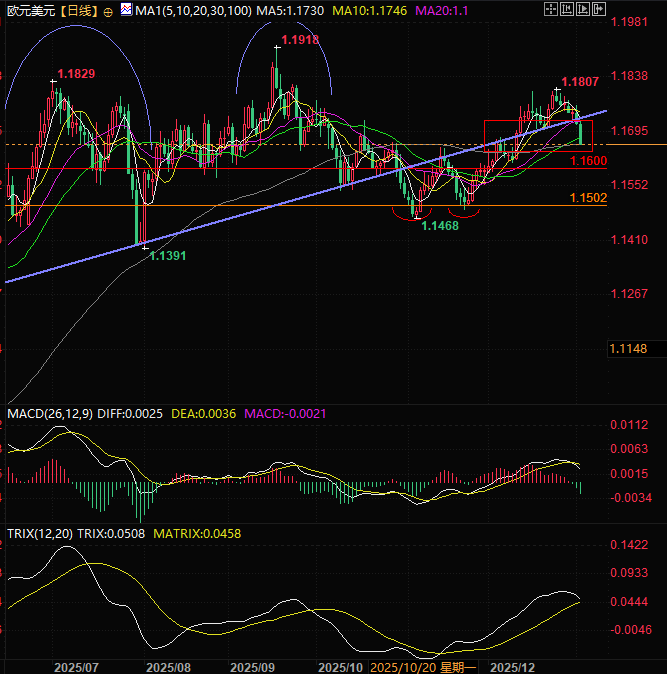
(Euro to US Dollar Daily Chart, Source: FX678)
At 21:32 Beijing time, the euro was trading at 1.1660/61 against the US dollar.
It is also worth noting that the British pound against the US dollar and the US dollar against the Japanese yen did not show significant performance, meaning that the appreciation of the US dollar was almost entirely driven by the euro. What happened to the euro?
The Venezuelan geopolitical events are impacting market risk appetite.
The geopolitical events involving Venezuela that occurred over the weekend had a significant impact on overall risk appetite in the currency market. The joint statement from the 26 EU member states regarding Venezuela stated that respecting the will of the Venezuelan people is the only way for Venezuela to restore democracy and resolve the current crisis.
German Foreign Minister Karl-Heinz Wärts went even further, stating that the United States must provide a legal basis for its military actions and calling on the United States to increase transparency regarding Venezuela.
He stated that he hopes the United States "will not only respect international law, but also explain the basis for its actions to the United States and everyone else."
Meanwhile, the United States has recently continued to express interest in Greenland, Denmark, and Danish Prime Minister Mette Frederiksen said that President Trump must stop threatening Greenland.
Meanwhile, the issue of Denmark has also recently escalated. An EU spokesperson stated: "We have heard President Trump's statement on Greenland, and the EU will continue to uphold the principle of national sovereignty." A German minister even stated: "If necessary, NATO will discuss the protection of Greenland." This series of dialogues has directly increased market risk pricing for Europe.
Spain and several Latin American countries have criticized the United States for setting a dangerous precedent, and the Chilean president's warning, "Today it's Venezuela, tomorrow it could be any country," reflects widespread concern.
Escalating conflict between Russia and Ukraine puts pressure on the euro.
In addition to the issues of Venezuela and Greenland, Denmark, the continued escalation of the Russia-Ukraine conflict has further exacerbated the pressure on the euro.
Russia claims to have been hit by a series of drone attacks on its territory, while Ukraine has stated that its objective is to cripple Russia's core military and energy infrastructure. This escalation has reignited market concerns about European energy security—given the Eurozone's historical heavy reliance on Russian oil and gas imports.
Against this backdrop, investors are becoming more cautious about allocating their assets to the euro as a single currency, and rising risk aversion often puts downward pressure on the euro exchange rate.
Trading Logic Focus: The Link Between Employment Data and Non-Farm Payrolls Influences the Fed's Policy Path
Stephen Stanley, chief U.S. economist at Banco Bilbao Vizcaya Argentaria (BBVA), points out that the current recovery of U.S. manufacturing remains constrained by a highly uncertain tariff environment.
With the non-farm payrolls report approaching this Friday, the employment sub-index of the ISM Manufacturing PMI is attracting significant market attention.
From a transactional perspective, the performance of the labor market will directly affect the Federal Reserve's policy path, thereby influencing the dollar exchange rate and the trends of major asset classes.
Specifically, if the overall PMI reading is significantly better than expected and breaks through the 50 threshold, it will signal to the market that the US economy is improving marginally, while reducing the probability of a Fed rate cut, which would benefit the strengthening of the US dollar and thus put pressure on the euro. Conversely, if the data falls short of expectations, especially if it is significantly lower than the previous value of 48.2, it will weaken the dollar's performance, increase market bets on a Fed rate cut in March, and provide upward momentum for the euro against the dollar.
Central Bank Policy Support: The ECB's Wait-and-See Stance Provides a Buffer for the Euro
However, the European Central Bank's policy stance provided some support for the euro. At its December policy meeting, the bank chose to keep interest rates unchanged, signaling that rates are likely to remain at current levels for an extended period. ECB President Christine Lagarde emphasized that the current geopolitical and economic environment is fraught with uncertainty, making it difficult to provide clear forward guidance on future policy directions.
Currency Comparison Impact: Bank of England Policy Expectations Indirectly Affect Euro/Pound Sterling Exchange Rate
In contrast, the pound sterling gained support from expectations of the Bank of England's policy, which indirectly affected the euro-pound exchange rate.
The Bank of England cut its benchmark interest rate by 25 basis points to 3.75% in December, signaling a gradual easing of monetary policy. The market widely expects the Bank of England to initiate at least one more round of rate cuts in the first half of the year, with the pace of easing likely to remain steady and controllable.
The core logic supporting the Bank of England's cautious policy stance lies in the still high level of inflation. Although the UK's overall consumer price index (CPI) has fallen from its peak of 3.8% in September to 3.2% in November, it is still far from the 2% policy target, which forces the Bank of England to proceed cautiously in its policy operations.
Summary and Technical Analysis:
The threat to the sovereignty of other countries, triggered by the Venezuelan incident, has spread throughout Europe, putting pressure on the euro. However, given the deepening process of de-dollarization worldwide, this may be a relatively favorable position for the euro.
The euro broke below the trendline and the upper trading range, with the current measured decline around 1.1644. The exchange rate may rebound from this level, with 1.1600 being the next strong support level.
(Euro to US Dollar Daily Chart, Source: FX678)
At 21:32 Beijing time, the euro was trading at 1.1660/61 against the US dollar.
- Risk Warning and Disclaimer
- The market involves risk, and trading may not be suitable for all investors. This article is for reference only and does not constitute personal investment advice, nor does it take into account certain users’ specific investment objectives, financial situation, or other needs. Any investment decisions made based on this information are at your own risk.