48.3 or 50? One number will determine whether the dollar is a rebound champion or a paper tiger.
2026-01-05 21:44:46
Monday, January 5th. After a previous decline, the US dollar index rebounded, trading around 98.80 during the North American session. Traders awaited the release of the December Manufacturing Purchasing Managers' Index (PMI) from the Institute for Supply Management at 23:00, hoping to find new clues about the interest rate path from the economic indicators and sub-indices. On the other hand, comments from Federal Reserve officials regarding "approaching the neutral interest rate" have created a coexistence of expectations for both "continued observation" and "early rate cuts."

This week, the core pricing of the US dollar index remains focused on how the combination of "resilient growth, declining inflation, and cooling employment" will affect Federal Reserve policy. The market expectation for the manufacturing PMI was 48.3, a slight improvement from the previous value of 48.2, but still below the 50-point threshold separating expansion from contraction, indicating that the manufacturing sector is still generally contracting. For the dollar, the key is not just the overall index level, but also whether the sub-indices can change the perceived scope for interest rates. In the previous report, the new orders index fell to 47.4, indicating weak demand; the production index rebounded to 51.4, reflecting support for output from the supply side or inventory cycle; the price index remained in expansion territory around 58.5, suggesting that cost pressures have not completely subsided; and the employment index declined to 44, reinforcing the signal of "cautious employment." If the December data continues to weaken in sub-indices such as employment and orders, which are closer to demand and employment, the market may be more inclined to interpret it as a cooling of economic momentum, thereby increasing bets on easing this year, and the rebound momentum of the dollar index will be constrained. Conversely, if the overall index unexpectedly returns above 50, or if employment-related sub-indices show significant improvement, then expectations of declining interest rates may passively converge, increasing the probability that the US dollar will receive temporary support.
At the policy communication level, Minneapolis Fed President Kashkari's speech provided a fairly typical framework for a "soft landing narrative": he believes inflation is slowly declining, wage growth is also slowing, and he judges that current interest rates may be close to neutral. For the dollar index, "close to neutral" does not immediately mean a rate cut, but rather shifts the focus of discussion from "whether to continue tightening" to "to what extent restrictive measures need to be maintained." At the same time, he also explicitly warned of the risk of the unemployment rate "jumping from here," and described the job market as "significantly cooling." Such statements usually cause interest rate expectations to react in two stages: short-term interest rates remain resilient due to the "inflation is still high, requiring patience" aspect; but medium-term interest rates are more sensitive to weak data due to the "rising employment risks" aspect. Currently, the interest rate market has priced in a rate cut at the March meeting at over 50%, while also largely pricing in a unchanged rate at the January meeting, and pricing in a cumulative easing of about 58 basis points over the next year. This structure means that the US dollar is more sensitive to positive data because it can reduce the room for rate cuts that have already been priced in; while it is not insensitive to negative data either, because once employment and growth are confirmed to be weakening, there is still room for easing expectations to continue to expand.
The US dollar index has recently exhibited a pattern of "recovery after decline." Graphically, the previous high of around 100.3900 corresponds to an upward resistance zone, after which the price retraced and formed a temporary low around 97.7479, followed by a period of continuous recovery. Currently, the price is around 98.80, which is in the lower middle of the previous consolidation range. The 99.0000 level is more like a short-term dividing line between bullish and bearish sentiment; whether it can hold above this level often requires stronger fundamental catalysts. The area around 98.5510 also previously served as a pullback low.
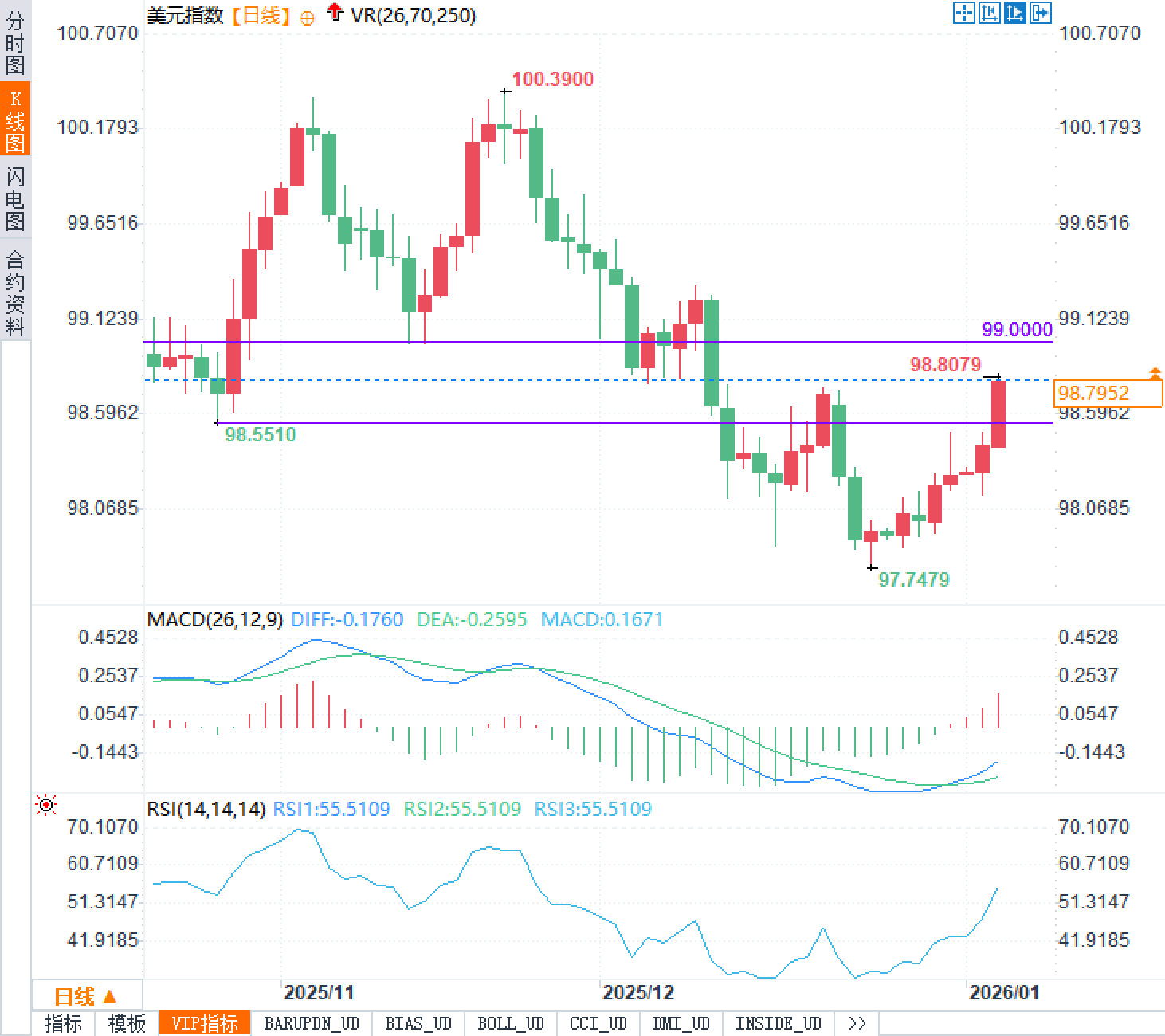
From a technical perspective, the daily Relative Strength Index (RSI) has rebounded to around 55.5109, indicating that buying power has recovered somewhat during the rebound, but it has not yet entered an overheated zone. The MACD histogram has turned positive at 0.1671, and the fast and slow lines are still running below the zero axis, reflecting a weakening of medium-term downward momentum, but a trend reversal still needs more confirmation. In other words, the short-term recovery of the US dollar index depends more on the coordination of data and expectations than on technical inertia alone.
Connecting these clues, we can see that the US dollar index is currently in a "verification window." On the one hand, declining inflation and slowing wage growth have convinced the market that policy tightening is no longer necessary; on the other hand, inflation has not yet fully returned to a reassuring range, making the Federal Reserve reluctant to make a clear commitment to interest rate cuts prematurely. Therefore, the strength or weakness of the dollar is more like an immediate vote on whether growth and employment are slowing in tandem: if both manufacturing activity and employment indicators point to a cooling trend, expectations of interest rate cuts may shift forward or downward, limiting the dollar's upside potential; if the data shows resilience, market confidence in interest rate cuts may decline, and the dollar may find easier support given the early-year capital inflows and position adjustments. Meanwhile, the market will continue to focus on changes in officials' wording regarding "neutral interest rates" and "employment risks," as this determines whether traders view weak data as "short-term noise" or a "prelude to a policy shift."
Overall, the performance of the US dollar index around 98.80 reflects the market's tug-of-war over the reassessment of policy paths at the beginning of the year: the manufacturing PMI provides cross-sectional information on economic activity, costs, and employment; officials' speeches provide the boundaries of the policy response function; and employment data determines whether this narrative can be implemented.
This week, the core pricing of the US dollar index remains focused on how the combination of "resilient growth, declining inflation, and cooling employment" will affect Federal Reserve policy. The market expectation for the manufacturing PMI was 48.3, a slight improvement from the previous value of 48.2, but still below the 50-point threshold separating expansion from contraction, indicating that the manufacturing sector is still generally contracting. For the dollar, the key is not just the overall index level, but also whether the sub-indices can change the perceived scope for interest rates. In the previous report, the new orders index fell to 47.4, indicating weak demand; the production index rebounded to 51.4, reflecting support for output from the supply side or inventory cycle; the price index remained in expansion territory around 58.5, suggesting that cost pressures have not completely subsided; and the employment index declined to 44, reinforcing the signal of "cautious employment." If the December data continues to weaken in sub-indices such as employment and orders, which are closer to demand and employment, the market may be more inclined to interpret it as a cooling of economic momentum, thereby increasing bets on easing this year, and the rebound momentum of the dollar index will be constrained. Conversely, if the overall index unexpectedly returns above 50, or if employment-related sub-indices show significant improvement, then expectations of declining interest rates may passively converge, increasing the probability that the US dollar will receive temporary support.
At the policy communication level, Minneapolis Fed President Kashkari's speech provided a fairly typical framework for a "soft landing narrative": he believes inflation is slowly declining, wage growth is also slowing, and he judges that current interest rates may be close to neutral. For the dollar index, "close to neutral" does not immediately mean a rate cut, but rather shifts the focus of discussion from "whether to continue tightening" to "to what extent restrictive measures need to be maintained." At the same time, he also explicitly warned of the risk of the unemployment rate "jumping from here," and described the job market as "significantly cooling." Such statements usually cause interest rate expectations to react in two stages: short-term interest rates remain resilient due to the "inflation is still high, requiring patience" aspect; but medium-term interest rates are more sensitive to weak data due to the "rising employment risks" aspect. Currently, the interest rate market has priced in a rate cut at the March meeting at over 50%, while also largely pricing in a unchanged rate at the January meeting, and pricing in a cumulative easing of about 58 basis points over the next year. This structure means that the US dollar is more sensitive to positive data because it can reduce the room for rate cuts that have already been priced in; while it is not insensitive to negative data either, because once employment and growth are confirmed to be weakening, there is still room for easing expectations to continue to expand.
Market performance
The US dollar index has recently exhibited a pattern of "recovery after decline." Graphically, the previous high of around 100.3900 corresponds to an upward resistance zone, after which the price retraced and formed a temporary low around 97.7479, followed by a period of continuous recovery. Currently, the price is around 98.80, which is in the lower middle of the previous consolidation range. The 99.0000 level is more like a short-term dividing line between bullish and bearish sentiment; whether it can hold above this level often requires stronger fundamental catalysts. The area around 98.5510 also previously served as a pullback low.
From a technical perspective, the daily Relative Strength Index (RSI) has rebounded to around 55.5109, indicating that buying power has recovered somewhat during the rebound, but it has not yet entered an overheated zone. The MACD histogram has turned positive at 0.1671, and the fast and slow lines are still running below the zero axis, reflecting a weakening of medium-term downward momentum, but a trend reversal still needs more confirmation. In other words, the short-term recovery of the US dollar index depends more on the coordination of data and expectations than on technical inertia alone.
Connecting these clues, we can see that the US dollar index is currently in a "verification window." On the one hand, declining inflation and slowing wage growth have convinced the market that policy tightening is no longer necessary; on the other hand, inflation has not yet fully returned to a reassuring range, making the Federal Reserve reluctant to make a clear commitment to interest rate cuts prematurely. Therefore, the strength or weakness of the dollar is more like an immediate vote on whether growth and employment are slowing in tandem: if both manufacturing activity and employment indicators point to a cooling trend, expectations of interest rate cuts may shift forward or downward, limiting the dollar's upside potential; if the data shows resilience, market confidence in interest rate cuts may decline, and the dollar may find easier support given the early-year capital inflows and position adjustments. Meanwhile, the market will continue to focus on changes in officials' wording regarding "neutral interest rates" and "employment risks," as this determines whether traders view weak data as "short-term noise" or a "prelude to a policy shift."
Overall, the performance of the US dollar index around 98.80 reflects the market's tug-of-war over the reassessment of policy paths at the beginning of the year: the manufacturing PMI provides cross-sectional information on economic activity, costs, and employment; officials' speeches provide the boundaries of the policy response function; and employment data determines whether this narrative can be implemented.
- Risk Warning and Disclaimer
- The market involves risk, and trading may not be suitable for all investors. This article is for reference only and does not constitute personal investment advice, nor does it take into account certain users’ specific investment objectives, financial situation, or other needs. Any investment decisions made based on this information are at your own risk.