After gold, silver, and copper, the market is asking: Will nickel be the next metal to experience a surge in price?
2026-01-07 19:18:24
On Wednesday (January 7), the London Metal Exchange (LME) base metals market saw mixed results after a strong start to the new year. Copper prices retreated from record highs, while nickel prices continued their upward trend, hitting multi-month highs. The market is reassessing the recent sharp rise and assessing whether the momentum can be sustained.

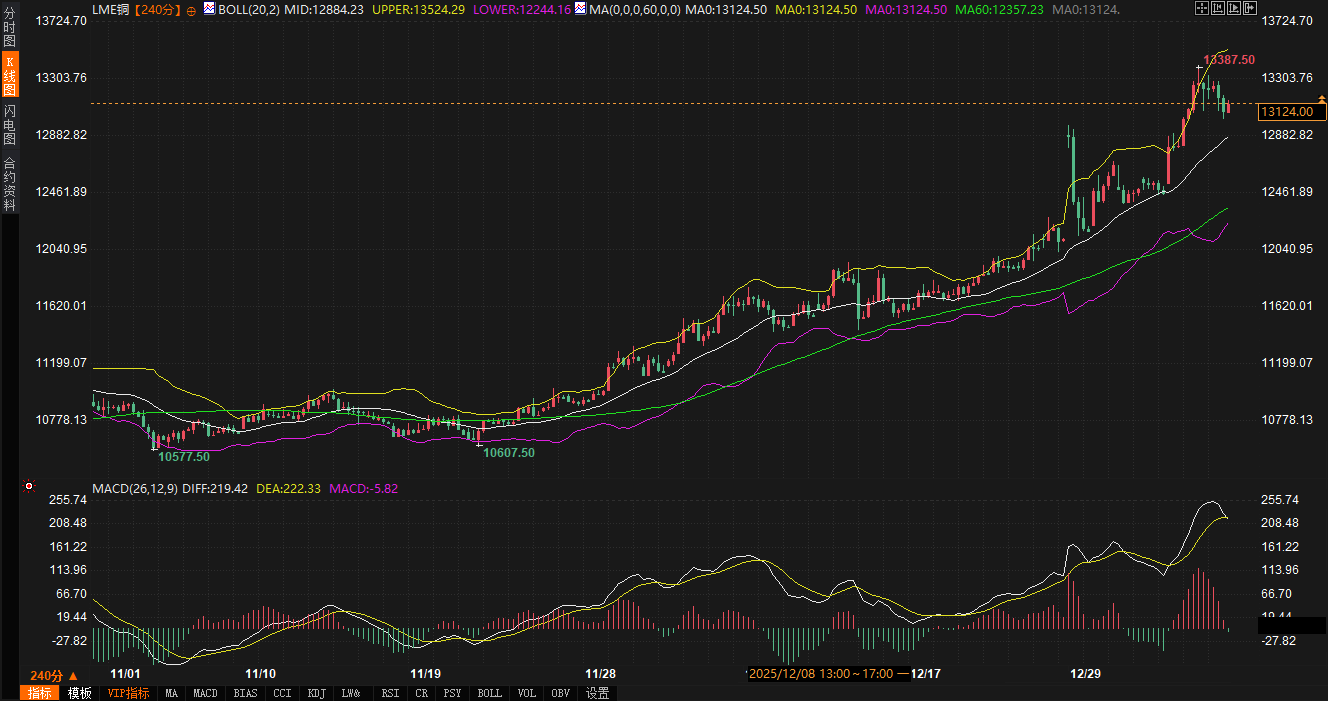
LME three-month copper was quoted at $13,144 per tonne in midday trading, down 0.7% on the day. Just the previous day, the contract had broken its all-time high of $13,387.50 per tonne. The 240-minute chart shows copper prices currently around $13,122, down about 1% on the day. Technical indicators show the Bollinger Bands (20,2) upper band at $13,524.42 and the middle band at $12,884.22, with prices retreating from near the upper band. The MACD indicator shows the DIFF line at 219.50 and the DEA line at 222.35, showing signs of high-level consolidation. This indicates that after a continuous rapid rise, short-term market momentum has weakened, and a technical correction is underway. An analyst from a well-known institution pointed out that base metal prices softened in early trading, and the bullish momentum that has driven the sector since late December is pausing. The market is currently still heavily driven by position adjustments and momentum trading, while supply chain risks and uncertainty surrounding US macroeconomic policies persist. Some analysts have pointed to a "fear of missing out" mentality in the market, even a "frenzy" for copper, and believe this situation is unsustainable. Nevertheless, some institutions, based on strong market momentum, have raised their first-quarter copper price targets to $14,000, while maintaining their full-year average price forecasts.
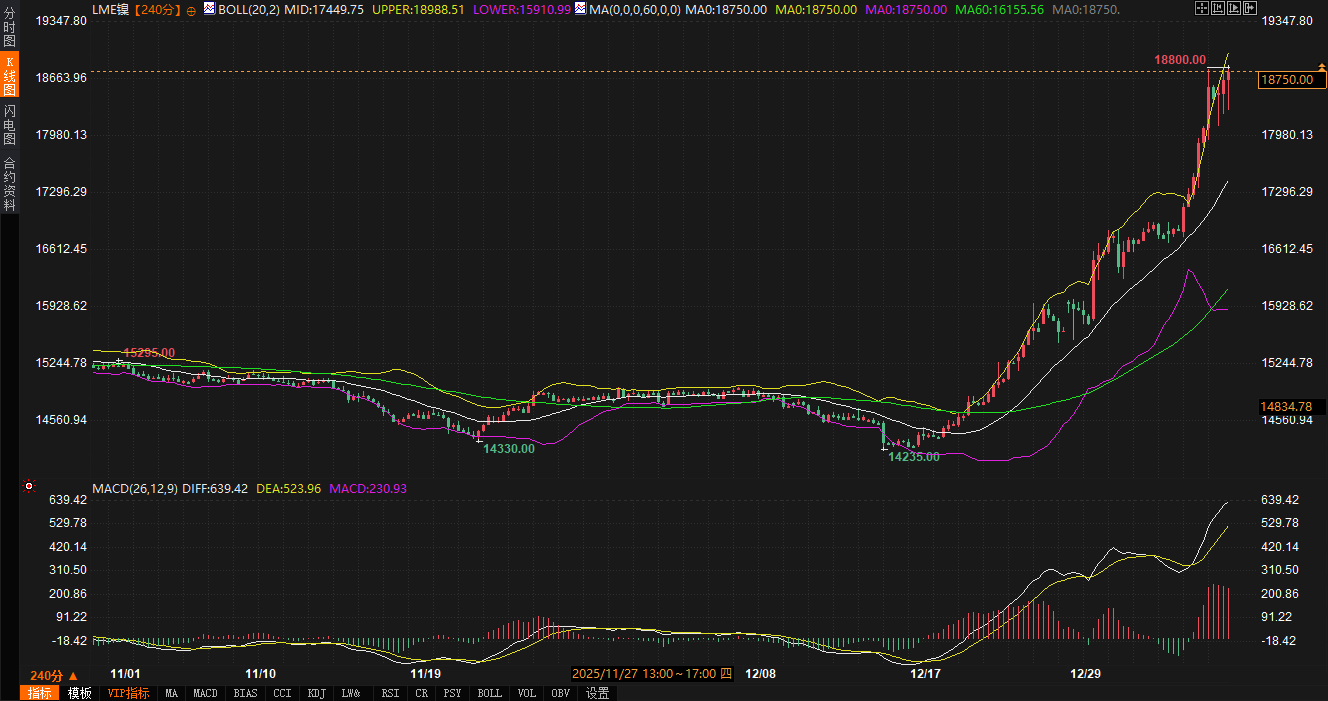
In contrast to the pullback in copper prices, LME nickel prices continued to rise, hitting $18,790 per tonne during the session, a 19-month high since June 5, 2024. Three-month nickel was last quoted at $18,565, up 0.3% on the day, with a cumulative increase of nearly 30% since mid-December last year. Looking at the 240-minute chart, nickel was trading at $18,750, up 1.22% on the day. Its upper Bollinger Band is at $18,988.51, and the current price is approaching this resistance area; the MACD indicator shows a DIFF value of 639.42 and a DEA value of 523.96, indicating that upward momentum remains strong. The main factor driving the rise in nickel prices is market concerns about Indonesia's plans to limit production, which has injected a significant supply risk premium into nickel prices. However, the fundamental data presents a complex picture: on the one hand, nickel inventories in LME registered warehouses surged to 275,600 tons, the highest since June 2018, and the discount of spot contracts to three-month contracts widened to $175 per ton, indicating that physical supply is not tight in the near term; on the other hand, exchange data show that a single entity holds 30% to 40% of LME nickel warrants, which may exacerbate the tense sentiment in the short-term market structure.
In summary, while the copper and nickel markets are diverging in the short term, both are at a critical juncture where technical and fundamental factors are at play. For copper, after reaching a new historical high, the market needs to digest the previous gains and confirm new support levels. Regarding support and resistance levels, the key support for LME three-month copper is around the Bollinger Band middle line at $12,884. If the correction deepens, a test of the $12,250-$12,500 range is possible. Initial resistance is at the previous high of $13,387, with stronger resistance at the $13,500-$13,600 area. Intraday monitoring should focus on changes in open interest near historical highs and whether momentum indicators (such as MACD) will form a death cross. Nickel prices are in a strong upward channel but are approaching a significant technical resistance level. The recent key resistance for LME three-month nickel is around the $19,000 psychological level and the upper Bollinger Band at $18,989. Initial support is seen in the $18,300-$18,500 area, with more significant support around the Bollinger Band middle line at $17,450. During trading, close attention should be paid to price performance near key resistance levels, as well as whether a significant increase in inventory and a deep discount in spot prices will substantially suppress the upward momentum.
Looking ahead, the focus of the copper market lies in whether macroeconomic sentiment, capital flows, and physical demand can match the current extremely high prices. In the short term, it may enter a period of high-level fluctuation. The upward logic of the nickel market relies more simply on the supply-side narrative, but its high inventory and weak spot market structure pose potential risks. The sustainability of its prices will depend on the specific implementation of Indonesian policies and the pace of inventory changes. Overall, after the frenzy at the beginning of the year, the market is returning to rational assessment, and volatility may increase.
LME three-month copper was quoted at $13,144 per tonne in midday trading, down 0.7% on the day. Just the previous day, the contract had broken its all-time high of $13,387.50 per tonne. The 240-minute chart shows copper prices currently around $13,122, down about 1% on the day. Technical indicators show the Bollinger Bands (20,2) upper band at $13,524.42 and the middle band at $12,884.22, with prices retreating from near the upper band. The MACD indicator shows the DIFF line at 219.50 and the DEA line at 222.35, showing signs of high-level consolidation. This indicates that after a continuous rapid rise, short-term market momentum has weakened, and a technical correction is underway. An analyst from a well-known institution pointed out that base metal prices softened in early trading, and the bullish momentum that has driven the sector since late December is pausing. The market is currently still heavily driven by position adjustments and momentum trading, while supply chain risks and uncertainty surrounding US macroeconomic policies persist. Some analysts have pointed to a "fear of missing out" mentality in the market, even a "frenzy" for copper, and believe this situation is unsustainable. Nevertheless, some institutions, based on strong market momentum, have raised their first-quarter copper price targets to $14,000, while maintaining their full-year average price forecasts.
In contrast to the pullback in copper prices, LME nickel prices continued to rise, hitting $18,790 per tonne during the session, a 19-month high since June 5, 2024. Three-month nickel was last quoted at $18,565, up 0.3% on the day, with a cumulative increase of nearly 30% since mid-December last year. Looking at the 240-minute chart, nickel was trading at $18,750, up 1.22% on the day. Its upper Bollinger Band is at $18,988.51, and the current price is approaching this resistance area; the MACD indicator shows a DIFF value of 639.42 and a DEA value of 523.96, indicating that upward momentum remains strong. The main factor driving the rise in nickel prices is market concerns about Indonesia's plans to limit production, which has injected a significant supply risk premium into nickel prices. However, the fundamental data presents a complex picture: on the one hand, nickel inventories in LME registered warehouses surged to 275,600 tons, the highest since June 2018, and the discount of spot contracts to three-month contracts widened to $175 per ton, indicating that physical supply is not tight in the near term; on the other hand, exchange data show that a single entity holds 30% to 40% of LME nickel warrants, which may exacerbate the tense sentiment in the short-term market structure.
In summary, while the copper and nickel markets are diverging in the short term, both are at a critical juncture where technical and fundamental factors are at play. For copper, after reaching a new historical high, the market needs to digest the previous gains and confirm new support levels. Regarding support and resistance levels, the key support for LME three-month copper is around the Bollinger Band middle line at $12,884. If the correction deepens, a test of the $12,250-$12,500 range is possible. Initial resistance is at the previous high of $13,387, with stronger resistance at the $13,500-$13,600 area. Intraday monitoring should focus on changes in open interest near historical highs and whether momentum indicators (such as MACD) will form a death cross. Nickel prices are in a strong upward channel but are approaching a significant technical resistance level. The recent key resistance for LME three-month nickel is around the $19,000 psychological level and the upper Bollinger Band at $18,989. Initial support is seen in the $18,300-$18,500 area, with more significant support around the Bollinger Band middle line at $17,450. During trading, close attention should be paid to price performance near key resistance levels, as well as whether a significant increase in inventory and a deep discount in spot prices will substantially suppress the upward momentum.
Looking ahead, the focus of the copper market lies in whether macroeconomic sentiment, capital flows, and physical demand can match the current extremely high prices. In the short term, it may enter a period of high-level fluctuation. The upward logic of the nickel market relies more simply on the supply-side narrative, but its high inventory and weak spot market structure pose potential risks. The sustainability of its prices will depend on the specific implementation of Indonesian policies and the pace of inventory changes. Overall, after the frenzy at the beginning of the year, the market is returning to rational assessment, and volatility may increase.
- Risk Warning and Disclaimer
- The market involves risk, and trading may not be suitable for all investors. This article is for reference only and does not constitute personal investment advice, nor does it take into account certain users’ specific investment objectives, financial situation, or other needs. Any investment decisions made based on this information are at your own risk.