Just when everyone thought they understood the dollar, the market quietly changed its script.
2026-01-07 21:08:37
In April 2025, the global foreign exchange market reached a turning point. At a policy press conference dubbed "Liberation Day," US President Trump announced "reciprocal tariffs" on almost all major trading partners. The tariff rates far exceeded market expectations, instantly stirring up global risk sentiment.
Funds rapidly withdrew from high-volatility, high-return assets and flowed into safe-haven assets offering high liquidity and security. In the foreign exchange market, major currency pairs experienced significant directional adjustments, with the US dollar in particular facing substantial selling pressure. Many attribute this to an accelerated trend of "de-dollarization"—but while this explanation sounds grand, it may not hold water.
In fact, the core pricing logic of the US dollar has always been anchored to the Federal Reserve's monetary policy path. Although global central banks are indeed slowly advancing reserve diversification, this is a long-term structural change and is unlikely to shake the dollar's dominance in the short term. What truly affects the market are more direct and verifiable factors: such as the extreme levels of market positioning and changes in expectations regarding future interest rate trends.
Looking back at the weakening of the US dollar in the first half of 2025, it appears on the surface to be due to the rising narrative of "de-dollarization," but in reality, two more realistic forces were driving it. First, previously accumulated extreme long positions in the US dollar began to be liquidated in a concentrated manner; second, market expectations for a Federal Reserve interest rate cut continued to rise.
Back in 2024, as policy uncertainty increased following Trump's election victory, the market reassessed the inflation outlook, pricing the Federal Reserve's stance as more "hawkish," thus fueling a strong bullish run in the US dollar. However, when a trade becomes too crowded, even without a fundamental reversal, it can be triggered by the slightest disturbance, leading to a sharp pullback.
As 2025 approached, concerns about growth stemming from tariff policies gradually intensified, with "Liberation Day" becoming the final straw. Investors began to worry that escalating trade frictions would suppress global economic activity, forcing the Federal Reserve to shift to easing monetary policy ahead of schedule. Consequently, the original logic of betting on "high interest rates supporting the dollar" was shattered, leading to a large amount of capital choosing to take profits or even shorting the market.
This round of decline is more like a market self-correction process—both clearing out overheated positions and reflecting a shift in interest rate expectations. Rather than a sign of a weakening dollar, it's more accurately described as a typical "expectation-driven" price adjustment.
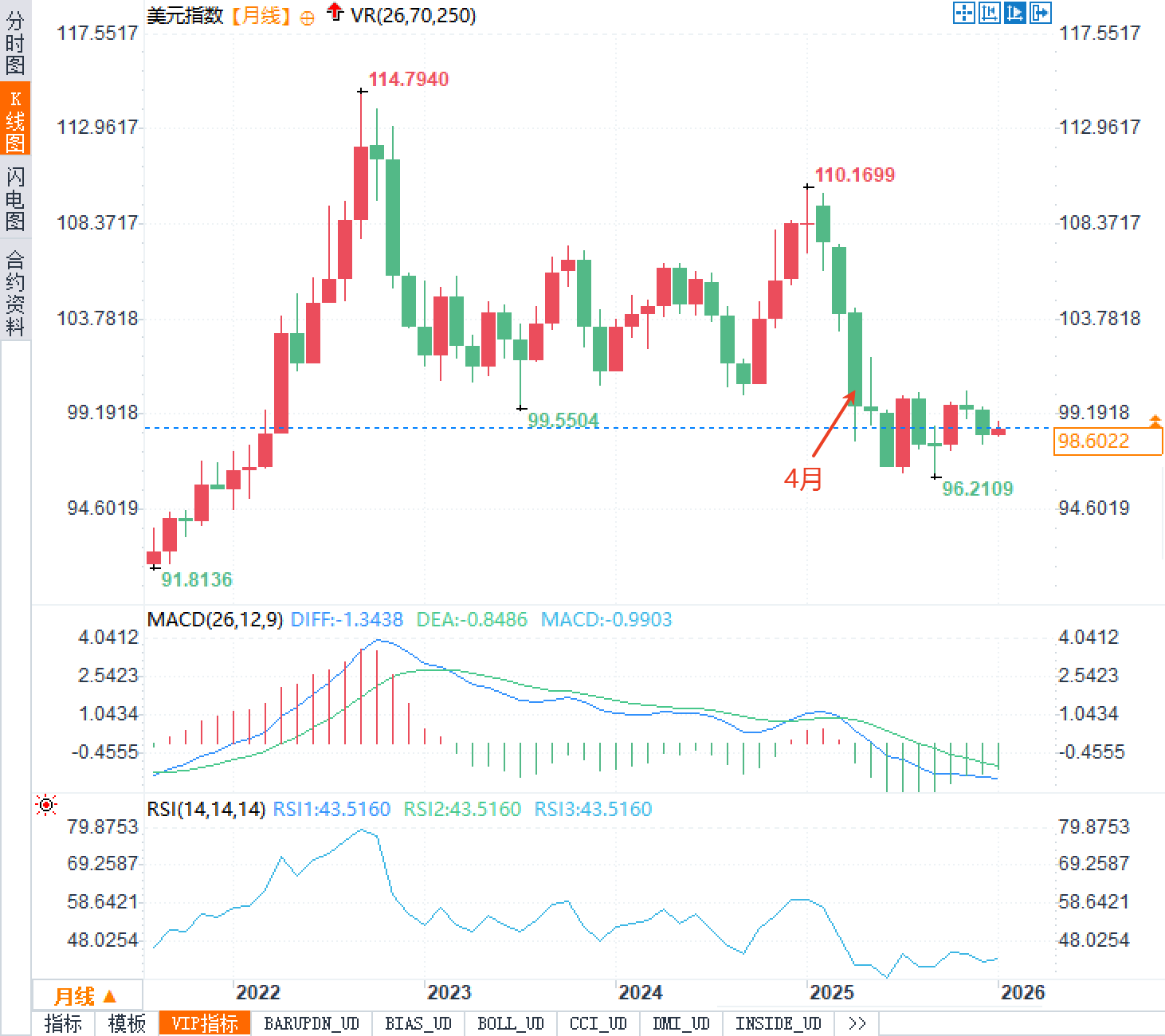
Looking at a longer timeframe, on a monthly chart, after a sharp decline in April 2025, the US dollar index did not continue its downward trend but gradually entered a period of range-bound trading. Currently, the dollar index has essentially returned to near its April lows, indicating that the market has completed a relatively thorough round of position clearing.
The foreign exchange market is currently in a state of "awaiting new signals." On the one hand, the expectation that the Federal Reserve will cut interest rates at least twice has been widely priced in; on the other hand, unless new information emerges that exceeds expectations, it will be difficult for the dollar to move in a clear direction based solely on the pace of interest rate cuts that are "in line with expectations."
The key to determining the next phase of the market trend lies in whether the market will reassess the Fed's policy path. Two scenarios could break the current deadlock: First, unexpectedly strong economic data could cool expectations for rate cuts, or even trigger a "hawkish reversal," leading to a rebound in dollar long positions; second, persistently weak inflation or employment data could strengthen bets on rapid rate cuts, further compressing the yield advantage of US Treasury bonds and putting new pressure on the dollar.
Currently, the latter possibility is increasing. Several recently released indicators show that the momentum of US economic growth is slowing moderately. For example, the consensus forecast for the upcoming December ISM Services PMI is 52.3, continuing to decline from November's 52.6, and will be the lowest level since September 2024. Although still in expansion territory, the slowdown in the trend cannot be ignored.
Among numerous macroeconomic data, the service sector's economic performance is often more forward-looking. It not only covers a large portion of the US economy's output but also reflects changes in multiple dimensions, including business demand, hiring intentions, and cost transmission. Therefore, analysts generally focus on several key sub-indices of the ISM Services Index.
First, there's the new orders index. The latest survey shows that the growth rate of new business for service sector companies has fallen to its lowest level in about 20 months, indicating weakening end-user demand. Meanwhile, the employment indicator also stagnated in December, failing to record growth for the first time since February of that year. Businesses generally cited cost control, tight budgets, and slowing demand as the main reasons for the hiring freeze.
These details send a clear signal: if demand and employment weaken in tandem, the policy balance will more easily tilt towards "supporting growth," thereby increasing market expectations for the Federal Reserve to accelerate interest rate cuts. However, whether this path will hold depends on whether inflation-related indicators cooperate.
The most closely watched component is the "Paid Prices" sub-index, which reflects the input cost pressures felt by businesses. In November, this figure plummeted from 70.0 to 65.4, the largest drop in 21 months. While still above the historical average, it indicates a cooling trend. If this indicator continues its downward trend or at least stabilizes at a low level in December, the market will have greater confidence that inflation is entering a sustainable decline.
However, surveys from regional Federal Reserve banks provided mixed signals: data from New York and Philadelphia showed a slight increase in cost pressures, while only Dallas saw a decline. Overall, December prices paid are more likely to rebound slightly or stabilize, forming a technical correction to the sharp drop of the previous month. This means that inflation stickiness has not completely subsided, and the market may reassess the pace of interest rate cuts.
Ultimately, the next move of the US dollar will depend on the marginal impact of data on interest rate expectations. If service sector data is weak across the board and cost pressures fail to rebound, bets on interest rate cuts may intensify again, pushing the dollar index to test the lower end of its range; conversely, if the data shows resilience, especially with a significant rebound in payment prices, the dollar is expected to see a phase of rebound.
Overall, the volatility of the US dollar in 2025 will not stem from grand geopolitical narratives, but rather from the combined effects of positioning structure and monetary policy expectations. Entering the new year, the focus of forex trading will shift from chasing slogan-like concepts to accurately capturing the expectation gaps created by each data release.
Funds rapidly withdrew from high-volatility, high-return assets and flowed into safe-haven assets offering high liquidity and security. In the foreign exchange market, major currency pairs experienced significant directional adjustments, with the US dollar in particular facing substantial selling pressure. Many attribute this to an accelerated trend of "de-dollarization"—but while this explanation sounds grand, it may not hold water.
In fact, the core pricing logic of the US dollar has always been anchored to the Federal Reserve's monetary policy path. Although global central banks are indeed slowly advancing reserve diversification, this is a long-term structural change and is unlikely to shake the dollar's dominance in the short term. What truly affects the market are more direct and verifiable factors: such as the extreme levels of market positioning and changes in expectations regarding future interest rate trends.
The truth behind the dollar's decline: not the narrative, but the collusion between positioning and expectations.
Looking back at the weakening of the US dollar in the first half of 2025, it appears on the surface to be due to the rising narrative of "de-dollarization," but in reality, two more realistic forces were driving it. First, previously accumulated extreme long positions in the US dollar began to be liquidated in a concentrated manner; second, market expectations for a Federal Reserve interest rate cut continued to rise.
Back in 2024, as policy uncertainty increased following Trump's election victory, the market reassessed the inflation outlook, pricing the Federal Reserve's stance as more "hawkish," thus fueling a strong bullish run in the US dollar. However, when a trade becomes too crowded, even without a fundamental reversal, it can be triggered by the slightest disturbance, leading to a sharp pullback.
As 2025 approached, concerns about growth stemming from tariff policies gradually intensified, with "Liberation Day" becoming the final straw. Investors began to worry that escalating trade frictions would suppress global economic activity, forcing the Federal Reserve to shift to easing monetary policy ahead of schedule. Consequently, the original logic of betting on "high interest rates supporting the dollar" was shattered, leading to a large amount of capital choosing to take profits or even shorting the market.
This round of decline is more like a market self-correction process—both clearing out overheated positions and reflecting a shift in interest rate expectations. Rather than a sign of a weakening dollar, it's more accurately described as a typical "expectation-driven" price adjustment.
Waiting Amidst Volatility: The US Dollar Enters a Critical Observation Period
Looking at a longer timeframe, on a monthly chart, after a sharp decline in April 2025, the US dollar index did not continue its downward trend but gradually entered a period of range-bound trading. Currently, the dollar index has essentially returned to near its April lows, indicating that the market has completed a relatively thorough round of position clearing.
The foreign exchange market is currently in a state of "awaiting new signals." On the one hand, the expectation that the Federal Reserve will cut interest rates at least twice has been widely priced in; on the other hand, unless new information emerges that exceeds expectations, it will be difficult for the dollar to move in a clear direction based solely on the pace of interest rate cuts that are "in line with expectations."
The key to determining the next phase of the market trend lies in whether the market will reassess the Fed's policy path. Two scenarios could break the current deadlock: First, unexpectedly strong economic data could cool expectations for rate cuts, or even trigger a "hawkish reversal," leading to a rebound in dollar long positions; second, persistently weak inflation or employment data could strengthen bets on rapid rate cuts, further compressing the yield advantage of US Treasury bonds and putting new pressure on the dollar.
Currently, the latter possibility is increasing. Several recently released indicators show that the momentum of US economic growth is slowing moderately. For example, the consensus forecast for the upcoming December ISM Services PMI is 52.3, continuing to decline from November's 52.6, and will be the lowest level since September 2024. Although still in expansion territory, the slowdown in the trend cannot be ignored.
The next tipping point: Clues hidden in a service industry report
Among numerous macroeconomic data, the service sector's economic performance is often more forward-looking. It not only covers a large portion of the US economy's output but also reflects changes in multiple dimensions, including business demand, hiring intentions, and cost transmission. Therefore, analysts generally focus on several key sub-indices of the ISM Services Index.
First, there's the new orders index. The latest survey shows that the growth rate of new business for service sector companies has fallen to its lowest level in about 20 months, indicating weakening end-user demand. Meanwhile, the employment indicator also stagnated in December, failing to record growth for the first time since February of that year. Businesses generally cited cost control, tight budgets, and slowing demand as the main reasons for the hiring freeze.
These details send a clear signal: if demand and employment weaken in tandem, the policy balance will more easily tilt towards "supporting growth," thereby increasing market expectations for the Federal Reserve to accelerate interest rate cuts. However, whether this path will hold depends on whether inflation-related indicators cooperate.
The most closely watched component is the "Paid Prices" sub-index, which reflects the input cost pressures felt by businesses. In November, this figure plummeted from 70.0 to 65.4, the largest drop in 21 months. While still above the historical average, it indicates a cooling trend. If this indicator continues its downward trend or at least stabilizes at a low level in December, the market will have greater confidence that inflation is entering a sustainable decline.
However, surveys from regional Federal Reserve banks provided mixed signals: data from New York and Philadelphia showed a slight increase in cost pressures, while only Dallas saw a decline. Overall, December prices paid are more likely to rebound slightly or stabilize, forming a technical correction to the sharp drop of the previous month. This means that inflation stickiness has not completely subsided, and the market may reassess the pace of interest rate cuts.
Ultimately, the next move of the US dollar will depend on the marginal impact of data on interest rate expectations. If service sector data is weak across the board and cost pressures fail to rebound, bets on interest rate cuts may intensify again, pushing the dollar index to test the lower end of its range; conversely, if the data shows resilience, especially with a significant rebound in payment prices, the dollar is expected to see a phase of rebound.
Overall, the volatility of the US dollar in 2025 will not stem from grand geopolitical narratives, but rather from the combined effects of positioning structure and monetary policy expectations. Entering the new year, the focus of forex trading will shift from chasing slogan-like concepts to accurately capturing the expectation gaps created by each data release.
- Risk Warning and Disclaimer
- The market involves risk, and trading may not be suitable for all investors. This article is for reference only and does not constitute personal investment advice, nor does it take into account certain users’ specific investment objectives, financial situation, or other needs. Any investment decisions made based on this information are at your own risk.