A chart shows that the Baltic Dry Index has continued to decline, with Capesize and Supramax freight rates weakening.
2026-01-07 23:11:50
Latest data shows that the Baltic Dry Index (BDI) closed at 1776 points on January 7, 2025, a new low since July 11, 2025, down 2.95% month-on-month, the largest drop since December 23, 2025, and marking the third consecutive day of decline (including zero growth). Looking at the short-term charts, the recent 11 BDI data points show: 2 positive increases, 9 negative increases, and 0 zero increases. Specifically, the Panamax Freight Index (BPI) closed at 1317 points, up 1.00% from the previous value; the Capesize Freight Index (BCI) closed at 2878 points, down 4.58%; and the Supramax Freight Index (BSI) closed at 993 points, down 1.78%. For detailed 720-day and 10-year trend charts of the Baltic Dry Index and its three main sub-indices, please refer to the specially designed charts.
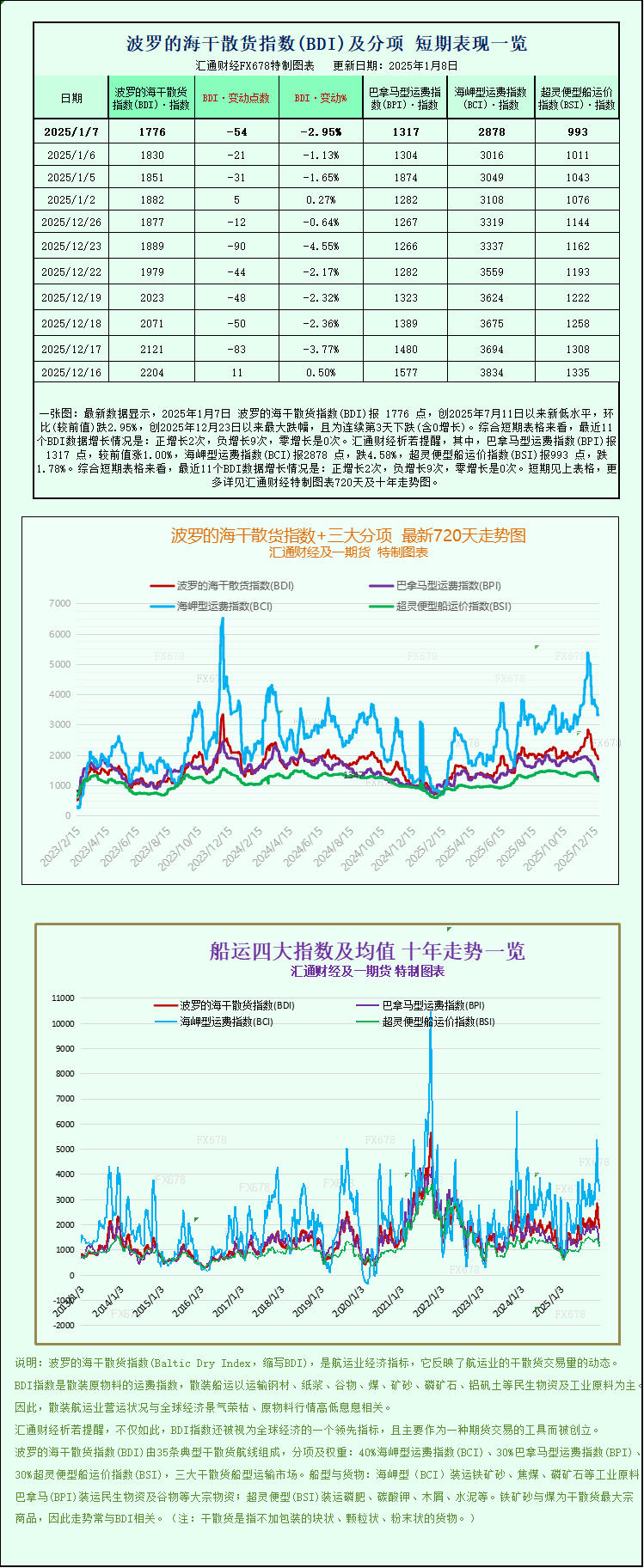
The Baltic Dry Index fell for the third consecutive trading day on Wednesday, hitting its lowest level in more than five months, mainly dragged down by weaker rates for Capesize and Panamax vessels. The index reflects global freight rates for ships transporting dry bulk commodities such as iron ore, coal, and grain; its continued decline indicates that overall demand in the dry bulk market remains weak.
The composite index tracking Capesize, Panamax, and Supramax freight rates fell 54 points to 1,776, its lowest level since July 2025. Despite the recent weakness, the index still represents a cumulative increase of approximately 88% for the year 2025, indicating a significant market rebound over the past year.
The Capesize index fell 138 points, or 4.6%, to 2,878. Capesize vessels primarily transport bulk dry commodities such as iron ore and coal, and the decline in freight rates reflects the incomplete recovery of demand in major global consumption regions.
The average daily charter rate for Capesize vessels fell by $1,259 to $22,595. These vessels, typically with a deadweight tonnage of around 150,000 tons, are an important part of the dry bulk shipping market, and changes in their charter rates are often seen as an important indicator of the activity in global commodity trade.
However, iron ore futures prices have recently bucked the trend, reaching their highest level in months. Market sentiment has been boosted by expectations of improved demand from China, the world's largest iron ore consumer, whose government has pledged to implement loose monetary policies until 2026. This is seen as potentially stimulating real estate and infrastructure construction activity, thereby increasing demand for iron ore.
In the smaller tonnage vessel sector, the Supramax index fell 18 points to 993. Supramax vessels primarily transport small-volume bulk cargo, and the decline in their freight rates indicates that small- and medium-sized bulk cargo trade is also facing pressure.
Meanwhile, the Panamax index rose 13 points, or 1%, to 1,317, becoming one of the few sectors to gain on the day. Panamax vessels typically transport 60,000 to 70,000 tons of coal or grain, and the rebound in freight rates may be related to increased short-term demand on specific routes.
Average daily charter rates for Panamax vessels increased by $115 to $11,851. Although the increase was modest, this positive performance provided some support to the overall weak market.
The Baltic Dry Index fell for the third consecutive trading day on Wednesday, hitting its lowest level in more than five months, mainly dragged down by weaker rates for Capesize and Panamax vessels. The index reflects global freight rates for ships transporting dry bulk commodities such as iron ore, coal, and grain; its continued decline indicates that overall demand in the dry bulk market remains weak.
The composite index tracking Capesize, Panamax, and Supramax freight rates fell 54 points to 1,776, its lowest level since July 2025. Despite the recent weakness, the index still represents a cumulative increase of approximately 88% for the year 2025, indicating a significant market rebound over the past year.
The Capesize index fell 138 points, or 4.6%, to 2,878. Capesize vessels primarily transport bulk dry commodities such as iron ore and coal, and the decline in freight rates reflects the incomplete recovery of demand in major global consumption regions.
The average daily charter rate for Capesize vessels fell by $1,259 to $22,595. These vessels, typically with a deadweight tonnage of around 150,000 tons, are an important part of the dry bulk shipping market, and changes in their charter rates are often seen as an important indicator of the activity in global commodity trade.
However, iron ore futures prices have recently bucked the trend, reaching their highest level in months. Market sentiment has been boosted by expectations of improved demand from China, the world's largest iron ore consumer, whose government has pledged to implement loose monetary policies until 2026. This is seen as potentially stimulating real estate and infrastructure construction activity, thereby increasing demand for iron ore.
In the smaller tonnage vessel sector, the Supramax index fell 18 points to 993. Supramax vessels primarily transport small-volume bulk cargo, and the decline in their freight rates indicates that small- and medium-sized bulk cargo trade is also facing pressure.
Meanwhile, the Panamax index rose 13 points, or 1%, to 1,317, becoming one of the few sectors to gain on the day. Panamax vessels typically transport 60,000 to 70,000 tons of coal or grain, and the rebound in freight rates may be related to increased short-term demand on specific routes.
Average daily charter rates for Panamax vessels increased by $115 to $11,851. Although the increase was modest, this positive performance provided some support to the overall weak market.
- Risk Warning and Disclaimer
- The market involves risk, and trading may not be suitable for all investors. This article is for reference only and does not constitute personal investment advice, nor does it take into account certain users’ specific investment objectives, financial situation, or other needs. Any investment decisions made based on this information are at your own risk.