Funds sell off aggressively! Gold and silver prices plummet – is this a buying opportunity or a warning sign?
2026-01-08 20:01:05
On Thursday (January 8), during the European and American trading sessions, spot gold fell 0.56% to $4,431 per ounce; spot silver fell 3.17% to $75.67 per ounce. Shanghai silver futures closed down 5.9%, while platinum and copper futures continued their decline from the previous trading day, falling by about 2.8%.
Gold and silver fell for the second consecutive trading day as the market prepares for the annual rebalancing of commodity indices. A massive sell-off of futures contracts worth billions of dollars is expected in the coming days. However, this passive selling may trigger a bandwagon effect in gold and silver, leading to opportune buying opportunities after the overselling.
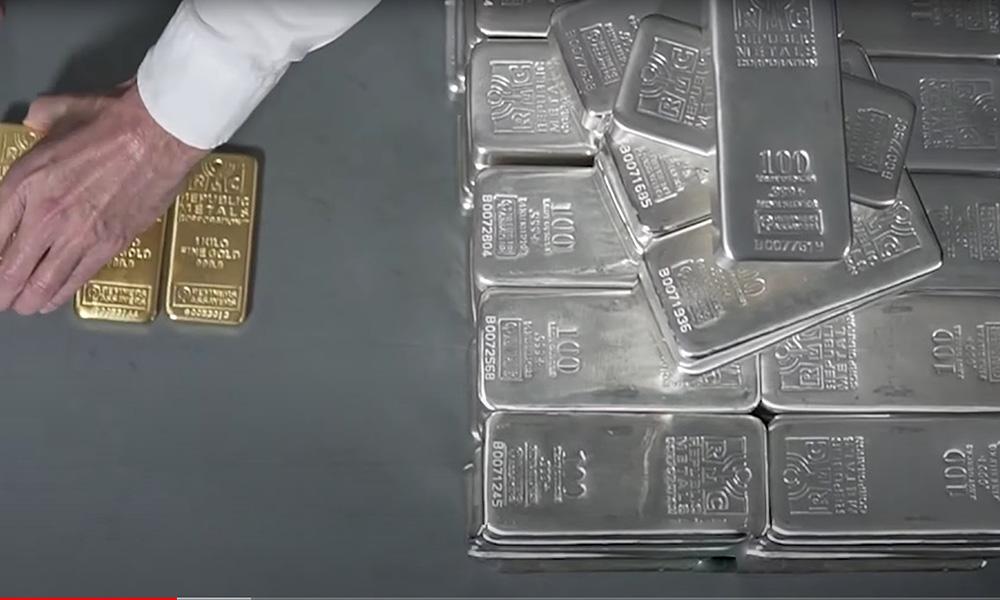
Spot gold fell below the $4,432 per ounce mark, which is the 5-day moving average, during the session. It had already recorded a drop of nearly 1% in the previous trading day. Passive tracking funds started selling precious metal futures on Thursday in order to align with the new weighting of the index after the adjustment. This routine operation has had a far greater impact on gold and silver this time than in the past due to the surge in precious metal prices last year.
Silver has become the most vulnerable commodity in this round of rebalancing, plunging more than 3% on Thursday alone. Coupled with the recent high volatility, it is extremely susceptible to concentrated selling.
Citigroup estimates that to meet index rebalancing requirements, the sale of silver futures could reach $6.8 billion, equivalent to 12% of the total open interest in silver contracts on the New York Mercantile Exchange (Comex).
Citigroup also pointed out that fund holdings data show that the outflow of funds from gold futures will be roughly the same as that from silver.
The core trigger for this concentrated sell-off is that the weight of precious metals in the benchmark commodity index has increased significantly due to last year's surge, and passive funds need to adjust their holdings to match the new weight.
Citigroup strategist Kenny Hu stated bluntly, "In all my years in the industry, I have never seen such a scale of capital flow."
Despite short-term selling pressure from rebalancing, gold and silver have not shown any signs of a significant pullback after achieving their best annual performance since 1979.
Throughout last year, both precious metals repeatedly hit record highs, supported by both central banks' continued gold purchases and inflows into gold ETFs.
A World Gold Council announcement on January 6 showed that global central banks' net gold purchases reached 45 tons in November; data released on Wednesday showed that the People's Bank of China has increased its gold holdings for 14 consecutive months, with official gold purchases continuing to be a core pillar supporting gold prices.
In addition, the recent US arrest of Venezuelan leader Nicolás Maduro, coupled with the Greenland threat, provided additional safe-haven support for gold – as of Wednesday's close, gold had risen by about 3% in the first half of the week.
Regarding the short-term impact of index rebalancing, David Wilson, head of commodities strategy at BNP Paribas, said: "Index rebalancing may suppress the upside potential of precious metals in the short term, but in the long run, silver has more robust upward momentum."
I have mentioned many times that silver, copper, and gold may follow the same trend as US stocks, because one of the core reasons for the recent rise is the industrial properties of metals, while US stocks, especially the Nasdaq, reflect the market's expectations for the prospects of AI and increased investment in AI.
Recently, US stocks and precious metals have undergone a correction, with gold and silver becoming leading indicators for US stocks. Since this correction in gold and silver is mainly due to the need for fund position rebalancing, US stocks and these three metals may have the opportunity to reach new highs afterward.
Silver prices surged by as much as 150% last year, outpacing gold's gains. In addition to the historic short squeeze in October, market concerns about potential US import tariffs also contributed significantly to silver's strength.
Recently, US stocks, especially the Nasdaq, have become a leading indicator for gold, silver, and copper, and pullbacks in gold and silver will also affect stock indices.
This is because they are all reflecting the market's optimistic bets on AI technology stocks.
Meanwhile, from a traditional perspective, traders are currently focused on key economic data such as the US December jobs report to be released on Friday.
If the data falls short of expectations, it will further strengthen market bets on a Federal Reserve rate cut, and the expectation of a rate cut has always been the core driving force for the rise of precious metals without yield.
From a technical perspective, spot silver, spot gold, and LME copper may all fail to close above their 5-day moving averages. Coupled with the recent rapid rebound in US tech stocks, this could become a short-term confluence of factors leading to a correction in the AI sector.
Meanwhile, the rapid rise in memory chip prices could lead to a significant correction in the stock prices of electronics manufacturers, led by Apple, thus affecting the performance of technology stocks and consequently the performance of gold, silver, and copper.
However, the good news is that with the easing of tensions between Elon Musk and the White House, and the continuous release of positive news from major AI companies, gold, silver, copper, and US tech stocks have the potential to continue reaching new highs after a period of volatility.
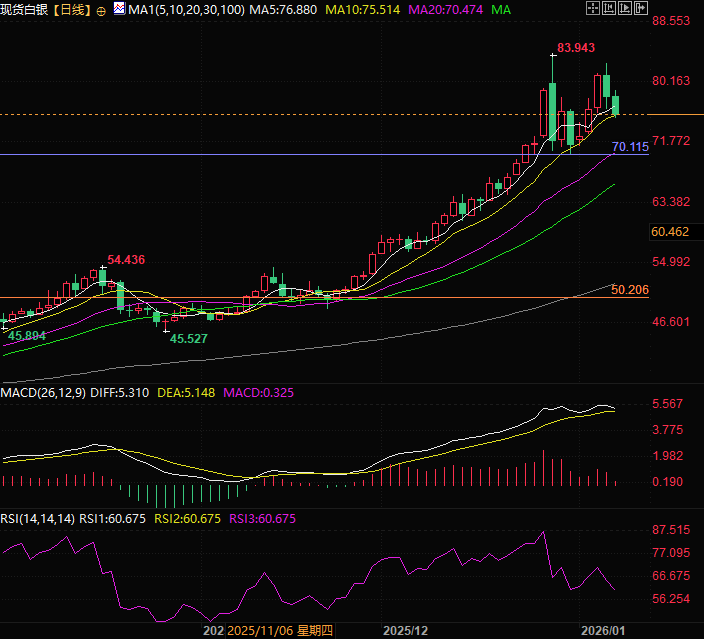
(Spot silver daily chart, source: EasyForex)
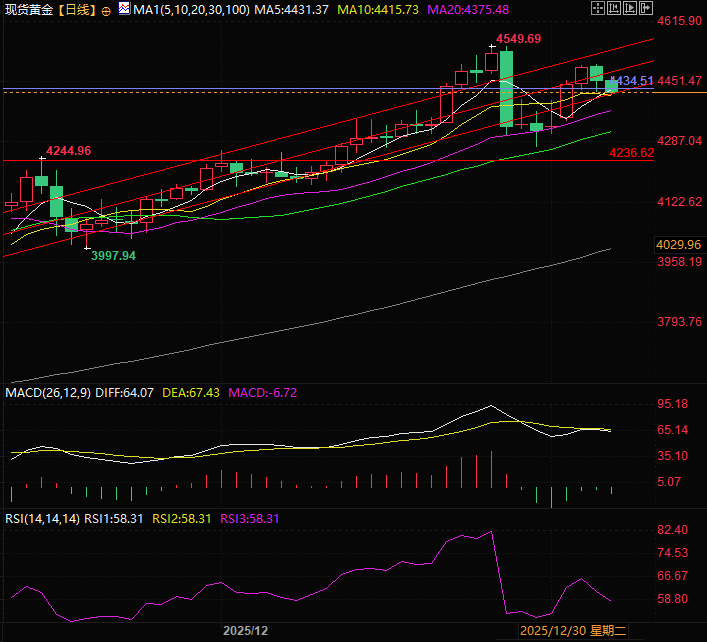
(Spot gold daily chart, source: FX678)
Gold and silver fell for the second consecutive trading day as the market prepares for the annual rebalancing of commodity indices. A massive sell-off of futures contracts worth billions of dollars is expected in the coming days. However, this passive selling may trigger a bandwagon effect in gold and silver, leading to opportune buying opportunities after the overselling.
The core of short-term selling pressure: passive selling triggered by index rebalancing.
Spot gold fell below the $4,432 per ounce mark, which is the 5-day moving average, during the session. It had already recorded a drop of nearly 1% in the previous trading day. Passive tracking funds started selling precious metal futures on Thursday in order to align with the new weighting of the index after the adjustment. This routine operation has had a far greater impact on gold and silver this time than in the past due to the surge in precious metal prices last year.
Silver has become the most vulnerable commodity in this round of rebalancing, plunging more than 3% on Thursday alone. Coupled with the recent high volatility, it is extremely susceptible to concentrated selling.
Citigroup estimates that to meet index rebalancing requirements, the sale of silver futures could reach $6.8 billion, equivalent to 12% of the total open interest in silver contracts on the New York Mercantile Exchange (Comex).
Citigroup also pointed out that fund holdings data show that the outflow of funds from gold futures will be roughly the same as that from silver.
The core trigger for this concentrated sell-off is that the weight of precious metals in the benchmark commodity index has increased significantly due to last year's surge, and passive funds need to adjust their holdings to match the new weight.
Citigroup strategist Kenny Hu stated bluntly, "In all my years in the industry, I have never seen such a scale of capital flow."
Solid long-term support: Central bank gold purchases and safe-haven demand provide a safety net.
Despite short-term selling pressure from rebalancing, gold and silver have not shown any signs of a significant pullback after achieving their best annual performance since 1979.
Throughout last year, both precious metals repeatedly hit record highs, supported by both central banks' continued gold purchases and inflows into gold ETFs.
A World Gold Council announcement on January 6 showed that global central banks' net gold purchases reached 45 tons in November; data released on Wednesday showed that the People's Bank of China has increased its gold holdings for 14 consecutive months, with official gold purchases continuing to be a core pillar supporting gold prices.
In addition, the recent US arrest of Venezuelan leader Nicolás Maduro, coupled with the Greenland threat, provided additional safe-haven support for gold – as of Wednesday's close, gold had risen by about 3% in the first half of the week.
Silver price performance: Stronger upward momentum, ample long-term growth potential.
Regarding the short-term impact of index rebalancing, David Wilson, head of commodities strategy at BNP Paribas, said: "Index rebalancing may suppress the upside potential of precious metals in the short term, but in the long run, silver has more robust upward momentum."
I have mentioned many times that silver, copper, and gold may follow the same trend as US stocks, because one of the core reasons for the recent rise is the industrial properties of metals, while US stocks, especially the Nasdaq, reflect the market's expectations for the prospects of AI and increased investment in AI.
Recently, US stocks and precious metals have undergone a correction, with gold and silver becoming leading indicators for US stocks. Since this correction in gold and silver is mainly due to the need for fund position rebalancing, US stocks and these three metals may have the opportunity to reach new highs afterward.
Silver prices surged by as much as 150% last year, outpacing gold's gains. In addition to the historic short squeeze in October, market concerns about potential US import tariffs also contributed significantly to silver's strength.
Summary and Technical Analysis:
Recently, US stocks, especially the Nasdaq, have become a leading indicator for gold, silver, and copper, and pullbacks in gold and silver will also affect stock indices.
This is because they are all reflecting the market's optimistic bets on AI technology stocks.
Meanwhile, from a traditional perspective, traders are currently focused on key economic data such as the US December jobs report to be released on Friday.
If the data falls short of expectations, it will further strengthen market bets on a Federal Reserve rate cut, and the expectation of a rate cut has always been the core driving force for the rise of precious metals without yield.
From a technical perspective, spot silver, spot gold, and LME copper may all fail to close above their 5-day moving averages. Coupled with the recent rapid rebound in US tech stocks, this could become a short-term confluence of factors leading to a correction in the AI sector.
Meanwhile, the rapid rise in memory chip prices could lead to a significant correction in the stock prices of electronics manufacturers, led by Apple, thus affecting the performance of technology stocks and consequently the performance of gold, silver, and copper.
However, the good news is that with the easing of tensions between Elon Musk and the White House, and the continuous release of positive news from major AI companies, gold, silver, copper, and US tech stocks have the potential to continue reaching new highs after a period of volatility.
(Spot silver daily chart, source: EasyForex)
(Spot gold daily chart, source: FX678)
- Risk Warning and Disclaimer
- The market involves risk, and trading may not be suitable for all investors. This article is for reference only and does not constitute personal investment advice, nor does it take into account certain users’ specific investment objectives, financial situation, or other needs. Any investment decisions made based on this information are at your own risk.