The euro/dollar exchange rate traded in a narrow range, with the market remaining cautious ahead of the non-farm payroll report.
2026-01-08 20:06:29
On Thursday (January 8), the euro/dollar exchange rate traded in a narrow range during the European session, encountering resistance below the 1.1700 level for the second consecutive trading day. The euro/dollar was trading at 1.1677 at one point, with the market reacting mutedly to the European data released during the day. The market is currently awaiting key data to guide the exchange rate direction.

A review of the US economic data released on Wednesday revealed a mixed picture, failing to provide clear guidance for the Federal Reserve's monetary policy path. Employment data remained weak, confirming that the labor market is still stagnant; however, optimistic reports from the services sector indicated significant signs of a US economic recovery in the fourth quarter of 2025. This divergence between the two core economic pillars further exacerbated market uncertainty regarding the policy outlook.
Key Data Preview for Today: Eurozone Indicators and US Initial Jobless Claims Data in Response
Thursday's economic calendar was packed with key data releases from the Eurozone, with a mixed picture. On the positive side, the unemployment rate unexpectedly fell to 6.3% in November for the first time in seven months, from 6.4%, with the number of unemployed decreasing by 71,000, demonstrating the resilience of the labor market and consistent with previous surveys showing improved employment prospects in the private sector. On the negative side, business confidence declined in December, the economic sentiment index fell to 96.7, ending a four-month upward trend, and declining employment expectations and weak consumer confidence dragged down household spending. Germany also saw a slight increase in unemployment in December, raising key questions about the timing of the effects of fiscal stimulus for investors. The data failed to provide a boost to the euro.
In the US, initial jobless claims for the week ending December 2025 are projected to rise to 210,000 from 199,000 the previous week. With market focus already heavily on Friday's December non-farm payroll report, today's initial claims data is likely to have a limited impact, and investors will likely remain on the sidelines.
Euro Fundamentals: Inflation Targets Achieved While Geopolitical Risks Coexist
Regarding inflation data, although Germany's Consumer Price Index (CPI) was slightly lower than market expectations, the overall Eurozone inflation data precisely matched the general expectation of 2.0%. It's worth noting that given the European Central Bank's consistently hawkish communication tone, even a slight lower-than-expected fluctuation in inflation is unlikely to trigger a market repricing of the ECB's policy stance. The latest report from Eurostat shows that the Eurozone's overall CPI fell to 2% in December, the first time it has reached the ECB's medium-term inflation target since last summer, causing the euro/dollar exchange rate to initially decline.
Regarding core inflation, the core CPI, excluding volatile food, energy, and service prices, remained at 2.2% this month. With international energy prices continuing to fall, the market generally expects the Eurozone inflation rate to continue declining, and it may even soon fall below the European Central Bank's (ECB) target of 1.9%. As for economic growth expectations, ECB economists have raised their growth outlook, predicting that the Eurozone economy will grow by 1.2% this year, higher than the previous forecast of 1%.
Geopolitical factors have become a key variable influencing the euro's trajectory, primarily focusing on two major hotspots in the East and West: In the West, the US and Denmark will hold talks next week on Greenland, with reports suggesting the White House is considering a commercial agreement to gain a foothold on the island, while the Trump administration still reserves the possibility of military intervention, although the market has relatively limited pricing in such risks; In the East, there has been some progress on the Ukraine issue, with the UK and France agreeing to send troops to Ukraine if a peace agreement is reached, but the euro exchange rate has not yet reacted significantly to this.
US Dollar: Employment data becomes key to policy, non-farm payroll report sets the tone for short-term direction.
Recent divergent US labor market data has become a key variable influencing the dollar's trajectory. The ADP Private Sector Employment Report for December showed that private companies added over 45,000 jobs that month, reversing a decline of more than 29,000 jobs in November. This data boosted the euro/dollar exchange rate, causing it to fall. In terms of employment structure, the new jobs were concentrated in the service sector, with education, healthcare, and hospitality being the main contributors, while the manufacturing sector continued to face job losses.
The market's primary focus is on the US December non-farm payrolls report due on Friday. Economists expect the report to show 64,000 new jobs added in December, mostly in the service sector, while manufacturing has lost thousands of jobs over the past 12 months. Furthermore, the fact that thousands of government employees accepted Trump's offer to resign is considered one of the main reasons for the unemployment rate jumping to 4.6%.
Regarding the outlook for monetary policy, there is a clear division within the Federal Reserve regarding the direction of interest rate decisions in 2026. The minutes of the December monetary policy meeting showed that most officials believed further rate cuts would be appropriate if inflation fell as expected, but some officials advocated maintaining interest rates to assess the policy's effectiveness. Currently, the market widely expects the Fed to maintain stable interest rates at its next meeting (January 27-28), and the performance of the December non-farm payroll report will directly influence market expectations regarding the Fed's subsequent policy path.
Monex Europe analysts say the euro remains driven by the dollar's performance, with eurozone data having little impact on the single currency. Wednesday's data confirmed that price pressures in the eurozone are easing, with inflation falling to 2.0% in December. However, the euro's reaction was muted, as eurozone factors are less significant than US factors, given the European Central Bank's expectation of maintaining firm interest rates. They say this makes the euro more sensitive to US labor market data.
Technical Analysis: The exchange rate continues its downward trend; the momentum for a rebound remains to be seen.
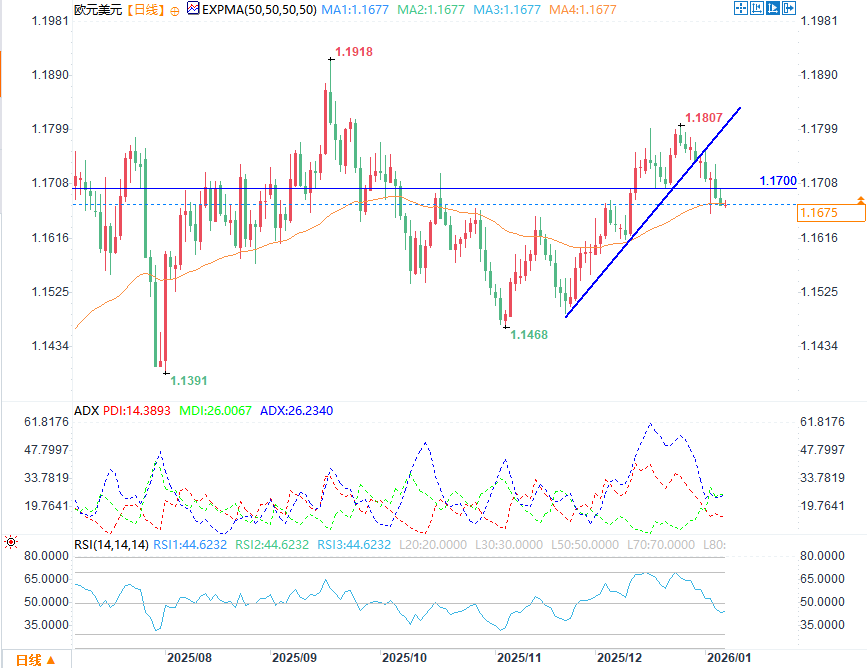
(EUR/USD daily chart source: FX678)
From a technical perspective, following the release of the latest consumer inflation report by Eurostat, the euro/dollar pair continued its strong downward trend this week, trading around 1.1677, a significant pullback from the December high of 1.1805. Looking at the daily chart, the pair has been declining steadily over the past few trading days, breaking below the sloping trendline connecting the lows of November and December last year, indicating short-term downward pressure.
However, positive signs also exist: the exchange rate remains above the 50-day exponential moving average (EMA), while the average trendline (ADX) has begun to decline, suggesting that the momentum of the current downtrend may be weakening. Based on this, a rebound is possible, with bulls targeting the key resistance level of 1.1805, the high of December 24th. A successful break above this level could lead to further gains towards the important 1.1920 level. Recent exchange rate data shows that EUR/USD briefly broke above 1.18 in late December 2025 before fluctuating downwards, currently exhibiting significant range-bound trading.
A review of the US economic data released on Wednesday revealed a mixed picture, failing to provide clear guidance for the Federal Reserve's monetary policy path. Employment data remained weak, confirming that the labor market is still stagnant; however, optimistic reports from the services sector indicated significant signs of a US economic recovery in the fourth quarter of 2025. This divergence between the two core economic pillars further exacerbated market uncertainty regarding the policy outlook.
Key Data Preview for Today: Eurozone Indicators and US Initial Jobless Claims Data in Response
Thursday's economic calendar was packed with key data releases from the Eurozone, with a mixed picture. On the positive side, the unemployment rate unexpectedly fell to 6.3% in November for the first time in seven months, from 6.4%, with the number of unemployed decreasing by 71,000, demonstrating the resilience of the labor market and consistent with previous surveys showing improved employment prospects in the private sector. On the negative side, business confidence declined in December, the economic sentiment index fell to 96.7, ending a four-month upward trend, and declining employment expectations and weak consumer confidence dragged down household spending. Germany also saw a slight increase in unemployment in December, raising key questions about the timing of the effects of fiscal stimulus for investors. The data failed to provide a boost to the euro.
In the US, initial jobless claims for the week ending December 2025 are projected to rise to 210,000 from 199,000 the previous week. With market focus already heavily on Friday's December non-farm payroll report, today's initial claims data is likely to have a limited impact, and investors will likely remain on the sidelines.
Euro Fundamentals: Inflation Targets Achieved While Geopolitical Risks Coexist
Regarding inflation data, although Germany's Consumer Price Index (CPI) was slightly lower than market expectations, the overall Eurozone inflation data precisely matched the general expectation of 2.0%. It's worth noting that given the European Central Bank's consistently hawkish communication tone, even a slight lower-than-expected fluctuation in inflation is unlikely to trigger a market repricing of the ECB's policy stance. The latest report from Eurostat shows that the Eurozone's overall CPI fell to 2% in December, the first time it has reached the ECB's medium-term inflation target since last summer, causing the euro/dollar exchange rate to initially decline.
Regarding core inflation, the core CPI, excluding volatile food, energy, and service prices, remained at 2.2% this month. With international energy prices continuing to fall, the market generally expects the Eurozone inflation rate to continue declining, and it may even soon fall below the European Central Bank's (ECB) target of 1.9%. As for economic growth expectations, ECB economists have raised their growth outlook, predicting that the Eurozone economy will grow by 1.2% this year, higher than the previous forecast of 1%.
Geopolitical factors have become a key variable influencing the euro's trajectory, primarily focusing on two major hotspots in the East and West: In the West, the US and Denmark will hold talks next week on Greenland, with reports suggesting the White House is considering a commercial agreement to gain a foothold on the island, while the Trump administration still reserves the possibility of military intervention, although the market has relatively limited pricing in such risks; In the East, there has been some progress on the Ukraine issue, with the UK and France agreeing to send troops to Ukraine if a peace agreement is reached, but the euro exchange rate has not yet reacted significantly to this.
US Dollar: Employment data becomes key to policy, non-farm payroll report sets the tone for short-term direction.
Recent divergent US labor market data has become a key variable influencing the dollar's trajectory. The ADP Private Sector Employment Report for December showed that private companies added over 45,000 jobs that month, reversing a decline of more than 29,000 jobs in November. This data boosted the euro/dollar exchange rate, causing it to fall. In terms of employment structure, the new jobs were concentrated in the service sector, with education, healthcare, and hospitality being the main contributors, while the manufacturing sector continued to face job losses.
The market's primary focus is on the US December non-farm payrolls report due on Friday. Economists expect the report to show 64,000 new jobs added in December, mostly in the service sector, while manufacturing has lost thousands of jobs over the past 12 months. Furthermore, the fact that thousands of government employees accepted Trump's offer to resign is considered one of the main reasons for the unemployment rate jumping to 4.6%.
Regarding the outlook for monetary policy, there is a clear division within the Federal Reserve regarding the direction of interest rate decisions in 2026. The minutes of the December monetary policy meeting showed that most officials believed further rate cuts would be appropriate if inflation fell as expected, but some officials advocated maintaining interest rates to assess the policy's effectiveness. Currently, the market widely expects the Fed to maintain stable interest rates at its next meeting (January 27-28), and the performance of the December non-farm payroll report will directly influence market expectations regarding the Fed's subsequent policy path.
Monex Europe analysts say the euro remains driven by the dollar's performance, with eurozone data having little impact on the single currency. Wednesday's data confirmed that price pressures in the eurozone are easing, with inflation falling to 2.0% in December. However, the euro's reaction was muted, as eurozone factors are less significant than US factors, given the European Central Bank's expectation of maintaining firm interest rates. They say this makes the euro more sensitive to US labor market data.
Technical Analysis: The exchange rate continues its downward trend; the momentum for a rebound remains to be seen.
(EUR/USD daily chart source: FX678)
From a technical perspective, following the release of the latest consumer inflation report by Eurostat, the euro/dollar pair continued its strong downward trend this week, trading around 1.1677, a significant pullback from the December high of 1.1805. Looking at the daily chart, the pair has been declining steadily over the past few trading days, breaking below the sloping trendline connecting the lows of November and December last year, indicating short-term downward pressure.
However, positive signs also exist: the exchange rate remains above the 50-day exponential moving average (EMA), while the average trendline (ADX) has begun to decline, suggesting that the momentum of the current downtrend may be weakening. Based on this, a rebound is possible, with bulls targeting the key resistance level of 1.1805, the high of December 24th. A successful break above this level could lead to further gains towards the important 1.1920 level. Recent exchange rate data shows that EUR/USD briefly broke above 1.18 in late December 2025 before fluctuating downwards, currently exhibiting significant range-bound trading.
- Risk Warning and Disclaimer
- The market involves risk, and trading may not be suitable for all investors. This article is for reference only and does not constitute personal investment advice, nor does it take into account certain users’ specific investment objectives, financial situation, or other needs. Any investment decisions made based on this information are at your own risk.