Gold Trading Alert: Powell's criminal case triggers global safe-haven buying frenzy, gold prices briefly break through the $4,600 mark. How long can this bull market continue its run?
2026-01-13 07:56:15
In the turbulent beginning of 2026 in the global financial markets, gold prices surged like a runaway horse, breaking through the historical mark of $4,600 per ounce and setting a new record that left everyone speechless. This surge in gold prices not only ignited investors' enthusiasm for safe-haven assets but also revealed the deep-seated market logic amidst geopolitical uncertainties and the volatility of Federal Reserve policies. As a traditional safe-haven asset, gold is experiencing an unprecedented period of strength, and the driving forces behind it deserve in-depth analysis. From the sudden criminal investigation of Powell to the weakening dollar and inflation expectations, and the continued escalation of global geopolitical tensions, these factors have collectively forged a golden age for gold. On Tuesday (January 13) in early Asian trading, spot gold fluctuated at high levels and is currently trading around $4,590 per ounce.
Spot gold prices rose nearly 2% on Monday, closing at $4,597.21 per ounce, after hitting a high of $4,630.08 during the session. U.S. February gold futures rose even more, closing up 2.5% at $4,614.70. This breakout rally was not accidental, but rather a direct reaction from investors to a sharp increase in global uncertainty.
Looking back over the past year, gold prices have surged by more than 64%, marking the best annual performance since 1979, thanks to the continued low interest rate environment and a surge in safe-haven demand.
Michael Haigh, global head of commodities research at Societe Generale, points out that this high level of uncertainty is adding new factors almost every week, making it difficult to reverse in the short term. Gold, as a non-yielding asset, is particularly popular during periods of declining interest rates because it effectively hedges against inflation and currency devaluation risks.
Meanwhile, silver prices also surged, with spot silver hitting a record high of $86.22 per ounce during the session before closing at $85.12, a gain of 5.2%. Ned Naylor-Leyland, gold and silver fund manager at Jupiter Asset Management, emphasized that the silver market is smaller and more sensitive to capital inflows, thus its price increases tend to be more dramatic. This correlation between gold and silver further enhanced the overall attractiveness of the precious metals sector, drawing in a large influx of funds and driving prices higher.
The Trump administration's criminal investigation into Federal Reserve Chairman Jerome Powell was the core catalyst for the recent surge in gold prices. The U.S. Department of Justice's threat to file criminal charges against Powell for his congressional testimony regarding the $2.5 billion renovation project of the Federal Reserve's Washington headquarters was like a bombshell, opening the floodgates of market concerns about the Fed's independence.
Powell himself denounced the move as an “excuse” for the White House to try to pressure for interest rate cuts, and his term will end in May, with Trump already beginning to interview potential successors, including BlackRock executive Rick Rieder.
This incident not only exacerbated the risk of political interference in the Federal Reserve but also directly impacted the long-term outlook for the dollar, causing the dollar index to fall 0.23% on Monday, closing at 98.90, after briefly approaching the 200-day moving average. Marc Chandler, chief market strategist at Bannockburn Global Forex, said the subpoena incident overshadowed geopolitical factors and ended the dollar's new year rally.
Against this backdrop, investors are turning to gold as a safe haven, as the erosion of the Federal Reserve's independence could undermine the credibility of the U.S. financial system and amplify global economic uncertainty.
Historical experience tells us that gold often benefits when the Federal Reserve's policies face political pressure, and this time is no exception. This crisis directly stimulated a surge in safe-haven buying, pushing gold prices to new highs.
In addition to the internal turmoil within the Federal Reserve, the continued escalation of global geopolitical risks has also provided strong support for gold. The Trump administration is weighing its response to Iran's crackdown on protests, which are seen as the most serious challenge to the Iranian regime since the 1979 Islamic Revolution, while Iran says it will maintain communication channels with the United States.
Furthermore, Trump's earlier ouster of Venezuelan President Nemadouro and his proposed acquisition of Greenland further destabilized the international landscape. These combined events created a highly unstable global environment, prompting a rapid influx of funds into safe-haven assets such as gold.
Michael Haigh added that the cumulative effect of these uncertainties makes it difficult to change the supporting environment for gold in the short term. It is worth noting that the US Supreme Court is about to rule on Trump's tariff policies implemented under the International Emergency Economic Powers Act, with the ruling expected as early as this week. This could further impact the global trade landscape and inflation expectations. Historically, gold has served as "crisis insurance" during periods of high geopolitical risk, with its price often positively correlated with risk events. The current intertwining of multiple geopolitical conflicts undoubtedly provides additional upward momentum for gold prices.
The Federal Reserve's policy path is a key variable affecting gold prices. Although the Fed is expected to keep interest rates unchanged at its January 27-28 meeting, the market still anticipates two more rate cuts later this year, which has boosted demand for gold.
New York Federal Reserve President John Williams further clarified this outlook in a speech on Monday. He pointed out that current inflation has risen by about 0.5 percentage points due to factors such as tariffs, mainly borne by American consumers, but the underlying trend is favorable, and there is no widespread price pressure. He expects the inflation rate to peak in the first half of 2026, then gradually slow down, falling back to the 2% target level in 2027.
Meanwhile, Williams believes the US labor market is stable and the annual economic growth rate is likely to be between 2.5% and 2.75%, holding a "quite optimistic" view of the outlook. He emphasized that monetary policy is currently "closer to neutral," and future decisions will rely heavily on data, suggesting that there is no need for hasty adjustments in the short term, but if economic data weakens, there is still room for interest rate cuts.
In the bond market, U.S. Treasury yields were largely unchanged, with the 10-year yield at 4.177% and the 30-year yield at 4.828%.
The market is awaiting this week's CPI and PPI data. These factors combined reinforce expectations of a low-interest-rate environment, in which gold performs particularly well due to lower holding costs. Meanwhile, the break-even yield on inflation-protected bonds has risen to 2.289%, indicating that the market expects an average annual inflation rate of approximately 2.3% over the next decade, further supporting gold's position as an inflation hedge.
Although the U.S. December employment data released last Friday was lower than expected, it was not enough to change the expectation that the Federal Reserve would only cut interest rates twice, which was reflected in the bond market as yields fluctuating within a narrow range.
Jim Barnes, head of fixed income at Bryn Mawr Trust, said the market is gradually adjusting to the pressure on the Federal Reserve, believing its independence is unshakeable, but this uncertainty still presents trading opportunities. Monday's auctions of three-year and 10-year Treasury bonds saw robust demand, with bid-to-cover ratios above or near average, reflecting that investor confidence in U.S. assets has not completely collapsed. However, the upcoming Supreme Court hearing on Trump's attempt to remove Federal Reserve Governor Cook could further amplify policy uncertainty.
Williams also noted that as inflation risks diminish while downside risks to the job market rise, the Federal Reserve needs to balance controlling inflation with avoiding employment shocks. This structural support makes gold not just a short-term safe-haven asset, but a core asset in long-term investment portfolios.
Nomura FX analyst Craig Chan points out that the US dollar faces mixed factors in the short term, including a stable macroeconomic backdrop and support from geopolitical risks, but the risks of the Federal Reserve's independence and expectations of tariff decisions will push the dollar weaker, which indirectly benefits gold.
In conclusion, the surge in gold prices above $4,600 was driven by a confluence of uncertainties, from the Powell criminal investigation to geopolitical tensions, Federal Reserve policy, and inflation expectations. These factors combined to create a solid foundation for the price increase. While short-term market volatility may intensify, the bull market trend for gold is unlikely to reverse in the near term. Looking ahead, as the Fed's decisions become more data-driven and global risks evolve, gold still has room to rise. Investors should closely monitor this week's economic data and court rulings. Gold is not only a safe haven but also a guardian of wealth in turbulent times. In this era of uncertainty, timely investment in gold may be a wise move.
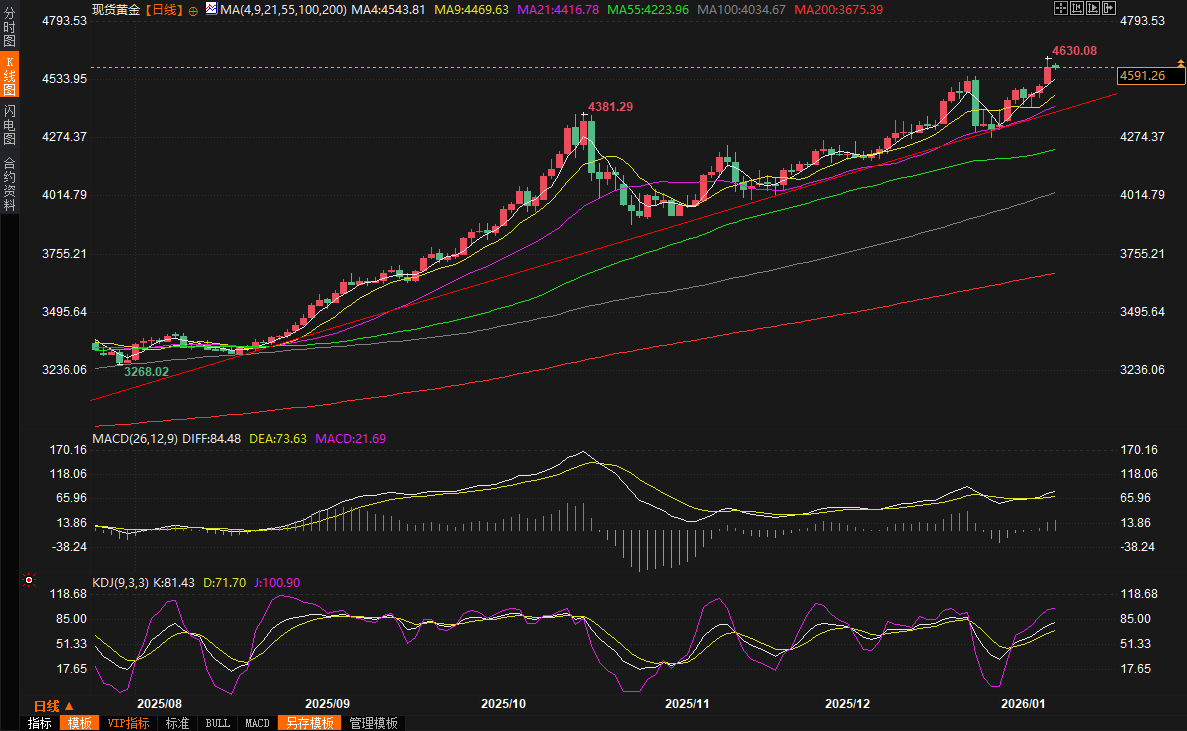
(Spot gold daily chart, source: FX678)
At 07:53 Beijing time, spot gold was trading at $4,591.88 per ounce.
Gold prices hit record high: Safe-haven demand fuels market frenzy
Spot gold prices rose nearly 2% on Monday, closing at $4,597.21 per ounce, after hitting a high of $4,630.08 during the session. U.S. February gold futures rose even more, closing up 2.5% at $4,614.70. This breakout rally was not accidental, but rather a direct reaction from investors to a sharp increase in global uncertainty.
Looking back over the past year, gold prices have surged by more than 64%, marking the best annual performance since 1979, thanks to the continued low interest rate environment and a surge in safe-haven demand.
Michael Haigh, global head of commodities research at Societe Generale, points out that this high level of uncertainty is adding new factors almost every week, making it difficult to reverse in the short term. Gold, as a non-yielding asset, is particularly popular during periods of declining interest rates because it effectively hedges against inflation and currency devaluation risks.
Meanwhile, silver prices also surged, with spot silver hitting a record high of $86.22 per ounce during the session before closing at $85.12, a gain of 5.2%. Ned Naylor-Leyland, gold and silver fund manager at Jupiter Asset Management, emphasized that the silver market is smaller and more sensitive to capital inflows, thus its price increases tend to be more dramatic. This correlation between gold and silver further enhanced the overall attractiveness of the precious metals sector, drawing in a large influx of funds and driving prices higher.
Powell's criminal investigation storm: A crisis of Fed independence ignites gold price surge.
The Trump administration's criminal investigation into Federal Reserve Chairman Jerome Powell was the core catalyst for the recent surge in gold prices. The U.S. Department of Justice's threat to file criminal charges against Powell for his congressional testimony regarding the $2.5 billion renovation project of the Federal Reserve's Washington headquarters was like a bombshell, opening the floodgates of market concerns about the Fed's independence.
Powell himself denounced the move as an “excuse” for the White House to try to pressure for interest rate cuts, and his term will end in May, with Trump already beginning to interview potential successors, including BlackRock executive Rick Rieder.
This incident not only exacerbated the risk of political interference in the Federal Reserve but also directly impacted the long-term outlook for the dollar, causing the dollar index to fall 0.23% on Monday, closing at 98.90, after briefly approaching the 200-day moving average. Marc Chandler, chief market strategist at Bannockburn Global Forex, said the subpoena incident overshadowed geopolitical factors and ended the dollar's new year rally.
Against this backdrop, investors are turning to gold as a safe haven, as the erosion of the Federal Reserve's independence could undermine the credibility of the U.S. financial system and amplify global economic uncertainty.
Historical experience tells us that gold often benefits when the Federal Reserve's policies face political pressure, and this time is no exception. This crisis directly stimulated a surge in safe-haven buying, pushing gold prices to new highs.
Escalating geopolitical tensions: Iranian protests and Trump policies exacerbate global uncertainty.
In addition to the internal turmoil within the Federal Reserve, the continued escalation of global geopolitical risks has also provided strong support for gold. The Trump administration is weighing its response to Iran's crackdown on protests, which are seen as the most serious challenge to the Iranian regime since the 1979 Islamic Revolution, while Iran says it will maintain communication channels with the United States.
Furthermore, Trump's earlier ouster of Venezuelan President Nemadouro and his proposed acquisition of Greenland further destabilized the international landscape. These combined events created a highly unstable global environment, prompting a rapid influx of funds into safe-haven assets such as gold.
Michael Haigh added that the cumulative effect of these uncertainties makes it difficult to change the supporting environment for gold in the short term. It is worth noting that the US Supreme Court is about to rule on Trump's tariff policies implemented under the International Emergency Economic Powers Act, with the ruling expected as early as this week. This could further impact the global trade landscape and inflation expectations. Historically, gold has served as "crisis insurance" during periods of high geopolitical risk, with its price often positively correlated with risk events. The current intertwining of multiple geopolitical conflicts undoubtedly provides additional upward momentum for gold prices.
Federal Reserve Policy and Inflation Outlook: Rate Cut Expectations Support Long-Term Bull Market for Gold
The Federal Reserve's policy path is a key variable affecting gold prices. Although the Fed is expected to keep interest rates unchanged at its January 27-28 meeting, the market still anticipates two more rate cuts later this year, which has boosted demand for gold.
New York Federal Reserve President John Williams further clarified this outlook in a speech on Monday. He pointed out that current inflation has risen by about 0.5 percentage points due to factors such as tariffs, mainly borne by American consumers, but the underlying trend is favorable, and there is no widespread price pressure. He expects the inflation rate to peak in the first half of 2026, then gradually slow down, falling back to the 2% target level in 2027.
Meanwhile, Williams believes the US labor market is stable and the annual economic growth rate is likely to be between 2.5% and 2.75%, holding a "quite optimistic" view of the outlook. He emphasized that monetary policy is currently "closer to neutral," and future decisions will rely heavily on data, suggesting that there is no need for hasty adjustments in the short term, but if economic data weakens, there is still room for interest rate cuts.
In the bond market, U.S. Treasury yields were largely unchanged, with the 10-year yield at 4.177% and the 30-year yield at 4.828%.
The market is awaiting this week's CPI and PPI data. These factors combined reinforce expectations of a low-interest-rate environment, in which gold performs particularly well due to lower holding costs. Meanwhile, the break-even yield on inflation-protected bonds has risen to 2.289%, indicating that the market expects an average annual inflation rate of approximately 2.3% over the next decade, further supporting gold's position as an inflation hedge.
US Economic Data and Market Adaptation: Structural Support for Gold Price Increases
Although the U.S. December employment data released last Friday was lower than expected, it was not enough to change the expectation that the Federal Reserve would only cut interest rates twice, which was reflected in the bond market as yields fluctuating within a narrow range.
Jim Barnes, head of fixed income at Bryn Mawr Trust, said the market is gradually adjusting to the pressure on the Federal Reserve, believing its independence is unshakeable, but this uncertainty still presents trading opportunities. Monday's auctions of three-year and 10-year Treasury bonds saw robust demand, with bid-to-cover ratios above or near average, reflecting that investor confidence in U.S. assets has not completely collapsed. However, the upcoming Supreme Court hearing on Trump's attempt to remove Federal Reserve Governor Cook could further amplify policy uncertainty.
Williams also noted that as inflation risks diminish while downside risks to the job market rise, the Federal Reserve needs to balance controlling inflation with avoiding employment shocks. This structural support makes gold not just a short-term safe-haven asset, but a core asset in long-term investment portfolios.
Nomura FX analyst Craig Chan points out that the US dollar faces mixed factors in the short term, including a stable macroeconomic backdrop and support from geopolitical risks, but the risks of the Federal Reserve's independence and expectations of tariff decisions will push the dollar weaker, which indirectly benefits gold.
In conclusion, the surge in gold prices above $4,600 was driven by a confluence of uncertainties, from the Powell criminal investigation to geopolitical tensions, Federal Reserve policy, and inflation expectations. These factors combined to create a solid foundation for the price increase. While short-term market volatility may intensify, the bull market trend for gold is unlikely to reverse in the near term. Looking ahead, as the Fed's decisions become more data-driven and global risks evolve, gold still has room to rise. Investors should closely monitor this week's economic data and court rulings. Gold is not only a safe haven but also a guardian of wealth in turbulent times. In this era of uncertainty, timely investment in gold may be a wise move.
(Spot gold daily chart, source: FX678)
At 07:53 Beijing time, spot gold was trading at $4,591.88 per ounce.
- Risk Warning and Disclaimer
- The market involves risk, and trading may not be suitable for all investors. This article is for reference only and does not constitute personal investment advice, nor does it take into account certain users’ specific investment objectives, financial situation, or other needs. Any investment decisions made based on this information are at your own risk.