The US dollar hangs at the 99 mark: Small business confidence is recovering, but they dare not rise?
2026-01-13 20:07:38
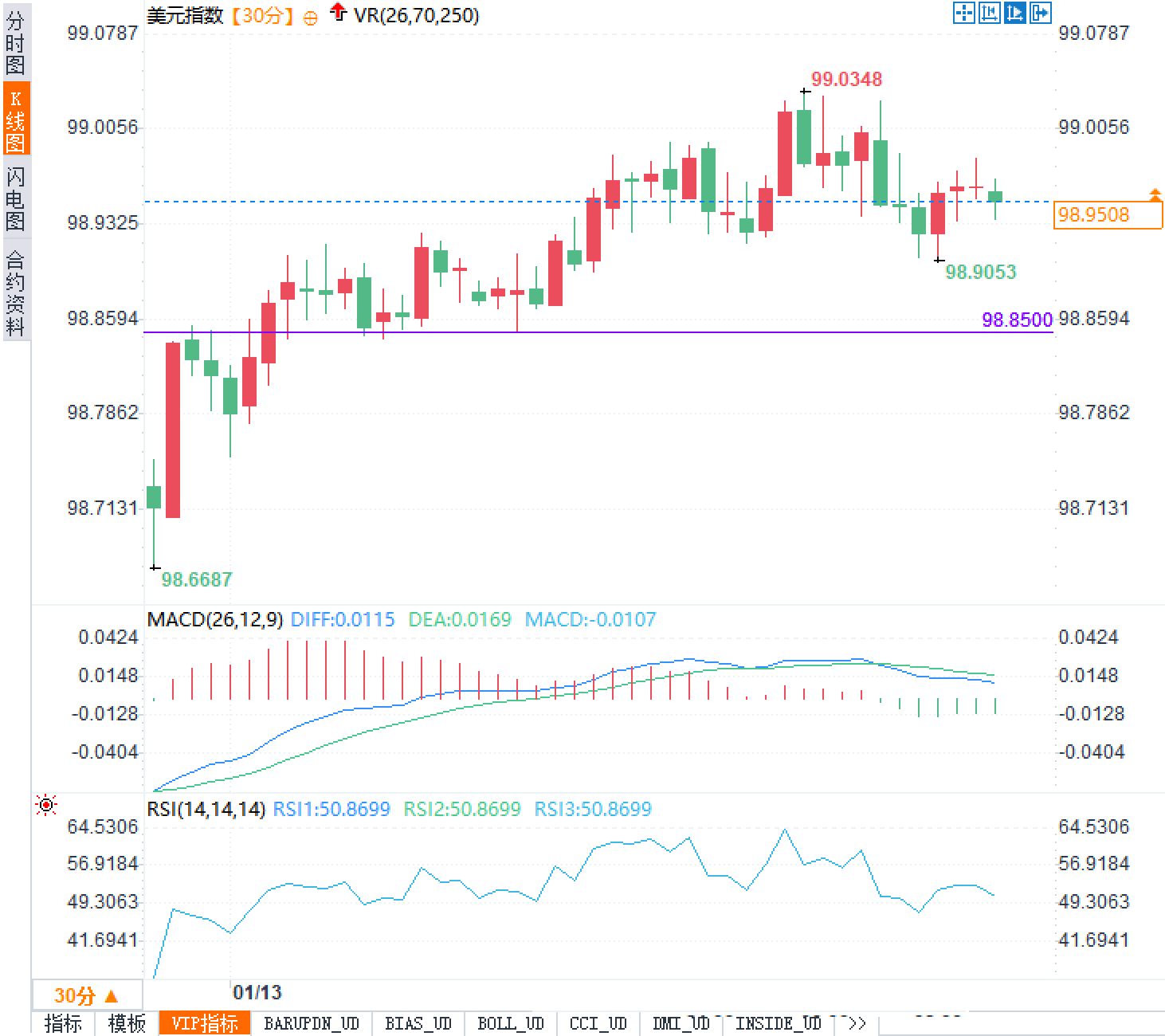
On Tuesday (January 13), the US dollar index fluctuated narrowly around 98.95 during the European session, showing a hesitant trend. From a technical perspective, the price rebounded after forming a low of 98.6687, briefly rising to 99.0348, but the subsequent momentum weakened significantly, failing to hold the 99 level, and then fell back to consolidate below.

This position has become the focus of short-term battle between bulls and bears: 99.0 above constitutes both psychological and technical resistance, while 98.8500 below is considered a key support area. If this support is repeatedly breached, the index may further decline to around 98.7 to seek rebalancing; conversely, if it can effectively break through and hold above 99.0, it may open up upward potential.
Technical indicators also confirm the market's stalemate. The short-term RSI is around 50.8699, in the neutral range, indicating a temporary balance between buying and selling forces with no clear trend. As for the MACD, the DIFF is 0.0115, the DEA is 0.0169, and the histogram is -0.0107, showing that although prices have rebounded somewhat, the upward momentum is weakening. This means that the current market movement is more of a technical correction than a trend reversal. Analysts believe that in the absence of decisive fundamental drivers, the market is in a digestion phase of an "information vacuum," and trading sentiment is becoming cautious.
The recently released NFIB Small Business Optimism Index showed that it rose 0.5 points to 99.5 in December, exceeding market expectations of 99.2 and continuing its trend of being above the 52-year historical average of 98.0. More notably, the uncertainty index dropped sharply by 7 points to 84, reaching its lowest level since June 2024. This seemingly insignificant change is actually quite significant—it reflects the most genuine feelings of businesses in their operational decisions: concerns about costs, labor, taxes, and supply chains are easing.
Small businesses, acting as the "capillaries" of the economy, often have a leading indicator effect on their economic health. When their expectations for the future improve, this is typically reflected first in increased hiring intentions, expanded capital expenditure plans, and enhanced pricing power. These behaviors gradually transmit to the job market and inflation path, thus influencing the direction of monetary policy. For example, if businesses generally plan to expand hiring or invest, it means increased labor demand, and wage pressures may rise again; if the intention to raise prices strengthens, it indicates upward momentum in future inflation. These factors will all become important references for the Federal Reserve in adjusting its interest rate policy.
Therefore, the value of this data lies not in the monthly fluctuations themselves, but in the window it provides to observe the "true economic landscape." The current high optimism index, coupled with a significant decline in uncertainty, indicates that business confidence in the operating environment is recovering. If this recovery continues, the market may reassess the resilience of growth in the coming quarters and even begin to question previously overly pessimistic recession expectations.
Despite positive data from small businesses, the US dollar index failed to strengthen and instead fluctuated, reflecting a fierce debate in the market regarding two interpretations of the same data. The first line of reasoning is "growth-driven expectations of interest rate hikes": if economic fundamentals improve, the market will perceive a decrease in the necessity for the Federal Reserve to cut interest rates, and may even consider resuming rate hikes in the future to suppress potential inflation, thereby pushing up interest rate expectations and benefiting the dollar. In this scenario, US Treasury yields may rise, widening the interest rate differential and attracting capital inflows into dollar assets.
However, another line of reasoning points in the opposite direction: "Cost easing = expected easing." If the recovery in business confidence stems primarily from lower cost pressures and easing labor shortages, rather than strong demand expansion, then the risk of a rebound in inflation is limited. In this scenario, even with a slight recovery in growth, the Federal Reserve may maintain a dovish stance and continue its rate-cutting program. Under these circumstances, the upside potential for interest rates is limited, and the dollar is unlikely to receive sustained support. This also explains why long-term US Treasury yields are currently reacting mutedly, and the market's pricing of the Fed's policy path has not fundamentally changed.
More complexly, risk appetite is also influencing the dollar's performance. A recovery in small business confidence is often seen as a sign of a rising probability of a "soft landing," which should boost risk sentiment. Theoretically, this should weaken the dollar's safe-haven appeal, putting it under pressure. However, in reality, the dollar has not weakened significantly; instead, it has remained resilient. This indicates that the market has not fully bet on the combination of "interest rate cuts + a rise in risk assets," but is in a wait-and-see mode: seeing evidence of economic resilience while also worrying about a resurgence of inflation, making a complete shift to easing monetary policy difficult.
Currently, the US dollar index remains at a critical juncture, poised for a directional shift. Analysts point out that a single NFIB data point is insufficient to break the current deadlock; the market needs more high-frequency data for confirmation, particularly inflation figures, non-farm payroll sub-indexes, wage growth, and policy communications from Federal Reserve officials. Only when multiple signals converge and point in the same direction can a trend-driven market movement be triggered.
In the short term, the 98.85 level remains a key level to watch. If the US dollar index finds support here, and subsequent data continues to strengthen growth and inflation expectations—for example, a comprehensive rebound in corporate hiring plans, capital expenditure intentions, and price increases—the market may repric the Fed's interest rate path, delaying rate cut expectations and pushing the dollar to attempt to break through the 99.0 level. Conversely, if support is repeatedly broken and other data fails to follow suit, the market may shift back to an easing narrative, and the dollar index may retreat to around 98.7.
In the medium term, the "operational recovery" clue provided by the NFIB needs to be judged in conjunction with other high-weighted variables. If inflation stickiness reappears, financial conditions tighten, and the labor market remains tense, the interest rate differential is expected to continue to tilt towards the US dollar, providing it with upward momentum; however, if the economic recovery mainly relies on efficiency improvements rather than demand expansion, and inflationary pressures are manageable, the Federal Reserve will continue to cut interest rates at its pace, and the US dollar will most likely maintain a range-bound trading pattern.
In conclusion, the current "stillness" of the US dollar is not indifference, but rather a wait for a "trigger point"—it could be better-than-expected CPI data, or it could be a subtle shift in the Fed's rhetoric.
This position has become the focus of short-term battle between bulls and bears: 99.0 above constitutes both psychological and technical resistance, while 98.8500 below is considered a key support area. If this support is repeatedly breached, the index may further decline to around 98.7 to seek rebalancing; conversely, if it can effectively break through and hold above 99.0, it may open up upward potential.
Technical indicators also confirm the market's stalemate. The short-term RSI is around 50.8699, in the neutral range, indicating a temporary balance between buying and selling forces with no clear trend. As for the MACD, the DIFF is 0.0115, the DEA is 0.0169, and the histogram is -0.0107, showing that although prices have rebounded somewhat, the upward momentum is weakening. This means that the current market movement is more of a technical correction than a trend reversal. Analysts believe that in the absence of decisive fundamental drivers, the market is in a digestion phase of an "information vacuum," and trading sentiment is becoming cautious.
The recovery in small business confidence is sending a signal of the true state of the economy.
The recently released NFIB Small Business Optimism Index showed that it rose 0.5 points to 99.5 in December, exceeding market expectations of 99.2 and continuing its trend of being above the 52-year historical average of 98.0. More notably, the uncertainty index dropped sharply by 7 points to 84, reaching its lowest level since June 2024. This seemingly insignificant change is actually quite significant—it reflects the most genuine feelings of businesses in their operational decisions: concerns about costs, labor, taxes, and supply chains are easing.
Small businesses, acting as the "capillaries" of the economy, often have a leading indicator effect on their economic health. When their expectations for the future improve, this is typically reflected first in increased hiring intentions, expanded capital expenditure plans, and enhanced pricing power. These behaviors gradually transmit to the job market and inflation path, thus influencing the direction of monetary policy. For example, if businesses generally plan to expand hiring or invest, it means increased labor demand, and wage pressures may rise again; if the intention to raise prices strengthens, it indicates upward momentum in future inflation. These factors will all become important references for the Federal Reserve in adjusting its interest rate policy.
Therefore, the value of this data lies not in the monthly fluctuations themselves, but in the window it provides to observe the "true economic landscape." The current high optimism index, coupled with a significant decline in uncertainty, indicates that business confidence in the operating environment is recovering. If this recovery continues, the market may reassess the resilience of growth in the coming quarters and even begin to question previously overly pessimistic recession expectations.
Why didn't the positive news boost the dollar? Two conflicting lines of reasoning are at play.
Despite positive data from small businesses, the US dollar index failed to strengthen and instead fluctuated, reflecting a fierce debate in the market regarding two interpretations of the same data. The first line of reasoning is "growth-driven expectations of interest rate hikes": if economic fundamentals improve, the market will perceive a decrease in the necessity for the Federal Reserve to cut interest rates, and may even consider resuming rate hikes in the future to suppress potential inflation, thereby pushing up interest rate expectations and benefiting the dollar. In this scenario, US Treasury yields may rise, widening the interest rate differential and attracting capital inflows into dollar assets.
However, another line of reasoning points in the opposite direction: "Cost easing = expected easing." If the recovery in business confidence stems primarily from lower cost pressures and easing labor shortages, rather than strong demand expansion, then the risk of a rebound in inflation is limited. In this scenario, even with a slight recovery in growth, the Federal Reserve may maintain a dovish stance and continue its rate-cutting program. Under these circumstances, the upside potential for interest rates is limited, and the dollar is unlikely to receive sustained support. This also explains why long-term US Treasury yields are currently reacting mutedly, and the market's pricing of the Fed's policy path has not fundamentally changed.
More complexly, risk appetite is also influencing the dollar's performance. A recovery in small business confidence is often seen as a sign of a rising probability of a "soft landing," which should boost risk sentiment. Theoretically, this should weaken the dollar's safe-haven appeal, putting it under pressure. However, in reality, the dollar has not weakened significantly; instead, it has remained resilient. This indicates that the market has not fully bet on the combination of "interest rate cuts + a rise in risk assets," but is in a wait-and-see mode: seeing evidence of economic resilience while also worrying about a resurgence of inflation, making a complete shift to easing monetary policy difficult.
What's next? The key is whether "signal resonance" can form.
Currently, the US dollar index remains at a critical juncture, poised for a directional shift. Analysts point out that a single NFIB data point is insufficient to break the current deadlock; the market needs more high-frequency data for confirmation, particularly inflation figures, non-farm payroll sub-indexes, wage growth, and policy communications from Federal Reserve officials. Only when multiple signals converge and point in the same direction can a trend-driven market movement be triggered.
In the short term, the 98.85 level remains a key level to watch. If the US dollar index finds support here, and subsequent data continues to strengthen growth and inflation expectations—for example, a comprehensive rebound in corporate hiring plans, capital expenditure intentions, and price increases—the market may repric the Fed's interest rate path, delaying rate cut expectations and pushing the dollar to attempt to break through the 99.0 level. Conversely, if support is repeatedly broken and other data fails to follow suit, the market may shift back to an easing narrative, and the dollar index may retreat to around 98.7.
In the medium term, the "operational recovery" clue provided by the NFIB needs to be judged in conjunction with other high-weighted variables. If inflation stickiness reappears, financial conditions tighten, and the labor market remains tense, the interest rate differential is expected to continue to tilt towards the US dollar, providing it with upward momentum; however, if the economic recovery mainly relies on efficiency improvements rather than demand expansion, and inflationary pressures are manageable, the Federal Reserve will continue to cut interest rates at its pace, and the US dollar will most likely maintain a range-bound trading pattern.
In conclusion, the current "stillness" of the US dollar is not indifference, but rather a wait for a "trigger point"—it could be better-than-expected CPI data, or it could be a subtle shift in the Fed's rhetoric.
- Risk Warning and Disclaimer
- The market involves risk, and trading may not be suitable for all investors. This article is for reference only and does not constitute personal investment advice, nor does it take into account certain users’ specific investment objectives, financial situation, or other needs. Any investment decisions made based on this information are at your own risk.