Inflation data is finally being released, but the market is beginning to doubt its effectiveness? Let's see how the pound can capitalize on this.
2026-01-13 20:44:32
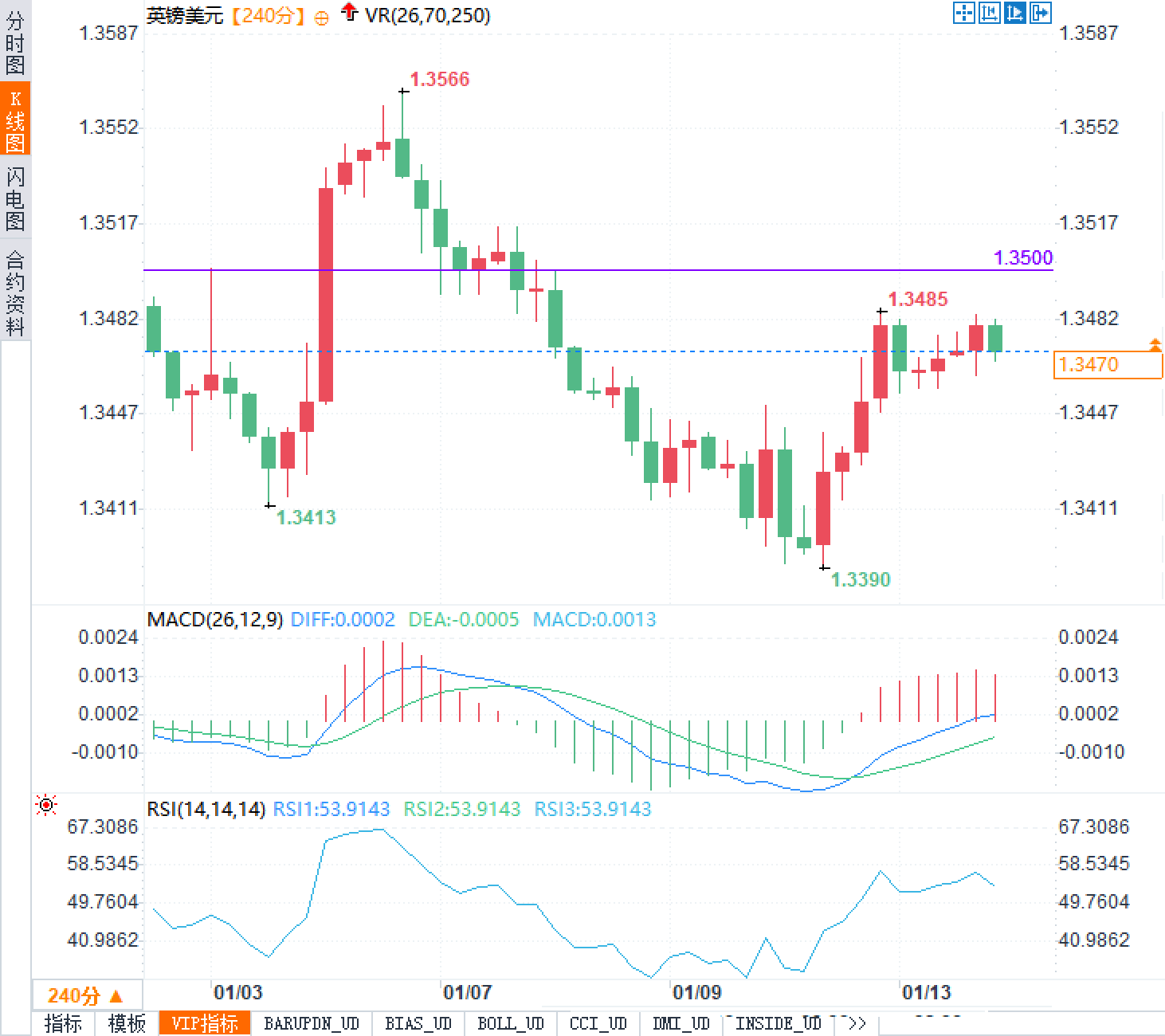
The British pound continued its upward trend against the US dollar on Tuesday (January 13) after rebounding on Monday, trading around 1.3470 in pre-market trading. Market sentiment was generally positive, but the price action remained capped by key technical levels above. From a chart perspective, the pair is consolidating around the 1.3470 area on the 240-minute chart, having previously formed a low of 1.3390 before initiating the rebound.

During the recent upward trend, 1.3485 has become a short-term resistance level, while the more crucial resistance lies at the psychological level of 1.3500. If the price can effectively hold above 1.3500 and maintain its position without breaking through on pullbacks, it may further challenge the previous high of 1.3566 in the short term; conversely, if it repeatedly encounters resistance at this level, it may return to a range-bound trading pattern.
Technical indicators show that the current momentum is recovering. The MACD DIFF value is 0.0002, DEA is -0.0005, and the histogram is 0.0013, indicating that although the bullish force has strengthened, it is still in the initial stage. The RSI (14) has reached 53.9143, which is in the neutral to strong zone, indicating that the buyers have a slight advantage, but it has not yet entered the overbought state. Judging from the K-line pattern, this rebound is more like a technical recovery wave that started from the low point of 1.3390. Whether a real trend opportunity can be established depends on whether a breakout with volume can be achieved in the range of 1.3485 to 1.3500. Otherwise, in the absence of strong fundamental support, the market is more likely to maintain the normal state of "caution before data release and tug-of-war within the range".
The market's short-term focus is heavily on the December US Consumer Price Index (CPI), to be released tonight at 9:30 PM. This data has historically had a direct impact on the dollar and interest rate expectations, but analysts have noted that the market's sensitivity to a single inflation reading appears to have decreased. The reason behind this is a subtle shift in the Federal Reserve's considerations regarding its policy path. While some officials, such as Atlanta Fed President Bostic, still emphasize that "inflation remains too high" and must be firmly controlled, more policymakers are beginning to focus on the potential drag on the economy from a weak labor market, rather than simply keeping a close eye on price levels.
At its December monetary policy meeting, the Federal Reserve lowered interest rates by 25 basis points to 3.50%-3.75%, a move seen as a precautionary measure against risks to the employment sector. Following the meeting, Powell explicitly stated that the economy was not overheating, that service sector inflation had shown signs of decline, and that goods inflation was more influenced by external factors such as tariffs. He also emphasized that "there are no long-term inflation concerns." This policy stance means that even if the CPI data shows slight fluctuations, the market is likely to interpret it within the framework of "employment and inflation rebalancing," thus limiting the likelihood of significant fluctuations in the dollar due to a single data point.
Specifically, the market expects the US core CPI to rise to 2.7% year-on-year in December (previous value 2.6%), while the overall CPI will remain unchanged at 2.7% year-on-year; on a month-on-month basis, both the overall and core CPI are expected to increase by 0.3%. If the actual results are close to expectations, the dollar's reaction may be relatively muted, with exchange rate fluctuations driven more by risk appetite or policy uncertainty; however, if the data deviates significantly from expectations—especially if the core CPI rises more than expected year-on-year or month-on-month—it could trigger a reassessment of interest rate expectations, which would then be quickly transmitted to the short-term direction of the pound against the dollar through the dollar index.
Beyond the economic data itself, another significant disruptive factor this week is the escalating controversy surrounding the Federal Reserve's independence. On Monday, news broke that U.S. federal prosecutors had subpoenaed Federal Reserve Chairman Jerome Powell to investigate his testimony at the June 2025 Senate hearing and the use of funds for the Fed's Washington headquarters renovation project. While still in its early stages, the matter is highly symbolic. Powell's camp responded that such criminal charges might be intended to interfere with the central bank's independent stance of "making policies based on the public interest," rather than stemming from genuine law enforcement needs.
This development has sparked widespread concern in the market. Central bank independence is considered one of the cornerstones of maintaining the long-term credibility of the US dollar. Rating agencies have repeatedly pointed out that it is precisely because of the Federal Reserve's long-standing free operation from political interference that US Treasury bonds have maintained a high credit rating. If this institutional trust is shaken, investors may demand higher risk premiums to hold dollar assets, thereby weakening the dollar's attractiveness. Although there is currently no direct evidence of policy intervention, the news has already sown the seeds of uncertainty in the market sentiment, especially during a sensitive period of global capital flows, where any speculation about "political intervention in monetary policy" could amplify volatility.
Meanwhile, the US December retail sales and producer price index (PPI) will be released this week. If these data show strong demand or rising cost pressures, they may provide temporary support for the US dollar; conversely, if the data is generally weak, it will further reinforce the narrative of "economic slowdown + policy easing," which is beneficial for the continued rebound of non-US currencies, including the British pound.
The pound's own trajectory is increasingly being scrutinized by domestic fundamentals. The UK's November monthly GDP and manufacturing output data, to be released on Thursday, will be a crucial litmus test for whether its economic momentum has bottomed out. Current market expectations indicate that after a 0.1% contraction in October, November GDP is likely to remain flat; manufacturing output is expected to grow steadily by 0.5% month-on-month, while industrial output is expected to remain roughly flat. The core significance of this data lies in verifying two questions: first, whether economic growth has truly stabilized; and second, whether the improvement in manufacturing is sustainable.
If both data points exceed expectations, the pound is expected to gain stronger fundamental support, moving away from the passive rebound logic driven solely by a weaker dollar and towards proactive strengthening. However, if the data fall short of expectations, the current rally may be redefined as a technical correction, significantly reducing its sustainability.
During the recent upward trend, 1.3485 has become a short-term resistance level, while the more crucial resistance lies at the psychological level of 1.3500. If the price can effectively hold above 1.3500 and maintain its position without breaking through on pullbacks, it may further challenge the previous high of 1.3566 in the short term; conversely, if it repeatedly encounters resistance at this level, it may return to a range-bound trading pattern.
Technical indicators show that the current momentum is recovering. The MACD DIFF value is 0.0002, DEA is -0.0005, and the histogram is 0.0013, indicating that although the bullish force has strengthened, it is still in the initial stage. The RSI (14) has reached 53.9143, which is in the neutral to strong zone, indicating that the buyers have a slight advantage, but it has not yet entered the overbought state. Judging from the K-line pattern, this rebound is more like a technical recovery wave that started from the low point of 1.3390. Whether a real trend opportunity can be established depends on whether a breakout with volume can be achieved in the range of 1.3485 to 1.3500. Otherwise, in the absence of strong fundamental support, the market is more likely to maintain the normal state of "caution before data release and tug-of-war within the range".
US inflation data is finally on display, and interest rate expectations are unlikely to fluctuate dramatically.
The market's short-term focus is heavily on the December US Consumer Price Index (CPI), to be released tonight at 9:30 PM. This data has historically had a direct impact on the dollar and interest rate expectations, but analysts have noted that the market's sensitivity to a single inflation reading appears to have decreased. The reason behind this is a subtle shift in the Federal Reserve's considerations regarding its policy path. While some officials, such as Atlanta Fed President Bostic, still emphasize that "inflation remains too high" and must be firmly controlled, more policymakers are beginning to focus on the potential drag on the economy from a weak labor market, rather than simply keeping a close eye on price levels.
At its December monetary policy meeting, the Federal Reserve lowered interest rates by 25 basis points to 3.50%-3.75%, a move seen as a precautionary measure against risks to the employment sector. Following the meeting, Powell explicitly stated that the economy was not overheating, that service sector inflation had shown signs of decline, and that goods inflation was more influenced by external factors such as tariffs. He also emphasized that "there are no long-term inflation concerns." This policy stance means that even if the CPI data shows slight fluctuations, the market is likely to interpret it within the framework of "employment and inflation rebalancing," thus limiting the likelihood of significant fluctuations in the dollar due to a single data point.
Specifically, the market expects the US core CPI to rise to 2.7% year-on-year in December (previous value 2.6%), while the overall CPI will remain unchanged at 2.7% year-on-year; on a month-on-month basis, both the overall and core CPI are expected to increase by 0.3%. If the actual results are close to expectations, the dollar's reaction may be relatively muted, with exchange rate fluctuations driven more by risk appetite or policy uncertainty; however, if the data deviates significantly from expectations—especially if the core CPI rises more than expected year-on-year or month-on-month—it could trigger a reassessment of interest rate expectations, which would then be quickly transmitted to the short-term direction of the pound against the dollar through the dollar index.
The Federal Reserve's independence is underpinned by escalating tensions, raising market concerns about a potential collapse in its credibility.
Beyond the economic data itself, another significant disruptive factor this week is the escalating controversy surrounding the Federal Reserve's independence. On Monday, news broke that U.S. federal prosecutors had subpoenaed Federal Reserve Chairman Jerome Powell to investigate his testimony at the June 2025 Senate hearing and the use of funds for the Fed's Washington headquarters renovation project. While still in its early stages, the matter is highly symbolic. Powell's camp responded that such criminal charges might be intended to interfere with the central bank's independent stance of "making policies based on the public interest," rather than stemming from genuine law enforcement needs.
This development has sparked widespread concern in the market. Central bank independence is considered one of the cornerstones of maintaining the long-term credibility of the US dollar. Rating agencies have repeatedly pointed out that it is precisely because of the Federal Reserve's long-standing free operation from political interference that US Treasury bonds have maintained a high credit rating. If this institutional trust is shaken, investors may demand higher risk premiums to hold dollar assets, thereby weakening the dollar's attractiveness. Although there is currently no direct evidence of policy intervention, the news has already sown the seeds of uncertainty in the market sentiment, especially during a sensitive period of global capital flows, where any speculation about "political intervention in monetary policy" could amplify volatility.
Meanwhile, the US December retail sales and producer price index (PPI) will be released this week. If these data show strong demand or rising cost pressures, they may provide temporary support for the US dollar; conversely, if the data is generally weak, it will further reinforce the narrative of "economic slowdown + policy easing," which is beneficial for the continued rebound of non-US currencies, including the British pound.
With UK data yet to be released, can the pound sterling shake off its "passive rebound" label?
The pound's own trajectory is increasingly being scrutinized by domestic fundamentals. The UK's November monthly GDP and manufacturing output data, to be released on Thursday, will be a crucial litmus test for whether its economic momentum has bottomed out. Current market expectations indicate that after a 0.1% contraction in October, November GDP is likely to remain flat; manufacturing output is expected to grow steadily by 0.5% month-on-month, while industrial output is expected to remain roughly flat. The core significance of this data lies in verifying two questions: first, whether economic growth has truly stabilized; and second, whether the improvement in manufacturing is sustainable.
If both data points exceed expectations, the pound is expected to gain stronger fundamental support, moving away from the passive rebound logic driven solely by a weaker dollar and towards proactive strengthening. However, if the data fall short of expectations, the current rally may be redefined as a technical correction, significantly reducing its sustainability.
- Risk Warning and Disclaimer
- The market involves risk, and trading may not be suitable for all investors. This article is for reference only and does not constitute personal investment advice, nor does it take into account certain users’ specific investment objectives, financial situation, or other needs. Any investment decisions made based on this information are at your own risk.