Venezuelan supply recovery weighed on oil price gains, but the Iranian risk premium persisted.
2026-01-14 11:57:07
Oil prices retreated slightly in Asian trading on Wednesday (January 14), falling about 0.4% to around $60.70 a barrel after rising for four consecutive trading days. The previous session saw prices touch a near seven-week high of $61.50. This pullback follows a sharp rise earlier this week and reflects market consolidation as it weighs geopolitical risks and supply dynamics, rather than a trend reversal.

The recent rally has been primarily driven by escalating protests in Iran, which have heightened market concerns about potential supply disruptions from OPEC's fourth-largest oil producer. While US President Donald Trump urged Iranians to continue their protests and hinted at impending aid, he provided no specific details.
Analysts at Citigroup pointed out that the turmoil in Iran could tighten the global oil supply-demand balance, primarily by increasing geopolitical risk premiums rather than directly causing production losses. Citigroup raised its three-month Brent crude oil price forecast to $70 per barrel, emphasizing that even if physical supply remains stable, political uncertainty could still impact prices.
Importantly, the protests have not yet spread to Iran's main oil-producing regions. Therefore, so far, the impact has been limited to expectations and risk perception, rather than actual supply disruptions. This distinction highlights a correlation-driven relationship, where prices react to perceived instability rather than a direct supply shock leading to a mechanical reduction in exports.
To counterbalance concerns from Iran, Venezuela has begun reversing production cuts previously implemented under the US oil embargo, and crude oil exports have resumed. On Monday, two supertankers, each carrying approximately 1.8 million barrels of crude oil, departed Venezuelan waters, potentially the first shipments under a possible 50 million barrel supply agreement between Caracas and Washington. The resumption of exports has resulted in an increase in actual supply, directly offsetting concerns about potential supply disruptions in other regions.
Venezuela's return to the export market has tempered bullish momentum by demonstrating that global supply can respond to easing geopolitical constraints. This represents a clearer transmission mechanism, as additional barrels directly impact supply expectations rather than just market sentiment.
Despite persistent geopolitical headlines, broader market fundamentals indicate a relatively loose supply-demand balance. Data from the American Petroleum Institute (API) further corroborates this view. In the week ending January 9, crude oil inventories increased by 5.23 million barrels, gasoline inventories by 8.23 million barrels, and distillate fuel inventories by 4.34 million barrels. As the world's largest oil consumer, the rise in US inventories suggests recent weak demand or ample supply, exerting downward pressure on prices through direct fundamental channels.
A survey indicates that U.S. crude oil inventories are expected to decline, highlighting the level of uncertainty surrounding short-term data. Official data from the U.S. Energy Information Administration (EIA), scheduled for release later Wednesday, could reinforce or challenge the current market narrative of oversupply.
The current oil market is shaped by the interplay of political risks and fundamental factors. The turmoil in Iran continues to support oil prices by maintaining a geopolitical premium, while the recovery in Venezuelan exports and the increase in US inventories suggest that market conditions may be easing. In this environment, oil price movements depend more on how traders weigh potential risks against observable supply data than on sudden changes in production.
Overall, oil prices remain near recent highs, with the market oscillating between offsetting forces. The pause in the rally reflects a reassessment rather than a loss of confidence, and future trends may depend on whether geopolitical tensions escalate into actual supply disruptions or remain merely at the level of risk perception.
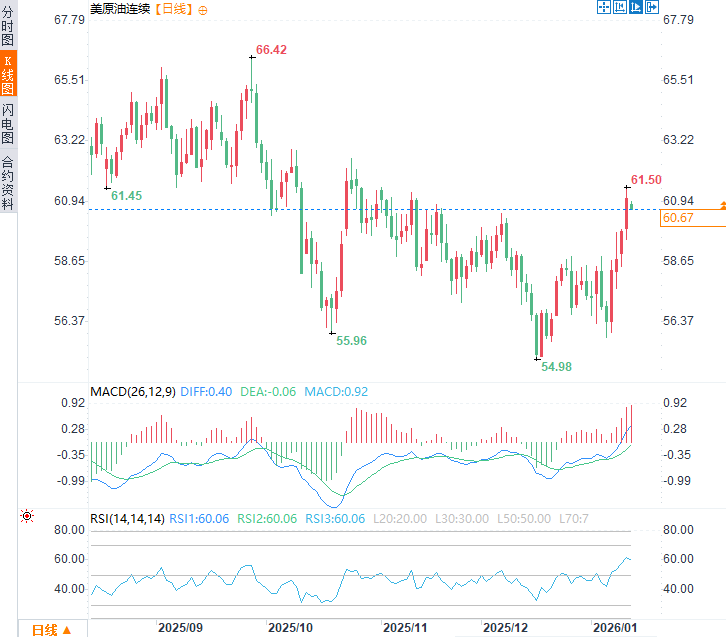
(US crude oil daily chart, source: FX678)
At 11:33 Beijing time, US crude oil futures were trading at $60.72 per barrel.
The recent rally has been primarily driven by escalating protests in Iran, which have heightened market concerns about potential supply disruptions from OPEC's fourth-largest oil producer. While US President Donald Trump urged Iranians to continue their protests and hinted at impending aid, he provided no specific details.
Analysts at Citigroup pointed out that the turmoil in Iran could tighten the global oil supply-demand balance, primarily by increasing geopolitical risk premiums rather than directly causing production losses. Citigroup raised its three-month Brent crude oil price forecast to $70 per barrel, emphasizing that even if physical supply remains stable, political uncertainty could still impact prices.
Importantly, the protests have not yet spread to Iran's main oil-producing regions. Therefore, so far, the impact has been limited to expectations and risk perception, rather than actual supply disruptions. This distinction highlights a correlation-driven relationship, where prices react to perceived instability rather than a direct supply shock leading to a mechanical reduction in exports.
Venezuelan exports offset supply concerns
To counterbalance concerns from Iran, Venezuela has begun reversing production cuts previously implemented under the US oil embargo, and crude oil exports have resumed. On Monday, two supertankers, each carrying approximately 1.8 million barrels of crude oil, departed Venezuelan waters, potentially the first shipments under a possible 50 million barrel supply agreement between Caracas and Washington. The resumption of exports has resulted in an increase in actual supply, directly offsetting concerns about potential supply disruptions in other regions.
Venezuela's return to the export market has tempered bullish momentum by demonstrating that global supply can respond to easing geopolitical constraints. This represents a clearer transmission mechanism, as additional barrels directly impact supply expectations rather than just market sentiment.
Potential market fundamentals and inventory
Despite persistent geopolitical headlines, broader market fundamentals indicate a relatively loose supply-demand balance. Data from the American Petroleum Institute (API) further corroborates this view. In the week ending January 9, crude oil inventories increased by 5.23 million barrels, gasoline inventories by 8.23 million barrels, and distillate fuel inventories by 4.34 million barrels. As the world's largest oil consumer, the rise in US inventories suggests recent weak demand or ample supply, exerting downward pressure on prices through direct fundamental channels.
A survey indicates that U.S. crude oil inventories are expected to decline, highlighting the level of uncertainty surrounding short-term data. Official data from the U.S. Energy Information Administration (EIA), scheduled for release later Wednesday, could reinforce or challenge the current market narrative of oversupply.
Balancing politics and physical supply
The current oil market is shaped by the interplay of political risks and fundamental factors. The turmoil in Iran continues to support oil prices by maintaining a geopolitical premium, while the recovery in Venezuelan exports and the increase in US inventories suggest that market conditions may be easing. In this environment, oil price movements depend more on how traders weigh potential risks against observable supply data than on sudden changes in production.
Overall, oil prices remain near recent highs, with the market oscillating between offsetting forces. The pause in the rally reflects a reassessment rather than a loss of confidence, and future trends may depend on whether geopolitical tensions escalate into actual supply disruptions or remain merely at the level of risk perception.
(US crude oil daily chart, source: FX678)
At 11:33 Beijing time, US crude oil futures were trading at $60.72 per barrel.
- Risk Warning and Disclaimer
- The market involves risk, and trading may not be suitable for all investors. This article is for reference only and does not constitute personal investment advice, nor does it take into account certain users’ specific investment objectives, financial situation, or other needs. Any investment decisions made based on this information are at your own risk.