Gold Trading Alert: US Unemployment Claims Drop Surprisingly, Iran Tensions Ease, Has Gold's Safe-Haven Myth Shattered?
2026-01-16 07:48:34
Amidst global financial market volatility, gold, as a traditional safe-haven asset, often shines during periods of economic uncertainty and geopolitical tension. On Thursday (January 15th), gold prices faced an unexpected decline. Spot gold prices retreated from Wednesday's record high, closing at $4615.73 per ounce, a drop of approximately 0.2%, while US gold futures also closed down 0.3%. Behind this shift were strong US employment data boosting the dollar and President Trump's softening tone on the Iran issue, further weakening the safe-haven demand for gold. In early Asian trading on Friday (January 16th), spot gold continued its decline, currently trading around $4607 per ounce, down approximately 0.2%.
Data released by the U.S. Labor Department on Thursday showed that initial jobless claims unexpectedly fell by 9,000 last week to a seasonally adjusted 198,000, far below economists' expectations of 215,000. This unexpected surprise directly pushed the dollar index to a six-week high of 99.49, before closing at 99.35, a gain of 0.28%. The stronger dollar made dollar-denominated gold more expensive for overseas buyers, thus suppressing demand.
Experts point out that this improvement in employment data has strengthened market expectations that the Federal Reserve will maintain interest rates unchanged in the short term. Chicago Fed President Goolsby emphasized that the Fed should prioritize reducing inflation, as the job market has shown sufficient stability.
Kansas City Fed President Schmid went further, opposing an immediate rate cut, arguing that inflation remains "overheated" and that the Trump administration's policies could further stimulate economic demand and push up price pressures.
These comments have led federal funds rate futures to postpone expectations of the next rate cut until June, with the probability of a March rate cut dropping from 50% a month ago to 21.6%. In this environment, gold's appeal as a non-interest-bearing asset naturally diminishes, and investors turn to dollar-related assets seeking higher returns.
It's worth noting that while current data appears strong, some strategists, such as Lou Brien of DRW Trading, warn that the "birth-death model" of US employment data may be flawed, leading to an overestimation of actual growth, and future annual revisions may reveal underlying weakness in the labor market. This presents a potential reversal opportunity for gold, but in the short term, the strength of the US dollar is undoubtedly the main driver of gold price declines.
Geopolitical factors have always been a sensitive trigger for gold prices, and Trump's conciliatory tone on the Iranian protests has further weakened the safe-haven demand for gold.
He stated that he had been informed that the killings in Iran's crackdown on protests were easing and that there were currently no plans for mass executions, marking a shift from earlier threats of intervention to a wait-and-see approach. This change directly reduced market expectations of an escalation of the Middle East conflict, leading to a decline in gold demand.
However, the situation is not entirely optimistic. Fox News reported that as tensions with Iran escalate, the United States is deploying more troops to the Middle East, including at least one aircraft carrier and more missile defense systems, to provide Trump with military options.
The report mentioned that the additional aircraft carrier may come from the USS Abraham Lincoln in Asia or other ships, and it will take at least a week to deploy.
This troop surge aims to strengthen the defense capabilities of US military bases and Israel, suggesting continued uncertainty in the Middle East. If the Iranian situation deteriorates again, or the troop increase triggers new friction, gold's role as a safe-haven asset will quickly become apparent, driving its price back up.
However, the current easing tone is dominating market sentiment, putting short-term pressure on gold prices. Investors should closely monitor subsequent geopolitical developments, as any unexpected events could reverse the current trend.
US President Trump's remarks further complicated the market. He made it clear that despite the Justice Department's criminal investigation into Federal Reserve Chairman Powell, he currently has no plans to fire Powell, only stating that a final decision is "too early."
This statement boosted risk sentiment to some extent and eased investor concerns about instability within the Federal Reserve leadership. Despite Trump's consistent calls for rate cuts, the market widely expects the Fed to hold rates steady at its January 27-28 meeting, with only two rate cuts of 25 basis points each throughout the year.
Trump's statements, combined with positive employment data, strengthened the dollar's upward momentum, putting double pressure on gold.
Overall, the Trump administration's policy direction is shifting from stimulating the economy to a wait-and-see approach. This should have been beneficial for gold in a low-interest-rate environment, but current strong economic data has temporarily invalidated this logic. Investors should be wary that if the Federal Reserve's investigation escalates or Trump's policies change, gold's safe-haven appeal could quickly return, driving a price rebound.
The dynamics of the US bond market also provided important clues for the gold market. Strong economic data released on Thursday, including a decline in initial jobless claims, a 0.4% increase in import prices, and better-than-expected manufacturing reports from New York State and the Mid-Atlantic region, led to a rise in most US Treasury yields. The 10-year Treasury yield rose 1.6 basis points to 4.156%, the two-year yield climbed 4.4 basis points to 3.558%, while the 30-year yield fell slightly by 0.8 basis points to 4.787%. The spread between the two-year and 10-year yields remained at +59.6 basis points, indicating market optimism about the economic outlook.
The break-even yields of Treasury Inflation-Protected Securities (TIPS) also hit new highs, with the 5-year yield at 2.37% and the 10-year yield at 2.297%, implying an average annual inflation rate of about 2.3% over the next ten years.
These changes reflect a cooling of market expectations for a Federal Reserve rate cut, with only a 5% probability of a rate cut at the end of January meeting. Rising bond yields are generally unfavorable for gold because they increase the opportunity cost of holding bonds, leading investors to shift towards fixed-income assets.
In summary, Thursday's decline in gold prices was the result of a confluence of factors: strong US employment data boosted the dollar, Trump's conciliatory stance on Iran weakened safe-haven demand, and rising bond yields further compressed gold's upside potential. Although the short-term trend is weak, and the risk of further price corrections should be noted, with short-term support levels around 4580 and 4540, potential geopolitical risks such as increased troop activity in the Middle East and possible revisions to employment data could limit the downside for gold. Investors should remain vigilant, paying close attention to the Fed meeting and geopolitical developments, seeking opportunities amidst uncertainty. The gold market is never calm, and its future direction remains highly uncertain, but its status as a safe-haven asset remains solid.
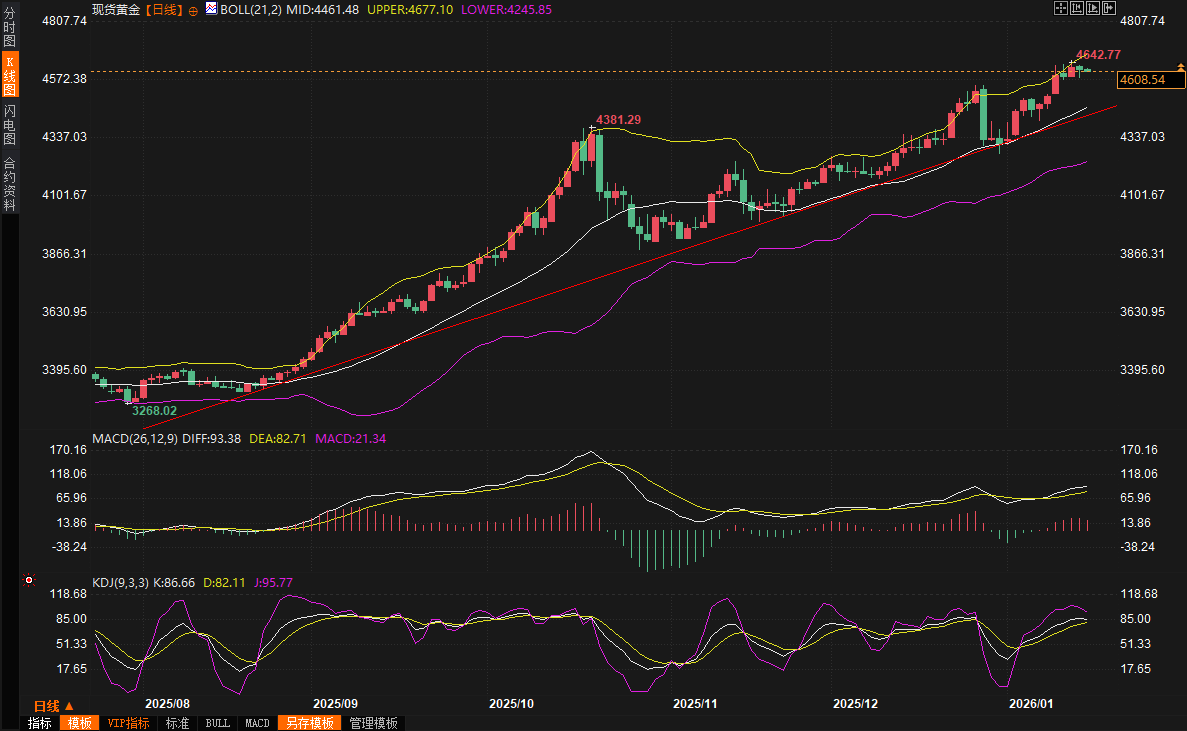
(Spot gold daily chart, source: FX678)
At 07:44 Beijing time, spot gold was trading at $4607.32 per ounce.
US jobs data exceeded expectations, sending the dollar to a one-and-a-half-month high.
Data released by the U.S. Labor Department on Thursday showed that initial jobless claims unexpectedly fell by 9,000 last week to a seasonally adjusted 198,000, far below economists' expectations of 215,000. This unexpected surprise directly pushed the dollar index to a six-week high of 99.49, before closing at 99.35, a gain of 0.28%. The stronger dollar made dollar-denominated gold more expensive for overseas buyers, thus suppressing demand.
Experts point out that this improvement in employment data has strengthened market expectations that the Federal Reserve will maintain interest rates unchanged in the short term. Chicago Fed President Goolsby emphasized that the Fed should prioritize reducing inflation, as the job market has shown sufficient stability.
Kansas City Fed President Schmid went further, opposing an immediate rate cut, arguing that inflation remains "overheated" and that the Trump administration's policies could further stimulate economic demand and push up price pressures.
These comments have led federal funds rate futures to postpone expectations of the next rate cut until June, with the probability of a March rate cut dropping from 50% a month ago to 21.6%. In this environment, gold's appeal as a non-interest-bearing asset naturally diminishes, and investors turn to dollar-related assets seeking higher returns.
It's worth noting that while current data appears strong, some strategists, such as Lou Brien of DRW Trading, warn that the "birth-death model" of US employment data may be flawed, leading to an overestimation of actual growth, and future annual revisions may reveal underlying weakness in the labor market. This presents a potential reversal opportunity for gold, but in the short term, the strength of the US dollar is undoubtedly the main driver of gold price declines.
Geopolitical Easing and Potential Risks: Iran Issue Temporarily Relieved, But Troop Increase in the Middle East Draws Attention
Geopolitical factors have always been a sensitive trigger for gold prices, and Trump's conciliatory tone on the Iranian protests has further weakened the safe-haven demand for gold.
He stated that he had been informed that the killings in Iran's crackdown on protests were easing and that there were currently no plans for mass executions, marking a shift from earlier threats of intervention to a wait-and-see approach. This change directly reduced market expectations of an escalation of the Middle East conflict, leading to a decline in gold demand.
However, the situation is not entirely optimistic. Fox News reported that as tensions with Iran escalate, the United States is deploying more troops to the Middle East, including at least one aircraft carrier and more missile defense systems, to provide Trump with military options.
The report mentioned that the additional aircraft carrier may come from the USS Abraham Lincoln in Asia or other ships, and it will take at least a week to deploy.
This troop surge aims to strengthen the defense capabilities of US military bases and Israel, suggesting continued uncertainty in the Middle East. If the Iranian situation deteriorates again, or the troop increase triggers new friction, gold's role as a safe-haven asset will quickly become apparent, driving its price back up.
However, the current easing tone is dominating market sentiment, putting short-term pressure on gold prices. Investors should closely monitor subsequent geopolitical developments, as any unexpected events could reverse the current trend.
Trump Policy Updates: Fed Surveys and Interest Rate Expectations Intertwined
US President Trump's remarks further complicated the market. He made it clear that despite the Justice Department's criminal investigation into Federal Reserve Chairman Powell, he currently has no plans to fire Powell, only stating that a final decision is "too early."
This statement boosted risk sentiment to some extent and eased investor concerns about instability within the Federal Reserve leadership. Despite Trump's consistent calls for rate cuts, the market widely expects the Fed to hold rates steady at its January 27-28 meeting, with only two rate cuts of 25 basis points each throughout the year.
Trump's statements, combined with positive employment data, strengthened the dollar's upward momentum, putting double pressure on gold.
Overall, the Trump administration's policy direction is shifting from stimulating the economy to a wait-and-see approach. This should have been beneficial for gold in a low-interest-rate environment, but current strong economic data has temporarily invalidated this logic. Investors should be wary that if the Federal Reserve's investigation escalates or Trump's policies change, gold's safe-haven appeal could quickly return, driving a price rebound.
Bond Market Reaction and Precious Metals Linked: Rising Yields Highlight Inflation Expectations
The dynamics of the US bond market also provided important clues for the gold market. Strong economic data released on Thursday, including a decline in initial jobless claims, a 0.4% increase in import prices, and better-than-expected manufacturing reports from New York State and the Mid-Atlantic region, led to a rise in most US Treasury yields. The 10-year Treasury yield rose 1.6 basis points to 4.156%, the two-year yield climbed 4.4 basis points to 3.558%, while the 30-year yield fell slightly by 0.8 basis points to 4.787%. The spread between the two-year and 10-year yields remained at +59.6 basis points, indicating market optimism about the economic outlook.
The break-even yields of Treasury Inflation-Protected Securities (TIPS) also hit new highs, with the 5-year yield at 2.37% and the 10-year yield at 2.297%, implying an average annual inflation rate of about 2.3% over the next ten years.
These changes reflect a cooling of market expectations for a Federal Reserve rate cut, with only a 5% probability of a rate cut at the end of January meeting. Rising bond yields are generally unfavorable for gold because they increase the opportunity cost of holding bonds, leading investors to shift towards fixed-income assets.
In summary, Thursday's decline in gold prices was the result of a confluence of factors: strong US employment data boosted the dollar, Trump's conciliatory stance on Iran weakened safe-haven demand, and rising bond yields further compressed gold's upside potential. Although the short-term trend is weak, and the risk of further price corrections should be noted, with short-term support levels around 4580 and 4540, potential geopolitical risks such as increased troop activity in the Middle East and possible revisions to employment data could limit the downside for gold. Investors should remain vigilant, paying close attention to the Fed meeting and geopolitical developments, seeking opportunities amidst uncertainty. The gold market is never calm, and its future direction remains highly uncertain, but its status as a safe-haven asset remains solid.
(Spot gold daily chart, source: FX678)
At 07:44 Beijing time, spot gold was trading at $4607.32 per ounce.
- Risk Warning and Disclaimer
- The market involves risk, and trading may not be suitable for all investors. This article is for reference only and does not constitute personal investment advice, nor does it take into account certain users’ specific investment objectives, financial situation, or other needs. Any investment decisions made based on this information are at your own risk.