More dangerous than war: The real "black swan" event for Iran's 5 million barrels of crude oil was the workers' strike.
2026-01-19 13:47:25
For decades, traders have viewed Iran through the lens of geopolitical conflict. The country is synonymous with the Strait of Hormuz, a vital chokepoint for global oil transport. However, while markets closely monitor the possibility of military action, the greatest threat to Iran's oil supplies is far less dramatic: strikes by workers in the country's oil industry .
This distinction is crucial. The risk of a U.S. attack has diminished, but the possibility of labor unrest is quietly rising. Military strikes may frighten markets, but they rarely disrupt supply for long. However, large-scale strikes are often overlooked, yet they have historically triggered massive production disruptions on numerous occasions.
On Monday (January 19) during the Asian session, US crude oil traded in a narrow range around $59.30 per barrel.
Recent protests in Iran have been met with a brutal crackdown by the state, and the government has now regained control of major cities. The violence is severe, with the death toll potentially reaching thousands, making it the worst crackdown in the regime's 47-year history, surpassing those of the crackdowns in 1988, 1999, 2011, and 2022.
This crackdown gave US President Donald Trump a way out. After initially inciting protesters, Trump stated on January 14 that "the killing in Iran is stopping." When asked about military options, he adopted a wait-and-see approach.
But this sense of closure is misleading. The government can suppress dissent, but it cannot resolve the severe economic crisis that has fueled public anger. Core grievances remain: inflation is nearing 50%; the national currency, the riyal, is in freefall; and unemployment continues to rise.
Unless the authorities address the cost-of-living crisis, the unrest will continue, and there is a risk that the unrest will spread to the country’s vital oil fields.
While international sanctions and low oil prices have damaged the Iranian economy, the fundamental problems lie internally. The Iranian economy is increasingly influenced by corruption and military control, with Supreme Leader Ali Khamenei's inner circle and the powerful Islamic Revolutionary Guard Corps (IRGC) dominating a vast network of local businesses.
Without genuine economic and political reforms, Iran appears to be heading towards greater instability. Raz Zimt, an analyst at the Tel Aviv Institute for National Security, points out that the country may be entering a period of civil disobedience characterized by sporadic protests.
The protests of 2018-2019, including nationwide strikes in sectors such as transportation, provided a potential blueprint. On January 10, Reza Pahlavi, the exiled son of the king overthrown in the 1979 revolution, called on protesters to cut off the regime's "economic lifeline" by launching a nationwide strike in the oil, fuel, and energy sectors.
History has shown that labor actions can have a catastrophic impact on Iran's oil production. In mid-1978, an oil workers' strike caused production to plummet by about 80% in just a few weeks. This event, the largest oil supply disruption in history, paved the way for the revolution that brought Khomeini to power the following year.
However, the industry has changed significantly since then. Several factors now make it more difficult to succeed again:
1. Islamic Revolutionary Guard Corps Control: The Islamic Revolutionary Guard Corps now maintains tight control over the oil industry, owning key infrastructure and employing loyal staff.
2. Tight security: Security forces maintain tight control over Khuzestan and Kokhgilye-Boyar-Ahmed provinces, which are home to the largest oil fields.
3. Vulnerable workforce: Many oil workers are contract workers with very low job security, making it unlikely that they would risk losing their livelihood by striking.
Today, Iran produces nearly 5 million barrels of crude oil and other petroleum liquids per day, a level comparable to that of 1978. The potential risk of internal turmoil remains a low-probability but high-impact scenario.
It may not immediately cause a surge in oil prices (hence the current narrow price range), but it significantly increases the likelihood of future sharp price fluctuations due to sudden supply disruptions . Traders will therefore pay closer attention to the stability of Iranian supply, and any early signs of a strike could quickly trigger a price increase.
Crucially, this is a threat that Washington cannot control. The White House can adjust military operations to avoid targeting the energy sector, as it did in June when it dissuaded attacks on oil facilities. But it cannot control the actions of street protesters or oilfield workers. For those following the energy markets, the real story isn't about the bombs, but about the workers .
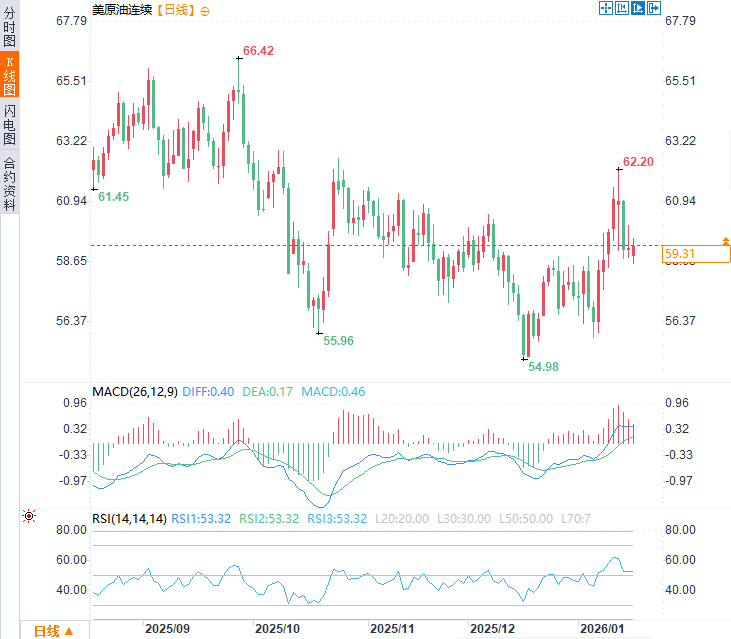
(US crude oil daily chart, source: FX678)
At 13:42 Beijing time, US crude oil futures were trading at $59.31 per barrel.
This distinction is crucial. The risk of a U.S. attack has diminished, but the possibility of labor unrest is quietly rising. Military strikes may frighten markets, but they rarely disrupt supply for long. However, large-scale strikes are often overlooked, yet they have historically triggered massive production disruptions on numerous occasions.
On Monday (January 19) during the Asian session, US crude oil traded in a narrow range around $59.30 per barrel.
The fragile calm after violent protests
Recent protests in Iran have been met with a brutal crackdown by the state, and the government has now regained control of major cities. The violence is severe, with the death toll potentially reaching thousands, making it the worst crackdown in the regime's 47-year history, surpassing those of the crackdowns in 1988, 1999, 2011, and 2022.
This crackdown gave US President Donald Trump a way out. After initially inciting protesters, Trump stated on January 14 that "the killing in Iran is stopping." When asked about military options, he adopted a wait-and-see approach.
But this sense of closure is misleading. The government can suppress dissent, but it cannot resolve the severe economic crisis that has fueled public anger. Core grievances remain: inflation is nearing 50%; the national currency, the riyal, is in freefall; and unemployment continues to rise.
Unless the authorities address the cost-of-living crisis, the unrest will continue, and there is a risk that the unrest will spread to the country’s vital oil fields.
Economic recession and calls for disobedience
While international sanctions and low oil prices have damaged the Iranian economy, the fundamental problems lie internally. The Iranian economy is increasingly influenced by corruption and military control, with Supreme Leader Ali Khamenei's inner circle and the powerful Islamic Revolutionary Guard Corps (IRGC) dominating a vast network of local businesses.
Without genuine economic and political reforms, Iran appears to be heading towards greater instability. Raz Zimt, an analyst at the Tel Aviv Institute for National Security, points out that the country may be entering a period of civil disobedience characterized by sporadic protests.
The protests of 2018-2019, including nationwide strikes in sectors such as transportation, provided a potential blueprint. On January 10, Reza Pahlavi, the exiled son of the king overthrown in the 1979 revolution, called on protesters to cut off the regime's "economic lifeline" by launching a nationwide strike in the oil, fuel, and energy sectors.
Historical precedent: A strike that overthrew the regime
History has shown that labor actions can have a catastrophic impact on Iran's oil production. In mid-1978, an oil workers' strike caused production to plummet by about 80% in just a few weeks. This event, the largest oil supply disruption in history, paved the way for the revolution that brought Khomeini to power the following year.
However, the industry has changed significantly since then. Several factors now make it more difficult to succeed again:
1. Islamic Revolutionary Guard Corps Control: The Islamic Revolutionary Guard Corps now maintains tight control over the oil industry, owning key infrastructure and employing loyal staff.
2. Tight security: Security forces maintain tight control over Khuzestan and Kokhgilye-Boyar-Ahmed provinces, which are home to the largest oil fields.
3. Vulnerable workforce: Many oil workers are contract workers with very low job security, making it unlikely that they would risk losing their livelihood by striking.
Low-risk, high-impact threats
Today, Iran produces nearly 5 million barrels of crude oil and other petroleum liquids per day, a level comparable to that of 1978. The potential risk of internal turmoil remains a low-probability but high-impact scenario.
It may not immediately cause a surge in oil prices (hence the current narrow price range), but it significantly increases the likelihood of future sharp price fluctuations due to sudden supply disruptions . Traders will therefore pay closer attention to the stability of Iranian supply, and any early signs of a strike could quickly trigger a price increase.
Crucially, this is a threat that Washington cannot control. The White House can adjust military operations to avoid targeting the energy sector, as it did in June when it dissuaded attacks on oil facilities. But it cannot control the actions of street protesters or oilfield workers. For those following the energy markets, the real story isn't about the bombs, but about the workers .
(US crude oil daily chart, source: FX678)
At 13:42 Beijing time, US crude oil futures were trading at $59.31 per barrel.
- Risk Warning and Disclaimer
- The market involves risk, and trading may not be suitable for all investors. This article is for reference only and does not constitute personal investment advice, nor does it take into account certain users’ specific investment objectives, financial situation, or other needs. Any investment decisions made based on this information are at your own risk.