A watershed moment for the US dollar and gold: With the Cook case verdict imminent, is the Fed's independence in jeopardy?
2026-01-20 09:13:27
The most important test of the Federal Reserve's independence in its more than 100-year history will take place this Wednesday (January 21) at the U.S. Supreme Court. The focus will be on whether the judges will follow Congress's wishes to protect the Fed from political influence or allow President Donald Trump to carry out personnel purges at will .
This case—which revolves around Trump’s attempt to fire Federal Reserve Governor Lisa Cook on allegations of mortgage fraud—could erode the Fed’s independence in extreme cases, but even if it doesn’t, it could provide the first roadmap for how a president can remove members of a deeply independent central bank governance body.
Even if Cook retains his job—an outcome many legal analysts believe is likely given the Supreme Court's previous statements on the Federal Reserve—the conservative Supreme Court may still point out why Trump's attempt to fire him was unsuccessful, thereby clarifying what "just cause" is needed to remove a monetary policy maker from office .
This requirement, established under the Federal Reserve Act, is designed to protect Federal Reserve governors (including those in power at the Fed) from being dismissed due to interest rate disputes. Cook and recent Fed Chairman Jerome Powell have both argued that this was Cook's real motive for trying to fire him and threatening criminal charges against Powell.
Analysts say this provision has never been tested in court before, and if the requirements are strict enough, its content could affirm the Federal Reserve's independence, but it could also become a target for creative government attacks.
Former Cleveland Fed President Loretta Mester said, "The door is open. The problem is how to solve this so that people in the president's office don't just decide, 'Okay, I don't want that person, so I accuse him of what he did,' and that's enough."
Cook believes that Trump did exactly that in August 2025. At that time, based on allegations that she provided false information in her mortgage applications, Trump threatened to fire her, even though her term at the Federal Reserve wouldn't end until 2038, well beyond his presidency. No charges have been filed, no financial institution has accused her of fraud, and no executive proceedings have been initiated.
She filed a lawsuit, and a lower court ruled that she could remain in office pending a hearing—a stark contrast to the outcome when Trump attempted to reshape other ostensibly independent institutions. His administration appealed this decision.
The Trump team's argument is essentially that "reason" means whatever the president says, a standard that seems to put Federal Reserve governors just one step away from being "arbitrarily" fired.
It is reported that Powell will attend a hearing in the U.S. Supreme Court on the Cook case on Wednesday .
Jon Foster, a former senior advisor to Jerome Powell and former Federal Reserve Chair Janet Yellen, and now a professor of economics at Johns Hopkins University, said he is concerned that even if Cook remains in office, the outcome will undermine the Fed's independence from political pressure, given the Supreme Court's support for the Trump administration on many other issues.
Foster said, "I think the chances of a tough and difficult barrier being overcome are extremely low. There are many reasons for a ruling in favor of (Cook)... The battle will continue, Trump will continue to launch attacks, and if he chooses to use all means... independence is very likely to collapse. I think we already know where things are headed."
However, others still hold out hope.
"It looks like they are indeed trying to find some kind of exception that would allow the Federal Reserve to remain independent," said Catherine Jude, a professor at Columbia Law School.
"But for this independence to truly function, the justification must be substantive, and there must be some meaningful limitation on the president's ability to dismiss council members based on unfounded accusations."
Fire a Federal Reserve governor should be a difficult task, a principle reflected in the “reason” requirement and their 14-year term, although few people serve that long.
Monetary policy decisions can have painful short-term economic effects, which is detrimental to elected officials whose terms are two to four years.
Former Federal Reserve Chairman Paul Volcker used punitive double-digit interest rates in the 1980s to curb high inflation. The consequence was two recessions, with unemployment exceeding 10% at one point and remaining above 7% for about four years. President Jimmy Carter, who appointed Volcker, lost his 1980 re-election campaign amid the economic downturn.
But the short-term pain came at the cost of long-term benefits. By demonstrating its determination to curb inflation, the Federal Reserve enhanced its credibility, which helped anchor public sentiment—namely, "inflation expectations"—an effect that is believed to continue to help curb inflation to this day.
The price surge during the pandemic never caused inflation expectations to deviate significantly from the Federal Reserve's 2% target. Researchers attribute this result to the continued credibility of the central bank in declaring that it would restore the inflation rate to that level, which is believed to have helped reduce inflation while avoiding the recession predicted by most economists.
If monetary policy begins to cater to political demands, its credibility and the benefits it brings will be at risk, which is precisely the consequence if the president could fire Federal Reserve officials at will.
All of this might work. When inflation poses a threat, presidents might accept that high interest rates and slower economic growth are necessary. In that environment, Federal Reserve policymakers might shirk the risk of their own jobs and make decisions based on evidence rather than political winds.
However, past records are not optimistic.
Last week, three former Federal Reserve chairs, including longtime Alan Greenspan, issued a statement supporting Powell in response to the U.S. Department of Justice's investigation. The statement contained an ironic undertone, suggesting that the government's actions were reminiscent of "the way monetary policy is formulated in weakly institutionalized emerging markets," rather than by the institution responsible for controlling inflation of the world's reserve currency .
Just as overly tight policies unnecessarily slow growth and increase unemployment, overly loose policies push the economy to levels beyond its productive capacity, causing unemployment to fall to unsustainable lows and driving up wages and prices.
Because the Federal Reserve's decisions take time to have an impact on the economy, the Fed Chair is often out of sync with what politicians believe is the right policy pace at the moment.
William English, a professor at Yale School of Management and former head of the Federal Reserve's monetary affairs department, said: "If you're not an independent central bank, inflation will be higher, much higher... This has been well-proven. The benefits are immediate, while the costs are apparent later, so there may be an incentive to loosen policy, tout the Trump boom, and make inflation someone else's problem."
This Supreme Court hearing and its final ruling are far more than just a personnel or legal dispute; they are a test of the very foundation of the dollar's value .
In the short term, the ruling will directly trigger fluctuations in the US dollar exchange rate through market sentiment and expectations. Any signal that weakens independence could lead to a sell-off. During Tuesday's Asian trading session, the US dollar index fluctuated narrowly around 99.10.
In the long run, the outcome of this case will define the boundaries of the relationship between the Federal Reserve and executive power, thereby affecting its credibility in combating inflation, the effectiveness of monetary policy, and the "institutional credibility" of the dollar as the global reserve currency .
If the Federal Reserve's independence is substantially eroded, the "excessive privileges" enjoyed by the dollar will face unprecedented challenges. The impact will extend beyond the foreign exchange market, permeating global capital flows, asset pricing, and macroeconomic stability. Therefore, global market participants are watching the January 21 hearing with bated breath, as it concerns not only the fate of a governor but also the future of the fundamental institutions underpinning the trillion-dollar financial system.
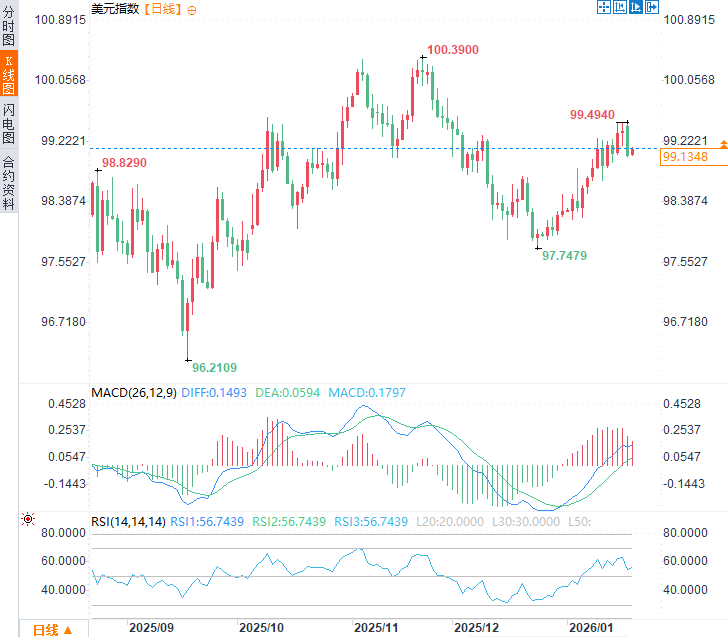
(US Dollar Index Daily Chart, Source: FX678)
This case is one of the core macroeconomic risk events facing the gold market. If the ruling fails to completely and clearly eliminate the possibility of political interference in the Federal Reserve, it is likely to weaken the credibility of the US dollar, thus providing solid or even strong upward momentum for gold prices through two key paths: "de-dollarization" and hedging demand. On Tuesday in Asian trading, spot gold fluctuated around $4,665 per ounce, after hitting a record high of $4,690.46 in the previous trading day.
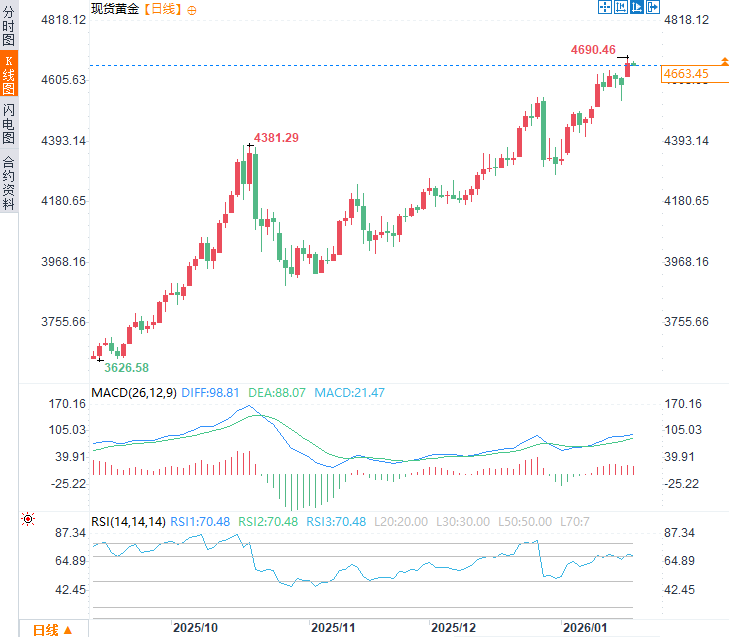
(Spot gold daily chart, source: FX678)
At 9:12 AM Beijing time, spot gold was trading at $4,669.66 per ounce.
This case—which revolves around Trump’s attempt to fire Federal Reserve Governor Lisa Cook on allegations of mortgage fraud—could erode the Fed’s independence in extreme cases, but even if it doesn’t, it could provide the first roadmap for how a president can remove members of a deeply independent central bank governance body.
The Federal Reserve's independence faces legal test
Even if Cook retains his job—an outcome many legal analysts believe is likely given the Supreme Court's previous statements on the Federal Reserve—the conservative Supreme Court may still point out why Trump's attempt to fire him was unsuccessful, thereby clarifying what "just cause" is needed to remove a monetary policy maker from office .
This requirement, established under the Federal Reserve Act, is designed to protect Federal Reserve governors (including those in power at the Fed) from being dismissed due to interest rate disputes. Cook and recent Fed Chairman Jerome Powell have both argued that this was Cook's real motive for trying to fire him and threatening criminal charges against Powell.
Analysts say this provision has never been tested in court before, and if the requirements are strict enough, its content could affirm the Federal Reserve's independence, but it could also become a target for creative government attacks.
Former Cleveland Fed President Loretta Mester said, "The door is open. The problem is how to solve this so that people in the president's office don't just decide, 'Okay, I don't want that person, so I accuse him of what he did,' and that's enough."
Progress and Controversy in Judicial Proceedings
Cook believes that Trump did exactly that in August 2025. At that time, based on allegations that she provided false information in her mortgage applications, Trump threatened to fire her, even though her term at the Federal Reserve wouldn't end until 2038, well beyond his presidency. No charges have been filed, no financial institution has accused her of fraud, and no executive proceedings have been initiated.
She filed a lawsuit, and a lower court ruled that she could remain in office pending a hearing—a stark contrast to the outcome when Trump attempted to reshape other ostensibly independent institutions. His administration appealed this decision.
The Trump team's argument is essentially that "reason" means whatever the president says, a standard that seems to put Federal Reserve governors just one step away from being "arbitrarily" fired.
It is reported that Powell will attend a hearing in the U.S. Supreme Court on the Cook case on Wednesday .
Experts' concerns about independence
Jon Foster, a former senior advisor to Jerome Powell and former Federal Reserve Chair Janet Yellen, and now a professor of economics at Johns Hopkins University, said he is concerned that even if Cook remains in office, the outcome will undermine the Fed's independence from political pressure, given the Supreme Court's support for the Trump administration on many other issues.
Foster said, "I think the chances of a tough and difficult barrier being overcome are extremely low. There are many reasons for a ruling in favor of (Cook)... The battle will continue, Trump will continue to launch attacks, and if he chooses to use all means... independence is very likely to collapse. I think we already know where things are headed."
However, others still hold out hope.
"It looks like they are indeed trying to find some kind of exception that would allow the Federal Reserve to remain independent," said Catherine Jude, a professor at Columbia Law School.
"But for this independence to truly function, the justification must be substantive, and there must be some meaningful limitation on the president's ability to dismiss council members based on unfounded accusations."
The Federal Reserve's credibility is at risk.
Fire a Federal Reserve governor should be a difficult task, a principle reflected in the “reason” requirement and their 14-year term, although few people serve that long.
Monetary policy decisions can have painful short-term economic effects, which is detrimental to elected officials whose terms are two to four years.
Former Federal Reserve Chairman Paul Volcker used punitive double-digit interest rates in the 1980s to curb high inflation. The consequence was two recessions, with unemployment exceeding 10% at one point and remaining above 7% for about four years. President Jimmy Carter, who appointed Volcker, lost his 1980 re-election campaign amid the economic downturn.
But the short-term pain came at the cost of long-term benefits. By demonstrating its determination to curb inflation, the Federal Reserve enhanced its credibility, which helped anchor public sentiment—namely, "inflation expectations"—an effect that is believed to continue to help curb inflation to this day.
The price surge during the pandemic never caused inflation expectations to deviate significantly from the Federal Reserve's 2% target. Researchers attribute this result to the continued credibility of the central bank in declaring that it would restore the inflation rate to that level, which is believed to have helped reduce inflation while avoiding the recession predicted by most economists.
If monetary policy begins to cater to political demands, its credibility and the benefits it brings will be at risk, which is precisely the consequence if the president could fire Federal Reserve officials at will.
out of touch with politicians
All of this might work. When inflation poses a threat, presidents might accept that high interest rates and slower economic growth are necessary. In that environment, Federal Reserve policymakers might shirk the risk of their own jobs and make decisions based on evidence rather than political winds.
However, past records are not optimistic.
Last week, three former Federal Reserve chairs, including longtime Alan Greenspan, issued a statement supporting Powell in response to the U.S. Department of Justice's investigation. The statement contained an ironic undertone, suggesting that the government's actions were reminiscent of "the way monetary policy is formulated in weakly institutionalized emerging markets," rather than by the institution responsible for controlling inflation of the world's reserve currency .
Just as overly tight policies unnecessarily slow growth and increase unemployment, overly loose policies push the economy to levels beyond its productive capacity, causing unemployment to fall to unsustainable lows and driving up wages and prices.
Because the Federal Reserve's decisions take time to have an impact on the economy, the Fed Chair is often out of sync with what politicians believe is the right policy pace at the moment.
William English, a professor at Yale School of Management and former head of the Federal Reserve's monetary affairs department, said: "If you're not an independent central bank, inflation will be higher, much higher... This has been well-proven. The benefits are immediate, while the costs are apparent later, so there may be an incentive to loosen policy, tout the Trump boom, and make inflation someone else's problem."
The impact of legal rulings on confidence in the US dollar
This Supreme Court hearing and its final ruling are far more than just a personnel or legal dispute; they are a test of the very foundation of the dollar's value .
In the short term, the ruling will directly trigger fluctuations in the US dollar exchange rate through market sentiment and expectations. Any signal that weakens independence could lead to a sell-off. During Tuesday's Asian trading session, the US dollar index fluctuated narrowly around 99.10.
In the long run, the outcome of this case will define the boundaries of the relationship between the Federal Reserve and executive power, thereby affecting its credibility in combating inflation, the effectiveness of monetary policy, and the "institutional credibility" of the dollar as the global reserve currency .
If the Federal Reserve's independence is substantially eroded, the "excessive privileges" enjoyed by the dollar will face unprecedented challenges. The impact will extend beyond the foreign exchange market, permeating global capital flows, asset pricing, and macroeconomic stability. Therefore, global market participants are watching the January 21 hearing with bated breath, as it concerns not only the fate of a governor but also the future of the fundamental institutions underpinning the trillion-dollar financial system.
(US Dollar Index Daily Chart, Source: FX678)
Gold's safe-haven properties become more prominent
This case is one of the core macroeconomic risk events facing the gold market. If the ruling fails to completely and clearly eliminate the possibility of political interference in the Federal Reserve, it is likely to weaken the credibility of the US dollar, thus providing solid or even strong upward momentum for gold prices through two key paths: "de-dollarization" and hedging demand. On Tuesday in Asian trading, spot gold fluctuated around $4,665 per ounce, after hitting a record high of $4,690.46 in the previous trading day.
(Spot gold daily chart, source: FX678)
At 9:12 AM Beijing time, spot gold was trading at $4,669.66 per ounce.
- Risk Warning and Disclaimer
- The market involves risk, and trading may not be suitable for all investors. This article is for reference only and does not constitute personal investment advice, nor does it take into account certain users’ specific investment objectives, financial situation, or other needs. Any investment decisions made based on this information are at your own risk.