Easing trade concerns reduced safe-haven demand, causing gold prices to retreat from record highs, but the upward trend remains intact.
2026-01-22 14:44:52
Gold (XAU/USD) continued its decline from historical highs during Thursday's Asian session, falling slightly. This marks the first significant pullback in nearly four trading days.
Previously, gold prices had approached the $4,900 mark and hit a new historical high, but as the market environment changed, risk aversion cooled rapidly, prompting some long positions to take profits.
 The core driver of this gold price decline was the improvement in global risk sentiment. US President Trump withdrew his threat to impose additional tariffs on eight European countries and made it clear that he would not use force to control Greenland, while also revealing that the US and NATO had reached a "framework" for a future agreement on Greenland.
These statements significantly reduced the tail risk of a direct conflict between the US and Europe or NATO, prompting funds to shift from safe-haven assets to risk assets, thus putting pressure on gold.
Against this backdrop, the US dollar received some support, putting additional pressure on dollar-denominated gold. Meanwhile, market expectations for future easing by the Federal Reserve have cooled. With persistent inflation stickiness and policy uncertainty, bets on two additional rate cuts in 2026 have been reduced, further limiting gold's short-term performance.
Regarding the geopolitical situation, market concerns about the situation in Ukraine have shown signs of easing. The US has revealed that it will hold a new round of talks with Russian President Putin, while Trump stated that Ukrainian President Zelensky and Putin are at a stage where an agreement may be reached.
This positive signal further diminished gold's appeal as a safe-haven asset. However, the pullback in gold prices remained relatively restrained. On one hand, the market is awaiting the upcoming release of the US Personal Consumption Expenditures (PCE) price index and the final reading of third-quarter GDP to determine the Federal Reserve's future policy path;
On the other hand, concerns about potential political interference in the Federal Reserve's independence continue to limit the dollar's upside potential, thus providing potential support for gold.
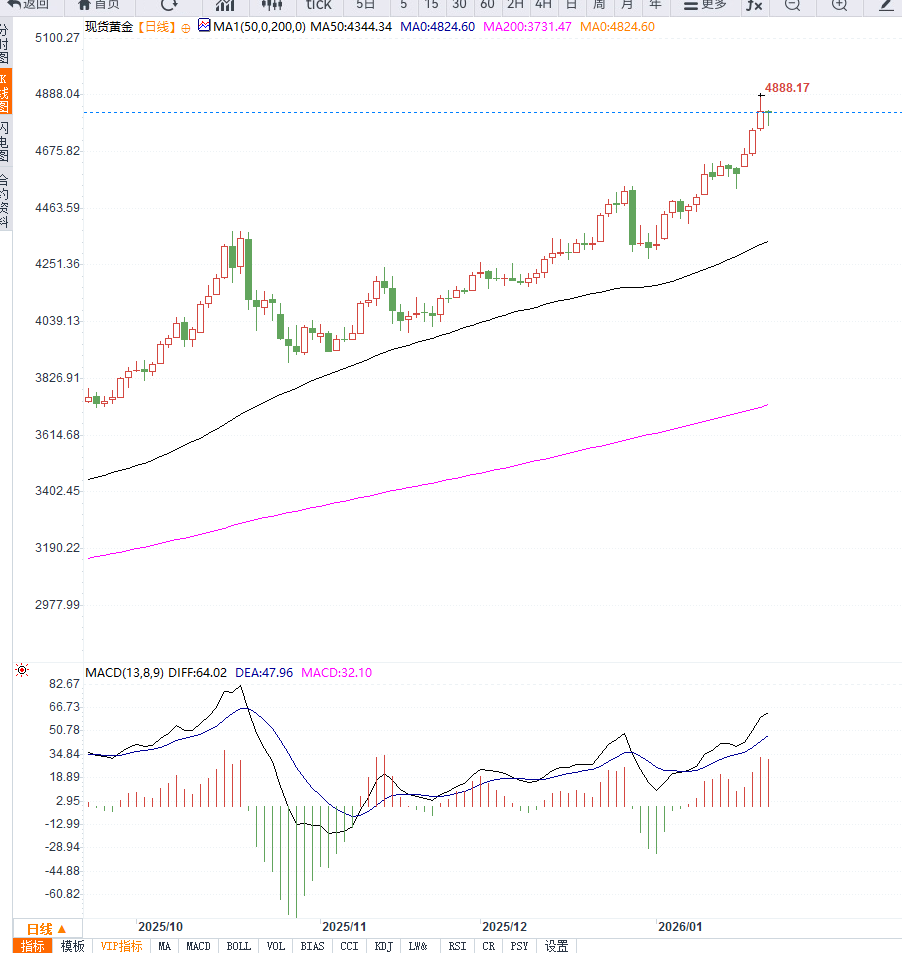
From a technical perspective, the short-term pullback in gold is still a normal correction phase after a strong upward trend. The 100-hour moving average continues to rise and is located below the price, around $4720, forming an important dynamic support level. As long as the gold price remains above this moving average, the overall short-term trend remains bullish.
From a wave structure perspective, during the rebound from the low of $4,530 to the high of $4,889, the 23.6% Fibonacci retracement level is located near $4,800, which is the first support level; the 38.2% retracement level is located near $4,750. If this level is breached, the correction may be more severe.
In terms of indicators, the MACD remains below the zero line, but the green bars continue to converge, indicating weakening bearish momentum; the RSI has fallen back to around 46, in the neutral zone, leaving room for future directional choices. Overall, as long as the price does not effectively break below the 38.2% Fibonacci retracement level, gold prices remain in a high-level consolidation phase rather than a trend reversal.
Editor's Note:
The current pullback in gold is more of a temporary correction driven by improved risk sentiment and adjustments in policy expectations, rather than a fundamental change in the bullish logic.
Easing trade concerns and signs of geopolitical deterioration have temporarily dampened the safe-haven premium, but global monetary policy uncertainty, inflation stickiness, and concerns about central bank independence remain important medium- to long-term factors supporting gold prices.
Before the release of key US data, gold prices are likely to remain in a high-level consolidation pattern. What will truly determine the direction in the next stage will be the repricing of inflation data on the Fed's policy expectations.
Previously, gold prices had approached the $4,900 mark and hit a new historical high, but as the market environment changed, risk aversion cooled rapidly, prompting some long positions to take profits.
The core driver of this gold price decline was the improvement in global risk sentiment. US President Trump withdrew his threat to impose additional tariffs on eight European countries and made it clear that he would not use force to control Greenland, while also revealing that the US and NATO had reached a "framework" for a future agreement on Greenland.These statements significantly reduced the tail risk of a direct conflict between the US and Europe or NATO, prompting funds to shift from safe-haven assets to risk assets, thus putting pressure on gold.
Against this backdrop, the US dollar received some support, putting additional pressure on dollar-denominated gold. Meanwhile, market expectations for future easing by the Federal Reserve have cooled. With persistent inflation stickiness and policy uncertainty, bets on two additional rate cuts in 2026 have been reduced, further limiting gold's short-term performance.
Regarding the geopolitical situation, market concerns about the situation in Ukraine have shown signs of easing. The US has revealed that it will hold a new round of talks with Russian President Putin, while Trump stated that Ukrainian President Zelensky and Putin are at a stage where an agreement may be reached.
This positive signal further diminished gold's appeal as a safe-haven asset. However, the pullback in gold prices remained relatively restrained. On one hand, the market is awaiting the upcoming release of the US Personal Consumption Expenditures (PCE) price index and the final reading of third-quarter GDP to determine the Federal Reserve's future policy path;
On the other hand, concerns about potential political interference in the Federal Reserve's independence continue to limit the dollar's upside potential, thus providing potential support for gold.
From a technical perspective, the short-term pullback in gold is still a normal correction phase after a strong upward trend. The 100-hour moving average continues to rise and is located below the price, around $4720, forming an important dynamic support level. As long as the gold price remains above this moving average, the overall short-term trend remains bullish.
From a wave structure perspective, during the rebound from the low of $4,530 to the high of $4,889, the 23.6% Fibonacci retracement level is located near $4,800, which is the first support level; the 38.2% retracement level is located near $4,750. If this level is breached, the correction may be more severe.
In terms of indicators, the MACD remains below the zero line, but the green bars continue to converge, indicating weakening bearish momentum; the RSI has fallen back to around 46, in the neutral zone, leaving room for future directional choices. Overall, as long as the price does not effectively break below the 38.2% Fibonacci retracement level, gold prices remain in a high-level consolidation phase rather than a trend reversal.
Editor's Note:
The current pullback in gold is more of a temporary correction driven by improved risk sentiment and adjustments in policy expectations, rather than a fundamental change in the bullish logic.
Easing trade concerns and signs of geopolitical deterioration have temporarily dampened the safe-haven premium, but global monetary policy uncertainty, inflation stickiness, and concerns about central bank independence remain important medium- to long-term factors supporting gold prices.
Before the release of key US data, gold prices are likely to remain in a high-level consolidation pattern. What will truly determine the direction in the next stage will be the repricing of inflation data on the Fed's policy expectations.
- Risk Warning and Disclaimer
- The market involves risk, and trading may not be suitable for all investors. This article is for reference only and does not constitute personal investment advice, nor does it take into account certain users’ specific investment objectives, financial situation, or other needs. Any investment decisions made based on this information are at your own risk.