Gold Market: Is the Davos easing just a smokescreen? What's truly keeping the market up at night is that question no one dares to ask.
2026-01-22 20:48:29
Spot gold recently experienced a rapid rise, reaching a new high of $4888.17 before consolidating at higher levels. On Thursday (January 22), it traded around $4825 in pre-market trading, repeatedly fluctuating around the $4800 mark, indicating market hesitation and a wait-and-see attitude after the breakout. The risk premiums that previously drove gold prices higher—such as geopolitical tensions and policy uncertainty—have cooled somewhat, leading some safe-haven funds to take profits. In particular, the US President's remarks at the Davos Forum eased market concerns about additional tariffs between the US and Europe, announcing the abandonment of additional tariffs on eight European countries and mentioning a possible framework for an agreement on the Greenland issue. This series of news weakened short-term safe-haven demand.
However, the risks have not been completely eliminated. German Finance Minister Lars Klingbeer explicitly cautioned that the current situation is far from allowing for complete relaxation, and negotiations are still subject to back-and-forth. This means that while the safe-haven appeal of gold has temporarily subsided, it has not been fundamentally removed. If subsequent communications falter or tensions escalate again, market risk appetite could quickly reverse, and gold may regain favor with investors. Therefore, the current fluctuations are more like a "mid-game break" in an upward trend than a signal of a trend reversal.
In the absence of major geopolitical shocks, macroeconomic data and interest rate expectations have become the core variables driving gold price movements. The market will soon see a series of key inflation indicators, including the final reading of US Q3 GDP, initial jobless claims, and the Personal Consumption Expenditures (PCE) price index. These data will directly influence market expectations regarding the future path of the Federal Reserve's monetary policy. Weak data could further lower interest rate expectations, weakening the dollar's attractiveness and thus benefiting gold; conversely, strong data would strengthen market expectations of prolonged high interest rates, pushing up the dollar and real interest rates, thus putting downward pressure on gold.
Meanwhile, the dollar's trajectory is also undergoing subtle changes. Following the US government's signals of easing tensions, the dollar index found support, leading to a shift in trading logic from "selling US Treasuries" to "risk recovery." Stock markets rebounded, Treasury yields fell, and short sellers of the euro against the dollar staged a counterattack. This complex asset correlation means gold faces multiple forces pulling at it: on the one hand, declining yields theoretically benefit gold, a non-interest-bearing asset; on the other hand, a recovery in risk appetite diverts safe-haven funds that would otherwise flow into gold. As a result, gold prices are unlikely to move in one direction, instead exhibiting more high-level fluctuations.
Despite the short-term tug-of-war in gold prices, the fundamental logic supporting gold remains solid from a longer-term perspective. One factor that cannot be ignored is the rising uncertainty at the policy and institutional levels. Recently, the US Supreme Court rejected the White House's attempt to remove Federal Reserve Governor Lisa Cook from her post, arguing that such a move could undermine the central bank's independence. This event was widely interpreted by the market as a failed attempt at political interference in monetary policy, but it also exposed challenges to institutional stability. Historical experience shows that whenever national governance structures become ambiguous or controversial, gold tends to be sought after due to its characteristics of not relying on the credit of a single country and possessing cross-cycle liquidity.
Furthermore, the trend of global central banks continuously increasing their gold holdings continues. Net purchases by official sectors not only strengthen the market's support level but also make each pullback appear more moderate, reducing the likelihood of a deep decline.
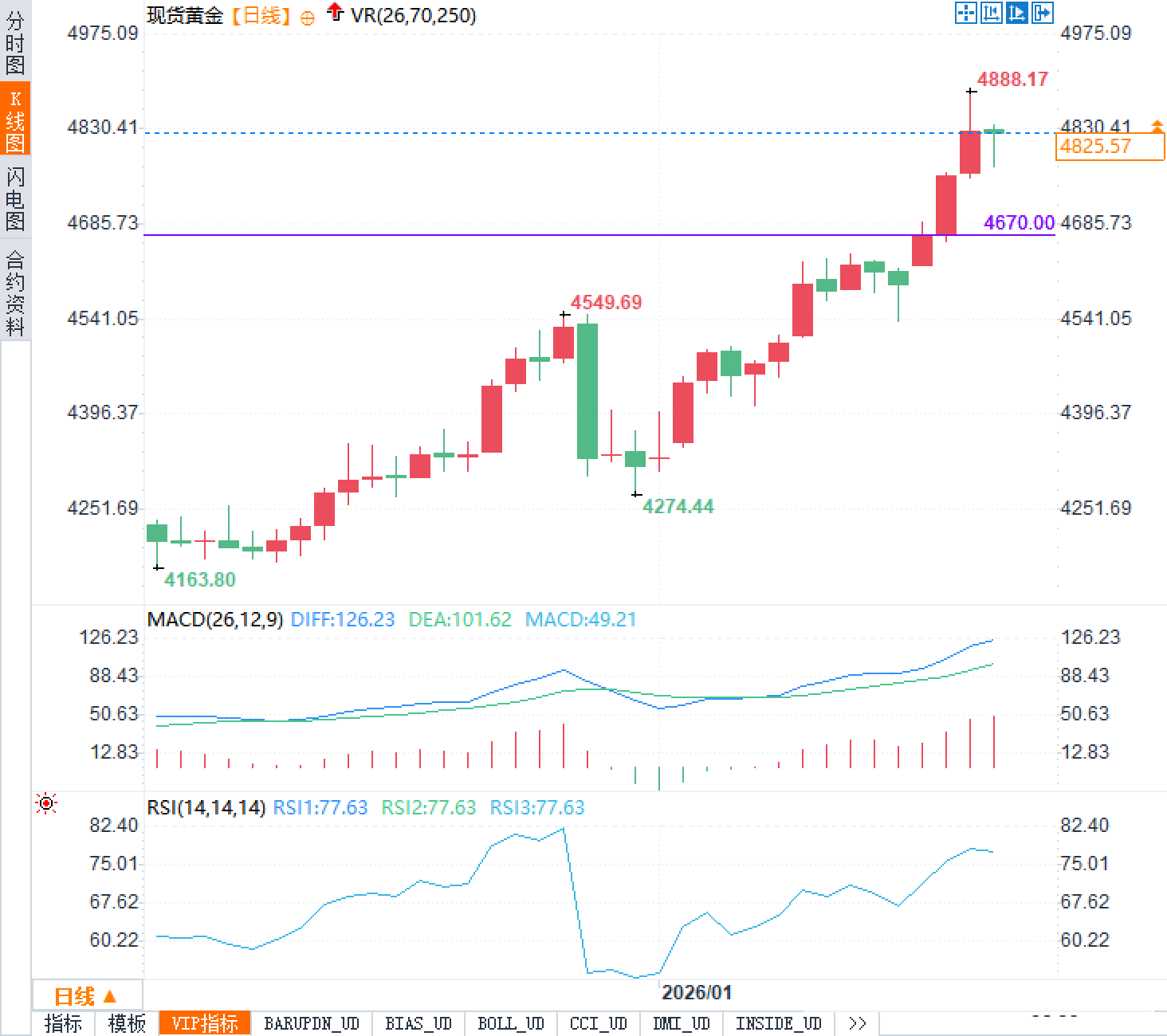
In summary, the current consolidation of gold prices above $4,800 reflects the market's awaiting clearer macroeconomic signals and geopolitical developments. Technically, the daily chart shows gold trading within a consolidation zone between the previous high of $4,888.17 and the support level of $4,670.00. The RSI indicator is at a relatively high level of 77.63, indicating a short-term need for correction; however, the MACD remains in positive territory and continues to rise, suggesting that overall momentum has not been broken. This implies that the market is more likely undergoing a strong consolidation rather than a trend reversal.
Whether gold prices can accelerate again in the future depends on two key points: First, whether they can break through and hold the previous high of $4,888.17 with increased volume. If this is achieved, it may trigger the entry of trend funds and open up new upward space. Second, if they fall below the important support of $4,670.00, we need to be wary of the correction turning into a deep pullback, at which time the bullish momentum may be disrupted.
Overall, gold's bullish trend remains intact despite short-term fluctuations. While safe-haven demand has weakened marginally, institutional risks, central bank gold purchases, and global uncertainties collectively provide solid medium- to long-term support. The key focus going forward remains on data-driven repricing of the US dollar and interest rates, and whether relations between the US and Europe will experience further turbulence.
However, the risks have not been completely eliminated. German Finance Minister Lars Klingbeer explicitly cautioned that the current situation is far from allowing for complete relaxation, and negotiations are still subject to back-and-forth. This means that while the safe-haven appeal of gold has temporarily subsided, it has not been fundamentally removed. If subsequent communications falter or tensions escalate again, market risk appetite could quickly reverse, and gold may regain favor with investors. Therefore, the current fluctuations are more like a "mid-game break" in an upward trend than a signal of a trend reversal.
Data and Interest Rate Game: The Key to Gold's Future
In the absence of major geopolitical shocks, macroeconomic data and interest rate expectations have become the core variables driving gold price movements. The market will soon see a series of key inflation indicators, including the final reading of US Q3 GDP, initial jobless claims, and the Personal Consumption Expenditures (PCE) price index. These data will directly influence market expectations regarding the future path of the Federal Reserve's monetary policy. Weak data could further lower interest rate expectations, weakening the dollar's attractiveness and thus benefiting gold; conversely, strong data would strengthen market expectations of prolonged high interest rates, pushing up the dollar and real interest rates, thus putting downward pressure on gold.
Meanwhile, the dollar's trajectory is also undergoing subtle changes. Following the US government's signals of easing tensions, the dollar index found support, leading to a shift in trading logic from "selling US Treasuries" to "risk recovery." Stock markets rebounded, Treasury yields fell, and short sellers of the euro against the dollar staged a counterattack. This complex asset correlation means gold faces multiple forces pulling at it: on the one hand, declining yields theoretically benefit gold, a non-interest-bearing asset; on the other hand, a recovery in risk appetite diverts safe-haven funds that would otherwise flow into gold. As a result, gold prices are unlikely to move in one direction, instead exhibiting more high-level fluctuations.
Institutional risks + central bank gold purchases: the deep support for gold remains unshaken.
Despite the short-term tug-of-war in gold prices, the fundamental logic supporting gold remains solid from a longer-term perspective. One factor that cannot be ignored is the rising uncertainty at the policy and institutional levels. Recently, the US Supreme Court rejected the White House's attempt to remove Federal Reserve Governor Lisa Cook from her post, arguing that such a move could undermine the central bank's independence. This event was widely interpreted by the market as a failed attempt at political interference in monetary policy, but it also exposed challenges to institutional stability. Historical experience shows that whenever national governance structures become ambiguous or controversial, gold tends to be sought after due to its characteristics of not relying on the credit of a single country and possessing cross-cycle liquidity.
Furthermore, the trend of global central banks continuously increasing their gold holdings continues. Net purchases by official sectors not only strengthen the market's support level but also make each pullback appear more moderate, reducing the likelihood of a deep decline.
In summary, the current consolidation of gold prices above $4,800 reflects the market's awaiting clearer macroeconomic signals and geopolitical developments. Technically, the daily chart shows gold trading within a consolidation zone between the previous high of $4,888.17 and the support level of $4,670.00. The RSI indicator is at a relatively high level of 77.63, indicating a short-term need for correction; however, the MACD remains in positive territory and continues to rise, suggesting that overall momentum has not been broken. This implies that the market is more likely undergoing a strong consolidation rather than a trend reversal.
What's next for the market? Key levels will determine the direction.
Whether gold prices can accelerate again in the future depends on two key points: First, whether they can break through and hold the previous high of $4,888.17 with increased volume. If this is achieved, it may trigger the entry of trend funds and open up new upward space. Second, if they fall below the important support of $4,670.00, we need to be wary of the correction turning into a deep pullback, at which time the bullish momentum may be disrupted.
Overall, gold's bullish trend remains intact despite short-term fluctuations. While safe-haven demand has weakened marginally, institutional risks, central bank gold purchases, and global uncertainties collectively provide solid medium- to long-term support. The key focus going forward remains on data-driven repricing of the US dollar and interest rates, and whether relations between the US and Europe will experience further turbulence.
- Risk Warning and Disclaimer
- The market involves risk, and trading may not be suitable for all investors. This article is for reference only and does not constitute personal investment advice, nor does it take into account certain users’ specific investment objectives, financial situation, or other needs. Any investment decisions made based on this information are at your own risk.