Geopolitical rules are collapsing, industrial demand is being validated, and gold prices are pointing towards 5365.
2026-01-23 17:18:16
On Friday (January 23), spot gold rose slightly and then fell back during the Asian and European sessions, generally exhibiting a narrow range of fluctuations. It held onto most of the gains from Thursday, which saw gold fall as much as 1.5% on Thursday due to the easing of tensions over Greenland and US-EU tariffs, but it resumed its upward trend during the New York session and ultimately closed up 2.18%.
The market's enthusiasm for precious metals remains unabated. Gold prices have defied negative news and even experienced buying pressure when they dip. This article briefly summarizes the factors influencing gold prices recently.

For decades, the postwar order has been built on the consensus that “power is subject to rules,” particularly regarding the clear boundaries of national sovereignty and territorial issues.
The United States has demonstrated its willingness to break with convention and challenge existing rules for geopolitical interests in the Greenland and Venezuela incidents, repeatedly pushing the boundaries of international law and the bottom line of international relations.
The United States’ actions have triggered a strong backlash from countries regarding arms races and geopolitical concerns, while also marking a dangerous beginning for international norms to become more flexible.
Goldman Sachs raised its December 2026 gold price target from $4,900/oz to $5,400/oz, an increase of more than 10%.
It believes that the private sector continues to hedge global policy risks through gold and will not sell off on a large scale. The Fed’s interest rate cuts will drive up holdings of Western gold ETFs, and emerging market central banks will maintain a purchase volume of about 60 tons per month.
Meanwhile, the narrative of selling dollars has recently resurfaced. Sweden's largest pension fund, Alecta, sold off the vast majority of its holdings of US Treasury bonds this Wednesday, and Denmark's "Academic Pension Fund" announced on the 20th that it will sell $100 million worth of US government bonds by the end of this month, citing the poor financial situation of the US government.
When the market starts to sell dollar assets, it will naturally increase its allocation to other assets, and gold is the obvious choice.
Gold prices reflect market expectations. The Federal Reserve mostly decided to postpone rate cuts in January, but influenced by pressure from the White House and Trump's statement that inflation was as low as 1.5%, the market expects the Fed to cut rates at least twice more this year after the new Fed chairman is announced. This means the Fed is realistically hawkish but dovish in expectations, which is beneficial to gold.
Meanwhile, the rapid rise in US Treasury yields has been an unavoidable problem for every US president. Higher yields mean increased costs for the government to issue bonds and realize their value, which in turn increases the cost of governance. The market expects that the Trump administration will not be able to tolerate the high US Treasury yields any longer, which is a real negative for long-term gold but a positive for expectations.
The recent surge in futures prices for nickel, copper, silver, platinum, and lithium carbonate indirectly confirms that industries such as AI computing power, electricity, and energy storage are accelerating their capital expenditures. Upstream raw materials are experiencing continuous price increases due to increased orders. Precious metals exhibit a dual pattern of very low price elasticity of supply and demand, meaning that the increased demand for precious metals from industrial applications will be fully reflected, and even amplified, in the price of precious metals.
Because production is rigid, increased demand will lead to higher prices, but demand will not decrease significantly due to the price increase, so prices will continue to rise.
Readers can refer back to previous articles for the current gold price movement and its causes. As analyzed above, the fundamentals suggest that gold prices still have a chance to reach new highs. However, attention should be paid to the US dollar index and the turning point of the "sell the US narrative," as the US dollar is a currency that is prone to a significant rebound after a sharp decline.
As mentioned in a previous technical analysis article, the measured upside target was 4932, and yesterday's closing price was 4936, making it a worthwhile profit-taking point.
Gold prices are currently far from the 5-day moving average and need consolidation, having formed a slight bearish engulfing pattern. However, they remain in a strong bullish zone, with support at 4882. If gold prices can continue to hold strongly above the 5-day moving average, the next target price is around 5365.
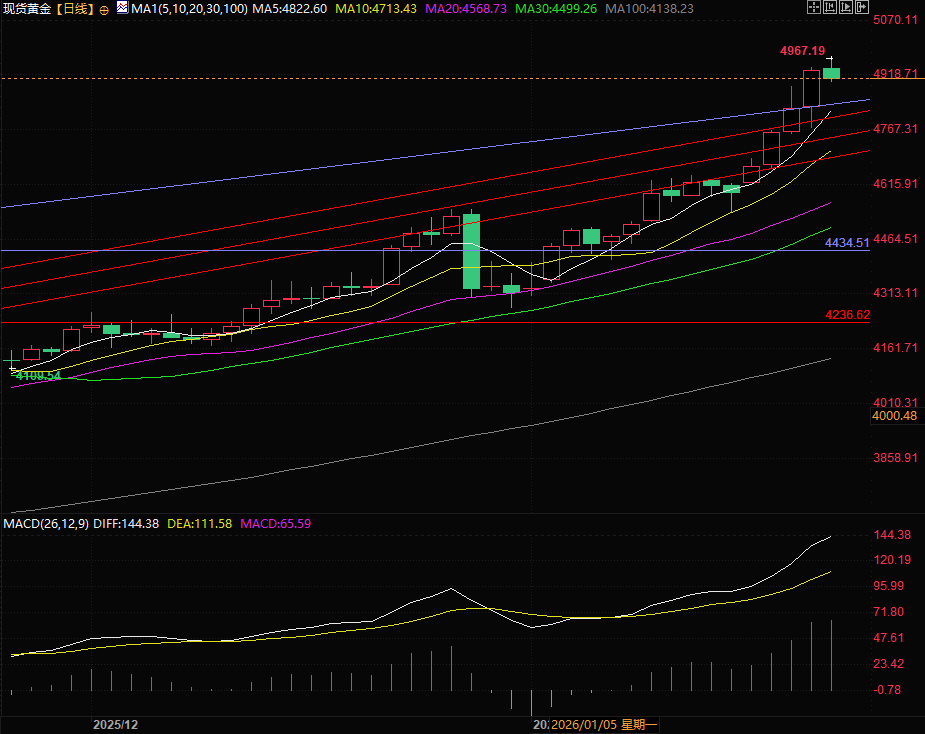
(Spot gold daily chart, source: FX678)
At 17:14 Beijing time, spot gold was trading at $4912.06 per ounce.
The market's enthusiasm for precious metals remains unabated. Gold prices have defied negative news and even experienced buying pressure when they dip. This article briefly summarizes the factors influencing gold prices recently.
A new geopolitical narrative: the global geopolitical trust system is on the verge of collapse.
For decades, the postwar order has been built on the consensus that “power is subject to rules,” particularly regarding the clear boundaries of national sovereignty and territorial issues.
The United States has demonstrated its willingness to break with convention and challenge existing rules for geopolitical interests in the Greenland and Venezuela incidents, repeatedly pushing the boundaries of international law and the bottom line of international relations.
The United States’ actions have triggered a strong backlash from countries regarding arms races and geopolitical concerns, while also marking a dangerous beginning for international norms to become more flexible.
The narrative of selling the dollar, coupled with Goldman Sachs' latest research report, ignited bullish sentiment in the market.
Goldman Sachs raised its December 2026 gold price target from $4,900/oz to $5,400/oz, an increase of more than 10%.
It believes that the private sector continues to hedge global policy risks through gold and will not sell off on a large scale. The Fed’s interest rate cuts will drive up holdings of Western gold ETFs, and emerging market central banks will maintain a purchase volume of about 60 tons per month.
Meanwhile, the narrative of selling dollars has recently resurfaced. Sweden's largest pension fund, Alecta, sold off the vast majority of its holdings of US Treasury bonds this Wednesday, and Denmark's "Academic Pension Fund" announced on the 20th that it will sell $100 million worth of US government bonds by the end of this month, citing the poor financial situation of the US government.
When the market starts to sell dollar assets, it will naturally increase its allocation to other assets, and gold is the obvious choice.
The Federal Reserve and US Treasury bonds are favorable for gold.
Gold prices reflect market expectations. The Federal Reserve mostly decided to postpone rate cuts in January, but influenced by pressure from the White House and Trump's statement that inflation was as low as 1.5%, the market expects the Fed to cut rates at least twice more this year after the new Fed chairman is announced. This means the Fed is realistically hawkish but dovish in expectations, which is beneficial to gold.
Meanwhile, the rapid rise in US Treasury yields has been an unavoidable problem for every US president. Higher yields mean increased costs for the government to issue bonds and realize their value, which in turn increases the cost of governance. The market expects that the Trump administration will not be able to tolerate the high US Treasury yields any longer, which is a real negative for long-term gold but a positive for expectations.
Multiple sources have verified the industrial applications of precious metals.
The recent surge in futures prices for nickel, copper, silver, platinum, and lithium carbonate indirectly confirms that industries such as AI computing power, electricity, and energy storage are accelerating their capital expenditures. Upstream raw materials are experiencing continuous price increases due to increased orders. Precious metals exhibit a dual pattern of very low price elasticity of supply and demand, meaning that the increased demand for precious metals from industrial applications will be fully reflected, and even amplified, in the price of precious metals.
Because production is rigid, increased demand will lead to higher prices, but demand will not decrease significantly due to the price increase, so prices will continue to rise.
Summary and Technical Analysis:
Readers can refer back to previous articles for the current gold price movement and its causes. As analyzed above, the fundamentals suggest that gold prices still have a chance to reach new highs. However, attention should be paid to the US dollar index and the turning point of the "sell the US narrative," as the US dollar is a currency that is prone to a significant rebound after a sharp decline.
As mentioned in a previous technical analysis article, the measured upside target was 4932, and yesterday's closing price was 4936, making it a worthwhile profit-taking point.
Gold prices are currently far from the 5-day moving average and need consolidation, having formed a slight bearish engulfing pattern. However, they remain in a strong bullish zone, with support at 4882. If gold prices can continue to hold strongly above the 5-day moving average, the next target price is around 5365.
(Spot gold daily chart, source: FX678)
At 17:14 Beijing time, spot gold was trading at $4912.06 per ounce.
- Risk Warning and Disclaimer
- The market involves risk, and trading may not be suitable for all investors. This article is for reference only and does not constitute personal investment advice, nor does it take into account certain users’ specific investment objectives, financial situation, or other needs. Any investment decisions made based on this information are at your own risk.