The yen surged 180 points before crashing, revealing whose hand?
2026-01-23 17:32:25
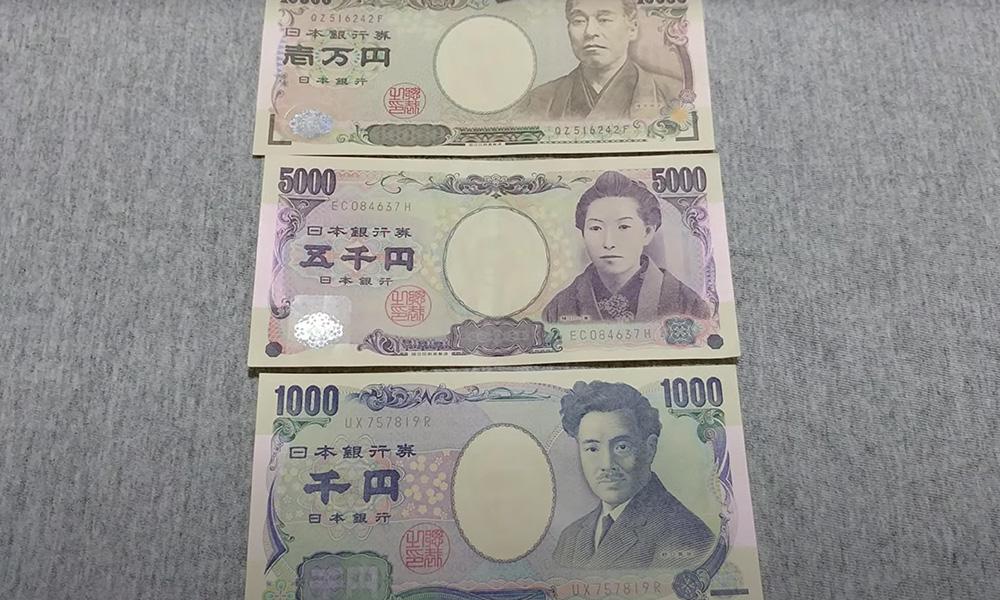
The Bank of Japan decided to keep the overnight call rate unchanged at 0.75% at its latest monetary policy meeting (January 23), with a vote of 8 to 1. Behind this seemingly calm decision, however, lies a significant undercurrent – the only dissenting vote came from board member Takada, who advocated for raising the short-term interest rate directly to 1.0%. This radical suggestion reveals a signal: some policymakers believe that the current price situation is strong enough, and it's time to accelerate the exit from the era of ultra-loose monetary policy.
More notably, the disagreement wasn't limited to the interest rate vote; even the wording regarding the future economic outlook was contentious. Tamura and another committee member attempted to revise the report's wording to convey a more hawkish policy stance, but ultimately failed to secure majority support. This suggests that while the overall direction is towards policy normalization, there is clearly no consensus within the central bank regarding the specific pace. Some want to move quickly, while others insist on a slower pace; this "speed debate" is becoming a key variable influencing the future policy path.
This explains why the statement still emphasizes a "moderate recovery, but still some weakness" in the economy. The central bank explicitly stated that the impact of the interest rate hike last December still needs time to be transmitted to the real economy, and the overall financial environment remains relatively loose. In other words, they do not intend to take immediate and continuous action, but rather choose to proceed cautiously and wait for more data to confirm whether inflation can truly stabilize at the 2% target.
The Bank of Japan's latest forecasts indicate a growing conviction about inflation. While core CPI is projected to remain unchanged at 2.7% for fiscal year 2025, the long-term forecast has been slightly revised upwards: from 1.8% to 1.9% in 2026, and still at 2.0% in 2027. What truly captures market attention is the so-called "core of core" indicator—the inflation rate excluding fresh food and energy. This figure, reflecting the true strength of domestic demand, has been revised upwards across the board: from 2.8% to 3.0% in 2025, from 2.0% to 2.2% in 2026, and slightly adjusted to 2.1% in 2027.
These figures illustrate a key point: Japan's inflation is not driven by external energy price increases, but rather by strengthening endogenous drivers. Even considering the base effect which might cause core inflation to briefly fall below 2% in the first half of this year, the central bank remains confident that prices will return to a path consistent with the 2% target in the latter half of the forecast period. This confidence is precisely the basis for the potential for further interest rate hikes in the future.
At the same time, economic growth forecasts have also been revised upwards. Real GDP growth for fiscal year 2025 has been revised upwards from 0.7% to 0.9%, and for 2026 from 0.7% to 1.0%. However, the 2027 forecast has been revised downwards from 1.0% to 0.8%, reflecting a cautious assessment of long-term potential. The central bank estimates that Japan's potential growth rate is only around 0.5%. This means that even with the current positive recovery momentum, structural bottlenecks will still limit expansion. Policymakers must walk a tightrope between stimulating growth and controlling inflation; any misstep could disrupt the balance.
At the subsequent press conference, Bank of Japan Governor Ueda's remarks were seen as an important instance of "expectation management." He reiterated that while the economy was recovering moderately, its foundations were not yet solid; underlying inflation would continue to rise slowly and was expected to reach the price stability target later in the forecast period. The most crucial point was that future policy adjustments would be primarily based on inflation trends, rather than on intervention in the exchange rate.
This statement carries significant weight. It essentially tells the market: don't expect us to rush into raising interest rates simply because the yen is depreciating. While Ueda acknowledges that a weaker yen will push up import costs, making it easier for businesses to pass on these increases to domestic prices, and he emphasizes the need to closely monitor the impact of exchange rate fluctuations on prices, this does not mean a policy shift is imminent. Exchange rates are determined by a variety of factors, including global interest rate differentials, capital flows, and market sentiment; central banks do not comment on specific levels.
However, his remarks on the bond market were distinctly different. He stated that the central bank would coordinate closely with the government, and if abnormal fluctuations occurred in the bond market, it might use market operations to maintain stability. This statement was widely interpreted as a response to the recent sharp fluctuations in government bond yields, and also as a risk warning—we can tolerate prices rising slowly, but we cannot accept a loss of control in the financial markets.
Immediately after Ueda's speech, the USD/JPY exchange rate surged to 158.90, a one-week high, indicating traders interpreted it as a sign that "there are no plans for a rate hike in the short term." However, the market then abruptly changed – within seconds, the exchange rate plummeted from nearly 159.21 to around 157.34, before quickly rebounding. This "flash crash" volatility was highly characteristic: rapid, large-scale, and with liquidity evaporating instantly, quickly sparking speculation: had the Japanese Ministry of Finance intervened?
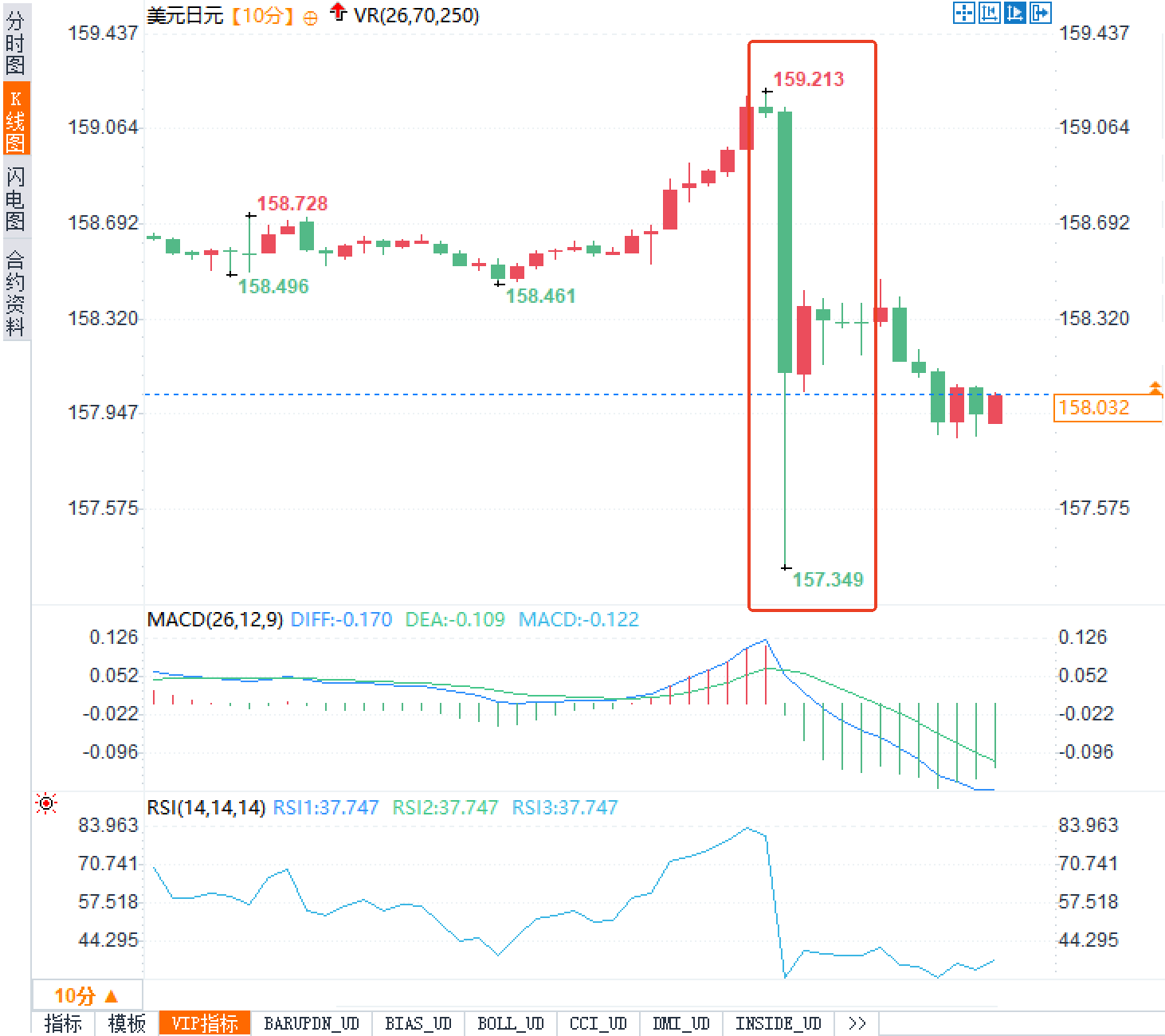
Although there has been no official confirmation, the market generally believes that this is likely a so-called "currency inquiry"—that is, the authorities sending a warning signal to the market by inquiring about exchange rate quotes by telephone. Similar operations occurred in September 2022 and July 2024, followed by actual intervention shortly afterward. Although no actual money was injected into the market this time, the effect is already evident: yen short sellers have become wary and are extremely cautious about adding to their positions around 159.
Analysts point out that a single intervention or verbal warning is unlikely to reverse the trend, especially when fundamentals still support a strong dollar. However, if inflation remains robust and wage growth further solidifies, the Bank of Japan will inevitably have to take the next step in raising interest rates sooner or later. At that time, not only will the interest rate environment change, but the entire Asia-Pacific and even global arbitrage trading landscape may be reshaped. This seemingly calm meeting is actually gathering energy for the next storm. The real question traders should be asking is not "Will it move?", but "When will it move, and how hard will it move?"
More notably, the disagreement wasn't limited to the interest rate vote; even the wording regarding the future economic outlook was contentious. Tamura and another committee member attempted to revise the report's wording to convey a more hawkish policy stance, but ultimately failed to secure majority support. This suggests that while the overall direction is towards policy normalization, there is clearly no consensus within the central bank regarding the specific pace. Some want to move quickly, while others insist on a slower pace; this "speed debate" is becoming a key variable influencing the future policy path.
This explains why the statement still emphasizes a "moderate recovery, but still some weakness" in the economy. The central bank explicitly stated that the impact of the interest rate hike last December still needs time to be transmitted to the real economy, and the overall financial environment remains relatively loose. In other words, they do not intend to take immediate and continuous action, but rather choose to proceed cautiously and wait for more data to confirm whether inflation can truly stabilize at the 2% target.
Inflation is more resilient than expected, with underlying price pressures continuing to rise.
The Bank of Japan's latest forecasts indicate a growing conviction about inflation. While core CPI is projected to remain unchanged at 2.7% for fiscal year 2025, the long-term forecast has been slightly revised upwards: from 1.8% to 1.9% in 2026, and still at 2.0% in 2027. What truly captures market attention is the so-called "core of core" indicator—the inflation rate excluding fresh food and energy. This figure, reflecting the true strength of domestic demand, has been revised upwards across the board: from 2.8% to 3.0% in 2025, from 2.0% to 2.2% in 2026, and slightly adjusted to 2.1% in 2027.
These figures illustrate a key point: Japan's inflation is not driven by external energy price increases, but rather by strengthening endogenous drivers. Even considering the base effect which might cause core inflation to briefly fall below 2% in the first half of this year, the central bank remains confident that prices will return to a path consistent with the 2% target in the latter half of the forecast period. This confidence is precisely the basis for the potential for further interest rate hikes in the future.
At the same time, economic growth forecasts have also been revised upwards. Real GDP growth for fiscal year 2025 has been revised upwards from 0.7% to 0.9%, and for 2026 from 0.7% to 1.0%. However, the 2027 forecast has been revised downwards from 1.0% to 0.8%, reflecting a cautious assessment of long-term potential. The central bank estimates that Japan's potential growth rate is only around 0.5%. This means that even with the current positive recovery momentum, structural bottlenecks will still limit expansion. Policymakers must walk a tightrope between stimulating growth and controlling inflation; any misstep could disrupt the balance.
The governor's statement sets the tone, clearly pointing the policy focus towards inflation rather than exchange rates.
At the subsequent press conference, Bank of Japan Governor Ueda's remarks were seen as an important instance of "expectation management." He reiterated that while the economy was recovering moderately, its foundations were not yet solid; underlying inflation would continue to rise slowly and was expected to reach the price stability target later in the forecast period. The most crucial point was that future policy adjustments would be primarily based on inflation trends, rather than on intervention in the exchange rate.
This statement carries significant weight. It essentially tells the market: don't expect us to rush into raising interest rates simply because the yen is depreciating. While Ueda acknowledges that a weaker yen will push up import costs, making it easier for businesses to pass on these increases to domestic prices, and he emphasizes the need to closely monitor the impact of exchange rate fluctuations on prices, this does not mean a policy shift is imminent. Exchange rates are determined by a variety of factors, including global interest rate differentials, capital flows, and market sentiment; central banks do not comment on specific levels.
However, his remarks on the bond market were distinctly different. He stated that the central bank would coordinate closely with the government, and if abnormal fluctuations occurred in the bond market, it might use market operations to maintain stability. This statement was widely interpreted as a response to the recent sharp fluctuations in government bond yields, and also as a risk warning—we can tolerate prices rising slowly, but we cannot accept a loss of control in the financial markets.
The market experienced a sudden and sharp fluctuation, with 159 becoming a "psychological red line" for the yen.
Immediately after Ueda's speech, the USD/JPY exchange rate surged to 158.90, a one-week high, indicating traders interpreted it as a sign that "there are no plans for a rate hike in the short term." However, the market then abruptly changed – within seconds, the exchange rate plummeted from nearly 159.21 to around 157.34, before quickly rebounding. This "flash crash" volatility was highly characteristic: rapid, large-scale, and with liquidity evaporating instantly, quickly sparking speculation: had the Japanese Ministry of Finance intervened?
Although there has been no official confirmation, the market generally believes that this is likely a so-called "currency inquiry"—that is, the authorities sending a warning signal to the market by inquiring about exchange rate quotes by telephone. Similar operations occurred in September 2022 and July 2024, followed by actual intervention shortly afterward. Although no actual money was injected into the market this time, the effect is already evident: yen short sellers have become wary and are extremely cautious about adding to their positions around 159.
Analysts point out that a single intervention or verbal warning is unlikely to reverse the trend, especially when fundamentals still support a strong dollar. However, if inflation remains robust and wage growth further solidifies, the Bank of Japan will inevitably have to take the next step in raising interest rates sooner or later. At that time, not only will the interest rate environment change, but the entire Asia-Pacific and even global arbitrage trading landscape may be reshaped. This seemingly calm meeting is actually gathering energy for the next storm. The real question traders should be asking is not "Will it move?", but "When will it move, and how hard will it move?"
- Risk Warning and Disclaimer
- The market involves risk, and trading may not be suitable for all investors. This article is for reference only and does not constitute personal investment advice, nor does it take into account certain users’ specific investment objectives, financial situation, or other needs. Any investment decisions made based on this information are at your own risk.