Is the dollar's rebound short-lived? Key resistance levels remain unbroken, and bears are still waiting in the wings.
2026-01-23 19:34:14
On Friday (January 23), the US dollar index traded around 98.35 during the European session, still hovering near its recent low of 98.23. Although US President Trump recently signaled an effort to ease tensions between the US and Europe—withdrawing plans to impose a 10% tariff on some European countries and reaching a "future agreement framework" with the NATO Secretary General on Greenland and the Arctic region—this initially led to a slight rebound in the dollar. However, this rise was short-lived. The market quickly realized that these actions were more like "verbal painkillers" and did not truly address deep-seated geopolitical and alliance trust issues. The so-called "framework agreement" sounded respectable, but lacked concrete implementation paths and legal binding force. Traders preferred to view it as short-term emotional reassurance rather than a reduction in structural risks.
This "band-aid" approach, which only addresses the symptoms and not the root cause, has actually amplified market uncertainty. Analysts point out that the foreign exchange market tends to become more sensitive when major issues end with only a vague consensus. Currently, although geopolitical tensions have eased slightly, the market remains concerned about potential reversals. If the US stance hardens again, risk aversion could quickly escalate, leading to frequent shifts in funds between risky assets and the US dollar, exacerbating exchange rate volatility.
Even though the latest US initial jobless claims figures were better than expected, showing some resilience in the labor market, the dollar still failed to reverse its decline. This indicates that the market's focus is no longer on the performance of a single economic indicator, but rather on the longer-term "interest rate path" and "policy certainty." While the employment data helps slow the rise of expectations for interest rate cuts, if other major economies do not show significant deterioration, the US's relative advantage will be diluted.
More importantly, the market is closely watching the announcement of the next Federal Reserve Chairman. Trump has indicated that he will decide on a candidate soon, with the shortlist including Kevin Hassett, Rick Riddell, Christopher Waller, Michelle Bowman, and former Governor Kevin Warsh. Different candidates represent different policy inclinations: if the new chairman is seen as hawkish, emphasizing inflation control or financial stability, the market may repric the probability of interest rate hikes, which would be beneficial to the dollar in the short term; conversely, if the candidate leans towards a dovish stance and emphasizes tolerance for economic growth, it could reignite expectations of a rate cut in 2026, further suppressing the dollar's performance. Therefore, the selection itself is not the end goal; the key is how the market interprets the underlying policy direction.
From a technical perspective, the daily chart structure of the US dollar index also confirms the fragility of the current rebound. The previous high was at 99.4940, while the interim low was 97.7479. Currently, the price is trading below 98.8500, meaning the previous upward support level has turned into resistance. In other words, if the market cannot effectively break through and hold this level, any upward movement may only be a technical correction rather than a trend reversal. The MACD indicator shows that the DIFF is -0.0034, the DEA is 0.0410, and the MACD histogram is -0.0887, all below the zero line with weak momentum, indicating that bearish forces still dominate.
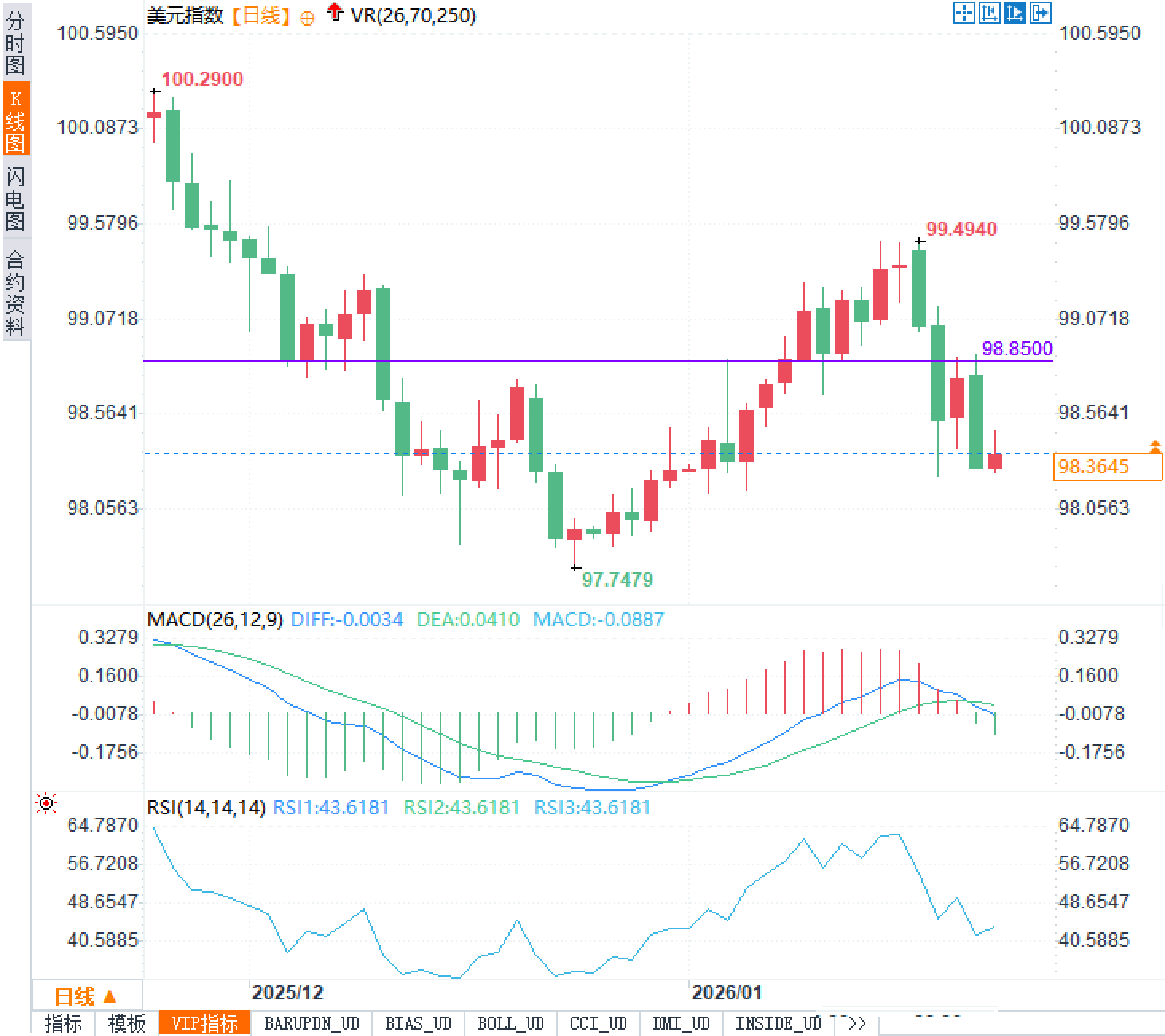
The RSI(14) reading is 43.6181, which is in the neutral to weak range. It is neither oversold nor shows any signs of strong bullish intervention. This means that although the current selling pressure is not extreme, the buying side also lacks the willingness to continue its offensive. In terms of news, the technical pattern is highly consistent with market sentiment: short-term positive news can bring fluctuations, but it is not enough to change the overall weak pattern. 98.23, as the recent low, has certain technical support significance and is likely to trigger short-term speculation; while 98.8500 is a key watershed, and only a breakout with increased volume can open up upward space.
Looking ahead, the dollar's trajectory will revolve around three core variables. First, will geopolitical and trade issues escalate again? Analysts believe the current "window of peace" is extremely fragile. If disagreements arise regarding tariff implementation or Arctic cooperation, risk aversion could quickly rise, but in the long term, the dollar's appeal will be weakened by policy unpredictability. Second, will the market reaction follow the announcement of the Federal Reserve Chair. The announcement itself may trigger immediate volatility, but the real test lies in the clarity and credibility of subsequent policy communication and its ability to rebuild market confidence in the monetary policy path.
Finally, there's the impact of US economic data on interest rate expectations for 2026. If the data continues to improve, especially if inflation and employment remain robust, the market may gradually lower its bets on interest rate cuts, providing temporary support for the dollar. However, if the data weakens or unexpected external risk events occur, the dollar will oscillate between "safe-haven demand" and "easing expectations," becoming mired in a period of fluctuation.
This "band-aid" approach, which only addresses the symptoms and not the root cause, has actually amplified market uncertainty. Analysts point out that the foreign exchange market tends to become more sensitive when major issues end with only a vague consensus. Currently, although geopolitical tensions have eased slightly, the market remains concerned about potential reversals. If the US stance hardens again, risk aversion could quickly escalate, leading to frequent shifts in funds between risky assets and the US dollar, exacerbating exchange rate volatility.
Fundamental drags are becoming apparent: even strong data can't lift the dollar.
Even though the latest US initial jobless claims figures were better than expected, showing some resilience in the labor market, the dollar still failed to reverse its decline. This indicates that the market's focus is no longer on the performance of a single economic indicator, but rather on the longer-term "interest rate path" and "policy certainty." While the employment data helps slow the rise of expectations for interest rate cuts, if other major economies do not show significant deterioration, the US's relative advantage will be diluted.
More importantly, the market is closely watching the announcement of the next Federal Reserve Chairman. Trump has indicated that he will decide on a candidate soon, with the shortlist including Kevin Hassett, Rick Riddell, Christopher Waller, Michelle Bowman, and former Governor Kevin Warsh. Different candidates represent different policy inclinations: if the new chairman is seen as hawkish, emphasizing inflation control or financial stability, the market may repric the probability of interest rate hikes, which would be beneficial to the dollar in the short term; conversely, if the candidate leans towards a dovish stance and emphasizes tolerance for economic growth, it could reignite expectations of a rate cut in 2026, further suppressing the dollar's performance. Therefore, the selection itself is not the end goal; the key is how the market interprets the underlying policy direction.
Technical charts are warning: the rebound is just a correction, and the trend has not yet reversed.
From a technical perspective, the daily chart structure of the US dollar index also confirms the fragility of the current rebound. The previous high was at 99.4940, while the interim low was 97.7479. Currently, the price is trading below 98.8500, meaning the previous upward support level has turned into resistance. In other words, if the market cannot effectively break through and hold this level, any upward movement may only be a technical correction rather than a trend reversal. The MACD indicator shows that the DIFF is -0.0034, the DEA is 0.0410, and the MACD histogram is -0.0887, all below the zero line with weak momentum, indicating that bearish forces still dominate.
The RSI(14) reading is 43.6181, which is in the neutral to weak range. It is neither oversold nor shows any signs of strong bullish intervention. This means that although the current selling pressure is not extreme, the buying side also lacks the willingness to continue its offensive. In terms of news, the technical pattern is highly consistent with market sentiment: short-term positive news can bring fluctuations, but it is not enough to change the overall weak pattern. 98.23, as the recent low, has certain technical support significance and is likely to trigger short-term speculation; while 98.8500 is a key watershed, and only a breakout with increased volume can open up upward space.
Three key points to watch for in the market outlook: Can the US dollar break out of its predicament?
Looking ahead, the dollar's trajectory will revolve around three core variables. First, will geopolitical and trade issues escalate again? Analysts believe the current "window of peace" is extremely fragile. If disagreements arise regarding tariff implementation or Arctic cooperation, risk aversion could quickly rise, but in the long term, the dollar's appeal will be weakened by policy unpredictability. Second, will the market reaction follow the announcement of the Federal Reserve Chair. The announcement itself may trigger immediate volatility, but the real test lies in the clarity and credibility of subsequent policy communication and its ability to rebuild market confidence in the monetary policy path.
Finally, there's the impact of US economic data on interest rate expectations for 2026. If the data continues to improve, especially if inflation and employment remain robust, the market may gradually lower its bets on interest rate cuts, providing temporary support for the dollar. However, if the data weakens or unexpected external risk events occur, the dollar will oscillate between "safe-haven demand" and "easing expectations," becoming mired in a period of fluctuation.
- Risk Warning and Disclaimer
- The market involves risk, and trading may not be suitable for all investors. This article is for reference only and does not constitute personal investment advice, nor does it take into account certain users’ specific investment objectives, financial situation, or other needs. Any investment decisions made based on this information are at your own risk.