Amid political and fiscal risks dominating the market, the Bank of Japan's slightly hawkish stance failed to boost the yen.
2026-01-24 00:12:44
In recent months, USD/JPY and other yen crosses have performed strongly due to the yen's continued weakness. USD/JPY is being pulled by two opposing forces. Theoretically, the Bank of Japan's growing confidence in growth and inflation should support the yen. However, in reality, political uncertainty and rising Japanese government bond yields are weakening this logic, keeping the USD/JPY forecast still biased towards appreciation. Following the Bank of Japan meeting, we may see some intervention from the Ministry of Finance, as the yen rebounded after its initial decline. However, this move has been quite limited, and there is currently no official confirmation.

The Bank of Japan kept its policy unchanged.
The Bank of Japan kept interest rates unchanged at 0.75% while raising its growth and inflation forecasts, sending a slightly hawkish signal. One member even called for a rate hike. Governor Kazuo Ueda acknowledged that core inflation is continuing to rise. This is important because it opens the door to further policy tightening later this year.
Following the policy announcement, the USD/JPY pair fluctuated in both directions. It initially rose during Ueda's press conference but subsequently fell due to potential intervention from the Ministry of Finance. However, the pair has since stabilized.
My base case is that the Bank of Japan may raise interest rates this summer, although Ueda deliberately avoided giving any explicit forward guidance at the press conference. He also declined to comment directly on the yen, focusing instead on inflation dynamics and how exchange rates affect price stability. In short, the Bank of Japan seems more comfortable with the idea of raising rates, but is still proceeding cautiously.
Politics and bonds are the real problems facing the yen.
Under normal circumstances, this Bank of Japan meeting would likely have pushed the USD/JPY exchange rate lower. However, Japan's political and fiscal situation is currently dominating market sentiment.
Japanese Prime Minister Sanae Takaichi has dissolved the House of Representatives in preparation for the February 8 election, injecting further uncertainty into an already fragile fiscal backdrop. Investors worry that if Takaichi is granted a strong mandate, new policies could further exacerbate the pressure on Japan's public finances.
This concern is already evident in the bond market. This week, the yield on Japan's 40-year government bonds surged to a record high, marking the biggest volatility in overall Japanese government bond yields since the initial stages of the Trump trade war. Although yields briefly retreated, they are currently rising again, which is bad news for the yen.
A rise in yields driven by fiscal risk is entirely different from a rise in yields driven by healthy growth. In this case, rising yields are interpreted as a signal of deteriorating debt dynamics, which reduces the attractiveness of Japanese assets and puts pressure on the yen.
As long as this situation in the bond market continues, the yen will find it difficult to gain substantial support from the Bank of Japan's slow shift towards a tightening policy.
The US dollar is under mild pressure.
From the perspective of the US dollar, this week's movements have been quite interesting after the tariff-related volatility. However, volatility has subsided, and the dollar remains weak overall, especially relative to commodity currencies and emerging market currencies. We've also seen precious metal prices hit record highs, highlighting the current "dollar depreciation" trade. Market concerns that the Federal Reserve may be subject to greater political influence are driving investors to gold and silver.
However, the dollar still has the potential to benefit against currencies with weaker fiscal positions, including the yen. Recent US economic data has also shown some signs of strength, which may continue to delay the Federal Reserve's rate cuts and provide support for the dollar relative to the low-yielding yen.
USD/JPY Forecast: Short-term upside bias, medium-term risks present.
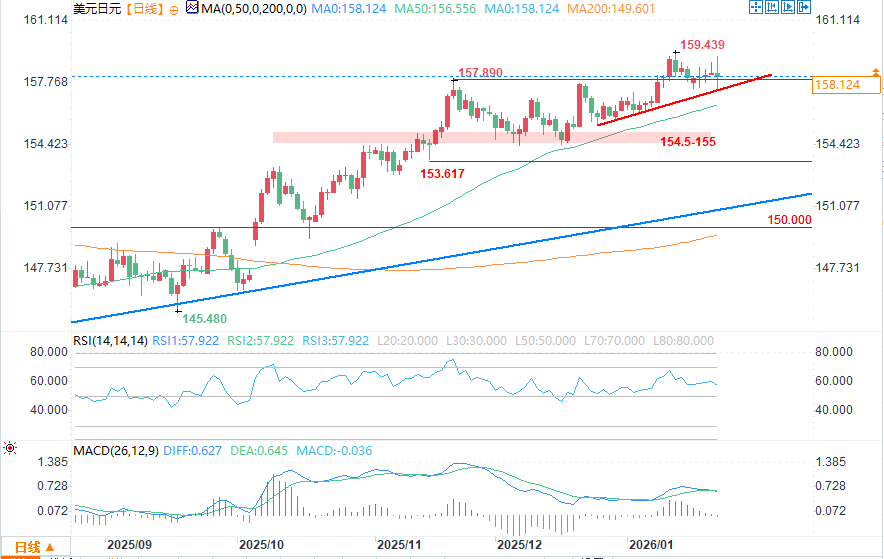
(USD/JPY daily chart source: EasyForex)
Overall, the USD/JPY pair remains slightly bullish in the short term, primarily due to political risks in Japan, rising Japanese government bond yields, and resilient US data. USD/JPY could potentially move towards 160 ahead of the February elections.
The long-term outlook remains uncertain, but currently, the yen appears to be caught between a central bank seeking to normalize its policies and a government that could worsen Japan's fiscal problems. Until this tension is resolved, USD/JPY is likely to continue to find support, with pullbacks tending to attract buyers rather than triggering a sustained decline. Unless there is large-scale, coordinated FX intervention, I believe key support levels like 155.00 and 157.00 should hold during short-term pullbacks.
The Bank of Japan kept its policy unchanged.
The Bank of Japan kept interest rates unchanged at 0.75% while raising its growth and inflation forecasts, sending a slightly hawkish signal. One member even called for a rate hike. Governor Kazuo Ueda acknowledged that core inflation is continuing to rise. This is important because it opens the door to further policy tightening later this year.
Following the policy announcement, the USD/JPY pair fluctuated in both directions. It initially rose during Ueda's press conference but subsequently fell due to potential intervention from the Ministry of Finance. However, the pair has since stabilized.
My base case is that the Bank of Japan may raise interest rates this summer, although Ueda deliberately avoided giving any explicit forward guidance at the press conference. He also declined to comment directly on the yen, focusing instead on inflation dynamics and how exchange rates affect price stability. In short, the Bank of Japan seems more comfortable with the idea of raising rates, but is still proceeding cautiously.
Politics and bonds are the real problems facing the yen.
Under normal circumstances, this Bank of Japan meeting would likely have pushed the USD/JPY exchange rate lower. However, Japan's political and fiscal situation is currently dominating market sentiment.
Japanese Prime Minister Sanae Takaichi has dissolved the House of Representatives in preparation for the February 8 election, injecting further uncertainty into an already fragile fiscal backdrop. Investors worry that if Takaichi is granted a strong mandate, new policies could further exacerbate the pressure on Japan's public finances.
This concern is already evident in the bond market. This week, the yield on Japan's 40-year government bonds surged to a record high, marking the biggest volatility in overall Japanese government bond yields since the initial stages of the Trump trade war. Although yields briefly retreated, they are currently rising again, which is bad news for the yen.
A rise in yields driven by fiscal risk is entirely different from a rise in yields driven by healthy growth. In this case, rising yields are interpreted as a signal of deteriorating debt dynamics, which reduces the attractiveness of Japanese assets and puts pressure on the yen.
As long as this situation in the bond market continues, the yen will find it difficult to gain substantial support from the Bank of Japan's slow shift towards a tightening policy.
The US dollar is under mild pressure.
From the perspective of the US dollar, this week's movements have been quite interesting after the tariff-related volatility. However, volatility has subsided, and the dollar remains weak overall, especially relative to commodity currencies and emerging market currencies. We've also seen precious metal prices hit record highs, highlighting the current "dollar depreciation" trade. Market concerns that the Federal Reserve may be subject to greater political influence are driving investors to gold and silver.
However, the dollar still has the potential to benefit against currencies with weaker fiscal positions, including the yen. Recent US economic data has also shown some signs of strength, which may continue to delay the Federal Reserve's rate cuts and provide support for the dollar relative to the low-yielding yen.
USD/JPY Forecast: Short-term upside bias, medium-term risks present.
(USD/JPY daily chart source: EasyForex)
Overall, the USD/JPY pair remains slightly bullish in the short term, primarily due to political risks in Japan, rising Japanese government bond yields, and resilient US data. USD/JPY could potentially move towards 160 ahead of the February elections.
The long-term outlook remains uncertain, but currently, the yen appears to be caught between a central bank seeking to normalize its policies and a government that could worsen Japan's fiscal problems. Until this tension is resolved, USD/JPY is likely to continue to find support, with pullbacks tending to attract buyers rather than triggering a sustained decline. Unless there is large-scale, coordinated FX intervention, I believe key support levels like 155.00 and 157.00 should hold during short-term pullbacks.
- Risk Warning and Disclaimer
- The market involves risk, and trading may not be suitable for all investors. This article is for reference only and does not constitute personal investment advice, nor does it take into account certain users’ specific investment objectives, financial situation, or other needs. Any investment decisions made based on this information are at your own risk.